
💡 Key Takeaways
- There is no single “Kanazawa city center.” Omicho Market, Korinbo, Kenrokuen and Higashi Chaya are in different directions, so the best transport depends on where your hotel actually is.
- The Kanazawa Loop Bus is cheap, but it is not always the easiest arrival option. A single adult ride is currently ¥220, while the ¥800 one-day pass only makes financial sense from the fourth eligible ride.
- With large suitcases, rain, snow, children or three to four travelers, take a taxi. Kanazawa’s short central distances often make the per-person cost surprisingly reasonable.
Working out how to get from Kanazawa Station to the city center sounds simple until you open a map and discover that “the center” could mean Omicho Market, Korinbo, Katamachi, Kenrokuen Garden, the 21st Century Museum or Higashi Chaya District. They are all central Kanazawa, but choosing the wrong loop direction can add stops, while choosing to walk can become a bad decision when you are pulling a heavy suitcase through coastal rain or winter slush.
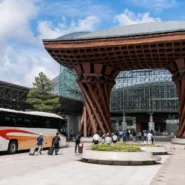
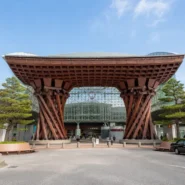
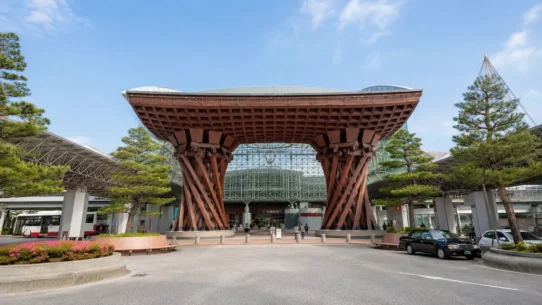
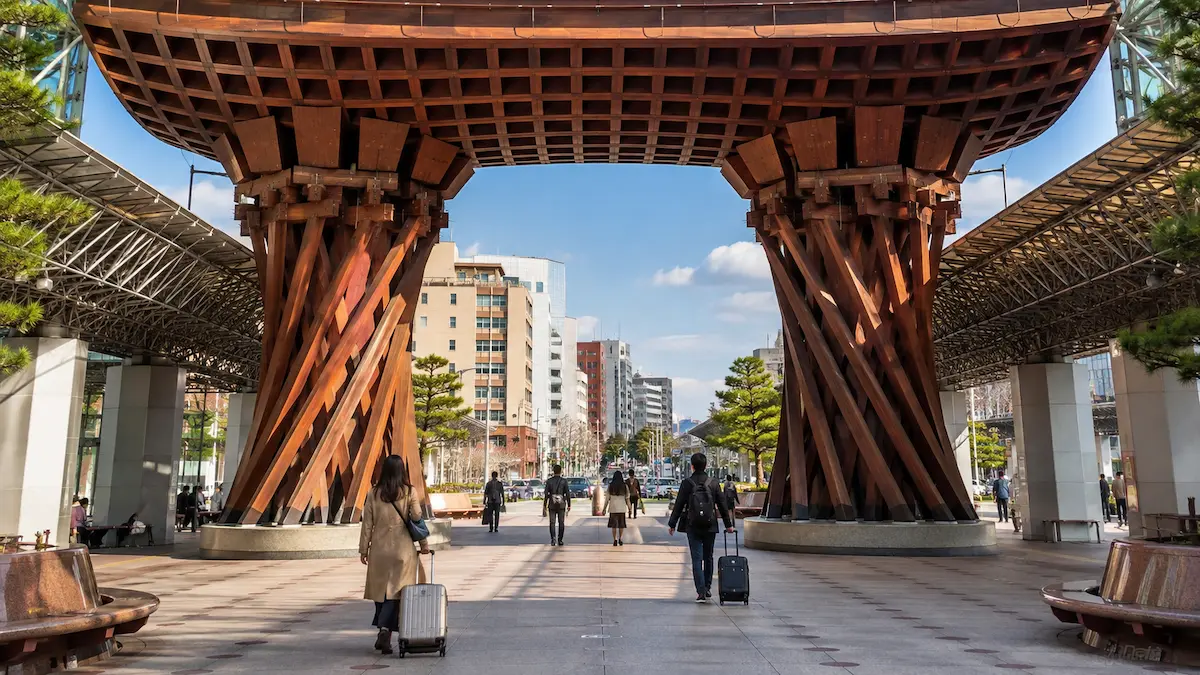
This is especially confusing after a long Shinkansen journey, a transfer at Tsuruga, or an airport-bus trip from Komatsu Airport. You arrive tired, follow the crowd through the impressive Tsuzumi-mon Gate, and suddenly face several bus stands, two station exits and advice online that may quote old fares. The practical answer is not “always take the bus.” It is to match the transport to your exact hotel area, arrival time, group size, luggage and weather.
First, identify your real destination: Musashigatsuji/Omicho Market is the closest sightseeing hub; Korinbo and Katamachi are better for shopping, restaurants and nightlife; Hirosaka and Kenrokuen suit museum and garden stays; Higashi Chaya offers atmosphere but is less convenient with luggage. Once you know which of these you are heading to, the decision becomes much easier.
The 1-Min Cheat Sheet
- Kanazawa Loop Bus or a suitable local bus: Best for solo travelers, light luggage and daytime arrivals. Expect ¥220 for an adult Loop Bus ride. Use the Right Loop for a more direct run toward Higashi Chaya and Kenrokuen; use the Left Loop for Nagamachi, Korinbo and Katamachi.
- Taxi: Best for large luggage, rain, snow, late arrivals, families and groups of three or four. Official estimates start at about ¥800 to Omicho Market and rise to roughly ¥1,400–¥1,800 for several major central sights.
- Walk: Best for Omicho-area hotels when the weather is dry and your luggage is genuinely manageable. Kanazawa Station to Omicho Market is about 15 minutes; farther central districts can turn this into a 25–40 minute walk.
- Machi-nori e-bike: Best after you have stored or delivered your luggage. It is excellent for sightseeing freedom, but it is not a sensible station-transfer solution with suitcases.
Top Survival Tips
- Use the Kenrokuen Gate, also called the East Exit, for the historic center. The East Exit serves the main sightseeing bus terminal and the most useful taxi rank for Omicho, Korinbo, Kenrokuen and Higashi Chaya. The Kanazawa Port Gate, or West Exit, is mainly useful for western districts and the port side.
- Do not buy a one-day bus pass just for the station-to-hotel trip. At ¥800, it becomes cheaper than four ¥220 eligible rides, but it is poor value if you will walk between nearby sights after checking in.
- Check the loop direction, not just the destination name. Both loops cover major attractions, but one direction may reach your area much faster. For Higashi Chaya and Kenrokuen, start by checking the Right Loop. For Korinbo, Nagamachi and Katamachi, start with the Left Loop.
- Keep a payment backup. The Loop Bus accepts cash, major nationwide transport IC cards such as Suica, PASMO and ICOCA, and supported contactless bank cards. Payment rules can vary on other local services, so carry small yen as a fallback.
- Do not wrestle a full-size suitcase onto a crowded sightseeing bus unless you have to. The station tourist information center offers paid same-day luggage delivery to many hotels and ryokan. Delivery is not available to every property, especially some unattended whole-house rentals, and delivery times cannot be specified.
- Assume rain is possible even when the morning looks fine. Kanazawa is known for sudden coastal showers. A “free” walk can cost you wet shoes, a damaged paper bag and an unpleasant first hour if you arrive unprepared.
- Save your hotel name and address in Japanese. This is especially useful for taxis and for properties with similar English names. A screenshot is more reliable than trying to pronounce a long address while tired.
The Full Experience: Every Way From Kanazawa Station to Central Kanazawa
🚌 Kanazawa Loop Bus: Best for Solo Travelers, Backpackers and Light Luggage
Budget-friendly · No transfer · Daytime · Best with small bags
The Kanazawa Loop Bus is the default recommendation for a reason: it leaves from the station’s East Exit bus terminal and connects the most important sightseeing districts without a train transfer. The current official adult fare is ¥220 per ride, with children paying ¥110. The Right Loop normally runs every 15 minutes from around 8:30 to 18:00, while the Left Loop normally runs every 20 minutes from around 8:38 to 17:58. Always check the station display on the day because schedules can change.
For first-time visitors, the most important decision is the loop direction. Both directions reach Musashigatsuji/Omicho Market soon after leaving the station, so either can work for an Omicho-area hotel. The Right Loop continues toward Higashi Chaya before Kenrokuen and Kanazawa Castle, making it the better first option for those areas. The Left Loop heads through Oyama Shrine, Nagamachi, Korinbo and Katamachi before reaching the museum and garden area, so it is usually the smarter choice for hotels in the main shopping and nightlife districts.
At Kanazawa Station, follow signs for the Kenrokuen Gate/East Exit and check the bus information for the Loop Bus boarding point, commonly shown at stop 7. Board through the rear door, press the stop button before your destination, and exit at the front. With cash, take a numbered ticket when required and pay when leaving. With a compatible IC or contactless card, follow the tap-on and tap-off instructions shown on the bus.
Best stops to know: use Musashigatsuji/Omi-cho Market for Omicho and nearby hotels; Korinbo for Korinbo shopping streets and the Nagamachi Samurai District; Hirosaka/21st Century Museum for the museum and nearby hotels; Kenrokuen Garden/Kanazawa Castle Park for the garden and castle; and Hashiba-cho for Higashi Chaya District.
✅ What Other Travelers Say
Traveler feedback is broadly positive about the Loop Bus for sightseeing because the routes are easy to understand once you know the Left-versus-Right logic. Many visitors also find central Kanazawa compact enough to combine one bus ride with walking. The repeated warning, however, is crowding: the bus can feel far less convenient when several trainloads of visitors arrive at once or when everyone boards with luggage.
⚠️ The Catch (Things to Keep in Mind)
The hidden cost is not money but friction. You may wait, stand with a suitcase, block the aisle, miss your stop or ride a longer arc because you chose the wrong loop. Road congestion can also make a short distance feel slow during weekends, holidays and peak foliage or blossom periods. After the daytime Loop Bus schedule ends, do not assume the same convenient frequency continues into the evening.
My verdict: choose the bus when you are traveling alone or as a couple, arriving during operating hours and carrying no more than a small suitcase each. For a family with several large cases, the savings rarely justify the hassle.
🚕 Taxi: Best for Suitcases, Families, Rain and Late Arrivals
Door-to-door · Fastest with luggage · Good for groups · Weather-proof
A taxi is the option budget guides often dismiss too quickly. Kanazawa’s central attractions are close enough to the station that a short taxi ride can be excellent value once the fare is shared. Official tourism estimates from Kanazawa Station begin at approximately ¥800 to Omicho Market, ¥1,400 to the Nagamachi Samurai District, ¥1,600 to Higashi Chaya or the 21st Century Museum, and ¥1,800 to Kenrokuen Garden. These are starting estimates rather than fixed prices; traffic, route choice and late-night or early-morning surcharges can increase the total.
Use the covered taxi stand by the Kenrokuen Gate/East Exit for the historic center. The West Exit taxi rank is better for Kanazawa Port and western districts, so taking a west-side taxi for a central sightseeing hotel may add unnecessary driving.
The value calculation changes with group size. A ¥1,600 ride split between four people is ¥400 each. That costs more than a bus, but it removes waiting, walking from the bus stop, rain exposure and the awkwardness of moving luggage through a crowded aisle. It can also save enough time to make an early dinner reservation or attraction entry.
Show the driver your hotel’s Japanese address or map pin. Do not rely only on an English hotel name, especially when several properties use words such as “Kanazawa,” “Central,” “Garden” or “Station.” Most standard taxis are designed for up to four passengers, but four adults plus four large hard-shell suitcases may not fit. In that situation, take two taxis or arrange a larger vehicle through your hotel.
✅ What Other Travelers Say
Travelers who use taxis in Kanazawa often report that they are more affordable than expected, particularly for short central trips and small groups. The biggest satisfaction comes from avoiding bad weather and eliminating the final walk from a bus stop to a hotel entrance. Taxis are also reassuring when arriving after dark, when navigation feels harder and daytime sightseeing buses have finished.
⚠️ The Catch (Things to Keep in Mind)
The meter means the fare is not guaranteed. Slow traffic can push the price above the estimate, and a taxi queue can form after a busy Shinkansen arrival. Cashless options are increasingly common, and app-based requests are available in Kanazawa, but you should not assume every street taxi accepts your preferred card. Confirm if necessary before departure or keep yen ready.
My verdict: this is the best overall arrival option for travelers with large luggage, anyone landing in heavy rain or snow, families with tired children, older travelers, and groups of three or four. Saving ¥1,000 is not a bargain if it costs you 30 uncomfortable minutes and a bad start to the trip.
🚶 Walking: Best for Omicho-Area Hotels and Dry-Weather Minimalists
Free · No waiting · Flat route · Only sensible with manageable luggage
Kanazawa is compact and mostly comfortable to explore on foot. From Kanazawa Station, Omicho Market is about a 15-minute walk, making walking a realistic option for hotels around Musashigatsuji, the market and the northern end of downtown. Korinbo is roughly a 25–30 minute walk for most visitors, while Katamachi, Kenrokuen and the farther historic areas can take around 30–40 minutes depending on your route, pace and traffic lights.
Leave through the Kenrokuen Gate/East Exit. The broad central route toward Musashigatsuji is straightforward, and you will gradually move from the modern station district into the denser downtown area. Walking gives you the freedom to stop for coffee, photograph Tsuzumi-mon, or begin exploring immediately rather than treating the transfer as dead time.
The key question is not whether you can walk. It is whether you will still think it was a good idea after 15 minutes. A small spinner case on dry pavement is manageable. A 25-kilogram suitcase, a backpack, a shopping bag and an umbrella are a different journey. Wheels catch on tactile paving, crowded crossings slow you down, and winter conditions can turn a simple route into work.
✅ What Other Travelers Say
Many independent travelers describe Kanazawa as very walkable, with the farthest major central sights around 30–40 minutes from the station and relatively little elevation. Visitors who travel with backpacks often enjoy walking from the station because it helps them understand the city layout immediately. This positive feedback usually assumes good weather and light luggage.
⚠️ The Catch (Things to Keep in Mind)
The zero-yen price hides physical cost. Kanazawa’s frequent rain, summer humidity and winter snow can make the walk unpleasant. It is also easy to underestimate the total distance: walking to your hotel is only the first leg, and you may spend several more hours on your feet at Omicho, Kanazawa Castle and Kenrokuen. Save your energy when the transfer offers little sightseeing value.
My verdict: walk to an Omicho-area hotel when it is dry and your bag is light. For Korinbo or beyond, walking is better after you have checked in or sent your luggage ahead.
🚲 Machi-nori E-Bike: Best for Hands-Free Sightseeing, Not Suitcase Transfers
Flexible · Electric assist · Great for scattered sights · No large luggage
Machi-nori is Kanazawa’s public electric-assist bike-share system, with a large network of docking ports around the station and central districts. The current visitor pricing listed by the official tourism guide is ¥165 for the first 30 minutes, followed by ¥110 for each additional 30 minutes if you do not dock the bike. A one-day pass is available for ¥1,650.
For moving between Omicho Market, Higashi Chaya, Kenrokuen, the museum area and Nagamachi, the e-bike can be faster and more flexible than waiting for buses. The electric assist is helpful on gentle rises, and docking after each short trip can keep the cost low. It is particularly useful during busy periods when road congestion makes bus arrival times less predictable.
However, this is not a serious answer to “How do I move my suitcase from Kanazawa Station to my hotel?” There is nowhere sensible to carry a large case, and cycling while balancing bags is unsafe. The smart combination is to leave luggage in a station locker, use staffed storage, arrange same-day hotel delivery, or check in first by taxi or bus. Then return to the station-area port or pick up a bike near your hotel.
Registration and unlocking require a phone-based process unless you buy an eligible counter-issued pass. Set up the app before you urgently need the bike, and enter your international phone number carefully. Availability can also vary by port, especially near popular sights at peak times.
✅ What Other Travelers Say
Travelers who successfully register often praise Machi-nori as one of the most enjoyable ways to explore Kanazawa, especially because the attractions are close but not all on one straight line. Riders like being able to stop in quieter neighborhoods that a sightseeing bus passes by. The electric assist also makes the system approachable for casual cyclists.
⚠️ The Catch (Things to Keep in Mind)
Phone verification, app setup and port availability add more failure points than a taxi or bus. Rain, snow, slippery surfaces and unfamiliar left-side traffic can make cycling a poor choice. You must also dock correctly to end the rental; failing to do so can continue the charge. Never ride while holding an umbrella or carrying a suitcase.
My verdict: use Machi-nori as a sightseeing tool after solving the luggage problem, not as your arrival transfer. For a dry, active day, it may be the most enjoyable transport in the city.
Choose by Hotel Area, Not by Habit
Staying Near Omicho Market or Musashigatsuji
Walk when the weather is dry and you have a small bag. Take almost any suitable east-side bus serving Musashigatsuji/Omi-cho Market when you want to save your legs. A taxi is still the best option with several suitcases because the official estimate starts around ¥800, and the door-to-door ride avoids dragging luggage through the market area.
Staying in Korinbo, Nagamachi or Katamachi
Check the Left Loop first, as it reaches the Nagamachi/Korinbo/Katamachi side earlier than the opposite direction. A taxi is often the sweet spot for two to four people because the fare is shared and these streets are not always convenient for rolling luggage from a bus stop. Walking is reasonable without luggage but can feel long after a travel day.
Staying Near Kenrokuen, Hirosaka or the 21st Century Museum
The Right Loop is often the more intuitive daytime route toward Kenrokuen, though the best stop depends on your hotel entrance. A taxi removes the uphill-feeling final approach and is strongly recommended with luggage, rain or limited mobility. Do not confuse a hotel’s marketing phrase “near Kenrokuen” with being directly beside a bus stop.
Staying Near Higashi Chaya or Hashiba-cho
Use the Right Loop toward Hashiba-cho for a practical daytime trip. A taxi is better with luggage because the preserved district contains narrower streets and not every accommodation has an easy roadside entrance. Confirm whether your property has staff at check-in time; some machiya stays use remote or self-check-in arrangements and may not accept same-day luggage delivery.
Key FAQs
What is the best way to get from Kanazawa Station to Omicho Market?
Walking is best in dry weather with light luggage because the trip takes about 15 minutes. The Loop Bus is better when you want to save energy, while a taxi is the easiest choice with heavy cases, children or bad weather and starts at roughly ¥800 according to official estimates.
Can I use Suica or ICOCA on the Kanazawa Loop Bus from Kanazawa Station?
Yes. The official Kanazawa transport guide lists major nationwide transport IC cards, including Suica, PASMO and ICOCA, as accepted on the Kanazawa Loop Bus. Other local bus services may have different payment arrangements, so check the vehicle signage and keep cash as a backup.
Is Kanazawa city center walkable from Kanazawa Station with luggage?
Omicho Market is walkable in about 15 minutes, and central Kanazawa is generally flat and compact. The answer changes with bag size and weather: a carry-on in dry conditions is manageable, but large suitcases, rain, summer heat or snow make a bus, taxi or same-day luggage delivery far more sensible.
Final Verdict and Your Next Step
For most solo travelers with light luggage, the Kanazawa Loop Bus offers the best balance of price and simplicity. For an Omicho-area hotel in dry weather, walking is faster than overthinking the bus. For families, groups, late arrivals, heavy luggage or bad weather, a taxi is the clear winner. And once your bags are safely stored, Machi-nori can be the most enjoyable way to connect the city’s scattered historic districts.
The biggest mistake is choosing transport before checking the hotel’s actual neighborhood. A room “in central Kanazawa” may be beside the station, near Omicho, in Korinbo or close to Higashi Chaya, and each location changes the best route. Check the map pin, nearest bus stop, reception hours and luggage policy before booking.
You do not need to pre-book the ordinary Loop Bus or a taxi-rank ride. What is worth booking early is a well-located hotel, a dated attraction ticket, or a tour that sells out on weekends and peak travel dates. Use these verified booking pages to plan the parts that genuinely benefit from advance confirmation:
- Compare Kanazawa hotels by neighborhood on Agoda
- Book a Kenrokuen Garden admission ticket on Klook
- Check a Kanazawa and Shirakawa-go tour departing from Kanazawa Station on KKday
Before departure, save your hotel address in Japanese, check the latest Loop Bus timetable, and look at the weather. Those three minutes of preparation can save you a wrong-direction ride, an unnecessary one-day pass and a long walk with a suitcase.
Fact-check note: Transport fares, typical service patterns, taxi estimates and luggage-delivery details were checked against official Kanazawa tourism and Hokuriku Railroad information on August 6, 2026. Timetables, fares and product availability can change, so reconfirm shortly before travel.