💡 Key Takeaways
- Stay at the inner Vieux-Port for a first visit. A room one or two streets from Quai des Belges keeps the M1 metro, the harbor and both banks within reach.
- Choose La Joliette for trams and less complicated luggage walks. Le Panier has more character at the door and considerably more uneven pavement.
- Book near Saint-Charles when the train or airport shuttle dictates the trip. Choose Catalans for a beach morning, or Cours Julien when evenings matter more than quiet.
If you are deciding where to stay in Marseille, start with the inner Vieux-Port near the Ombrière. From there, most first-time visitors can walk to both banks of the port, find dinner without committing to another ride and reach Saint-Charles on metro M1. The hard part is that hotels can share a Vieux-Port label while their front doors sit at opposite ends of the harbor. The side, the uphill stretch and the last usable step-free connection matter more than the distance to a pin in the water.
A two-night trip with an early train and a four-night trip built around beaches deserve different addresses. Compare the route you will repeat, the first trip with suitcases and the time you expect to come home. I would pay for one of those advantages before paying for a balcony view.
The 1-Min Cheat Sheet
- Vieux-Port around Quai des Belges: Best default for sightseeing or a one-day stop. Budget rooms exist a few streets back. Views on the quay usually cost more, and terraces are part of the evening soundtrack.
- Le Panier near Rue Caisserie or the Hôtel de Ville edge: Best for old streets, crafts and museum mornings. Suites and apartment prices vary, and a short uphill approach can make a budget stay more tiring.
- La Joliette around Place de la Joliette: Best for trams and modern hotels. Compare lower-cost private rooms with midrange chains. Distances increase quickly north of the square.
- Cours Julien and Notre-Dame du Mont: Best for galleries and evenings out. Compare small independent stays by exact street and window orientation. A quiet side street may give better value than a room directly on the square.
- Saint-Charles on the railway-station side: Best for early departures and A1 airport-shuttle arrivals. Business hotels and compact rooms compete on price. The station terrace is above much of the center.
- Catalans and the Pharo: Best if a sandy beach or park will be part of most days. Direct beach frontage carries a premium. A block or two back may make more sense if you plan to be outdoors.
For a starting point, the tourist office lists examples from €55 for a basic Vieux-Port hotel, €59 at a Joliette hotel and €74 at a Saint-Charles hotel. An example at Catalans starts at €200. These are starting rates for specific properties, not neighborhood averages or prices for your dates. Look at the tourism office’s city hotel examples, its Joliette listing and its beachfront listing. Compare the same dates, room type, cancellation terms and total due for each address.
Top Survival Tips
- Plot the hotel’s actual door. Search the full street address, then plot it from the arrival stop and from the last place you expect to be at night. A harbor-view hotel at the mouth of the basin may have excellent foot access to the Pharo and a longer walk to M1. Decide which journey will happen more.
- Use the station plan when carrying luggage. The monumental stairs are an attractive introduction to town when your hands are free. Check the Saint-Charles plan for the exit that serves your onward transport. The airport’s A1 shuttle terminates at its coach station, so use that terminal as the start of the map route after a flight.
- Build one late-night fallback before booking. RTM’s current evening plan lists early metro closure Monday through Wednesday with replacement buses. Look up the exact day as there are exceptions and works. A hotel near a tram stop or a genuinely short walk home can be more convenient on those nights than a cheaper room advertised as near a metro.
- Search room-level comments. Add the street name or words such as “stairs,” “courtyard,” and “lift” to recent reviews. Old stone buildings and popular evening streets affect people differently. Ask whether the lift starts at the street, how you enter after reception hours and whether the written quiet-room request actually changes the room category.
- Cross-check the price of the useful bed. A standard double is not the same room as a view double, twin, or three-person apartment. Compare mandatory charges and reception hours before you choose the lowest rate, especially for a late arrival after a boat or train.
Where to Stay in Marseille: A Closer Look
⚓ Vieux-Port: The Easiest Base for a First Visit
Harbor on foot · Metro M1 · Broad choice of rooms
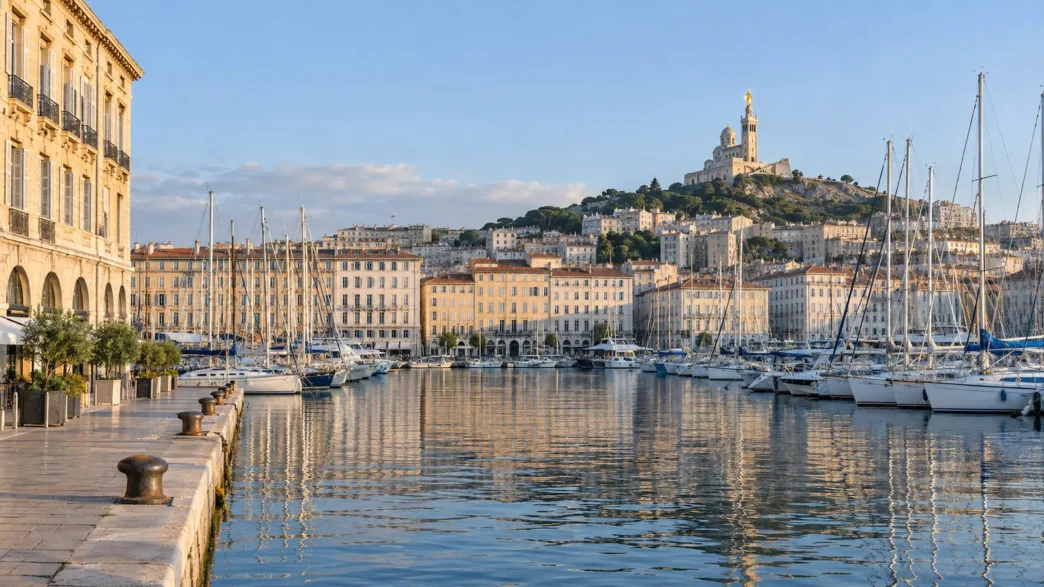
The inner harbor around the Ombrière and Quai des Belges is the easiest point from which to make up a day as you go. On the north side, Quai du Port leads toward City Hall, Le Panier and Fort Saint-Jean. On the south side, Quai de Rive Neuve leads past restaurant streets toward Saint-Victor and the Pharo. Pick the inner end if your schedule mixes both. The tourist office’s Old Port guide places the fish stalls beside the metro entrance and describes the short ferry crossing between the banks.
The metro link is particularly useful on a short stay with one suitcase: Saint-Charles to Vieux-Port is a direct M1 ride when operating. To make the harbor work at a lower room rate, search one or two blocks back rather than moving far from the center. A room near the Opéra gives access to the south-bank restaurants, while an address just north of the head of the basin makes the walk toward Le Panier easier.
For a boat trip, find the operator’s meeting point on the voucher. Some departures use a named quay farther along the harbor. The little cross-harbor ferry, sightseeing boats and regional sea shuttles do different jobs. Saving the operator name with the meeting point prevents an early wrong-bank detour.
✅ What Other Travelers Say: The walking tour shows how easy it is to link the exposed quays with inland streets. Guests booking through the district’s hotel listings often discuss whether they could leave the car parked and reach meals or sights on foot. Use those reviews to compare the exact room and block rather than the district alone.
⚠️ The Catch (Things to Keep in Mind): A port view may also put windows over waterfront dining or a traffic corridor. Ask for a rear room if people watching from a balcony is of little value to you.
🏘️ Le Panier: Best for Old Streets and Museum Mornings
Historic lanes · Mucem walks · More stairs
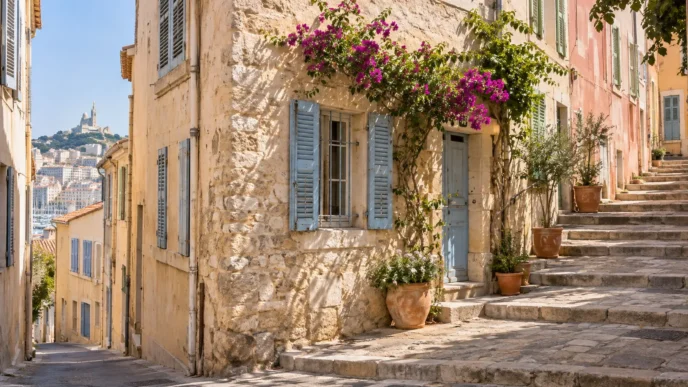
Le Panier rewards travelers who enjoy leaving the hotel slowly. Vieille Charité, little squares and the art-focused shops are part of the neighborhood itself. The official Panier guide gives the key landmarks. A lower address near Rue Caisserie or the Hôtel de Ville edge reduces the uphill stretch after you reach the port, while higher streets put you in the lanes as soon as you step outside.
There is a worthwhile walk from the old streets toward the Mucem. Fort Saint-Jean describes its connecting footbridges and its Tuesday closure. Keep the public street route in your plans so that a closed gate does not send you back uphill. This also matters for an evening return after the museum grounds close.
Choose by the host’s directions more than by room photos. Ask where a taxi can stop, where the key is collected and how many steps separate you from the lift. That simple exchange is more useful than trying to infer access from an aerial map.
✅ What Other Travelers Say: Independent walking footage shows long runs of narrow lanes broken by small squares, which explains the appeal of staying here. Give more weight to stay reviews that mention the actual approach with bags and the building entrance.
⚠️ The Catch (Things to Keep in Mind): Some lanes are steep or uneven and door-to-door vehicle access varies. Travelers who need reliably straightforward access usually have an easier time at the harbor edge or near a Joliette tram stop.
🚋 La Joliette: Best for Modern Rooms and Tram Access
M2 · T2 and T3 · Docks and waterfront
Use Place de la Joliette as the anchor, not the broad “Euroméditerranée” label. Marseille Tourism’s Joliette guide lists M2 and tram lines T2 and T3 at the square, along with walking routes toward Le Panier by the waterfront or Rue de la République. The square is practical if you want one hotel for a museum morning, a train trip and an evening farther south.
The streets around the Docks and Les Terrasses du Port have larger blocks and a different pace from Le Panier. It is usually simpler to negotiate a broad sidewalk with a case, but a hotel farther north can add walking at both ends of the day. If your address is closer to Arenc, compare the exact tram stop as part of the booking.
Room value is strongest when you actually use the local connections. Families looking at a hostel-style hotel should select the private category and verify the number of beds. Hotel shoppers who mostly want the Old Port after dinner should compare a sample late return before committing.
✅ What Other Travelers Say: The district footage shows the scale of the blocks and the open space around the transport hub. Visitors looking for a modern room often value the tram and shopping access more than the character of the immediate street.
⚠️ The Catch (Things to Keep in Mind): Frontage near major roads or port businesses feels less intimate after dark. Ask where you will eat late and use the actual metro or tram schedule rather than assuming all lines run equally late.
🎨 Cours Julien: Best for Street Art and a Late Evening
Notre-Dame du Mont · Food and music · Good on foot
Book here if you want your evening to happen near your hotel. The tourism office’s Cours Julien guide introduces the neighborhood’s wall art, studios and evening venues. Notre-Dame du Mont is on M2, and the walk down toward Noailles or the Old Port can be pleasant when you are traveling light.
The gradient matters on the way home. An evening that starts with harbor drinks and ends near La Plaine becomes a climb if the simplest transport has finished. Walkers who like a slow neighborhood morning may be happy with that. Families repeatedly returning to the room for naps might prefer a lower address with easier sight access.
Room prices depend as much on the building and room configuration as the square. A smaller double on a side street can offer the same access to restaurants with a better chance of a restful evening. Screenshots of graffiti or café signs tell you less than the room’s window side.
✅ What Other Travelers Say: The walking video captures how quickly busy terraces give way to ordinary residential streets. Recent room reviews that mention Friday or Saturday night are more informative than a general city-center noise score.
⚠️ The Catch (Things to Keep in Mind): Expect sound near cafés, small venues and occupied outdoor terraces. Request a quieter side or inner room if you turn in early. A listing that says “near Cours Julien” can cover quite different street experiences.
🚉 Saint-Charles: Best for an Early Train or Airport Coach
Platform proximity · Airport A1 · Metro M1 and M2
Stay by the station when the first departure is a train or an airport shuttle. Standing at the right exit at 6 a.m. matters more than a waterfront address you barely see. The station’s practical guide shows the rail and coach areas, while the airport timetable details A1 departures and the overnight access arrangements.
The station sits above the streets toward the port. A hotel on the platform-level approach may be easier than one downhill that looks closer on the map. For an onward flight, confirm which side the coach uses and whether the hotel can give you the correct walking route for your hour of departure.
For two or more sightseeing days, compare paying for one station night against staying central throughout. The gain from moving vanishes if you have to check out early, store your bags and collect them before the next room opens. This is where the direct M1 link to the Old Port can make choosing a single base worthwhile.
✅ What Other Travelers Say: The station walk gives more useful context than a straight-line hotel map. For a one-night stay, prioritize comments about check-in at the actual hour you arrive and clear directions from the platform, then check room comfort.
⚠️ The Catch (Things to Keep in Mind): There is less reason to be here between errands if your days revolve around the sea. Outside service hours, plan your door-to-door return instead of relying on the metro stations shown beside the listing.
🏖️ Catalans and Pharo: Best for a Beach-First Stay
Sandy beach · Park views · Bus 83
Catalans is the easier beach choice if you still want to spend time in town. The official beaches guide identifies its sandy shore and bus 83 stop. The Pharo side gives you access to park walks and a view back into the Old Port. Stay nearer the beach if you expect to take a morning swim, and nearer the Pharo if you plan to walk back along the south bank more often.
Look at both the night route and the windy-day plan. A day that alternates between playtime on the beach, lunch and a return to the room is easier with a nearby hotel. If the beach is only a one-afternoon trip, the inner harbor still makes a better default, with the bus or walk available when the weather works.
Ocean-facing rooms can cost considerably more than quieter blocks inland. Check whether “sea view” adds a feature you will use, and check beach access hours separately from the hotel arrival time. For a family, a grocery nearby and practical floor space can be worth more than a premium view.
✅ What Other Travelers Say: The route video makes the distance to the inner harbor visible. The tourism office notes the beach’s popularity and suggests arriving early to find a calmer stretch of sand.
⚠️ The Catch (Things to Keep in Mind): The beach can feel busy in good weather and the neighborhood has no metro stop of its own. Price the late taxi or look up an evening bus when arrival timing matters.
Key FAQs
Where should first-time visitors stay in Marseille without a car? Start with a hotel near Quai des Belges at the inner Vieux-Port. It combines a direct daytime metro from Saint-Charles with both harbor banks reachable on foot. La Joliette suits travelers who prefer tram access and a more modern building.
Is it better to stay in Le Panier or the Vieux-Port? Choose Le Panier if you want old lanes and a quiet early walk before museums open. Choose the inner Vieux-Port if you have bulky luggage, need more flexible evening routes or want easier walking to both sides of the harbor.
Which Marseille area is best after a late flight or for an early train? Use Saint-Charles if access to the coach station or a morning platform is the priority. Confirm late reception and the exit route. For an onward hotel, check the RTM evening plan and accessible station list before assuming the metro will be the simplest option.
Final Verdict and Your Next Step
For a first trip, look first at the inner Vieux-Port with a quiet room one street back. Reserve La Joliette if a modern room and tram connection are more important, or the station if your departure makes a second morning ride impractical. Compare at least two cancellable rooms for your dates before summer weekends or an event compresses the choices. See current Vieux-Port and La Canebière hotel options.
If Marseille is one stop on a longer trip, use the Travel Stay Guide area guides to run the same door-to-station check in the next city. Changing a pin from one block to the next can do more for a short trip than changing star category.