💡 Key Takeaways
- Use the city-side exits: Halls 1 and 2 lead toward the center. Hall 3 faces Belcier–Euratlantique and may suit a hotel on that side.
- Pick the tram by the address: C or D toward Place de la Bourse and Quinconces for the waterfront; F toward Hôtel de Ville for the cathedral.
- When a tram is too much work: Walk by the quays if bags are light, or use the designated taxi rank outside Hall 2 if you need a close drop-off.
The quickest hassle-free route from Bordeaux Saint-Jean to the city center is usually the tram. Choose C or D for the riverfront and F for Hôtel de Ville; all can be reached from the station’s city side. If your address is near the station, walking can be quicker than getting back to a platform. For travelers with two large cases or a difficult final walk, the Hall 2 taxi rank removes the transfer.
The common mistake happens before that choice. A sign for an exit is useful only if you know which side of the railway you want. Opening a route on your phone after crossing to the Belcier side can add several minutes and make the station feel much larger. Use the wording on the signs and the actual hotel entrance rather than trying to make a map marker agree with the nearest door.
The 1-Min Cheat Sheet
- Tram: Standard TBM price €1.90. Practical for Place de la Bourse, Quinconces, Saint-Michel, Porte de Bourgogne and Hôtel de Ville. Allow about 10–20 minutes in the tram to a central stop as a planning range, plus time for the ticket, wait and final walk.
- Walk: Free and predictable when you can carry your bags easily. Allow roughly 25–35 minutes to Place de la Bourse by the quays, depending on your pace and the exit. A Saint-Michel room can be substantially closer.
- Taxi: Follow the official Hall 2 rank for a metered ride, or use a confirmed pickup if carrying bulky bags. Ask for the fare basis and first accessible drop-off close to your hotel.
Top Survival Tips
- Use the SNCF Centre-ville exit guide and the current station plan to get oriented. Halls 1 and 2 are on the traditional city side. Hall 3 is useful to reach the other side, including the Parvis de l’Atlantique. Do not go there by accident because your ride was the first pin on the map.
- Look at your first stop after Gare Saint-Jean. Toward the old city, the route reaches Tauzia, then the Saint-Michel side. Belcier is the other direction. Checking a few sequential stops is more reliable than memorizing a terminus when branches and engineering works can change it.
- The quay path is often more comfortable than a similar-distance route through narrow streets. In rain, after dark, or when a case has a stiff wheel, shorten the walk rather than committing to a route because it looked flat from above.
- Use the same marked entrance on your departure day to reduce confusion. Cars cannot reach every part of the old core. If the property gives a cross street for taxi drop-off, save that in addition to its reception address.
- A tight transfer is not just the clock time to get downtown. Leave room to reach the station’s correct hall on return and to find the platform displayed for your specific train.
The Full Experience: Bordeaux Saint-Jean to the City Center
🚋 City Tram: Best for the Quays, Cathedral and Quinconces
€1.90 standard single · Station stop on the city side · Choose C, D or F by destination
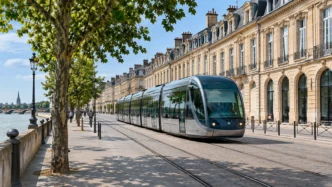
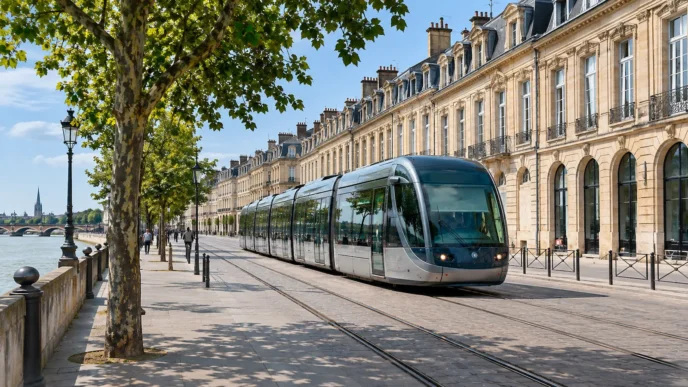
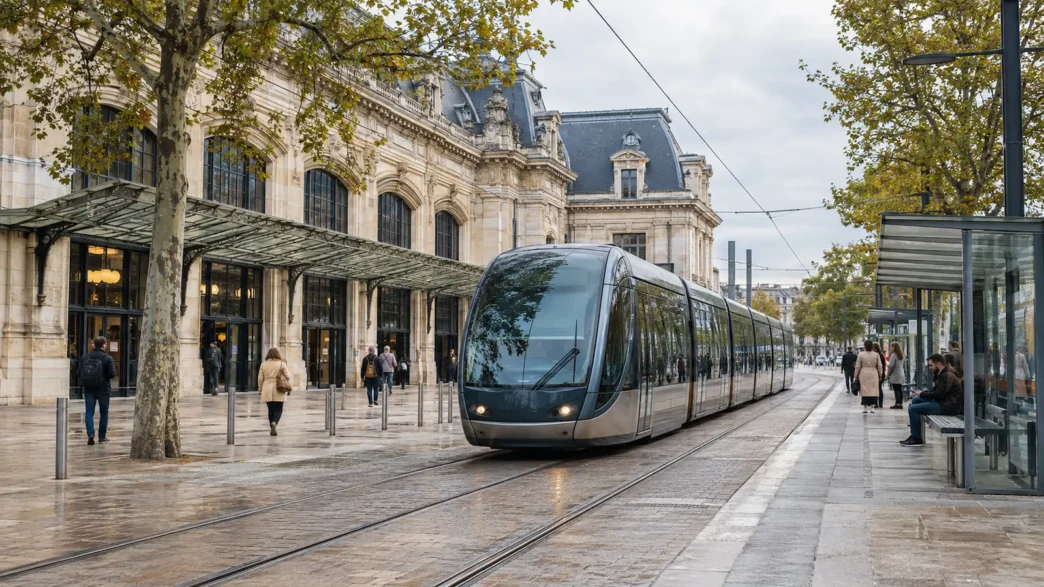
From the Centre-ville exits, follow the tram signs to Gare Saint-Jean. The stop is in front of the city-side station buildings. Take C or D toward the center for the riverfront. Place de la Bourse puts you close to the water mirror and the older streets behind it. Quinconces gives you a better starting point for a room near the public garden or the northern part of the central area.
Choose F in the city direction if your accommodation is around the cathedral, Place Pey-Berland or the Hôtel de Ville stop. It runs through Porte de Bourgogne, Place du Palais and Sainte-Catherine on the way. A hotel on an uphill-free, three-minute route from a lesser-known stop is often easier than an extra ride to a famous square. Check the F route map, then check live TBM information for alterations on your travel day.
If your hotel is on the far side of the Garonne, consider F or C/D to Porte de Bourgogne for an onward route on the A corridor, depending on the actual address. Leave extra time for a change if you are arriving at a busy hour. For several places in the historic center, walking the last few streets after a single tram is simpler than a transfer that saves one minute on paper.
Buy at a tram machine or use the app before boarding. The standard TBM single lists eligible travel for one hour at €1.90, with revalidation on every boarding. If you already have a valid ticket, double-check whether it remains within the window before buying a second. A regional train or separate coach uses its own fare rules.
✅ What Other Travelers Say: The cab-view film is useful for understanding how the tram follows the river and serves nearby stops. For your trip, rely on current station displays and the newest line map. Video footage cannot account for temporary stop changes.
⚠️ The Catch (Things to Keep in Mind): The first car you see may be heading away from the old center. A quick check for Tauzia and Saint-Michel in the onward stops is easier than trying to correct a wrong-direction ride while the service is busy.
🚶 Walk by the Quays: Best for Light Luggage and a Daytime Arrival
No fare · Allow time for crossings · Good if the room is near Saint-Michel
Go out through Hall 1 or 2 on the city side. For a straightforward first walk, get onto the west-bank quay corridor and head north toward Pont de Pierre and Place de la Bourse. The river on your right is a useful orientation check. Keep an eye on cycle lanes at the crossings rather than following the most direct diagonal through a shared space.
For a room near Saint-Michel or Sainte-Croix, leave the river route when you are level with the hotel. For the old center around Place du Parlement and Place de la Bourse, continue north until a comfortable cross street lets you approach the door. It is worth taking the wider approach if the sloping curb or paving on a shortcut looks awkward.
A useful exercise before choosing to walk is to compare both green signals and map minutes. The total depends on how far along the platform you arrive, whether you stop to orient yourself, and how easily a case rolls on the last few streets. In a light shower a coat might be enough; in steady rain with a train delay, stepping onto the tram is often the kinder option.
If your check-in is later, confirm a property’s bag drop rather than starting the sightseeing part of the walk with a suitcase. The quay is a pleasant way to say hello to Bordeaux once you have unloaded it. You can revisit Place de la Bourse at a better time for photographs and walk much further with less effort.
✅ What Other Travelers Say: The walking film gives a feel for the scale of the streets and the station perimeter. The scenery is a useful preview, but a leisurely video walk with stops is not a measure of actual hotel transfer time.
⚠️ The Catch (Things to Keep in Mind): A flat approach can still mean a number of street and tram-track crossings. Choose it in daylight when conditions suit your luggage and walking pace. If heavy bags make the quay path tiring, use C or D for the rest of the route.
🚕 Hall 2 Taxi: Best for Strollers, Heavy Cases and Late Arrival
Official station rank · No transfer · Confirm any pedestrian-zone drop-off
Follow signs to Parvis Hall 2. The SNCF taxi-rank listing puts the unbooked taxi queue there. Hall 3 is useful for Belcier hotels, but it is not the same main taxi line. For a confirmed private car, verify the meeting point and whether the driver is meeting at the train or outside a named door.
Give the driver the street and house number, then ask how close the vehicle can stop. That avoids agreeing to the wrong branch of a hotel chain or arriving at the back of a building with steps to the lobby. With a stroller or mobility equipment, say what needs to fit before putting bags in the boot.
The appeal is most obvious when everyone’s next move depends on the same lift, ramp or uneven section of paving. Compare one taxi fare with the cost of each traveler’s tram ticket and consider how much effort the car can realistically remove. A low-priced tram can still be a better choice for a solo passenger with an easy final stretch.
If several trains arrive close together, give yourself time to find the end of the queue. Avoid making a tight dinner booking on the assumption that a car will appear immediately. For an address inside a pedestrian zone, ask the accommodation about the drop-off beforehand so the final short walk stays manageable.
✅ What Other Travelers Say: Walking footage shows how different the halls and the street frontage feel at a large station. Learning the Hall 2 label before the train arrives will help more than remembering an entrance from a video filmed before a layout change.
⚠️ The Catch (Things to Keep in Mind): A taxi removes the public-transport change, but it does not guarantee a door-to-door stop inside restricted streets. Give a safe, legal pickup or drop-off address if the hotel sends one.
Key FAQs
Which Bordeaux Saint-Jean exit should I use for Bordeaux city center? Use the SNCF Centre-ville exits from Hall 1 or Hall 2. Hall 3 serves the Belcier–Euratlantique side, which can be the better approach to a hotel south or east of the station complex.
Can I take a direct tram to Place de la Bourse or the cathedral? Yes. Use C or D toward central Bordeaux for Place de la Bourse, and F for Hôtel de Ville by the cathedral. Check the live direction and routes in TBM before boarding.
Is Bordeaux Saint-Jean walkable from the old town? It is walkable with light luggage. Budget roughly half an hour for the quay route between the station and Place de la Bourse. Saint-Michel is closer; a hotel near the northern end of the center can make a tram more worthwhile.
Final Verdict and Your Next Step
Decide where you want to get off before the train reaches Bordeaux. Pick C or D for the waterfront, F for the cathedral, or walk if the first kilometer looks easy with your bags. Use Hall 2 for a cab when the last stretch is the real problem. If you are still choosing a room, compare the arrival routes in our neighborhood guides and book the option with the closest practical approach rather than the most central label.