

💡 Key Takeaways
- There is no single Bangkok transit card that neatly covers everything. BTS, MRT, Airport Rail Link and river services still have important ticketing differences, so buying the first “unlimited” pass you see can easily waste money.
- Use rail first, road second. BTS and MRT are usually the safest choices when traffic is heavy; taxis, Grab and Bolt make more sense for luggage, late-night journeys or places far from stations.
- The biggest first-timer mistake is planning only the line, not the exit and transfer. A technically correct route can still become miserable if it ends with a long skywalk, stairs, a confusing station interchange or a 15-minute walk in Bangkok heat with a suitcase.
The hardest part of a first trip to Bangkok is not finding transportation. It is choosing the right transportation for the exact journey. This Bangkok transportation guide focuses on the decisions that actually matter on the ground: whether the BTS One-Day Pass pays off, when a Rabbit Card is useful, why MRT ticketing changed in 2026, which airport train transfer is less painful with luggage, when the river is faster than the road, and when paying extra for a car is money well spent.
Bangkok rewards travelers who mix transport modes. Trying to use only taxis wastes time in traffic. Trying to use only trains can leave you dragging luggage through huge stations and long walkways. Trying to “save money” with an unlimited pass can cost more than ordinary point-to-point tickets. The smart approach is to treat BTS, MRT, airport rail, boats and ride-hailing as different tools rather than competing systems.
The 1-Min Cheat Sheet
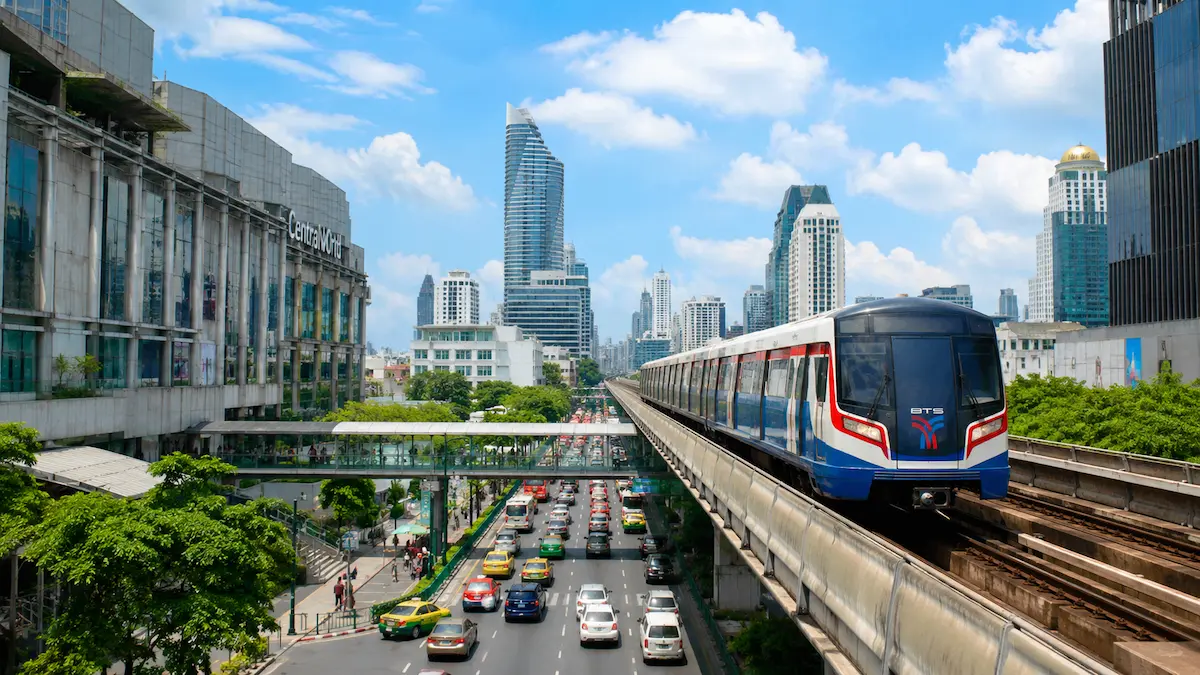
- BTS Skytrain: Best for Sukhumvit, Siam, Silom, Chatuchak-area connections and many shopping districts. Fast above traffic, but the BTS ticket system is not the same as the Blue Line MRT. A Rabbit Card saves queue time more reliably than it saves money.
- MRT: Best for Chinatown, the Old Town edge, Hua Lamphong, Queen Sirikit National Convention Centre, Chatuchak connections and many cross-city trips. In 2026, EMV contactless became much more important on the MRT network, making a compatible bank card very convenient.
- Airport Rail Link / SRT Red Line: Best when you arrive light and want predictable travel time. Use Airport Rail Link from Suvarnabhumi (BKK); use the SRT Red Line from Don Mueang (DMK). Both can become uncomfortable with large luggage at commuter rush hour.
- Chao Phraya boats: Best for Wat Arun, Wat Pho/Grand Palace area, ICONSIAM, Sathorn and riverside sightseeing. Often more enjoyable than a taxi and sometimes faster, but the local express boats and tourist boats are not the same product.
- Taxi / Grab / Bolt: Best for luggage, families, late arrivals, rain, hotel-to-hotel trips and destinations with poor rail access. The trade-off is Bangkok traffic; a cheap-looking road journey can become the slowest option of the day.
Top Survival Tips
- Do not assume “Bangkok has one metro card.” It does not work that simply. A Rabbit Card is useful for BTS and certain Rabbit-compatible services, but it is not a universal card for the Blue/Purple MRT or Airport Rail Link. If your itinerary mixes BTS and MRT heavily, you may still use different payment methods during the same day.
- Know the 2026 MRT change before buying anything. Since 1 June 2026, the old MRT and MRT Plus stored-value cards stopped being accepted on the Blue and Purple Lines. For most short-term visitors, a compatible EMV contactless bank card is now far more practical than hunting for the old card described in outdated blog posts. Single-journey options remain available, but do not follow a pre-2026 guide that tells you to buy an old MRT stored-value card.
- The BTS One-Day Pass is not automatically a bargain. It costs THB150 and is valid for unlimited rides on the day of use. In real itineraries, it usually starts making financial sense only when you are doing roughly four to six medium/long BTS rides in the same calendar day. If you are staying around one neighborhood and only making two or three train trips, single journeys are often cheaper.
- A Rabbit Card is mainly a convenience purchase. As of August 2026, BTS lists a THB120 issuance fee for a new Rabbit Card, with stored value added separately. For a two-day trip, that fee can outweigh any small fare advantage. Buy it because you want faster gate access and fewer ticket-machine queues, not because someone told you it is automatically the cheapest option.
- Check the station exit before the train arrives. Bangkok stations can be long, elevated, underground or attached to malls and skywalks. The wrong exit can add a hot, awkward detour. Before getting off, open the station map and identify the exit number closest to your hotel, attraction or pickup point.
- With luggage, count vertical movement—not just kilometers. A route with one “easy” rail transfer may involve elevators at opposite ends of platforms, stairs, long connectors and crowds. Airport Rail Link to BTS at Phaya Thai is usually more intuitive for many visitors than making a multi-step transfer elsewhere, but neither is fun with two huge suitcases during rush hour.
- At Suvarnabhumi, use the official taxi or official Grab pickup process. Ignore unsolicited ride offers inside the terminal. Public taxis have a formal queue system, and the airport adds a surcharge on top of the metered fare; expressway tolls and certain baggage charges can also apply. If you want a fixed, low-friction arrival after a long flight, a pre-booked transfer can be worth paying more for.
- Tuk-tuks are an experience, not a default transport strategy. Use them for a short ride when you are happy with the quoted price. Agree on the fare before moving. They are rarely the sensible choice for airport transfers, long cross-city trips or heavy luggage.
- Motorbike taxis solve last-mile problems but are a poor luggage solution. They can be brilliant for a short hop down a congested soi, but they are not where you should try to save money while carrying a suitcase, shopping bags or anything that affects balance.
- City buses are cheap but have a learning curve. They are worthwhile when the route is direct and you are not in a hurry. For a first day in Bangkok, BTS/MRT plus an occasional taxi is usually easier. If you do use buses, live-route apps such as ViaBus are more useful than trying to memorize route numbers from an old printed map.
The Full Experience
✈️ Airport Trains: Best for Beating Traffic from BKK and DMK
Best for: Solo travelers, light luggage, daytime arrivals, predictable journey times | Budget: Low | Luggage comfort: Fair outside rush hour
Suvarnabhumi Airport (BKK): The Airport Rail Link is the cheapest no-nonsense way into central Bangkok for many travelers. The fare from Suvarnabhumi to Phaya Thai is THB45, while Makkasan is THB35. Phaya Thai connects to the BTS Sukhumvit Line; Makkasan connects by walkway to MRT Phetchaburi. The train avoids road traffic, which is its biggest advantage after a daytime arrival.
For most first-timers staying around Siam, Phaya Thai, Ari or along much of Sukhumvit, going to Phaya Thai and changing to BTS is easy to understand. If your hotel is better placed for the MRT Blue Line, Makkasan → Phetchaburi may be more logical, but remember that this is a walking transfer rather than a magical same-platform interchange.
Don Mueang Airport (DMK): The SRT Red Line is the rail option. It links Don Mueang with Krung Thep Aphiwat, where you can connect onward. As of 17 August 2026, SRTET lists the adult Don Mueang–Krung Thep Aphiwat fare at THB33. This is excellent value, but the final connection to your hotel matters more than the train fare itself. If your hotel is deep in Sukhumvit and you have multiple bags, a direct car may still be the easier total journey.
✅ What Other Travelers Say
Travelers regularly praise the airport trains for being inexpensive and immune to Bangkok road congestion. The recurring complaint is luggage space and crowding: the Airport Rail Link behaves like a commuter train at busy times, so a journey that feels effortless at 11 a.m. can feel very different around peak commuting hours.
⚠️ The Catch (Things to Keep in Mind)
The train solves the airport-to-city section, not necessarily the airport-to-hotel section. If your accommodation is another 12-minute walk from the station, that walk can feel much longer in heat, rain or with luggage. Also check your flight arrival time against the final train schedule rather than assuming airport trains run all night.
🚆 BTS Skytrain: Best for Sukhumvit, Siam, Silom and Shopping Districts
Best for: First-time sightseeing, shopping, Sukhumvit hotels, avoiding traffic | Budget: Low to moderate | Ease of use: Excellent
The BTS is the transport system most visitors learn first because it passes through many hotel and shopping areas. The two core lines you will hear about constantly are the Sukhumvit Line and Silom Line, with Siam as the famous interchange. If your day includes Siam, Chit Lom, Phrom Phong, Thong Lo, Asok, Sala Daeng or Saphan Taksin, the BTS is often the backbone of the itinerary.
The practical question is not “How do I ride the BTS?” but which ticket should I buy?
- Single-journey ticket: Best for light-use days. Buy the exact trip, ride, and forget about it.
- BTS One-Day Pass: THB150 for unlimited rides on the day of activation/use. Best for an intentionally BTS-heavy sightseeing day, not simply because you are in Bangkok for one day.
- Rabbit Card: Best for repeated BTS use over several days when avoiding ticket queues matters. The card itself has an issuance cost, so short-stay travelers should think of it as a convenience upgrade.
A useful break-even rule: if your plan is hotel → one attraction → mall → hotel, the One-Day Pass is probably unnecessary. If you are deliberately bouncing across the city all day—say Phrom Phong → Siam → Saphan Taksin → National Stadium → Ari → back to Sukhumvit—the pass becomes much easier to justify.
✅ What Other Travelers Say
Traveler reviews repeatedly describe the BTS as clean, safe, fast and easy to understand. Rabbit Card users especially like skipping ticket-machine queues. The common downside is not complexity but crowding: Siam, Asok and other major stations can become very busy at commuter peaks.
⚠️ The Catch (Things to Keep in Mind)
Do not expect the payment card you use on MRT to work automatically at BTS Green Line gates. Bangkok still has separate fare systems. Also, “near a BTS station” can be misleading in hotel descriptions: a property 700–900 meters from a station may feel acceptable on a map and irritating in midday heat. For accommodation, a genuinely short walk to the station is worth paying attention to.
🚇 MRT: Best for Chinatown, Old Town Access and Cross-City Connections
Best for: Chinatown, Sanam Chai, convention center, cross-city trips, easy contactless payment | Budget: Low | 2026 update: EMV matters
The MRT Blue Line fills many gaps the BTS leaves open. For visitors, stations such as Wat Mangkon for Chinatown and Sanam Chai for the Wat Pho/Grand Palace side of the old city are particularly useful. Sukhumvit MRT also connects with BTS Asok, while Si Lom MRT connects with BTS Sala Daeng.
The important 2026 change is ticketing. From 1 June 2026, the old MRT and MRT Plus stored-value cards stopped being accepted on the Blue and Purple Lines. MRTA and BEM moved the system toward EMV contactless payment. For many international visitors, this means a compatible contactless Visa or Mastercard can be far simpler than buying a local stored-value product.
As of August 2026, the MRT Blue Line adult fare is THB17–44, depending on distance. That price range makes the MRT inexpensive enough that chasing an “unlimited” tourist product is often unnecessary. Pay for the trips you actually take.
✅ What Other Travelers Say
Recent traveler comments frequently highlight how easy contactless entry feels: tap in, ride, tap out, without stopping at a machine. Visitors also like the Blue Line for reaching areas that used to be awkward from the BTS-only tourist corridor.
⚠️ The Catch (Things to Keep in Mind)
Use the same physical card to tap in and out. Do not mix cards because one is easier to reach at the exit. Also remember that a BTS–MRT interchange usually means leaving one operator’s paid area and entering another. The signs may make the transfer easy, but the ticketing is still separate.
⛴️ Chao Phraya Boats: Best for Riverside Temples and Escaping Road Traffic
Best for: Wat Arun, Grand Palace area, ICONSIAM, Sathorn, scenic travel | Budget: Very low to low | Fun factor: High
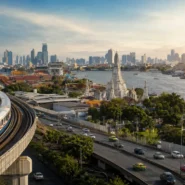
The river is not just sightseeing—it is a working transport corridor. This is one of the best ways to reach Bangkok’s riverside attractions without sitting in traffic. Saphan Taksin BTS connects conveniently with Sathorn Pier, making BTS + boat one of the most useful combinations in the city.
The first decision is whether you want the local Chao Phraya Express Boat or the more beginner-friendly Chao Phraya Tourist Boat.
- Local express boats: Cheaper and more “commuter” in feel. The official Chao Phraya Express Boat schedule updated in June 2026 lists fares such as THB17 for the Orange Line and THB22 for the Yellow Line. Great value if you understand the pier and flag system.
- Tourist boat: Easier for first-time visitors, more English-oriented and designed around major sights. Current sales pages list THB40 single rides and a THB150 day pass.
The tourist boat day-pass math is refreshingly simple: three THB40 rides cost THB120, while four cost THB160. So the THB150 day pass only becomes cheaper than individual THB40 rides from the fourth boarding onward. Buy it for convenience if you plan a full riverside day; skip it if you only need two or three boat legs.
✅ What Other Travelers Say
Visitors love the breeze, views and ability to connect major riverside sights without road traffic. Reviews of the tourist boat often mention that the English-friendly setup reduces the stress of figuring out piers and boat flags.
⚠️ The Catch (Things to Keep in Mind)
Do not confuse every boat at the pier with the service you intended to take. Bangkok has local express boats, tourist boats, cross-river ferries, hotel shuttles and private boats. Confirm the flag/service before boarding. Also check the latest pier closures—river operations can change because of renovation, events or temporary restrictions.
🚕 Taxis, Grab and Bolt: Best for Luggage, Late Nights and Door-to-Door Trips
Best for: Families, luggage, rain, late arrivals, poor rail access | Budget: Moderate | Main risk: Traffic, not distance
Road transport is where travelers either save a lot of effort or lose a lot of time. A taxi that looks perfect on Google Maps can crawl through traffic while the BTS flies overhead. On the other hand, after a 12-hour flight with two suitcases, paying more for a direct car can be the most rational decision you make all day.
Metered taxi: Often good value if the driver uses the meter and traffic is reasonable. At Suvarnabhumi Airport, use the official taxi queue. The airport’s current guidance says an additional THB50 airport surcharge applies, and passengers may also need to pay expressway tolls and applicable baggage charges.
Grab: Useful because the pickup and destination are recorded in the app, reducing language friction and giving you a fare estimate before you commit. Suvarnabhumi now has designated Grab pickup areas, which makes the airport experience much clearer than it used to be. Always check whether tolls are included or payable separately.
Bolt: Worth comparing for city rides because prices can differ from Grab. Availability and ride categories change by time and location, so treat it as a second quote rather than assuming it will always be cheaper.
✅ What Other Travelers Say
Travelers generally value ride-hailing for price visibility, recorded pickup details and easier communication. Metered taxis still win on price in some situations. The recurring frustration with both is Bangkok traffic: app convenience does not make the road move faster.
⚠️ The Catch (Things to Keep in Mind)
If a street taxi refuses the meter and quotes a price you dislike, do not turn it into a negotiation marathon—simply take another taxi or use an app. At the airport, ignore unofficial touts and follow official signage. During rush hour, compare the road ETA with a BTS/MRT route before pressing “book.”
Which Bangkok Transport Pass Is Actually Worth Buying?
Buy the BTS One-Day Pass if: you have mapped out a genuinely BTS-heavy day with multiple medium/long rides and want the freedom to hop on and off without calculating each fare.
Skip the BTS One-Day Pass if: you are making only two or three rides, staying mostly in one district, or mixing BTS with MRT, boats and taxis. “Unlimited” sounds better than it often performs in a mixed-mode Bangkok itinerary.
Buy a Rabbit Card if: you will use BTS repeatedly over several days and value skipping single-ticket queues. It is especially convenient for travelers staying near a BTS station who expect to ride morning and evening every day.
Skip a Rabbit Card if: your stay is short, your hotel is mainly served by MRT, or you are buying it only because you think it is a citywide transport card. The issuance fee means convenience—not automatic savings—is the real selling point.
Use EMV contactless on MRT if: your bank card is supported and your bank’s foreign transaction terms are acceptable. For many short-term visitors in 2026, this is the cleanest MRT solution.
Buy the Chao Phraya Tourist Boat day pass if: you expect at least four THB40 tourist-boat boardings in one day, or you value the simplicity of hopping on and off without buying each ride separately.
Key FAQs
What is the best way to get around Bangkok for first-time tourists?
Use BTS and MRT as your default for long cross-city movements, then add short taxi/Grab rides or boats for the last mile. This hybrid approach avoids the worst traffic without forcing you to walk excessive distances from stations. If you are carrying luggage, arriving late, traveling with children or staying far from rail, paying for a direct car often makes more sense.
Can I use one travel card for BTS, MRT and Airport Rail Link in Bangkok?
No—not in the simple “one card works everywhere” way many first-time visitors expect. Rabbit Card is useful on BTS and selected Rabbit-compatible services, while the MRT network has shifted strongly toward EMV contactless in 2026, and Airport Rail Link has its own fare system. Plan around the routes you will actually use rather than buying one card and assuming it covers the city.
Is the BTS One-Day Pass worth it in Bangkok?
Sometimes, but not by default. At THB150, it usually makes sense only on a BTS-heavy day with multiple rides. If your itinerary mixes MRT, river boats, walking and taxis, single BTS fares often cost less. The best way to decide is to count your planned BTS rides first—do not buy an unlimited pass just because “unlimited” sounds convenient.
Final Verdict and Your Next Step
The best Bangkok transportation strategy is not to pick one system and stay loyal to it. Use the Airport Rail Link or SRT Red Line when rail makes the airport journey simple, BTS for the Sukhumvit/Siam/Silom spine, MRT for Chinatown and cross-city gaps, boats for the riverside, and taxis or ride-hailing when luggage, weather, distance from stations or late-night timing make door-to-door travel worth the premium.
Before buying any pass, write down tomorrow’s actual journeys. If you cannot point to enough BTS rides to justify THB150, do not buy the day pass. If you will only use BTS twice, do not buy a Rabbit Card just because another traveler did. Bangkok is cheap enough that paying for the transport you need is often better value than paying upfront for transport you hope to use.
If you want to remove friction before arrival, these are the booking points worth considering:
- Check the Bangkok BTS One-Day Pass on Klook — useful if your itinerary really is BTS-heavy.
- Check the Bangkok BTS Rabbit Card on Klook — mainly for convenience and skipping ticket queues over several days.
- Compare Suvarnabhumi Airport transfers on Klook — especially useful for families, large luggage or late-night arrivals.
- Check the Bangkok BTS One-Day Pass on KKday — compare the final price and pickup terms before booking.
- Check the Chao Phraya Tourist Boat day pass on KKday — best when you plan several river stops in one day.
- Compare Suvarnabhumi Airport transfers on KKday — worth checking when a predictable door-to-door arrival matters more than the absolute lowest fare.
Booking tip: If your arrival is late, you are traveling with children, or you have more luggage than you can comfortably carry up and down station connections, pre-book the airport transfer before you fly. For everyone else, keep your arrival plan simple: know your first station, your transfer, your hotel exit and your backup taxi option.
Accuracy Note
Transport fares, payment systems, pier operations and airport pickup procedures can change. This guide was fact-checked on 17 August 2026 against current operator, airport and booking information. For same-day disruptions or last-train times, recheck the operator before departure.