



💡 Key Takeaways
- Do not treat Chiang Mai like one compact city attraction. The Old City is walkable, Doi Suthep is an uphill mountain trip, and Doi Inthanon is a full-day excursion roughly two hours from town in normal conditions.
- The smartest three-day split is city, mountain, national park. Day 1 stays inside and just east of the Old City, Day 2 stays on the Doi Suthep/Nimman side, and Day 3 gives Doi Inthanon the full day it deserves.
- Skip Chiang Rai on a three-day Chiang Mai stay. Many Chiang Rai day tours run roughly 9–14 hours. It is a separate destination, not a quick add-on, and it burns one-third of a short Chiang Mai trip.
- Most famous temples do not need advance tickets. The useful thing to pre-book is transport or a guided mountain/day tour. Be suspicious of anyone selling a “skip-the-line” temple ticket as if Chiang Mai worked like a major theme park.
- One hotel base is better than hotel-hopping. Stay in or near the Old City, Nimman, or the Night Bazaar/Riverside area and use short rides rather than dragging luggage between neighborhoods.
A good 3-day Chiang Mai itinerary is less about collecting as many temples, cafés, markets and mountains as possible and more about understanding the city’s geography. First-time visitors commonly underestimate three things: how tiring temple-hopping becomes in midday heat, how slow mountain roads can feel, and how much time disappears when they combine attractions that look “near Chiang Mai” on a map but sit in completely different directions. The result is a day that starts at sunrise, ends after dark, and somehow still feels like you barely experienced anything.
This route fixes that. It deliberately leaves breathing room, groups stops by direction, builds in a midday reset when Chiang Mai is hottest, and treats Doi Inthanon as a genuine day trip rather than another pin to squeeze between temples. It also assumes you are a normal traveler with normal legs—not someone trying to win a step-count competition.
Research checked August 17, 2026. Fees, opening hours, road conditions, seasonal trail closures and tour products can change. Re-check official attraction or operator information before you travel, especially during festivals, the rainy season and northern Thailand’s haze season.
The 1-Min Cheat Sheet
- Old City Temple Core: Wat Phra Singh + Wat Chedi Luang
Best for: first-time visitors, architecture lovers and anyone who wants the strongest Lanna-history payoff without crossing town.
Suggested time: 2.5–3.5 hours including a coffee or shade break.
Tickets: expect a small on-site foreign-visitor fee at some major temples; budgeting roughly THB 20–50 per temple avoids surprises. Fees can change, so check the gate rather than relying on an old blog post.
Nearest useful transport: walking inside the Old City; red songthaew, Grab/taxi or RTC city bus to reach the moat area. Chiang Mai has no metro system.
Reservation: not normally needed for temple entry.
Best time: around 07:30–10:30, before the heat and larger tour groups build.
Biggest catch: temple fatigue is real. Cover shoulders and knees, carry easy-off footwear, and note that the City Pillar shrine within the Wat Chedi Luang complex has a traditional restriction on women entering that specific shrine. - Tha Phae Gate + Night-Market Strategy
Best for: street-food hunters, souvenir shoppers and travelers who want a lively evening without another long transfer.
Suggested time: 1.5–3 hours, depending on your tolerance for crowds.
Tickets: free.
Nearest useful transport: walk from the eastern Old City; songthaew/Grab; the airport RTC city-bus network serves central Chiang Mai but should not be treated like a high-frequency metro.
Reservation: no.
Best time: if it is Sunday, enter the Walking Street around 16:00–17:30 before the densest evening crush. On other days, do Warorot/Ton Lamyai in late afternoon and the Night Bazaar/Anusarn area after dark.
Biggest catch: Sunday Walking Street is Sunday-only, becomes shoulder-to-shoulder, and turns a simple cross-town taxi plan into a road-closure problem if you wait until peak time. - Wat Pha Lat
Best for: travelers who prefer forest atmosphere to another gilded city temple, plus light hikers.
Suggested time: 45–75 minutes by road; longer if you deliberately hike part of the Monk’s Trail.
Tickets: generally free/donation-based; transport is the main cost.
Nearest useful transport: red songthaew, Grab/taxi, private driver or a Doi Suthep/Wat Pha Lat half-day tour.
Reservation: no for the temple; yes if you want a guaranteed tour departure.
Best time: early morning, before the forest path heats up and before larger groups arrive.
Biggest catch: roots, rocks and wet surfaces can be slippery. The trail is a poor choice for large strollers, wheeled luggage or anyone with uncertain footing. - Wat Phra That Doi Suthep
Best for: almost every first-time visitor—this is the iconic Chiang Mai mountain-temple experience.
Suggested time: 1.5–2 hours at the temple, plus the mountain drive.
Tickets: a small foreign-visitor admission is normally paid on-site; budget roughly THB 30–50 and allow extra for the lift/funicular option if you do not want the staircase. Confirm current prices at the temple.
Nearest useful transport: red songthaew, taxi/Grab, private driver or organized half-day tour; there is no train or city bus to the temple gate.
Reservation: no for temple entry; recommended for a sunrise/half-day tour in busy periods.
Best time: around 07:00–09:00, or later afternoon after many day groups leave.
Biggest catch: the famous Naga staircase has about 300 steps, and haze/cloud can erase the city view. Come for the temple, not only for the panorama. - Doi Inthanon National Park
Best for: nature lovers, waterfall fans and travelers who want one day outside the city’s temple-and-café rhythm.
Suggested time: a full 8–11 hour door-to-door day from Chiang Mai depending on your route and traffic.
Tickets: current commonly published national-park pricing is THB 300 for foreign adults and THB 150 for foreign children, with extra vehicle charges and a separate fee commonly charged for the Royal Twin Pagodas. Tour inclusions vary—read the fine print before paying.
Nearest useful transport: organized day tour or private car/driver. Public transport is possible in fragments but inefficient for a three-day trip.
Reservation: strongly recommended for tours/private drivers in high season and on weekends.
Best time: leave Chiang Mai around 06:30–07:00 or earlier. If you specifically want Kew Mae Pan, remember it is seasonal and typically closes during the wettest months for forest recovery.
Biggest catch: it is not “just outside Chiang Mai.” Expect long road time, cooler summit temperatures, and different weather from the city below.
Tourist Traps to Avoid & Itinerary Hacks
- Trap #1: Turning Chiang Rai into “Day 3 of Chiang Mai.” Search results for current Chiang Rai day tours commonly show roughly 9–14 hour durations. That is not a side trip; it is an endurance day to another province. With only three days, use that time for Doi Inthanon or save Chiang Rai for a separate overnight stay.
- Trap #2: Doing Doi Inthanon and Doi Suthep on the same day. Both involve mountain roads, but they are not one neat sightseeing corridor. The sensible pairing is Wat Pha Lat + Doi Suthep on one half-day, then Doi Inthanon on its own full day.
- Trap #3: Arriving at Sunday Walking Street at 19:00 and expecting a relaxed stroll. The market is excellent, but its popularity is the problem. Start around opening time, eat early, then leave before the crush becomes the whole experience.
- Trap #4: Renting a scooter because it looks like the cheapest transport hack. Inside the flat Old City, a scooter often creates parking and heat problems you did not need. On Doi Suthep’s winding road, lack of mountain-riding experience becomes a safety issue. Walk, use songthaews/Grab in town, and pay for a driver or tour on the mountain if you are not already a confident, properly licensed rider.
- Trap #5: Paying extra for a fake “skip-the-line” promise. Wat Phra Singh, Wat Chedi Luang, Wat Pha Lat and Doi Suthep are not attractions where a premium QR ticket magically bypasses a huge security-and-turnstile queue. Online bookings are useful for tours, transfers and guaranteed departures—not for pretending a temple has Disneyland-style fast lanes.
- Trap #6: Forcing a sunrise when the conditions are bad. A 04:30 wake-up is not automatically “better travel.” If cloud, rain or PM2.5 haze removes the view, a normal early-morning visit is often more enjoyable. During northern Thailand’s smoke-prone months, check real-time air quality before building the day around a panoramic viewpoint.
- Trap #7: Hotel-hopping between Old City and Nimman. These neighborhoods are close enough for short rides. Changing hotels wastes checkout time, luggage time and mental bandwidth for almost no sightseeing benefit.
- Itinerary hack: if you want an elephant experience, make it a deliberate separate half- or full-day decision and vet animal-welfare practices carefully. Do not bolt it onto Doi Inthanon just because a package promises “three attractions in one day.” More inclusions can mean less time, more driving and a weaker experience at every stop.
The Perfect 3-Day Itinerary at a Glance
Day 1: Old City Temples, Tha Phae and the East-Side Markets
Recommended start: 07:30.
Main route: Wat Phra Singh → Ratchadamnoen Road/coffee break → Wat Chedi Luang → early lunch inside the Old City → hotel rest → Tha Phae Gate → Warorot/Ton Lamyai → Night Bazaar/Anusarn. If it is Sunday, replace the later east-side markets with Sunday Walking Street from Tha Phae Gate along Ratchadamnoen Road.
Transport between stops: walk between the two main temples and through the Old City. From Tha Phae to Warorot, walk if the weather is pleasant or take a short songthaew/Grab if your legs are done. Do not hire a car for the Old City core unless mobility needs require it; parking and one-way streets can make a “convenient” car slower.
Walking/effort: roughly 6–8 km if you do the full city-and-market version, mostly flat but exposed to heat. The difficulty is not elevation; it is sun, humidity and standing.
Lunch strategy: eat before noon or just after, then take a genuine hotel/café reset between about 13:00 and 15:30. This is not “wasting travel time.” It prevents the classic Chiang Mai mistake of stumbling through your fourth temple at the hottest point of the day and enjoying none of it.
Easiest cut: Tha Phae Gate is a photo stop, not a two-hour attraction. If Sunday Walking Street is on your plan, skip Warorot or the Night Bazaar rather than doing three markets back-to-back.
Rain/tired alternative: shorten the temple loop, use Grab between districts, and swap a long market walk for a massage, café session or indoor time around One Nimman/MAYA. If it is only light rain, the Old City is still workable with an umbrella; the bigger issue is slippery paving and flooded curb edges.
Why this order works: it moves west-to-east across the Old City instead of zigzagging. You see the strongest temples while your energy is high, rest at midday, then finish on the eastern side where the evening markets actually belong.
Day 2: Wat Pha Lat, Doi Suthep and Nimman
Recommended start: 06:30–07:00.
Main route: Wat Pha Lat → Wat Phra That Doi Suthep → descend to Nimman for lunch → hotel/rest → One Nimman/Nimman cafés and an early dinner. Optional only if you still have energy: add one southwest-side stop such as Wat Umong or Baan Kang Wat, not both.
Transport between stops: use one red songthaew, taxi/Grab arrangement, private driver or a pre-booked half-day tour for the mountain. For most first-timers, it is smarter to visit Wat Pha Lat by road and then continue uphill by vehicle. Hike the lower Monk’s Trail only if you specifically want the hike; do not assume the entire climb to Doi Suthep is an easy nature walk.
Walking/effort: roughly 4–6 km without a long hike, plus the Doi Suthep staircase if you choose it. Moderate. Use the lift/funicular option if stairs are a problem.
Lunch strategy: descend and eat in Nimman rather than relying on the busiest food stalls at the temple entrance. You get more choice, air-conditioning and an easier afternoon reset.
Easiest cut: skip the optional extra temple/art village. The core of Day 2 is Wat Pha Lat + Doi Suthep + Nimman. Adding three more “nearby” pins is how a clean half-day turns into an exhausting citywide loop.
Rain/tired alternative: do both temples by vehicle and skip the Monk’s Trail. In heavy rain or very poor visibility, consider Wat Umong plus a spa/café/Nimman day and move Doi Suthep only if your schedule allows; the mountain temple is still beautiful in cloud, but the viewpoint may deliver nothing.
Why this order works: Wat Pha Lat sits below Doi Suthep on the same mountainside, so you keep climbing in one direction. Nimman lies naturally on the way back toward town and is a low-effort place to eat and recover.
Day 3: Doi Inthanon National Park Without the “See Everything” Mistake
Recommended start: hotel pickup around 06:30–07:00; earlier if your specific tour is built around sunrise.
Main route: drive toward Doi Inthanon → go high early for the summit/Ang Ka area → Royal Twin Pagodas → lunch/coffee stop in the park or a local community stop included by your operator → one major waterfall such as Wachirathan on the descent → return to Chiang Mai.
Transport between stops: organized minivan tour or private car/driver. Attractions inside the national park are spread out along mountain roads, so arriving at the gate without your own practical transport is a poor use of a short trip.
Walking/effort: about 3–6 km for the easy-sightseeing version; more if you add Kew Mae Pan or another proper trail. The altitude means temperatures can be dramatically cooler than in Chiang Mai city.
Lunch strategy: accept that this is not a “food crawl” day. Choose a tour with a clearly described lunch stop or tell a private driver you want one proper meal, not five rushed roadside snack stops.
Easiest cut: the second waterfall, an extra village stop, or a redundant viewpoint. If Kew Mae Pan is open and it is your priority, add the hike and remove something else. Do not add it on top of an already full checklist.
Rain/tired alternative: keep the summit/Ang Ka boardwalk, pagodas and one waterfall; skip a longer exposed trail. Kew Mae Pan is seasonal and regularly closes in the wet season for forest recovery, so confirm current status before building the entire day around it.
Why this order works: driving high first gives you the best chance of seeing the summit area before peak day-trip traffic, then you work down the same road corridor. The biggest efficiency win is simply refusing to detour to every waterfall and village that appears on a long tour brochure.
Save Your Legs! The Most Efficient Route
The hidden advantage of this itinerary is that each day has one clear direction. Day 1 is a compact west-to-east city day: Wat Phra Singh and Wat Chedi Luang are natural walking partners, Tha Phae sits at the eastern edge of the Old City, and Warorot/Night Bazaar continue farther east. Day 2 is a western mountainside day: Wat Pha Lat and Doi Suthep belong together, and Nimman is an easy recovery stop on the descent. Day 3 is a southwest provincial day: Doi Inthanon gets the full day because trying to combine it with city temples or Doi Suthep creates repeated mountain drives and a late return.
Some attractions look deceptively compatible online. Doi Suthep and Doi Inthanon both have “Doi” in the name, but they are not one efficient sightseeing cluster. Chiang Rai’s White Temple appears on endless Chiang Mai tour pages, but current tours commonly run most of a day and well into the evening. Mae Kampong is another attractive day trip, but placing it beside Doi Inthanon on a three-day first visit means you are spending too much of the trip in vans. Pick one major countryside day, not three.
Use walking where Chiang Mai is actually walkable. Inside the Old City, walking beats waiting for short rides as long as you schedule around the midday heat. Use red songthaews or Grab/taxis for short cross-city hops. For Doi Suthep, a shared red truck or pre-arranged half-day tour removes fare negotiation and waiting. For Doi Inthanon, use a proper tour or private driver because the park’s sights are spread out. The RTC city bus is useful for some central/airport movements—the Chiang Mai Airport website currently lists an RTC service and a low flat fare—but it is not a substitute for mountain transport.
Know where the walking becomes annoying. Doi Suthep’s Naga staircase is roughly 300 steps, though a lift/funicular option can save your knees. Wat Pha Lat’s forest paths include roots, stone and slippery surfaces after rain. Waterfall viewpoints at Doi Inthanon can include steep stair sections and spray-slick paving. The Old City itself is flat, but sidewalks can be narrow, broken or blocked, and Sunday Walking Street becomes difficult with a large stroller once crowds peak. None of these places is a good reason to bring a large suitcase sightseeing.
Where to stay for the least wasted time: the Old City is the easiest first-timer base for Day 1 and puts you near temple mornings, cafés and Sunday Walking Street; the downside is that some lanes are quiet at night while major edges can be noisy. Nimman is best for cafés, restaurants, modern hotels and quicker access toward the airport/western mountain side; the downsides are less historic atmosphere, heavier traffic at peak times and possible aircraft noise depending on the block. Night Bazaar/Riverside works well for evening energy, larger hotels and the Ping River, but you will make more short rides to the Old City and west-side mountain departure points.
Do not change hotels for a three-day stay. On arrival day, leave bags with your hotel before check-in whenever possible. On departure day, most hotels will hold luggage after checkout; that is usually easier than dragging bags to a market or temple. If you are arriving or leaving by train, a staffed luggage-storage service is currently listed at Chiang Mai Railway Station, but re-check opening hours before relying on it. For airport-to-hotel logistics, Chiang Mai also has commercial luggage-delivery services and pre-booked airport transfers. A currently live Klook airport-transfer page is here: Chiang Mai Airport private transfer on Klook.
Ticket Tips & Skip-the-Line Hacks
Chiang Mai is a place where pre-booking transport matters more than pre-booking temple admission. Wat Phra Singh, Wat Chedi Luang, Wat Pha Lat and Wat Phra That Doi Suthep do not normally require you to buy a timed entry weeks in advance. Small temple fees are generally handled at the entrance. That means a “skip-the-line” promise for these temples should be treated skeptically: there is usually no meaningful fast-lane product to buy.
Doi Inthanon is different because the useful advance purchase is a day tour or private driver. National-park admission is commonly handled at the park checkpoint or according to the tour operator’s process, and the Royal Twin Pagodas may have a separate charge. Do not assume your tour price includes every entry fee. Read the “included/excluded” section before paying.
Online marketplaces are still useful. Current Klook and KKday pages for Doi Suthep/Wat Pha Lat and Doi Inthanon show bookable tours with electronic confirmation/e-vouchers. In practice, that means you can keep the voucher or QR code on your phone and use it according to the operator’s instructions at pickup or the meeting point. That is not the same thing as a universal QR-code fast lane at the temple gate. Avoid publishing or promising that claim unless the exact product explicitly says so.
For a short trip, I would book the mountain transport before departure—especially for weekends, cool season dates, Songkran/Loi Krathong periods, or if you need an English-speaking guide. These are live purchase pages checked during research:
- Klook: Doi Suthep & Wat Pha Lat sunrise half-day tour
- KKday: Doi Suthep & Wat Pha Lat by local red truck
- Klook: Doi Inthanon National Park full-day tour
- KKday: Doi Inthanon National Park full-day tour
Before travel, verify current opening times, closures and reservation rules through official or first-party sources. Useful starting points include the Tourism Authority of Thailand pages for Wat Phra That Doi Suthep and Doi Inthanon National Park, plus the Chiang Mai Airport RTC city-bus page. For Kew Mae Pan, confirm seasonal opening directly before travel rather than assuming last year’s dates automatically apply.
Tried & Tested: My Honest Review
Editorial note: the verdicts below are based on route practicality, current official/booking information and recurring traveler feedback themes. Conditions can change with festivals, weather and air quality, so treat them as planning guidance rather than a guarantee of identical conditions on your day.
📍 Stop 1: Wat Phra Singh and Wat Chedi Luang
Tags: Lanna architecture · first-timer essential · flat walking · best before 10:30
If you only have patience for two major Old City temples, make them these. Wat Phra Singh gives you the polished, living-temple experience; Wat Chedi Luang gives you the visual drama of a massive historic chedi and a stronger sense of scale. They also solve an itinerary problem beautifully: both sit inside the walled city and can be linked on foot without paying for transport between every photo stop.
The mistake is turning this into a six-temple marathon. By the third or fourth complex, the details blur, shoes are constantly coming off, and the midday heat starts deciding your mood. Two major temples plus one spontaneous smaller wat you notice on the walk is a better experience than “completing” every famous pin.
✅ What Other Travelers Say: recent attraction and walking-tour feedback repeatedly praises the Old City for how easy it is to combine the main temples on foot, and Wat Chedi Luang is especially valued for the size and atmosphere of the ruined chedi. Monk-chat opportunities are also a recurring highlight when available.
⚠️ The Catch (Things to Keep in Mind): dress codes are not optional just because the weather is hot. Bring a light layer or wear temple-appropriate clothing from the start. Also, do not plan your entire visit around a specific monk-chat time unless the temple confirms it, because informal programs can change.
Verdict: high value, low logistics, and exactly where Day 1 should begin.
📍 Stop 2: Tha Phae Gate and the Night-Market Strategy
Tags: evening atmosphere · street food · Sunday crowds · free
Tha Phae Gate is useful less because the reconstructed gate itself demands a long visit and more because it is the hinge between the Old City and Chiang Mai’s busiest evening scene. On Sunday, Ratchadamnoen Road becomes the famous Walking Street. On other nights, the logical move is to continue east toward Warorot/Ton Lamyai and then the Night Bazaar/Anusarn area.
The smartest hack is timing. Sunday Walking Street is far more enjoyable around opening time than at the middle of the evening, when crowd density turns shopping into shuffling. Go early, identify the food stalls you actually want, and do not feel obliged to walk every branch of the market. If your trip does not include a Sunday, do not rearrange the whole itinerary or feel you “missed Chiang Mai.” Warorot gives you a more local market feel, while the Night Bazaar is easy, tourist-friendly and open on regular evenings.
✅ What Other Travelers Say: recent reviews consistently describe Sunday Walking Street as lively, colorful and excellent for crafts and food, but also emphasize how crowded it becomes. Warorot is often praised for feeling more like a functioning local market than a purpose-built souvenir strip.
⚠️ The Catch (Things to Keep in Mind): Sunday road closures complicate pickups near Ratchadamnoen Road. Set your pickup point on the moat or walk back to your hotel if you are staying inside the Old City. Do not bring a big suitcase or oversized stroller into the peak crowd.
Verdict: worth doing, but timing matters more than “must-see” status.
📍 Stop 3: Wat Pha Lat
Tags: forest temple · peaceful morning · Monk’s Trail · slippery after rain
Wat Pha Lat is the stop that makes Day 2 feel different from Day 1. Instead of another city courtyard, you get forest, rocks, water, old stonework and a quieter mood on the lower slopes of Doi Suthep. It is also perfectly positioned as the first stop before the famous summit temple.
You do not need to prove anything by hiking all the way up the mountain. For most first-timers, visiting Wat Pha Lat by road and then continuing by vehicle to Doi Suthep is the efficient choice. If you enjoy hiking, the lower Monk’s Trail section is a lovely add-on, but conditions change quickly after rain and the upper mountain is not where you want to discover that your shoes have no grip.
✅ What Other Travelers Say: current Doi Suthep/Wat Pha Lat tour feedback tends to highlight the contrast between the quiet forest temple and the busier gold-covered Doi Suthep complex. Many travelers specifically value Wat Pha Lat because it feels calmer and less commercial.
⚠️ The Catch (Things to Keep in Mind): the exact thing people love—the forest setting—creates the accessibility problem. Roots, uneven stone and wet surfaces are unfriendly to wheelchairs, large strollers and anyone with balance issues. Mosquito repellent and shoes with grip matter more here than they do on Day 1.
Verdict: one of the best “quiet wins” in a first Chiang Mai trip, and a natural partner for Doi Suthep.
📍 Stop 4: Wat Phra That Doi Suthep
Tags: Chiang Mai icon · panoramic views · 300-ish steps · go early
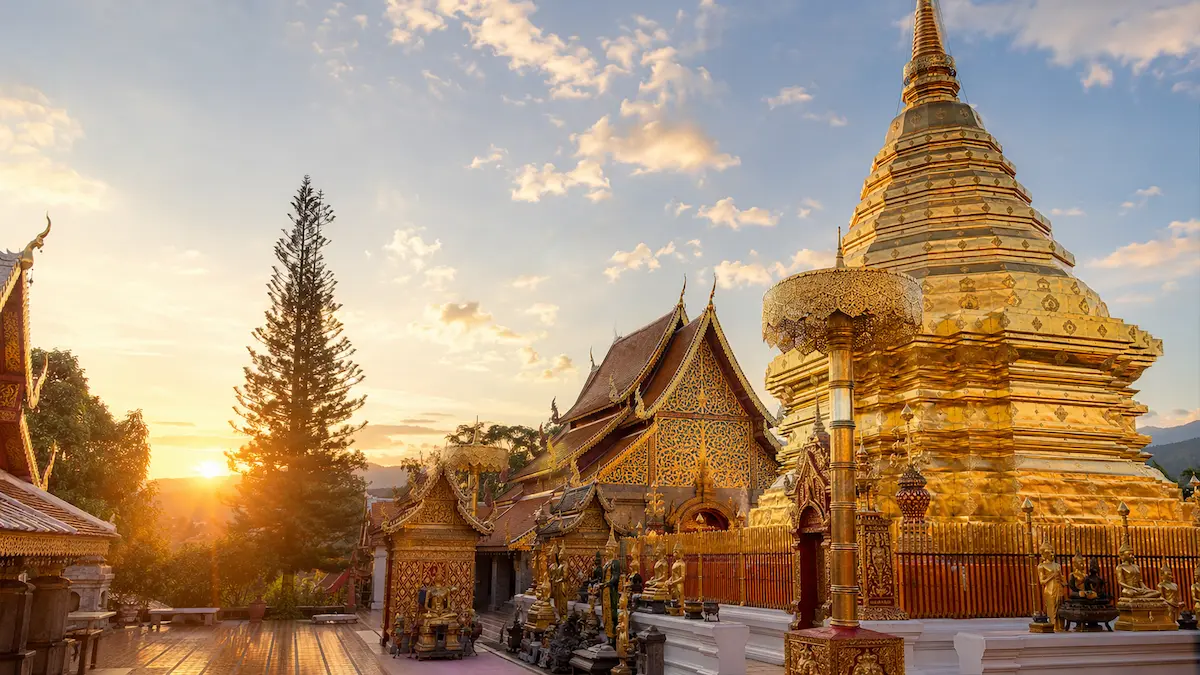
Doi Suthep is popular for a reason. The gold chedi, the pilgrimage atmosphere and the transition from city heat to mountain air make it feel like an actual destination rather than another temple stop. What I would not do is sell it as a “viewpoint with a temple attached.” The city view can be excellent, but cloud, rain and PM2.5 haze can erase it completely. If you would be disappointed without a panorama, check conditions before you climb.
The other practical point is the staircase. Photos make it look ceremonial; your knees may interpret it differently after two days of walking. There is no shame in using the lift/funicular if available and saving your legs for the temple complex itself. The key crowd-avoidance move is simple: arrive early, or go later than the big morning wave.
✅ What Other Travelers Say: current half-day tour pages show strong traveler ratings for sunrise and mountain-temple routes, with transfer quality often receiving especially good feedback. The recurring positives are the gold chedi, spiritual atmosphere, mountain setting and convenience of having transport arranged.
⚠️ The Catch (Things to Keep in Mind): red-truck departures can involve waiting if you rely on filling a shared vehicle on the spot, while private rides cost more. If your Day 2 schedule matters, a pre-arranged shared tour or fixed driver can be worth the small premium.
Verdict: absolutely worth it for a first trip—just do not ruin it by arriving at peak crowd time after already walking half the city.
📍 Stop 5: Doi Inthanon National Park
Tags: full-day trip · Thailand’s highest mountain · waterfalls · cool weather
Doi Inthanon is the right Day 3 because it gives your Chiang Mai trip a completely different landscape: cloud forest, high-elevation air, waterfalls and the Royal Twin Pagodas instead of another urban neighborhood. It is also the stop most likely to break an itinerary when travelers underestimate the road time.
Think of the national park as a chain of spread-out sights, not one entrance followed by a single walking trail. A good day chooses a few highlights and gives them time. A bad day tries to collect the summit, Ang Ka, Kew Mae Pan, two pagodas, three waterfalls, multiple villages, a coffee farm and sunset before racing two hours back to the city.
If Kew Mae Pan is open and it is the reason you are going, make it the priority and remove other stops. If the trail is seasonally closed, Ang Ka gives you a shorter, easier cloud-forest experience near the summit. Pack a light layer even when Chiang Mai city feels hot; the summit can feel surprisingly cool, wet and windy.
✅ What Other Travelers Say: current Doi Inthanon tour listings receive strong feedback for the scenery, waterfalls and relief from city heat. Travelers also repeatedly appreciate not having to solve transport between widely separated park stops themselves.
⚠️ The Catch (Things to Keep in Mind): long driving time is unavoidable. Also check whether park admission and the Royal Twin Pagodas fee are included in your booked price. “Cheap” tours can become less cheap once fees are added at the gate.
Verdict: the best one-day nature counterweight to a city-heavy Chiang Mai itinerary, but only if you let it have the whole day.
Key FAQs
Is 3 days enough for Chiang Mai for first-time visitors?
Yes—if you define “Chiang Mai” realistically. Three days is enough for the Old City, Doi Suthep/Wat Pha Lat, Nimman and one major countryside day such as Doi Inthanon. It is not enough for all of that plus Chiang Rai, Mae Kampong, Pai and an elephant sanctuary without turning your holiday into a transport schedule.
Can you visit Doi Suthep and Doi Inthanon on the same day from Chiang Mai?
Technically, a private driver could move you between a lot of places. Practically, it is a poor first-trip plan. Doi Suthep belongs with Wat Pha Lat and western Chiang Mai; Doi Inthanon is a separate full-day national-park trip. Combining them means more road time and less time at both.
Where should I stay in Chiang Mai for a 3-day itinerary without renting a scooter?
The Old City is the easiest all-round choice for first-timers because Day 1 is mostly walkable and songthaews/Grab are abundant. Nimman is excellent if cafés, restaurants and modern hotels matter more than historic atmosphere. Night Bazaar/Riverside suits travelers who prioritize evenings and larger hotels. Whichever you choose, stay in one place for all three nights.
Final Verdict and Your Next Step
The perfect three-day Chiang Mai trip is not the itinerary with the most pins. It is the one where you still have enough energy to enjoy the last stop. Keep Day 1 compact and cultural, put Wat Pha Lat and Doi Suthep together on Day 2, and protect Day 3 for Doi Inthanon. Skip Chiang Rai this time, resist hotel-hopping, and use short rides strategically instead of treating every transfer like a budget challenge.
Before you go, check the latest official opening hours, park notices, seasonal trail status and air-quality conditions. Then pre-book the transport-heavy parts of the trip. Electronic confirmations make the logistics much easier, but remember the important distinction: you are mainly reserving a tour, vehicle or departure slot—not buying a magical fast pass for a temple.
Best pre-trip booking options:
Check the Doi Suthep + Wat Pha Lat half-day tour on Klook
Check the Doi Suthep + Wat Pha Lat red-truck trip on KKday
Check the Doi Inthanon full-day tour on Klook
Check the Doi Inthanon full-day tour on KKday
One final rule: if a tour package looks impressive because it includes an unbelievable number of stops, count the hours in the vehicle before you count the attractions. In Chiang Mai, the smarter itinerary nearly always beats the longer checklist.