
💡 Key Takeaways
- Choose by hotel location, not headline journey time. The JR train is fastest to Sapporo Station, but an airport bus can be easier for Odori, Susukino, Nakajima Park and hotels near a direct stop.
- The bus is not the budget winner. As of August 2026, the JR non-reserved fare is ¥1,230, while the airport bus to central Sapporo is ¥1,500. The bus earns its keep by saving a city transfer and reducing luggage hauling.
- Late arrivals need a backup plan. The 23:21 JR departure leaves on time even when flights are delayed. If your plane lands late, immigration, baggage claim and winter disruption can turn a cheap transfer into an expensive last-minute taxi.
Most travelers searching for how to get from Sapporo Airport to the city center are actually arriving at New Chitose Airport (CTS), around 45 kilometers from central Sapporo—not the much smaller Okadama Airport (OKD). The route looks simple on a map, but the wrong choice can leave you dragging suitcases through Sapporo Station, waiting for a full bus, paying for an unnecessary taxi, or discovering that your “airport rental car” requires another shuttle before you even receive the keys.
The best option depends less on which vehicle is fastest and more on five practical questions: Where is your hotel? What time do you land? How many people are traveling? How many suitcases do you have? Are you staying in Sapporo or leaving immediately on a Hokkaido road trip?
This guide compares the real door-to-door experience—not just the advertised travel time. Fares and operating details were checked against current operator information in August 2026, but weather, road conditions and seasonal timetable changes can affect services. Check the official timetable again shortly before travel.
The 1-Min Cheat Sheet
- JR Rapid Airport train — best for Sapporo Station and time-sensitive travelers: ¥1,230 non-reserved or ¥2,230 reserved; approximately 33–43 minutes to Sapporo Station. Fast, frequent and protected from road traffic, but crowded trains and the onward transfer can be awkward with luggage.
- Airport limousine bus — best for Odori, Susukino, Nakajima Park and selected hotels: ¥1,500; official scheduled times are roughly 65 minutes to Sapporo Station, 73 minutes to Odori, 77 minutes to Susukino and 80 minutes to Nakajima Park. Slower and vulnerable to traffic, but your suitcase stays in the luggage hold.
- Shared shuttle or pre-booked private transfer — best for families, several suitcases and door-to-door comfort: shared services can start around ¥4,980 per person, while private rides start around ¥14,800 per vehicle and often rise with vehicle size, date and pickup conditions.
- Rental car — best only when Sapporo is not your first real stop: sensible for an immediate road trip to Lake Shikotsu, Noboribetsu, Furano or other rural areas; usually a poor-value airport-to-city transfer once parking, tolls, fuel, insurance and pickup time are included.
Our practical default: Take the JR train if you are staying around Sapporo Station. Take the airport bus if your accommodation is genuinely close to a central bus stop. Pre-book a door-to-door vehicle if your group would otherwise need multiple local tickets, a taxi after the train, or a difficult luggage transfer.
Top Survival Tips
- Pin your exact hotel before choosing. “Sapporo city center” covers several useful bases. A hotel near Sapporo Station favors JR; one near a direct Susukino or Nakajima Park bus stop may favor the bus.
- Measure the last 500 meters. In dry weather, an eight-minute walk is trivial. In snow, ice, slush or with two large cases, it can become the hardest part of the trip.
- Reserve the JR seat when comfort matters. Only Car 4 is reserved. The extra cost is not essential for everyone, but it can be worth paying during ski season, holiday peaks, evening arrivals or when traveling with children.
- Do not assume every airport bus accepts the same payment method. Hokkaido Chuo Bus lists transport IC cards and contactless cards, while Hokuto Kotsu currently states that transport IC cards such as Suica cannot be used on its buses. A contactless credit card plus some yen is the safest combination.
- Check the suitcase rule before joining the bus queue. Hokuto Kotsu’s current guidance says the trunk allowance is one suitcase per person, subject to available space. Keep lithium batteries and power banks with you rather than inside checked luggage in the bus hold.
- Do not rely on a tight late-night connection. The 23:21 JR service does not wait for delayed flights. International arrivals should allow time for immigration, baggage delivery and walking from the international terminal area.
- Add buffer time in winter. Trains can be disrupted by severe snow, while buses and cars can be delayed by traffic, highway closures or poor road conditions. Check both JR operating information and bus notices before leaving the arrivals hall.
- Do not rent a car merely to avoid one transfer. Most airport rental processes involve a counter, shuttle ride and off-site paperwork. For a city stay, collect a car later in Sapporo instead.
The Full Experience
🚆 JR Rapid Airport Train: Best for Sapporo Station and the Fastest Predictable Journey
Feature tags: Fastest | No road traffic | Frequent daytime service | IC card friendly | Optional reserved seat
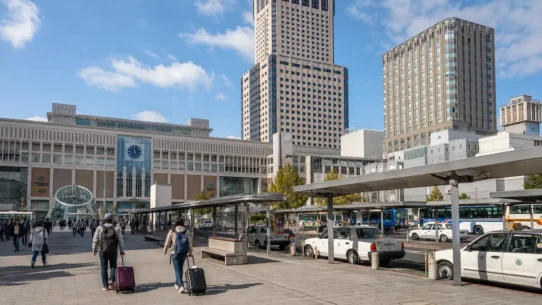
The JR Rapid Airport service is the simplest answer for most first-time visitors staying near Sapporo Station. New Chitose Airport Station is connected directly to the terminal complex, so you can reach the train without going outside—a major advantage in rain, snow or sub-zero temperatures.
JR Hokkaido currently operates Special Rapid, Rapid and Semi-Rapid Airport services. The fastest scheduled journey reaches Sapporo in about 33 minutes, while other services take around 37 to 43 minutes. Between 09:00 and 16:00, the operator advertises six Airport trains per hour, although early-morning and late-night frequencies differ.
Current one-way cost: ¥1,230 in a non-reserved car or ¥2,230 for a reserved seat. Cars 1, 2, 3, 5 and 6 are non-reserved; Car 4 is reserved. You can normally enter the non-reserved area by tapping a compatible IC card, while the reserved option requires the base fare plus a seat reservation.
Where it works best: Sapporo Station, the JR Tower area, hotels north or south of the station, and travelers connecting onward by JR to Otaru or another rail destination.
The real door-to-door calculation: The advertised 33–43 minutes ends at the platform. Add time for walking through the large Sapporo Station complex, finding the correct exit, and possibly taking the subway or a taxi. For a hotel in Susukino, the train can still be efficient, but it is no longer a one-seat ride.
How to take the train
- Follow the JR signs from the arrivals area to New Chitose Airport Station.
- Tap a compatible IC card for a non-reserved car, or buy a paper ticket.
- For a guaranteed seat, purchase the reserved-seat option for Car 4 before boarding.
- Check whether your service terminates at Sapporo or continues toward Teine or Otaru. You do not need to change trains to reach Sapporo Station.
✅ What Other Travelers Say
Travelers consistently praise the clear terminal-to-station route, frequent departures and predictable arrival time. The main complaints are crowding, limited convenient space around large suitcases and the surprisingly long walk after reaching Sapporo Station. The train feels effortless with one manageable bag; it feels less effortless when a family is moving four large cases through a busy platform and then changing to the subway.
⚠️ The Catch (Things to Keep in Mind)
- A non-reserved ticket does not guarantee a seat. At busy times, you may stand or split up from your group.
- Sapporo Station is not the same as your hotel. A cheap local subway ride, taxi or long underground walk may erase part of the train’s time and price advantage.
- The last train is a hard deadline. JR advertises a 23:21 departure from New Chitose Airport, and explicitly notes that it leaves on schedule regardless of flight delays.
- Winter reliability is better than the road, not perfect. Heavy snowfall can still cause delays, cancellations and crowded replacement arrangements.
Verdict: This is the best all-round choice for solo travelers, couples, light packers and anyone staying near Sapporo Station. Pay for the reserved seat when the cost of standing, separating from children or wrestling with luggage would spoil the start of the trip.
Check the official JR Airport train information
🚌 Airport Limousine Bus: Best for Odori, Susukino, Nakajima Park and Selected Hotels
Feature tags: No city transfer | Suitcase in luggage hold | Central hotel stops | Guaranteed seated ride | Traffic risk
The airport bus is often described as the cheaper alternative to JR, but that is outdated advice. The current central Sapporo fare is ¥1,500—¥270 more than the JR non-reserved fare. The bus is worth considering because it can remove a subway transfer, station navigation and suitcase hauling, not because it automatically costs less.
Direct central services stop at useful locations including Sapporo Station, Odori Park, Susukino and Nakajima Park. Some departures also serve named hotels. Official direct-service estimates are approximately 65 minutes to Sapporo Station, 73 minutes to Odori, 77 minutes to Susukino and 80 minutes to Nakajima Park.
Where it works best: Hotels within a short, flat walk of an airport-bus stop; travelers with one large suitcase; families using a stroller; and visitors who would otherwise take JR plus a local subway or taxi.
Hidden value: You sit for the full journey, your main suitcase travels in the underfloor hold and you avoid navigating Sapporo Station. That can be worth more than saving 20 minutes—especially after a long-haul flight.
How to take the bus
- Check the stop closest to your hotel before joining any queue.
- Confirm whether the approaching service is operated by Hokkaido Chuo Bus or Hokuto Kotsu, because payment acceptance differs.
- Place eligible luggage in the hold and keep valuables, medication, documents and batteries with you.
- Pay using the method accepted by that operator. Keep some cash available even if you plan to use contactless payment.
✅ What Other Travelers Say
Travelers staying around Susukino and central hotel stops often say the bus is the least tiring option because it removes the station transfer. Recent reports also praise the stop locations outside the terminal and the ability to pay by card. The recurring frustration is that a full bus can mean waiting for the next departure, while traffic can turn a comfortable ride into a slow one.
⚠️ The Catch (Things to Keep in Mind)
- The timetable is an estimate, not a promise. Traffic, highway closures and winter road conditions can cause significant delays.
- Buying a ticket does not reserve a seat. Central airport buses are generally non-reserved, and boarding follows the queue. If a bus is full, you may need the next one.
- Operator payment rules are inconsistent. Do not assume your Suica or other IC card will work on every jointly operated departure.
- Luggage capacity is finite. Hokuto Kotsu states a maximum of one suitcase per person in the trunk, and oversized items can be refused if space is insufficient.
- The “hotel stop” may still be across a wide road or several snowy blocks away. Check the exact map pin rather than trusting the stop name.
Verdict: Pick the bus when it drops you near your actual accommodation. Do not choose it for a Sapporo Station hotel merely because someone called it cheaper; JR is currently cheaper and usually much faster to the station itself.
Check the official central Sapporo airport-bus timetable and stops
🚐 Shared Shuttle, Private Transfer or Taxi: Best for Heavy Luggage, Families and Awkward Arrival Times
Feature tags: Door to door | No transfers | Best for groups | Pre-booking recommended | Higher cost
Door-to-door transport is not one single product. There are three different price levels, and mixing them up can lead to bad comparisons:
- Shared shuttle or shared taxi: You share a larger vehicle with other passengers traveling in a similar direction. Current New Chitose services can start around ¥4,980 per person to the Sapporo Station area.
- Pre-booked private transfer: One vehicle is reserved for your party. Current advertised starting prices can be around ¥14,800 per ride, with the final price depending on address, vehicle, passenger count, date and luggage.
- Regular or fixed-fare taxi: A taxi from the rank offers flexibility, but long-distance pricing can approach ¥20,000. One current Sapporo operator lists a ¥18,000 fixed fare for a small car and ¥21,600 during its late-night, early-morning or winter surcharge period.
Where it works best: Groups of four or more, families with young children, older travelers, mobility-limited guests, ski equipment, multiple large suitcases, hotels far from stations and travelers landing too late for a comfortable public-transport connection.
When the price becomes reasonable: A ¥16,000–¥20,000 vehicle sounds expensive for one person. Split among five or six travelers—especially when the alternative includes multiple JR tickets, a local taxi and the physical cost of moving luggage—the gap becomes easier to justify.
Shared shuttle versus private vehicle
Choose a shared shuttle when you want door-to-door service but can tolerate a flexible pickup window and possible detours for other passengers. Choose a private transfer when the group needs a specific vehicle size, child seat, direct routing, flight monitoring or a guaranteed luggage plan.
NearMe’s current shared-service terms are a useful example of the hidden details to check: one suitcase is included, extra items can cost more, oversized baggage is restricted, the reservation is not necessarily confirmed immediately, and a shared vehicle cannot always wait for a delayed flight because other passengers are onboard.
✅ What Other Travelers Say
Verified Klook feedback for New Chitose transfers repeatedly mentions punctual drivers, safe driving and help with luggage. This is the strongest option for travelers who value a smooth arrival more than the lowest possible fare. The most important lesson from transfer reviews is to book the correct vehicle capacity—not merely the cheapest car shown—because passenger count and suitcase count are separate constraints.
⚠️ The Catch (Things to Keep in Mind)
- “Up to four passengers” does not mean four passengers plus four giant suitcases. Check the luggage diagram and book a larger vehicle when necessary.
- Flight-delay policies vary. Confirm waiting time, grace period, rebooking rules and the exact meeting point before paying.
- Shared services may not be immediate. Your final pickup time and route can be assigned later, and detours can extend the trip.
- A taxi rank is not a guaranteed fixed price. Highway tolls, traffic, night charges and winter surcharges can change the final cost unless you pre-book an all-inclusive fare.
- Do not book an undersized vehicle to save a small amount. A second last-minute taxi is the most expensive possible outcome.
Verdict: For one or two light packers, this is a luxury. For a family of five with children and several suitcases, it can be the most rational option. Compare the final vehicle price, included waiting time and luggage capacity—not just the headline “from” fare.
Compare New Chitose Airport private transfers on Klook
Check a New Chitose Airport private transfer on KKday
🚗 Rental Car: Best Only If You Are Leaving Sapporo Immediately
Feature tags: Road-trip freedom | Rural access | Off-site pickup time | Parking cost | Winter-driving risk
A rental car is one of the best ways to explore rural Hokkaido, but it is usually one of the worst ways to travel only from New Chitose Airport to a city-center hotel. Sapporo has strong rail and subway coverage, while central parking adds cost and stress. You may spend more time collecting the car than you would waiting for the next JR train.
The phrase “airport rental car” is also misleading. Many companies have a counter in the terminal but an off-site rental depot. The usual process is: find the counter, register, wait for a shuttle, ride roughly 10 minutes to the branch, complete paperwork, inspect the car and load your luggage. At busy times, that can turn into a substantial arrival-day delay.
Where it works best: Travelers driving directly from the airport toward Lake Shikotsu, Noboribetsu, Lake Toya, Furano, Biei or another destination where public transport is limited. It also makes sense for a multi-day loop that does not need a city-center parking space.
Hidden costs: Rental fee, insurance or damage waiver, non-operation charge coverage, ETC card rental, highway tolls, fuel, hotel parking, city parking and winter equipment. International visitors must also carry the correct driving documents for their license-issuing country.
✅ What Other Travelers Say
Road-trippers generally value the freedom and report smooth shuttle operations with established rental companies. The repeated surprise is that the actual car is not waiting beside the arrivals hall. Travelers also recommend checking branch opening hours, insurance exclusions and vehicle size carefully, especially when carrying ski equipment or traveling in a large group.
⚠️ The Catch (Things to Keep in Mind)
- Pickup time is not driving time. Add the shuttle, queue and paperwork to your itinerary.
- Central Sapporo parking can erase any convenience. Confirm your hotel’s nightly fee and height restrictions before booking a large vehicle.
- Winter driving is not a beginner-friendly airport transfer. Snowfall, black ice, reduced visibility and unfamiliar road rules increase risk.
- Late flights can miss branch hours. A rental reservation does not guarantee that staff will remain after closing.
- A city-first itinerary is usually better with a later pickup. Take public transport into Sapporo, enjoy the car-free days, then collect the vehicle when you leave the city.
Verdict: Rent at the airport only when the airport is the start of your road trip, not merely the start of your Sapporo stay.
See the official New Chitose Airport rental-car company list
Which Option Is Best for Your Sapporo Area?
Sapporo Station and JR Tower
Take the JR train unless you have an exceptional amount of luggage or need true door-to-door assistance. The bus offers no meaningful location advantage here and is normally slower.
Odori Park
Check the exact distance from the Odori bus stop. The airport bus is attractive when the hotel is close to the stop; otherwise, JR plus one subway stop can be faster. In winter, an underground-connected hotel can make the JR route easier than the street map suggests.
Susukino
The direct airport bus is often the least tiring choice, particularly with a large suitcase. JR plus the Namboku subway line is usually faster when roads are busy, but it requires a transfer inside Sapporo Station.
Nakajima Park
The bus is highly convenient when the stop is close to your hotel. The scheduled ride is longer, but avoiding the JR-to-subway transfer can be worth it after a long flight.
Apartment, residential address or hotel away from a major stop
Calculate the full route. A shared shuttle or private vehicle may beat JR plus a local taxi once several passengers and suitcases are involved.
Key FAQs
What is the cheapest way from New Chitose Airport to Sapporo city center?
The JR Rapid Airport non-reserved fare is currently ¥1,230 to Sapporo Station, making it cheaper than the ¥1,500 central airport bus. However, if your hotel is in Susukino or Nakajima Park, include the cost and effort of the onward subway or taxi before deciding.
What is the best way from New Chitose Airport to Susukino with luggage?
For one large suitcase and a hotel close to the stop, the direct airport bus is usually the easiest because it avoids changing at Sapporo Station. For light luggage or when traffic is heavy, JR plus the Namboku subway line is faster. Families with several cases should compare a pre-booked private transfer.
How do I get from New Chitose Airport to Sapporo after a late-night flight?
JR currently advertises a 23:21 departure, and it leaves on schedule even if flights are delayed. Some airport buses may operate later depending on the timetable, but do not assume one will match your arrival. If your scheduled landing is late—or you are arriving internationally—check the exact date’s last train and bus, then pre-book a transfer or stay near the airport when the margin is too small.
Is Sapporo Airport the same as New Chitose Airport?
In most international travel searches, “Sapporo Airport” refers to New Chitose Airport (CTS), the main airport serving Sapporo. Okadama Airport (OKD) is a smaller regional airport inside Sapporo and uses different transport routes. Always check the three-letter airport code on your booking.
Final Verdict and Your Next Step
Choose JR for Sapporo Station, the fastest predictable trip and the lowest public-transport fare. Choose the airport bus when it genuinely drops you close to your Odori, Susukino, Nakajima Park or participating hotel accommodation. Choose a shared or private transfer when luggage, children, mobility, a residential address or an awkward arrival time makes transfers impractical. Choose a rental car only when you are leaving the city and beginning a wider Hokkaido road trip.
The most expensive mistake is not choosing the premium option. It is choosing a cheap option that does not fit your hotel location, landing time or luggage—and then paying for a second transfer under pressure.
Before booking, open your hotel on a map and check three points: distance from Sapporo Station, distance from the nearest airport-bus stop and whether the final walk is realistic in winter. Then reserve the parts of the journey where capacity matters. Train non-reserved seats can be bought on arrival, but reserved seats, large transfer vehicles and popular central hotels can sell out during ski season, the Sapporo Snow Festival and Japanese holiday periods.