


💡 Key Takeaways
- Start with December–February if lower rainfall matters most. It remains a hot tropical city; relatively cooler does not mean a cool-weather holiday.
- March–April favors a drier plan with stronger heat management. May–June adds frequent rain without immediately removing the heat.
- July–September needs a flexible daily route and rain contingency. October–November is a gradual transition, with October still substantially wet in the normals.
- Weather averages, holiday calendars and hotel prices answer different questions. Check the actual travel year’s holiday dates, dated room totals and near-term forecasts separately.
The best time to visit Ho Chi Minh City is usually December–February for travelers who want a lower-rainfall starting point. The more useful question is how much heat, rain disruption and holiday planning you are willing to accept. A dry month still needs shade and water breaks; a wet month can still contain worthwhile outdoor time.
The five periods below divide the city’s actual seasonal pattern into practical travel choices. They are not four temperate seasons, and there is no promise of perfect weather. The WMO World Weather Information Service’s Ho Chi Minh City page publishes information supplied by Viet Nam’s meteorological authority, with a 1991–2020 climate-normal period. Those averages describe a pattern, not your travel week’s forecast.
Vietnam’s official tourism guide broadly describes the dry season as December–April and the rainy season as May–November. Within that pattern, the transition months matter. Primary climate and calendar sources were checked in October 2026, and each video below is a real searched recording with a named creator.
The 1-Min Cheat Sheet
- December–February: the first choice for a more walking-oriented visit with lower rainfall. Check Tet and other fixed-date plans before assuming normal opening patterns or a particular hotel price.
- March–April: suitable when drier conditions matter and you can build the day around heat. Use earlier outdoor visits, a midday break and a short evening route.
- May–June: the shift into frequent rain, with heat still part of the trip. Choose a convenient base and keep outdoor plans movable.
- July–September: established wet-season planning. Favor flexible city days, realistic transport buffers and activities that can switch indoors.
- October–November: a gradual move toward the drier period. November improves in the averages, but calling all of October dry would be misleading.
Top Survival Tips
- Read the forecast close to the activity. Use the National Center for Hydro-Meteorological Forecasting for current forecasts and warnings. An old walking video, a climate chart and an annual seasonal label cannot tell you whether a particular afternoon is suitable.
- Keep one outdoor priority and one indoor alternative. Group them in the same part of town. Changing the order is easier than crossing the city because every activity is fixed to a distant appointment.
- Budget for useful flexibility. Compare room cancellation deadlines, tour amendment terms and an occasional vehicle ride. A wet-season date is not a guarantee of a cheaper hotel; only a dated quote can establish the saving.
- Protect the things that end a day when wet. Carry a small dry bag for your phone and documents, rain protection and footwear you can manage on wet surfaces. Do not attempt to walk through floodwater simply because a filmed traveler or motorbike does.
- Plan heat breaks in every period. Avoid designing an uninterrupted midday walking marathon. Shade, water and a useful hotel return can matter more than how many attractions fit on a map.
- Separate city weather from excursions. HCMC averages do not establish conditions at every Mekong Delta stop, river activity or coastal destination. Check the operator’s actual destination, weather policy and cancellation terms before paying.
- Leave a genuine departure buffer. Rain, road conditions and the arrival terminal can affect a journey. Metro Line 1 does not serve Tan Son Nhat Airport. Confirm the current terminal and pickup rather than relying on a fixed transfer time.
The Full Experience
☀️ December–February: Best Starting Point for Lower-Rainfall Sightseeing
Video context: WANDER filmed this daytime Ben Thanh walk on 9 February 2026 and published it in September. It is one actual February route, not a forecast or evidence that every February day is dry.
Choose this period first when you want the strongest lower-rainfall starting point and plenty of outdoor city time. January and February have the lowest rainfall figures in the WMO table. December is drier than the main wet months but still has rain in the long-term record.
Keep outdoor landmarks in a manageable cluster, allow a rest and choose an evening route near the hotel. A central base helps if you intend to return between outings.
Tet requires a separate calendar check. The government approved a 14–22 February break for Tet 2026. That was the 2026 public-sector holiday arrangement, not a rule for every business or future year. For another travel year, verify the calendar and the restaurants, attractions and transfers you actually need.
Compare dated hotel offers, the exact room and cancellation deadline. Around a holiday, confirming needed services may be more valuable than a small room saving.
✅ What Other Travelers Say
WANDER’s dated February 2026 market walk offers a concrete example of daytime sightseeing during this period. The account shows a particular visit, without establishing a seasonal review consensus, a current night-market schedule or your likely weather.
⚠️ The Catch (Things to Keep in Mind)
Drier does not mean rain-free or cool. Tet dates vary, and the same calendar period can bring different service arrangements. Confirm the actual year and booking conditions rather than reusing the 2026 holiday dates.
🌡️ March–April: Best When You Can Plan Around Strong Heat
Video context: Travel Groupies–Rita & Werner published this explicitly labeled April 2023 city walk. It includes the Bui Vien area; it is a dated street account, not current transport-terminal guidance.
March–April can work well if you prefer a generally drier seasonal setting and accept a heat-led daily routine. The WMO mean daily maximum reaches 34.5°C in April. That is an average of daily maxima, not a ceiling or a prediction for your booking.
The planning response is to shorten continuous exposure. Put your most important outdoor walk early, choose an indoor or restful middle of the day, and leave a nearby evening outing optional. A route that looks compact on a screen can still become tiring when repeated road crossings and long unshaded stretches are involved.
For families, older relatives or anyone who dislikes sustained heat, compare this period against December–February before selecting a nonrefundable fare. If March or April is the only available window, reduce the day’s ambitions rather than assuming determination will compensate for an uncomfortable schedule.
A hotel pool can provide a break if its access suits the booking. Check the room’s air conditioning and convenient return before dinner. For excursions, confirm outdoor duration, shade and breaks.
✅ What Other Travelers Say
Travel Groupies–Rita & Werner’s April 2023 account describes a daytime rooftop view and local street stops. It illustrates one outdoor visit in this period; it does not measure the temperature or prove that everyone will enjoy the same amount of walking.
⚠️ The Catch (Things to Keep in Mind)
Relatively low rainfall is not the same as easy all-day walking. Avoid treating April as the end of all heat: the published mean daily maximum is slightly higher in May. Plan the next period with both heat and rain in mind.
🌦️ May–June: Best for Travelers Comfortable with a Changing Daily Plan
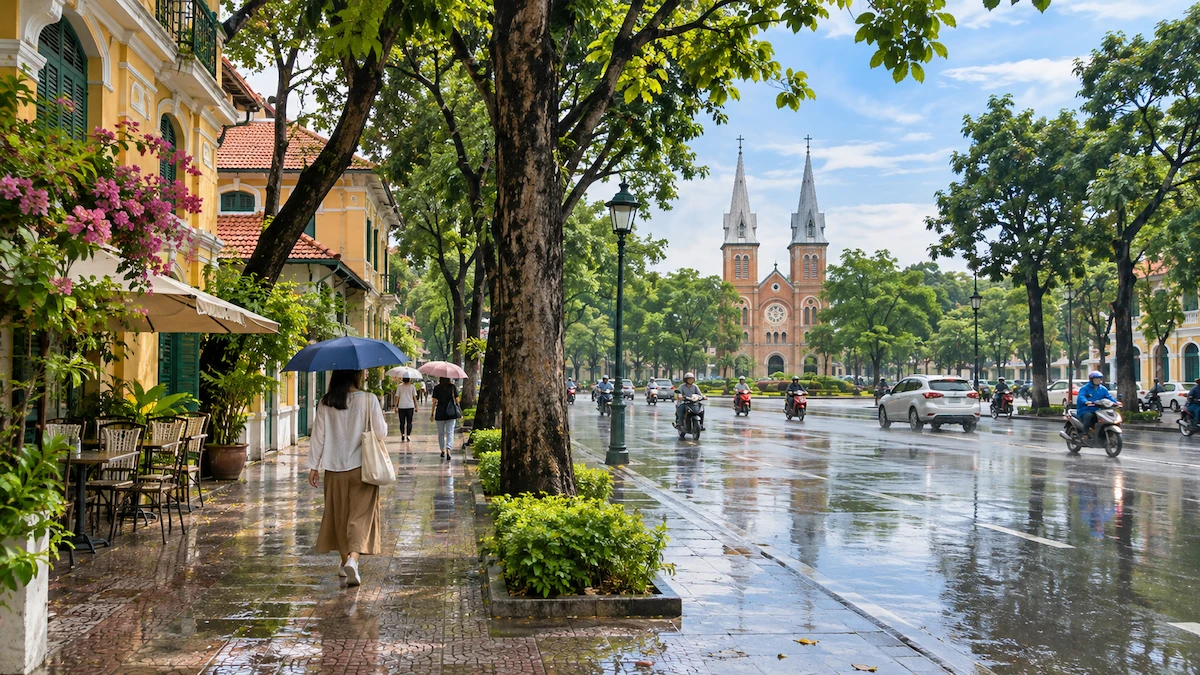
Video context: TRAVEL VIETNAM 4K published this Saigon heavy-rain walk on 14 June 2026. The publication date is verified; the exact recording day is not specified in the description.
The transition into frequent rain is substantial, rather than a minor change from April. May’s normal rainfall rises to 202 millimeters, while its mean daily maximum is 34.9°C. Rain arriving more often does not mean the heat has disappeared.
This period suits a traveler who can change the order of a city day. Pick a compact area, keep an indoor alternative close to the outdoor priority, and avoid stacking several weather-sensitive reservations with no room to move them. An extra night can add flexibility when dates and budget allow, without guaranteeing better conditions.
Do not rely on a rule that it rains only at a convenient hour. A short shower, a prolonged downpour and a wet arrival are different situations. Check the actual forecast before leaving, and ask an excursion operator how they handle changes rather than assuming a city café can solve every weather problem.
Compare room space, daylight, air conditioning and the route to meals. More time indoors can make the cheapest no-window category a less attractive saving.
✅ What Other Travelers Say
TRAVEL VIETNAM 4K’s June 2026 publication presents a rain-soaked city walk with natural street sound. It is a useful visual example of rain disrupting an ordinary walk, not evidence about how often all June days are affected.
⚠️ The Catch (Things to Keep in Mind)
Do not trade one simplistic label for another: early rainy season still includes heat. A small hotel discount can be outweighed by an unsuitable room, inflexible excursion or repeated extra transport. Compare the complete dated plan.
🌧️ July–September: Best for a Flexible, Mostly City-Based Visit
Video context: AP Archive’s report was filmed in Ho Chi Minh City on 30 September 2026 and published in October. It is news footage of a specific flood event, not an ordinary-day travel review.
Plan this period as the established wet season. September has the highest rainfall total in the published WMO monthly table, at 273 millimeters. That does not mean constant rain, identical conditions in every neighborhood or a canceled trip by default.
The workable approach is to keep city days flexible and reduce unnecessary cross-city movements. Put an outdoor priority and an indoor alternative close together. Leave time to stop, wait or return rather than trying to preserve an ambitious schedule at any cost.
The September 2026 AP footage documents genuine flood disruption on particular streets. It is a reason to take current warnings and the final hotel approach seriously, not to claim the whole city is flooded throughout the season. Ask the hotel about the practical vehicle approach if heavy rain is occurring, and use current advice for the route you need.
For fixed outdoor priorities, consider a drier-period date. For a flexible longer visit, compare actual room offers and cancellation terms. Do not assume a universal wet-season discount or crowd level.
✅ What Other Travelers Say
The named creator here is AP Archive. Its 30 September 2026 reporting documents traffic affected by floodwater. This is dated event evidence rather than traveler praise or a review consensus, and it should be read at that specific scale.
⚠️ The Catch (Things to Keep in Mind)
Transport disruption can matter more than the time spent sheltering from rain. Leave departure buffers and do not enter floodwater to keep an appointment. A video of one event cannot tell you the status of tomorrow’s road or hotel entrance.
🌤️ October–November: Best for a Gradual Transition, Especially Later
Video context: Richard Nomad’s October 2022 film is explicitly titled as a walk after night rain. It provides dated visual context, not a current forecast or promise of rain-free daytime hours.
October and November should not be compressed into a single dry-season promise. The WMO rainfall figures fall from 240 millimeters in October to 128 in November. The direction is useful for choosing dates, while the remaining rain still deserves a contingency.
If you have flexibility within this period, compare later dates against your need for outdoor time rather than assuming the first October week offers the same pattern as late November. No monthly average can select a guaranteed sunny weekend, so keep the final forecast check and amendment terms.
Check other Vietnam destinations separately. HCMC’s transition pattern does not establish conditions in the north, central regions or islands. Each stop needs its own weather and transport contingency.
Choose a base with convenient meals and a realistic airport departure plan. Read an outdoor experience’s actual weather and refund terms rather than relying on the label shoulder season.
✅ What Other Travelers Say
Richard Nomad documents a city walk after rain in an explicitly October 2022 account. The film illustrates why transition-period sightseeing can involve wet surfaces even when rain has stopped. It does not establish how a different October or November will unfold.
⚠️ The Catch (Things to Keep in Mind)
November’s lower normal rainfall is an improvement in averages, not a weather guarantee. October remains wet in the same source. Keep dated booking prices, actual forecasts and any holiday or event plans separate from the seasonal comparison.
Key FAQs
What is the best month to visit Ho Chi Minh City for less rain?
January and February have the lowest rainfall totals in the cited climate table. December–February is a useful starting window, but it remains hot and individual rainy days are possible. Check the actual year’s holiday calendar too.
Is the rainy season a bad time to visit Ho Chi Minh City?
It depends on your priorities and flexibility. A city visit with indoor alternatives can work, while a short trip built around fixed outdoor activities is more vulnerable. Allow for rain and possible transport disruption rather than assuming all-day rain or none.
When are hotels cheapest in Ho Chi Minh City?
A seasonal label cannot establish the cheapest room for your stay. Compare identical dates, occupancy, room categories, taxes and cancellation terms across real offers. Holiday calendars and property demand can change prices independently of average weather.
Final Verdict and Your Next Step
Begin with December–February for a lower-rainfall sightseeing trip. Choose March–April with a heat-conscious routine, May–June with both heat and rain preparation, July–September with maximum flexibility, and October–November as a gradual transition rather than an instant dry-season switch.
Check current weather advice, then compare actual rooms through Silverland Yen’s official reservations or Somerset Ho Chi Minh City’s booking page. Reserve ahead for fixed dates once the room, cancellation deadline and practical rain alternatives suit your plans.