
💡 Key Takeaways
- Plan by geography. Historic Venice uses walking and boats; mainland Mestre adds buses, trams and trains. Santa Lucia is the historic-city rail terminus, while Piazzale Roma is the road terminal. Lido and Giudecca require water crossings.
- Count chargeable ticket periods before buying a pass. The standard €9.50 urban water-network ticket lasts 75 minutes; the €25 Daily Pass lasts 24 hours. Two separate tickets cost €19, while three cost €28.50. A pass pays for use you will actually make.
- “Venice transport” is not one all-inclusive product. Ordinary ACTV passes exclude Marco Polo Airport journeys, Alilaguna and private boats. The €25 Daily Pass’s specified regional-rail inclusion should not be assumed for every other multiday product.
This Venice transportation guide starts with the part that changes most decisions: the final walk. A boat can reduce bridge carrying, but the wrong landing can put the hotel on the other side of the canal. An unlimited ticket can suit island outings and frequent boat journeys, while a traveler walking between nearby sights may spend less on individual tickets.
Fares, operator rules and purchase entries were checked on 20 October 2026. The dated films help you picture each mode. Use the linked operator information to check the rules and service notices for your own travel date, especially when combining airport, mainland and water journeys.
The 1-Min Cheat Sheet
- Walking: best for nearby sights on a manageable route. No transport fare, but bridges, crowds, luggage and the actual entrance determine effort.
- ACTV vaporettos: useful for a helpful canal landing, Lido, Giudecca and other served lagoon destinations. Compare the €9.50 standard 75-minute urban-network ticket with time-based passes. Check exclusions and validate correctly.
- Mainland buses, trams and regional trains: practical for a Mestre or Marghera base. Road and tram services reach Piazzale Roma; trains reach Santa Lucia. The nearest mainland station or stop and the last service home matter as much as the crossing.
- Alilaguna airport boats: a separate VCE airport connection, useful when its actual public stop suits the hotel. Airport–Venice tickets currently cost €18 single or €32 return, with their own luggage conditions.
- Private water taxis: request a whole-party route quote for a transfer where reducing changes is valuable. Confirm the destination landing, bags, access and delay terms. Gondola outings are another product and are not an ACTV-pass substitute.
Top Survival Tips
- Identify the exact arrival hub. VCE is Marco Polo Airport, TSF is Treviso Canova, Venezia Mestre is on the mainland, Santa Lucia is in historic Venice and Piazzale Roma is the road terminal. Tickets and directions for one do not automatically work at the others.
- Use the hotel entrance as the destination. Ask which landing and bank give the least difficult route. Rialto and Rialto Mercato differ, as do the several San Marco-area stops. Include any final bridge, street steps or lift restrictions.
- Count ticket periods, not every boarding. A permitted transfer inside a valid ticket period is not automatically another €9.50 purchase. A long sightseeing stop can put the next journey outside that period.
- Read the product rather than the sales channel. Buying on Venezia Unica does not turn a visitor ticket into the discounted Carta Venezia fare. Those fares require an appropriately enabled card. Ordinary visitors should compare the standard products.
- Validate or activate as required. ACTV tickets need validation at the beginning and on changing vehicles. Its app tickets for bus or tram must be activated three minutes before boarding. Read the ticket-specific instructions rather than assuming purchase alone is sufficient.
- Plan the return before the island outing. Use ACTV’s current route and service page, with the actual date, direction and stop. A night route does not reproduce every daytime service; fog, water levels and service notices can change the journey.
- Check the whole route for mobility needs. A boat ramp, a nearby stop or a hotel lift only answers part of the journey. Use municipal access information and confirm vessel, landing, street and room requirements with the operators and property.
- Keep the access fee separate. The 2026 trial ended on 26 July, so October 2026 needs no access-fee payment or exemption formalities. The current portal announces selected 2027 dates but says that year’s FAQs await the relevant official acts. Check the year’s calendar and overnight-guest proof rules. A transport pass is a separate purchase.
Which ACTV Ticket Is Worth Buying?
ACTV’s current tariff page lists a €9.50 standard 75-minute Rete Unica ticket and a €25 Venezia Daily Pass lasting 24 hours from first validation. The ordinary two-, three- and seven-day ACTV tickets cost €35, €45 and €65, lasting 48, 72 and 168 hours. These are continuous time windows, so an afternoon start does not consume a whole calendar day at midnight.
Use the duration that covers the journeys you intend to take. Two separate €9.50 periods total €19, so the €25 Daily Pass costs €6 more; three total €28.50, making it €3.50 cheaper. Four periods inside 48 hours total €38, compared with the €35 two-day product. Four inside 72 hours still total €38, below the €45 three-day product; five total €47.50, making that pass €2.50 cheaper. Those are arithmetic comparisons, not an instruction to take extra boats to justify a purchase.
The standard water-network products cover eligible ACTV urban boats, urban road/tram services and the People Mover, with exclusions including routes 16, 19, the Casino service, all Alilaguna services and Marco Polo Airport journeys. The €25 Daily Pass also specifically includes Trenitalia R/RV regional travel within the municipality, at the stations named in its conditions, including Mestre and Santa Lucia. Do not transfer that rail inclusion to the ordinary 48-, 72- or 168-hour products without checking their own terms.
For the airport, ACTV offers a €10 Aerobus single, an €18 bus return and a separate €18 Aerobus + 90-minute Rete Unica product that includes eligible urban boats. Pass buyers can instead purchase an airport supplement of €7 one way or €13 return at the same time as the pass, with travel within its validity. None of these purchases includes ATVO, Alilaguna or a private water taxi merely because it serves the airport.
The Full Experience
🚶 Walking: Best for Linking Nearby Sights Without a Ticket
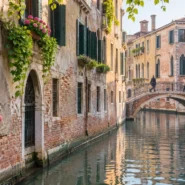
Walking Tours by LJ published this four-hour mixed Venice walk in June 2026. It includes Santa Lucia, Rialto and San Marco, with detours and sightseeing; its duration is not a direct station-to-hotel transfer estimate.
Walking lets you connect nearby sights and take smaller lanes without matching boat departures. It works particularly well once luggage is at the hotel. Plan one part of the city at a time and leave a useful boat crossing or return journey where it reduces effort, rather than treating the pass as a reason to board for every short leg.
The hotel’s canal bank matters. A short distance across the water may need a substantial diversion to a bridge; the nearest-looking boat stop can have the same problem. Use an exact entrance and ask about bridges if carrying a pushchair or case. Do not treat a hotel’s short distance from a landmark as an access assessment.
A walking film helps show surfaces, crowding and the character of a route. It cannot establish your arrival time, weather or current barrier-free route. If stairs are difficult, discuss the actual itinerary with the hotel and use the municipality’s access guidance rather than relying only on a general walking map.
✅ What Other Travelers Say Walking Tours by LJ describes a long sightseeing circuit with natural sound and named chapters. It illustrates the appeal of exploring on foot, while its extended sequence should not be copied as the shortest luggage route.
⚠️ The Catch (Things to Keep in Mind) Free transport can still be costly in fatigue. Save the long walk for a day bag if bridge carrying or the weather would make arrival difficult.
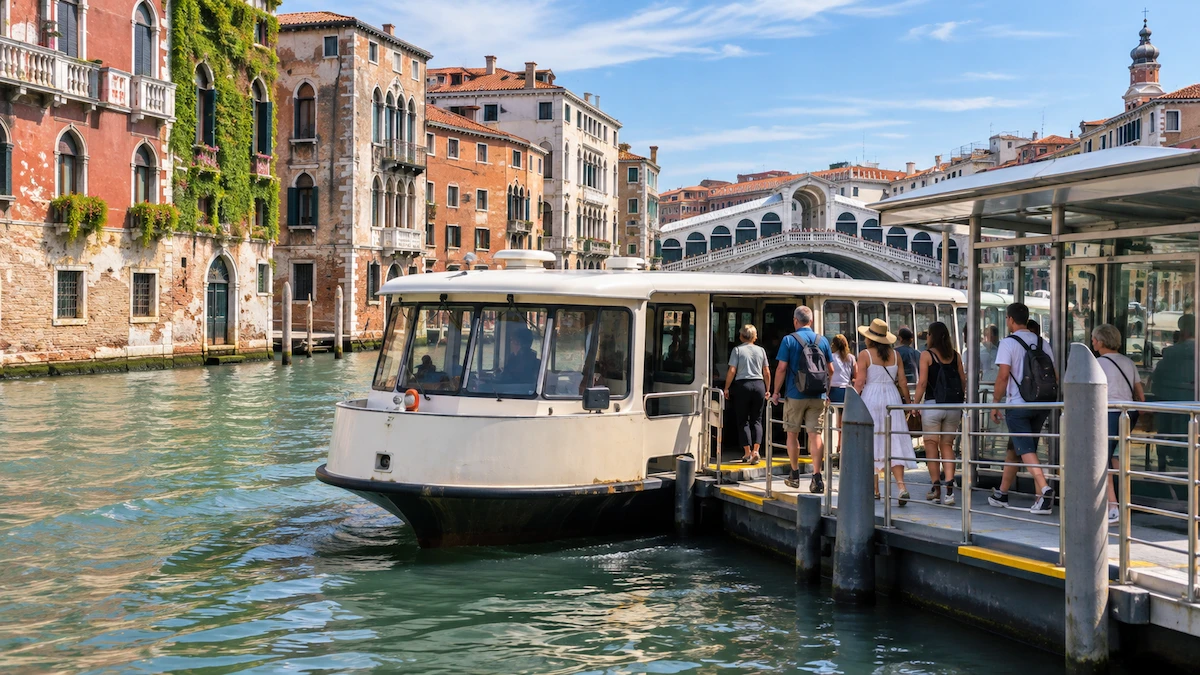
⛴️ ACTV Vaporettos: Best for Useful Landings and Lagoon Connections
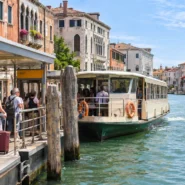
Nomad Citello published this vaporetto guide in April 2022, covering routes, ticketing and timetables. It remains a visual orientation example; the current operator sources govern fares, validation and service changes.
Start with ACTV’s actual route list and dated service notices. Line 1 runs along the Grand Canal corridor between Piazzale Roma, Ferrovia, Rialto and San Marco, continuing toward Lido. Other lines and variants serve different paths. A familiar number alone does not establish the correct direction, destination or departure pier.
At the stop, check the destination and the departure display before validating and entering the appropriate waiting area. Leave time for boarding and keep the ticket accessible for inspection. A ticket or pass gives travel according to its terms rather than a reserved seat or guaranteed space on a particular departure.
With luggage, follow ACTV’s current conditions: the ordinary allowance is three pieces, each no larger than 150 cm when its three dimensions are added. Extra pieces require the specified extra ticket; oversized pieces above that limit are not permitted. Crew retain safety and crowding discretion. Keep bags in permitted floor areas and out of passages and seats.
For a sightseeing day, cluster outings so the last useful boat journey remains within the purchased validity. For a hotel arrival, prioritize a landing that reduces the final carrying route. The same pass can be valuable for both purposes, but a good sightseeing service may be a poor choice for the exact hotel entrance.
✅ What Other Travelers Say Nomad Citello’s guide concentrates on finding routes, buying tickets and reading timetables. It is a useful practical introduction, while its 2022 publication makes checking present fares and service notices essential.
⚠️ The Catch (Things to Keep in Mind) Water transport is a network, not a guarantee of a short trip between any two points. Waiting, direction, intermediate calls and the final walk can outweigh a simple comparison of distances.
🚆 Mainland Bus, Tram and Regional Train: Best for a Mestre or Marghera Base
Railing Around the World published this Mestre-to-Santa Lucia regional-train account in March 2024. The creator stayed in Mestre and describes repeated crossings. The old fare and journey estimate in the description are not used as current promises here.
A mainland hotel needs a realistic daily connection. Compare the walk to its actual stop or station, the crossing and the onward route from Venice’s arrival hub. A room close to Mestre station can suit rail travel; another Mestre address may be better served by bus or tram. The municipality name on an address does not make every property equally convenient.
ACTV’s tram information distinguishes T1, connecting Piazzale Roma with Mestre Centro and Favaro, from T2 between Mestre Centro and Marghera. Neither tram drives through to San Marco. Urban bus and tram journeys within the standard road ticket’s scope currently use a €1.50, 75-minute road-network ticket; that ticket excludes the airport and does not include the urban water network.
Regional trains arrive at Venezia Santa Lucia. Check the exact train, fare and destination with Trenitalia and whether an existing ticket already includes the onward leg. A local R/RV journey and a Freccia or other long-distance train are different products. The Daily Pass’s specified municipal regional inclusion is not a blanket rail pass for the Veneto or Italy.
Trenitalia’s current Digital Regional Ticket automatically validates at the selected train’s scheduled departure, so older instructions to complete a manual check-in should not be followed for that product. Show the actual ticket with its dynamic bar and ID when requested. Paper regional tickets require validation before travel; follow the instructions on the product you hold. Manage a digital departure change before the applicable scheduled-departure deadline.
For evening plans, check the last usable connection to the hotel, including the mainland walk or change after arriving. A short train crossing alone does not describe the full daily commute. Families should compare the extra transfers and fares against the accommodation saving using their actual dates and party.
✅ What Other Travelers Say Railing Around the World describes taking the regional crossing daily from a Mestre hotel. That is one dated base-and-route example, rather than proof that every mainland hotel saves money or that its 2024 fare still applies.
⚠️ The Catch (Things to Keep in Mind) A low mainland road fare does not cover the boat onward from Piazzale Roma. Add the full itinerary and choose a ticket that actually covers its operators and modes.
🛥️ Alilaguna: Best for a Marco Polo Airport Landing Near the Hotel
Monira’s Vlog UK’s April 2026 film follows an Alilaguna journey from Marco Polo Airport to Rialto. It is a dated example of that connection, rather than evidence that all airport boats or ACTV tickets are interchangeable.
Alilaguna is an airport transfer to compare on the strength of its actual public landing. At VCE, use the first-floor Moving Walkway to reach the water-transport dock. Orange and Blue have different calls; a route serving Rialto and one reaching the San Marco side are not the same journey. Some runs skip stops, particularly later in the day.
The current airport–Venice fare is €18 single or €32 return, with one heavy bag and one hand bag included; extra pieces cost €4 each. Ordinary ACTV passes do not include it. Check the dates and service in Alilaguna’s public ticket shop before purchasing.
The route-page timetables inspected for this guide are effective 29 April–28 October 2026. Open the replacement schedule for later travel, and check both the outbound and return calls. An airport boat is not automatically the best way to reach Santa Lucia just because it eventually serves that stop; compare the whole road or water connection to the destination you need.
Treviso Canova is TSF, a different airport. Use its actual airport road-service page rather than looking for the Marco Polo boat dock. VCE road arrivals can use ACTV or ATVO to Piazzale Roma, with distinct tickets and any onward boat added as required.
✅ What Other Travelers Say Monira presents the Rialto approach as a scenic part of the trip. That can be an attraction when its route suits the hotel, but scenery does not establish the fastest arrival or the easiest final walk.
⚠️ The Catch (Things to Keep in Mind) A direct airport boat still has intermediate calls, a terminal-to-dock walk and a hotel approach. Compare all three before choosing it to avoid a transfer.
🚤 Private Water Taxi: Best When a Confirmed Landing Justifies the Party Cost
Quick Quick Slow Travel published this station water-taxi example in February 2025. Use it to picture the departure, then confirm the fare and complete landing-to-hotel route for your party.
A private water taxi can make sense for a luggage-heavy party, an awkward public connection or an agreed hotel landing. Begin with the actual origin and destination through a licensed operator’s route-and-date booking entry. Ask for the total for every traveler and bag, including any relevant late-hour, waiting or landing charges.
Compare the whole party fairly. One standard €9.50 ACTV ticket for each of four adults totals €38; four €18 Alilaguna singles total €72 before extra bags. These are different public journeys, so compare only the alternative that actually serves your route. Divide the private quote by four only after its stated capacity and inclusions cover that group.
Have the hotel confirm the usable landing and the remaining steps or walk. Water level, bridges, boat access and the entrance can prevent a direct dock arrival. A private boat and a road taxi also differ: cars can reach road-accessible terminals such as Piazzale Roma, rather than driving through the historic lanes to every hotel.
A gondola outing is a separate leisure purchase with its own route and terms. Do not budget an ACTV pass as if it pays for gondolas, shared airport transfers or private taxis. If transport is the objective, agree a transfer’s origin, destination, meeting and capacity before choosing the experience.
✅ What Other Travelers Say Quick Quick Slow Travel shows a station-origin water-taxi example. It helps visualize the departure setting; assess the value for your own group using the confirmed price, bags and hotel approach.
⚠️ The Catch (Things to Keep in Mind) A higher price only helps when the confirmed landing and service remove the difficulty you face. Keep the written total, meeting instructions, delay terms and hotel approach together.
Key FAQs
Is a Venice transport pass worth it for two or three days?
Count separate chargeable ticket periods inside the exact validity window. At current standard prices, four €9.50 periods cost €38 compared with the €35, 48-hour product; five cost €47.50 compared with the €45, 72-hour product. If you mostly walk, individual tickets can cost less. Check any airport, rail or other operator separately.
Does one Venice ticket cover ACTV, Alilaguna and the airport?
No ordinary ACTV urban pass covers all three. Alilaguna has separate tickets, and Marco Polo road travel requires the appropriate airport ticket or eligible pass supplement. The €25 Daily Pass has its own specified municipal R/RV rail inclusion; that does not make every multiday product a universal train-and-airport pass.
How do I choose the easiest Venice route with luggage or limited mobility?
Start at the actual arrival hub and finish at the actual hotel entrance. Confirm the bank, landing, bridge sequence, boarding arrangements and hotel steps. Use current municipal access information and operator assistance, then choose walking, a public boat or a private quote that solves the whole route.
Final Verdict and Your Next Step
Walk for nearby sights, buy ACTV travel for useful landings and island connections, and assess a mainland base by the full daily commute. Treat airport boats and private taxis as separate purchases. A pass works when its actual scope and time window cover the journeys you intend to make.
Write down the hotel landing, planned boat days and airport legs, then compare products on Venezia Unica’s ticket purchase page. For the appropriate separate journey, use Alilaguna’s public shop, ATVO’s actual ticketing entry or a specific private-water-taxi booking request. Arrange complicated arrivals in advance and recheck the dated service notices before travel.