



💡 Key Takeaways
- Sapporo Station is already in central Sapporo. The real question is whether your hotel is near the station, around Odori Park, or farther south in Tanukikoji or Susukino.
- For Odori, walking underground is often better than taking a one-stop subway ride. It is free and weather-protected, but only pleasant when your luggage rolls easily and your hotel is close to the correct exit.
- In winter, heavy luggage changes the calculation. Snow, hidden stairs, long station corridors and taxi queues can turn a “short” transfer into the most tiring part of your arrival day.
Most travelers searching for the best way to get from Sapporo Station to the city center have just arrived on the JR Airport train from New Chitose Airport. The map makes everything look close, and technically it is. But “close” is not the same as easy when you are carrying two suitcases, arriving during the evening rush, trying to find an elevator, or stepping into fresh Hokkaido snow.
The first fact that many guides fail to explain is that JR Sapporo Station is itself part of the city center. You may already be within walking distance of your hotel. However, many visitors stay around Odori Park, Tanukikoji Shopping Street, Susukino or Nakajima Park, which can still mean another 10 to 30 minutes of walking, a short subway ride, or a taxi.
This guide compares the realistic door-to-door experience—not just the time spent moving on a train. It includes the station transfer, luggage hassle, winter conditions, exit confusion, group cost and the final walk to your accommodation.
The 1-Min Cheat Sheet
- Walk via the underground passages: Best for Odori hotels, solo travelers and light luggage. Cost: free. Allow roughly 15–25 minutes from your JR platform to an Odori-area hotel, or around 25–35 minutes to central Susukino when pulling luggage.
- Take the Namboku Line subway: Best for Susukino, Nakajima Park, bad weather and travelers who can manage their bags through stations. Cost: ¥210 per adult for these central trips. Odori is one stop; Susukino is two stops.
- Take a taxi from the South Exit: Best for two to four people, large suitcases, young children, limited mobility, late arrivals or hotels several blocks from a subway exit. Budget roughly ¥800–¥1,200 to Odori and ¥1,200–¥1,700 to Susukino, with traffic, winter surcharges, app fees and waiting time potentially increasing the total.
My default recommendation: Walk underground to Odori when you have one manageable suitcase per person and your hotel is close to Chi-Ka-Ho. Take the subway to Susukino if you are traveling outside rush hour. Take a taxi when you have heavy bags, children, mobility concerns, or more than two adults sharing the fare.
First, Identify Which “Sapporo City Center” You Need
- Sapporo Station area: Hotels around JR Tower, Kita 4-jo, the Former Hokkaido Government Office and the northern end of Ekimae-dori may be walkable in 5–12 minutes. Do not pay for another ride before checking the exact hotel entrance.
- Odori Park area: This is the easiest zone to reach on foot through Chi-Ka-Ho, the 520-meter underground walkway linking subway Sapporo Station and Odori Station.
- Tanukikoji and Susukino: These areas remain connected underground through Odori and Pole Town, but the total walk from JR Sapporo Station can feel long with luggage. The subway or a taxi is often more sensible.
- Nakajima Park or hotels east/west of the main corridor: Do not assume the underground network will deliver you close to the door. A short subway ride plus a final walk—or a taxi—usually wins.
Top Survival Tips
- Search for your hotel’s nearest exit, not merely its nearest station. Odori has many exits spread across a wide area. Choosing the wrong one can add several street crossings and an unnecessary block or two.
- Do not confuse JR Sapporo Station with subway Sapporo Station. They are connected, but they are not the same platform area. From a JR train, allow extra time to leave the JR gates and reach the municipal subway.
- Follow the green Namboku Line for Odori and Susukino. From subway Sapporo Station, board a southbound train toward Makomanai. Odori is the next stop and Susukino is the stop after that.
- Use your existing nationwide IC card. Suica, PASMO, ICOCA, Kitaca and other major compatible cards can be used on the Sapporo subway, so most short-stay visitors do not need to buy a separate SAPICA card.
- Add 5–10 minutes when you need elevators. The shortest stair route and the step-free route are not always the same. At a large station, one missed elevator sign can erase the time saved by taking the subway.
- Avoid the Namboku Line peak with bulky luggage when possible. Sapporo and Odori are among the busiest stations. A two-stop journey is easy off-peak but uncomfortable when commuters are filling the platforms.
- In winter, judge the final 300 meters carefully. An underground route is excellent only if it emerges near your hotel. Dragging small suitcase wheels through packed snow at the end can be harder than the entire indoor section.
- For a taxi, use the South Exit for Odori and Susukino. Have the hotel name and address in Japanese ready on your phone. A map pin is useful, but the written hotel name is often faster for the driver.
- Do the group math. Four adults taking the subway pay ¥840 in total. A short taxi may cost only a few hundred yen more while removing stairs, transfers and the final luggage walk.
- Do not rely on the last subway without checking your date. The system generally operates from around 6:00 until midnight, but the exact final train varies by station, direction and day. A taxi is the safer plan after a late arrival.
The Full Experience
🚶 Chi-Ka-Ho Underground Walk: Best for Odori and Travelers Packing Light
💰 Free ❄️ Protected from snow and rain 🧳 Best with smooth-rolling luggage 📍 Strongest for Odori hotels
Walking is not the “budget compromise” here. For many Odori hotels, it is genuinely the most efficient option because taking the subway requires you to walk from the JR concourse to the subway gates, wait for a train, ride one stop, find the correct Odori exit and then walk again.
The official Chi-Ka-Ho route runs for approximately 520 meters between subway Sapporo Station and Odori Station and takes about 10 minutes to walk by itself. From a JR train platform, however, your true journey is longer. Allow time to leave the JR gates, descend through the station complex, pass through the APIA area, find the Chi-Ka-Ho entrance and continue from Odori to the correct hotel exit.
How to do it: After leaving the JR ticket gates, follow signs for the South Exit, subway and APIA. Descend to the underground level and continue toward the municipal subway Sapporo Station. Do not enter the subway gates. Follow signs for Odori or “Chi-Ka-Ho” and continue south along the broad pedestrian corridor. At Odori, check your hotel’s exit number before turning into a side passage. For Tanukikoji or Susukino, continue south through the connected underground shopping area known as Pole Town.
Realistic timing: A traveler without luggage may reach the Odori end quickly. From a JR platform to an Odori hotel, 15–25 minutes is more realistic. To central Susukino, allow around 25–35 minutes when pulling a suitcase, especially if you pause to confirm signs or need an elevator.
Hidden cost: The fare is zero, but the cost is physical effort. A 15-minute walk becomes a different experience after a long flight, and suitcase wheels that glide on polished indoor floors may struggle badly during the final outdoor section.
✅ What Other Travelers Say
Travelers repeatedly praise the underground route for being warm, clean and practical during Sapporo’s winter. The most common warning is not the distance but navigation: people often underestimate the number of connected passages and emerge from an exit that is technically near the hotel but inconvenient for luggage. Travelers with two large bags also report that a taxi becomes more attractive once snow covers the final street-level stretch.
⚠️ The Catch (Things to Keep in Mind)
Chi-Ka-Ho solves the weather problem between Sapporo and Odori, but it does not guarantee a fully step-free or fully indoor route to your hotel. Some building connections close outside shopping hours, and the most obvious route may include stairs. Check the last segment separately. For Susukino, walking the entire way is reasonable for sightseeing but not always the best arrival-day decision with heavy luggage.
Choose this when: Your hotel is near Odori or directly connected to the underground network, you arrive before late evening, and each traveler can comfortably control their own luggage.
🚇 Sapporo Municipal Subway: Best for Susukino and Fast Central Hops
💴 ¥210 adult fare ⚡ One stop to Odori 🌙 Two stops to Susukino 💳 Major IC cards accepted
The Namboku Line is the obvious public-transport route from Sapporo Station to Odori and Susukino. The ride itself is extremely short: Odori is one station away and Susukino is two. Trains typically take only a few minutes between central stops.
How to do it: From JR Sapporo Station, follow signs to the municipal subway and the green Namboku Line. Enter at subway Sapporo Station, numbered N06, and board a southbound train toward Makomanai. Get off at Odori, N07, for Odori Park and many central hotels, or Susukino, N08, for the nightlife district and the northern side of Tanukikoji.
Realistic timing: The train ride may be only 2–5 minutes, but a door-to-door transfer from your JR platform to an Odori hotel usually takes around 12–20 minutes. Susukino often takes around 15–25 minutes. The difference depends less on the train and more on your walking speed, platform wait, elevator route and hotel exit.
Realistic cost: Central trips fall within the ¥210 adult minimum subway fare. A one-day subway pass is poor value for this transfer alone; consider it only when you expect several additional rides that day. On weekends and specified holidays, the lower-priced Donichika one-day ticket can become worthwhile for a full sightseeing day, but not for one or two central journeys.
Why the subway often beats walking to Susukino: It removes most of the long north-south walk while keeping the fare low. It is especially useful when your hotel is close to Susukino Station, Nakajima Park Station or another stop farther south.
✅ What Other Travelers Say
Visitor reviews commonly describe the Sapporo subway as clean, frequent and easy to use, with English-language ticket machines and straightforward IC-card entry. Travelers also appreciate that central attractions are only a few stops apart. The recurring negative point is crowding: commuters funnel through Sapporo and Odori, making large luggage awkward during peak periods.
⚠️ The Catch (Things to Keep in Mind)
For Odori, the subway can be a false shortcut. You still need to reach the subway from the JR platform, and the wrong Odori exit can leave you farther from your hotel than expected. With two suitcases, a stroller or limited mobility, the elevator route may involve extra corridors. During rush hour, waiting for the next train may be more comfortable than forcing bulky bags into a crowded carriage.
Choose this when: Your hotel is near Susukino, Nakajima Park or a Namboku Line station; you are traveling outside the busiest commuter periods; and your luggage is manageable through gates and elevators.
🚕 Taxi From Sapporo Station: Best for Heavy Luggage, Families and Small Groups
🧳 Door-to-door 👨👩👧 Best for families and groups ❄️ Strong winter option 💸 Metered fare with possible surcharges
A taxi looks expensive beside a ¥210 subway fare, but the comparison changes when several people share the vehicle. It also avoids the least enjoyable parts of the transfer: searching for elevators, hauling bags through crowded gates, choosing an underground exit and dragging suitcases through snow.
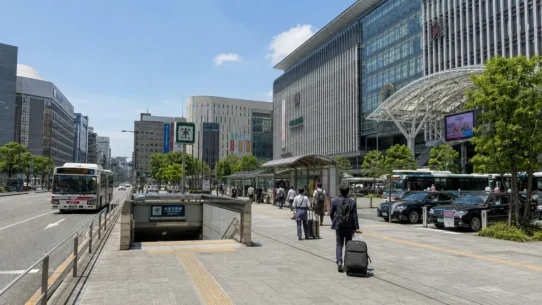
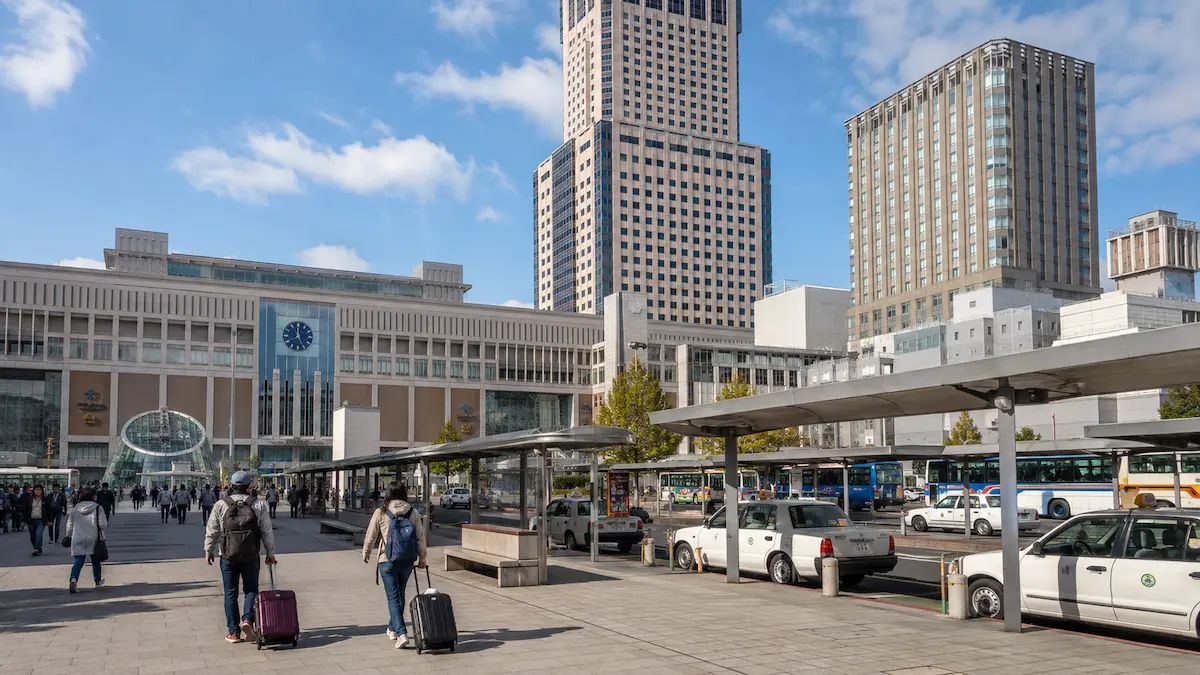
Where to board: Taxi ranks are available outside both the north and south sides of JR Sapporo Station. Use the South Exit taxi stand for Odori, Tanukikoji and Susukino. It points you in the correct direction and avoids beginning the trip on the opposite side of the station.
Realistic timing: In light traffic, expect roughly 5–10 minutes to Odori and around 8–15 minutes to Susukino. During snow, major events, evening congestion or road restrictions, the journey can take longer even though the distance is short.
Realistic cost: Current authorized ordinary-car fares in the Sapporo–Otaru district vary by operator within an approved range. The upper ordinary-car fare starts at ¥600 for the first 1.05 kilometers, with ¥100 added for each subsequent 272 meters or equivalent low-speed waiting time. For planning, allow roughly ¥800–¥1,200 to Odori and ¥1,200–¥1,700 to Susukino. A recent local report showed a winter journey from Sapporo Station to Susukino reaching approximately ¥1,300.
The winter surcharge: Operators in the Sapporo–Otaru district may apply a 20% winter surcharge during the designated period from December 10 to March 26. Application can vary by company, so do not treat a summer fare estimate as a guaranteed winter price. Ride-hailing apps may also add pickup or booking charges depending on the service.
Luggage reality: A standard taxi may not hold four adults plus four large hard-shell suitcases. For a group with bulky winter bags, reserve a larger vehicle or split into two taxis. Do not assume that passenger capacity equals luggage capacity.
✅ What Other Travelers Say
Travelers carrying large bags often describe the short taxi hop as money well spent, particularly in winter or before an early airport train. Ride-hailing apps can work well in Sapporo, but the station’s official rank is usually simpler when taxis are already waiting. Families and groups value being delivered to the hotel entrance rather than the nearest subway exit.
⚠️ The Catch (Things to Keep in Mind)
Taxi availability is not guaranteed at the moment you need it. Snowstorms, the Sapporo Snow Festival, weekend nights and the year-end party season can produce long lines. Metered fares also rise while the vehicle crawls in traffic. A pre-booked car may reduce uncertainty, but app pickup points around a busy station can be confusing, and booking fees may erase part of the value.
Choose this when: You are sharing the fare, carrying heavy luggage, traveling with children, arriving late, needing a step-free transfer, or staying several blocks from the underground network.
How to Choose Based on Your Hotel Area
- Hotel at or directly beside JR Sapporo Station: Walk. You are already there. A taxi may take longer once loading and traffic are included.
- Hotel between Sapporo Station and Odori: Walk underground if the property has a convenient Chi-Ka-Ho connection. Taxi only when bags or mobility make the walk unpleasant.
- Hotel beside Odori Station: Walk for light luggage; taxi for multiple large cases. The one-stop subway ride rarely produces a dramatic door-to-door time saving.
- Hotel near Tanukikoji: Subway to Odori or Susukino depending on the property’s exact block. For two or more travelers with luggage, compare the total taxi fare before committing to a station transfer.
- Hotel in central Susukino: Subway is the best-value default. Taxi is the comfort choice, especially after dark or in winter.
- Hotel near Nakajima Park: Take the Namboku Line to Nakajima Koen Station unless the group and luggage make a taxi economical.
- Hotel east of Odori near Nijo Market or Bus Center-mae: The Toho Line, a transfer at Odori, walking or a taxi may be better depending on the address. Do not automatically ride to Susukino just because it is labeled “downtown.”
Key FAQs
How far is Sapporo Station from Odori Park, and is it easy to walk with luggage?
Sapporo subway station and Odori Station are connected by the approximately 520-meter Chi-Ka-Ho underground walkway, which takes about 10 minutes to walk end to end. From a JR platform to an Odori hotel, allow closer to 15–25 minutes. It is easy with one smoothly rolling suitcase, but less attractive with several heavy bags or a hotel far from the correct underground exit.
What is the cheapest way to get from Sapporo Station to Susukino?
Walking is free, and the official tourism guide places Susukino about 1.5 kilometers—or roughly 20 minutes on foot—from JR Sapporo Station. The best low-cost option with luggage is usually the ¥210 Namboku Line subway ride, two stops from Sapporo to Susukino. Walking underground remains a good sightseeing option when you are not tired or heavily loaded.
Should I take a taxi from Sapporo Station to my hotel in winter?
Take a taxi when the hotel is not directly connected to the underground network, you have large luggage, your group can share the fare, or the final streets are snow-covered. Walk underground when your hotel is near Chi-Ka-Ho and your bags are easy to handle. Remember that participating taxi operators may apply a 20% winter surcharge during the designated December 10 to March 26 period.
Final Verdict and Your Next Step
There is no single best answer for every traveler, but there is a simple decision rule:
- Choose the underground walk for Odori, light luggage and a hotel close to the right exit.
- Choose the subway for Susukino or Nakajima Park when you can handle your bags and avoid the busiest commuter periods.
- Choose a taxi for heavy luggage, young children, limited mobility, late arrivals or groups that can split the fare.
The biggest mistake is booking a hotel described as “near Sapporo city center” without checking its exact station exit and final street-level walk. Before paying, open the hotel location, identify the nearest underground or subway exit, and imagine the route with your actual luggage—not with an empty-handed map estimate.
For the easiest arrival, compare hotels around Sapporo Station, Odori and Susukino on Booking.com’s Sapporo hotel page or Agoda’s Sapporo hotel page. Prioritize a direct underground connection or a hotel within a very short walk of the correct exit, especially for a winter trip.
If you are arriving at New Chitose Airport with several people, oversized luggage, ski equipment, young children or a late flight, consider bypassing the Sapporo Station transfer completely. Check vehicle size, included waiting time, cancellation terms and luggage capacity before booking a New Chitose Airport transfer on Klook or a New Chitose Airport–Sapporo private transfer on KKday. Reserve early for the Snow Festival, ski season, weekends and late-night arrivals, when suitable vehicles and central hotels can sell out first.