

💡 Key Takeaways
- Hakata Station is already in central Fukuoka. If your hotel address says Hakata Ekimae, Gion or the east side of Hakata Station, you may only need to walk rather than pay for another ride.
- Choose the subway line by your exact hotel location. Use the Airport Line for Nakasu-Kawabata and the north side of Tenjin; use the Nanakuma Line for Kushida Shrine, Canal City, Tenjin-Minami, Watanabe-dori and Yakuin.
- The ¥150 bus is the cheapest ride to Tenjin, but not always the smartest. With large suitcases, rush-hour crowds or a tight check-in deadline, the subway or a shared taxi can save more stress than the small fare difference.
Searching for the best way to travel from Hakata Station to Fukuoka city center sounds simple until you discover that Fukuoka does not have one single downtown stop. Many travelers arrive at Hakata after flying into Fukuoka Airport, follow a generic instruction to “take the subway to the center,” and then realize that their hotel was already beside the station—or that they chose Tenjin Station when Tenjin-Minami would have placed them much closer.
The result is a classic first-day travel mistake: paying for an unnecessary ride, walking through a long underground passage with luggage, or making an awkward bus journey during rush hour just to save ¥60. This guide treats Hakata, Tenjin, Nakasu, Canal City and Yakuin as different destinations, so you can choose the route that works for your hotel, arrival time, group size, luggage and budget.
First, What Does “Fukuoka City Center” Actually Mean?
Fukuoka’s main railway station is Hakata Station, but Hakata Station is not outside the city waiting to be connected to downtown. It is one of the city’s two main central hubs. The other is Tenjin. Between them are Gion, Canal City, Kushida Shrine and Nakasu, while Yakuin and Watanabe-dori sit just south of Tenjin.
- Hakata: Best for Shinkansen and JR connections, airport access, business hotels, department stores and early departures. A hotel near Hakata Station may require no onward transport at all.
- Gion and Hakata Old Town: Close enough to walk from the west side of Hakata Station if you have light luggage and reasonable weather.
- Canal City and Kushida Shrine: Between Hakata and Nakasu. The Nanakuma Line to Kushida Shrine Station is usually easier than going all the way to Tenjin.
- Nakasu: Best known for nightlife, riverside dining and yatai food stalls. Nakasu-Kawabata Station is convenient for the northern side; Kushida Shrine Station can be better for the southern side.
- Tenjin: Fukuoka’s main shopping and entertainment district. Airport Line Tenjin Station and Nanakuma Line Tenjin-Minami Station serve different ends of a large underground area.
- Watanabe-dori and Yakuin: Better reached directly on the Nanakuma Line. Going to Tenjin first can create an unnecessary walk or transfer.
The practical rule: do not choose your transport based only on the word “Tenjin” or “city center.” Check the nearest station and the hotel entrance before leaving Hakata Station.
The 1-Min Cheat Sheet
- Airport Line subway: Best for Nakasu-Kawabata, northern Tenjin, Tenjin Underground Mall and hotels near Meiji-dori. The train ride to Tenjin is about 5–6 minutes and the adult fare is ¥210.
- Nanakuma Line subway: Best for Kushida Shrine, Canal City, Tenjin-Minami, Watanabe-dori and Yakuin. It avoids crossing central Tenjin on foot and costs ¥210 for the short central journeys described here.
- Nishitetsu city bus: Best for budget travelers with small bags and hotels directly beside a bus stop. Any bus between Hakata Station and Tenjin is ¥150, but road traffic makes the arrival time less predictable.
- Taxi: Best for three or four travelers, families, mobility needs, late-night arrivals or multiple large suitcases. It is door-to-door, but traffic, pickup charges and the 22:00–05:00 surcharge can raise the final meter.
- Walking: Best for Hakata Ekimae, Gion and Canal City when the weather is comfortable and your luggage is light. It becomes false economy in summer heat, heavy rain or after a long flight.
Top Survival Tips
- Copy your hotel’s Japanese address before arrival. Similar hotel names and multiple branches can lead you to the wrong side of Hakata or Tenjin. Show the full address to a taxi driver rather than only the English hotel name.
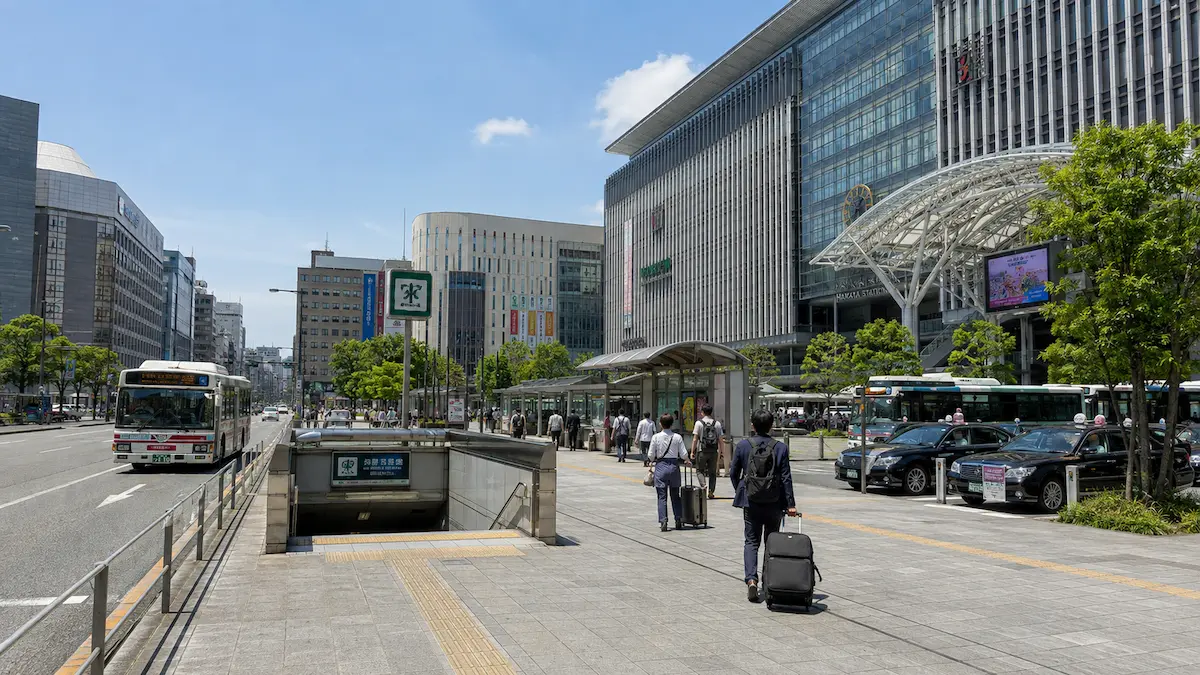
- Check the station exit, not just the station. Tenjin and Hakata have extensive underground areas. A “five-minute subway ride” can become a 20-minute door-to-door trip if your exit is at the opposite end.
- Do not automatically buy a one-day subway pass for one hotel transfer. A single central ride is inexpensive. A pass only starts to make sense when you will take several additional subway trips that day.
- Avoid buses with large luggage during commuter peaks. The fare is attractive, but crowded aisles, narrow boarding doors and standing passengers can make the cheapest option the most tiring.
- Use an IC card or contactless payment where accepted. This reduces ticket-machine confusion and removes the need to prepare exact cash for each journey.
- Use Hakata Station lockers if check-in is hours away. Dropping your suitcase first can turn Canal City or Gion into an enjoyable walk instead of a luggage endurance test.
- Remember the late-night gap. Fukuoka’s subway generally operates from around 05:30 until shortly after midnight. After the last train, a taxi may be the only practical central option.
- Do not confuse Tenjin Station with Tenjin-Minami Station. They are connected through the underground shopping area, but dragging luggage between them is not the same as a simple platform transfer.
The Full Experience
🚇 Airport Line Subway: Best for Nakasu-Kawabata and Northern Tenjin
Tags: Fastest predictable option · ¥210 per adult · No road traffic · Good for light-to-medium luggage
The orange Airport Line is the default choice for travelers heading from Hakata Station to Nakasu-Kawabata or Tenjin Station. From the subway area at Hakata, board a train toward Meinohama, Chikuzen-Maebaru or another westbound destination. Tenjin is only a few stops away, with Nakasu-Kawabata immediately before it.
Realistic travel time: the train itself takes only around 5–6 minutes to Tenjin, but allow roughly 15–25 minutes from the JR platform to your hotel entrance. Hakata is a large station, and the walk from your arrival platform to the subway gates may take longer than expected. The final walk through Tenjin can also be substantial.
Choose this line for: hotels close to Tenjin Station, the northern and central sections of Tenjin Underground Mall, ACROS Fukuoka, Nakasu-Kawabata, Hakataza Theatre and the northern side of Nakasu.
Skip this line for: Canal City, Kushida Shrine, Watanabe-dori or Yakuin. The Nanakuma Line usually leaves you closer and avoids backtracking.
✅ What Other Travelers Say
Travelers consistently value the subway for being easy to understand, frequent and unaffected by road congestion. It is especially reassuring when you have a timed dinner reservation or need a predictable arrival rather than the absolute lowest fare.
⚠️ The Catch (Things to Keep in Mind)
The short train ride can hide a long station walk. Tenjin Station serves a broad area, so choosing it for a hotel near Tenjin-Minami may mean hauling luggage through underground corridors. Peak-hour trains can also be crowded, and a family with several full-size suitcases may find a taxi more comfortable even when the subway is cheaper.
🚇 Nanakuma Line Subway: Best for Canal City, Tenjin-Minami and Yakuin
Tags: Direct from Hakata · Best station placement · ¥210 central fare · Often overlooked by first-time visitors
The green Nanakuma Line is the route many older guides fail to use properly. It now runs directly to Hakata Station, making it the most practical option for several central districts that previously required a bus, taxi or long walk.
From Hakata, the first stop is Kushida Shrine Station, which serves Kushida Shrine, the southern side of Nakasu and Canal City. The next stop is Tenjin-Minami, followed by Watanabe-dori and Yakuin.
Realistic travel time: the ride to Kushida Shrine or Tenjin-Minami is only a few minutes. Allow around 15–20 minutes door to door once you include finding the Nanakuma Line area inside Hakata Station, waiting for the train and locating the right exit.
Choose this line for: Canal City, Kushida Shrine, Haruyoshi, southern Nakasu, Tenjin-Minami, Daimaru Fukuoka Tenjin, Watanabe-dori and Yakuin.
Why it can save your legs: a hotel may advertise itself as “Tenjin,” yet sit much closer to Tenjin-Minami than Airport Line Tenjin Station. The correct green-line stop can remove 10–15 minutes of underground walking with luggage.
✅ What Other Travelers Say
Travelers who know about the extended Nanakuma Line often describe it as the easiest way to reach Canal City and the southern half of Tenjin. Its biggest advantage is not headline speed; it is arriving on the correct side of the district.
⚠️ The Catch (Things to Keep in Mind)
The Nanakuma Line platforms are deeper inside Hakata Station than many visitors expect. Follow the green signs rather than assuming every subway entrance leads to the same platform. At Tenjin-Minami, do not plan a tight connection to the Airport Line at Tenjin Station: the two stations are linked by a walk through the underground area, not by a quick cross-platform interchange.
🚌 Nishitetsu City Bus: Best for the Lowest Fare and Door-Adjacent Stops
Tags: ¥150 Hakata–Tenjin · Many stop choices · Traffic dependent · Best with small bags
Nishitetsu states that any bus between Hakata Station and Tenjin costs ¥150, making the bus cheaper than a ¥210 subway ride. The bus can also place you closer to a hotel that sits directly beside a surface stop, saving the underground walk at either end.
This is particularly useful for travelers who can identify their stop confidently and are not carrying much. Depending on the service, buses run through the corridor linking Hakata, Gion, Canal City or Tenjin, but the exact route and stop pattern vary. Check the destination display and a live route planner rather than boarding solely because the bus appears to be heading west.
Realistic travel time: in light traffic, a central trip can be reasonably quick. At commuting times, weekends, rainy evenings or during events, the same journey can take considerably longer. Build in a buffer if hotel reception closes at a fixed time.
Video note: this route-comparison video was produced around the transition from the former ¥100 central fare. The current official Hakata–Tenjin bus fare is ¥150, so use the video for the boarding and route experience rather than its older price references.
✅ What Other Travelers Say
Budget travelers like the low flat fare and the chance to avoid deep subway platforms. A direct surface stop can feel easier than navigating a large underground complex, especially after you have already learned the bus system.
⚠️ The Catch (Things to Keep in Mind)
The ¥60 saving over the subway is small compared with the inconvenience of standing with a suitcase, missing your stop or waiting in traffic. Buses are not the best first choice for two people with two large cases during rush hour. Boarding and payment procedures can also feel less intuitive than simply tapping through subway gates.
🚕 Taxi: Best for Groups, Heavy Luggage and Late Arrivals
Tags: Door-to-door · Best for 3–4 people · Metered fare · 20% late-night surcharge
A taxi looks expensive when compared with one ¥210 subway ticket, but the calculation changes for a family or group. Four adults taking the subway to Tenjin pay ¥840 in total before considering the walk from the station. A taxi costs more, but it may deliver everyone and every suitcase directly to the hotel entrance without stairs, wrong exits or a second walk.
Under the Fukuoka City taxi tariff revised on July 1, 2026, an ordinary taxi starts at ¥600 for up to 1.1 kilometres, then adds ¥100 for each further 287 metres. Slow traffic also adds time-distance charges. As a planning estimate rather than a fixed quote, expect approximately ¥900–¥1,300 to Canal City or southern Nakasu and roughly ¥1,300–¥1,800 to central Tenjin in normal conditions. Congestion, the exact hotel entrance and pickup fees can push the fare higher.
Choose a taxi when: you have multiple large cases, a stroller, limited mobility, tired children, three or four people sharing the cost, a hotel far from a subway exit, or an arrival after normal train service.
Where to board: use an official taxi rank at Hakata Station rather than accepting an unsolicited ride. Keep your hotel’s full Japanese address ready on your phone.
✅ What Other Travelers Say
Groups often find that the convenience is worth the modest per-person premium for a short central trip. The biggest benefit is certainty at the final kilometre: you reach the actual hotel door instead of the correct district but the wrong exit.
⚠️ The Catch (Things to Keep in Mind)
Taxi prices are metered, not fixed. Fares increase by 20% between 22:00 and 05:00, and individual operators may charge a pickup fee for app or phone dispatches. A standard car may also struggle with four passengers plus four large suitcases; request a larger vehicle rather than assuming everything will fit.
🚶 Walking: Best for Hakata Ekimae, Gion and Light-Luggage Travelers
Tags: Free · No waiting · Best in mild weather · Poor choice with heavy luggage
Walking is not merely the budget option. For a hotel on Hakata Ekimae-dori, near Gion or on the Hakata side of Canal City, it can genuinely be faster than finding a platform, waiting for one stop and walking back from the exit.
As a rough guide, allow 5–12 minutes for many Hakata Ekimae hotels, 10–15 minutes for Gion, and around 15–20 minutes for Canal City from the west side of Hakata Station. Southern Nakasu may take around 25–30 minutes, while walking all the way to Tenjin commonly takes 35–45 minutes depending on your route and pace.
The walk toward Canal City and Tenjin can be enjoyable after check-in, passing shopping streets, the river and central neighbourhoods. It is far less enjoyable while pulling a suitcase over crossings in humid summer weather.
✅ What Other Travelers Say
Visitors appreciate how compact central Fukuoka feels once they are free of luggage. Hakata to Canal City is a realistic sightseeing walk for many people, and Hakata to Tenjin can be a pleasant urban stroll when it is part of the day’s plan rather than an arrival-day chore.
⚠️ The Catch (Things to Keep in Mind)
Map times assume continuous walking and do not account for station navigation, traffic lights, crowded pavements, heat, rain or finding a hidden hotel entrance. A free walk is not a saving if you arrive exhausted, soaked or too late for check-in. In July and August, or during heavy rain, use the subway even for distances that look manageable.
Which Route Should You Choose for Your Hotel Area?
- Hotel beside Hakata Station: Walk. Confirm whether the property is on the Hakata Exit or Chikushi Exit side before leaving the station.
- Gion or Hakata Old Town: Walk with a small bag; take the Airport Line one stop to Gion or a taxi with heavy luggage.
- Canal City or Kushida Shrine: Take the Nanakuma Line one stop to Kushida Shrine Station. Walk only in comfortable weather with manageable luggage.
- Southern Nakasu or Haruyoshi: Nanakuma Line to Kushida Shrine is often the cleanest route. A taxi is better late at night or with several bags.
- Northern Nakasu or Kawabata: Airport Line to Nakasu-Kawabata.
- Tenjin near Meiji-dori or the north side: Airport Line to Tenjin Station.
- Tenjin near Daimaru, Kego, Haruyoshi or the south side: Nanakuma Line to Tenjin-Minami.
- Watanabe-dori or Yakuin: Nanakuma Line direct from Hakata. Do not ride to Tenjin and walk back south.
- Three or four travelers with several suitcases: Compare the total public-transport cost with a taxi, not the per-person fare alone.
- Arrival after midnight: Plan for a taxi and include the late-night surcharge in your budget.
Hidden Costs Most Route Guides Do Not Mention
Walking time inside stations: A journey planner may show a six-minute train ride but exclude the time required to reach the platform, wait, find the lift and walk from the correct exit.
The wrong-side penalty: Hakata Station has major east and west sides, while Tenjin covers a wide underground zone. Exiting on the wrong side can add a tiring detour with luggage.
Taxi dispatch and late-night charges: The meter is not the only variable. A dispatched taxi may have a pickup fee, and travel between 22:00 and 05:00 carries a 20% fare increase.
Bus delay risk: The bus fare may be lower, but a missed check-in, restaurant booking or last connection costs more than the ¥60 saved over the subway.
Luggage capacity: Four seats do not guarantee room for four full-size suitcases. Vehicle size matters when deciding whether a taxi is genuinely door-to-door.
Weather: A 15-minute walk can be sensible on a cool morning and a poor decision during Fukuoka’s humid summer or a downpour. Treat weather as part of the transport cost.
Key FAQs
Is Hakata Station already in Fukuoka city center?
Yes. Hakata is one of Fukuoka’s two principal central hubs, alongside Tenjin. If your accommodation is around Hakata Station, Hakata Ekimae, Gion or the eastern station area, you may already be at your destination. Check the hotel address before buying another ticket.
What is the cheapest way to get from Hakata Station to Tenjin?
The Nishitetsu city bus is the cheapest standard ride at ¥150 between Hakata Station and Tenjin. The subway costs ¥210 and is usually more predictable because it avoids road traffic. For travelers with large luggage, the extra ¥60 is often money well spent.
Which subway line should I take from Hakata Station to Canal City or Tenjin?
For Canal City, take the Nanakuma Line one stop to Kushida Shrine Station. For Tenjin, choose by location: Airport Line Tenjin Station for the north and central side, or Nanakuma Line Tenjin-Minami for the south side, Daimaru area, Haruyoshi, Watanabe-dori and Yakuin.
Final Verdict and Your Next Step
For most solo travelers and couples, the subway is the best balance of price, speed and predictability—but only when you choose the correct line. Take the Airport Line for Nakasu-Kawabata and northern Tenjin. Take the Nanakuma Line for Canal City, Kushida Shrine, Tenjin-Minami, Watanabe-dori and Yakuin.
Stay on foot when your hotel is genuinely near Hakata Station, Gion or Canal City and the weather is comfortable. Use the ¥150 bus when your luggage is small, traffic is light and the stop is more convenient than the subway. Choose a taxi when three or four people can share the fare, when your bags are the real problem, or when your arrival time makes public transport inconvenient.
The biggest mistake is not choosing an expensive option. It is choosing a cheap route that leaves you at the wrong side of the city center with heavy luggage.
Book your accommodation by district, not just by the word “Fukuoka.” Compare properties near the station or subway line that matches your plans:
For travelers arriving at Fukuoka Airport with children, mobility needs, an international-terminal arrival or several large suitcases, reserving an airport transfer or direct bus in advance can remove one more decision after landing:
Before booking: enter your exact hotel, passenger count and luggage quantity. A private transfer that appears costly for one person can become reasonable for a family, while a simple subway ride remains the smarter choice for a lightly packed solo traveler.
Editorial verification: Subway routes, operating hours, central fares, Nishitetsu’s Hakata–Tenjin bus fare and Fukuoka taxi tariffs were checked against operator or city sources on August 5, 2026. Transport schedules, fares, road conditions and video availability can change, so recheck time-sensitive details before travel.