

💡 Key Takeaways
- For most travelers, the Hiroden streetcar is the best-value choice: it costs ¥240 and serves Hatchobori, Kamiyacho, Hondori and the Atomic Bomb Dome area, but it can feel cramped with large suitcases.
- “Hiroshima city center” is not one stop. Hatchobori is best for nightlife and shopping, Kamiyacho/Hondori for the commercial core, and Genbaku Dome-mae or Fukuro-machi for Peace Memorial Park hotels.
- Do not blindly follow old station guides. Since August 2025, Hiroden streetcars depart from the new terminal inside the second floor of the minamoa station building, not the former outdoor ground-level stop.
Getting from Hiroshima Station to Hiroshima city center looks simple on a map, but this short journey creates more confusion than it should. The problem is not distance. The problem is that “downtown Hiroshima” covers several different neighborhoods, while route planners may recommend a tram, local bus, sightseeing loop bus or walk without considering your luggage, arrival time or the exact side of the city center where your hotel is located.
A route that is perfect for a backpacker staying beside Hatchobori can be a poor choice for a family carrying three suitcases to a hotel near Peace Boulevard. Likewise, the cheapest option can become the most tiring once you add a crowded vehicle, a ten-minute walk from the stop and a confusing station exit.
This guide compares the real trade-offs. It focuses on the areas most visitors mean by “Hiroshima city center”: Hatchobori and Nagarekawa, Kamiyacho and Hondori, and the Peace Memorial Park and Peace Boulevard area. Prices and operating information were checked in August 2026, but always confirm live service information on your travel day.
The 1-Min Cheat Sheet
- Hiroden streetcar — best overall: ¥240 per adult. Usually the easiest option for solo travelers and couples with light luggage. Take Lines 1, 2 or 6 for most central areas, depending on your hotel.
- Meipuru-pu sightseeing loop bus — best for daytime sightseeing: ¥240 per ride or ¥600 for a one-day ticket. Useful for the Atomic Bomb Dome, Peace Memorial Park and Hiroshima Castle, but it runs mainly between 9:00 and 18:00 and starts from the Shinkansen Entrance side.
- Taxi — best with heavy luggage or three to four people: budget roughly ¥1,000–¥2,000 to most central hotels, depending on distance, traffic and time. Door-to-door convenience can justify the extra cost.
- Walking — best for light packers in good weather: roughly 20–25 minutes to Hatchobori and around 30–35 minutes to Hondori or Peace Memorial Park. Free, but not sensible with large bags in summer heat or rain.
Choose Your Stop Before You Choose Your Transport
The fastest way to make a bad decision is to search only for “Hiroshima city center.” Check your hotel address first, then match it to the nearest useful stop:
- Hatchobori: best for Hiroshima PARCO, department stores, Nagarekawa nightlife and the eastern end of Hondori. Lines 1, 2 and 6 are usually convenient.
- Kamiyacho-higashi or Kamiyacho-nishi: best for the Hiroshima Bus Center, Sogo, Shareo underground mall, Hiroshima Castle access and the northern side of Hondori.
- Hondori: best for hotels around the shopping arcade and the southeastern side of Peace Memorial Park. Line 1 is particularly useful.
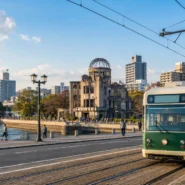
- Genbaku Dome-mae: best for the Atomic Bomb Dome, Orizuru Tower and the northern side of Peace Memorial Park. Use Line 2 or 6.
- Fukuro-machi or Chuden-mae: often better than Genbaku Dome-mae for hotels on Peace Boulevard or near the Peace Memorial Museum. Use Line 1.
Top Survival Tips
- Ignore old photos of the outdoor tram stop. Follow signs for the Hiroden streetcar terminal inside minamoa on the second floor. The new connection is on the same general concourse level as the main JR station circulation area.
- Do not assume the Atomic Bomb Dome stop is best for every Peace Park hotel. The park is long. A hotel near Peace Boulevard may be closer to Fukuro-machi or Chuden-mae.
- A transport pass is not automatically a bargain. Two single tram rides cost ¥480. A pass makes more sense when you will use several trams or buses, or combine city transport with a Miyajima ferry benefit.
- Avoid peak-hour streetcars with multiple large suitcases. The city-center lines are frequent, but they are also used by local commuters. One carry-on is manageable; several full-size cases can turn a short ride into an awkward one.
- Know which side of Hiroshima Station you need. Streetcars leave from the minamoa side of the station, while the Meipuru-pu sightseeing loop bus departs from the Shinkansen Entrance area.
- Keep an IC card or small cash ready. Suica, ICOCA and other major transport IC cards are accepted. Cash passengers should avoid relying on large notes when boarding buses.
- After about 22:00, check the exact last tram rather than trusting a generic “trams run until 11.” Last departures differ by line and destination. A later tram may not continue to the stop you need.
- For a same-day sightseeing stop, store your luggage first. Leaving bags at Hiroshima Station or your hotel is usually better than taking them through Peace Memorial Park and crowded downtown vehicles.
The Full Experience
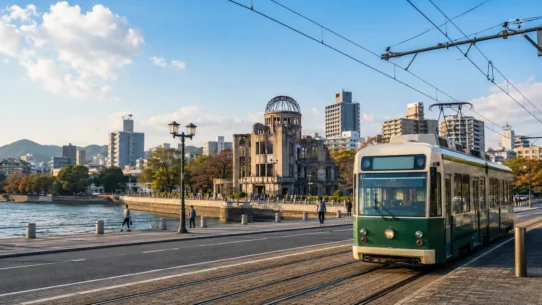
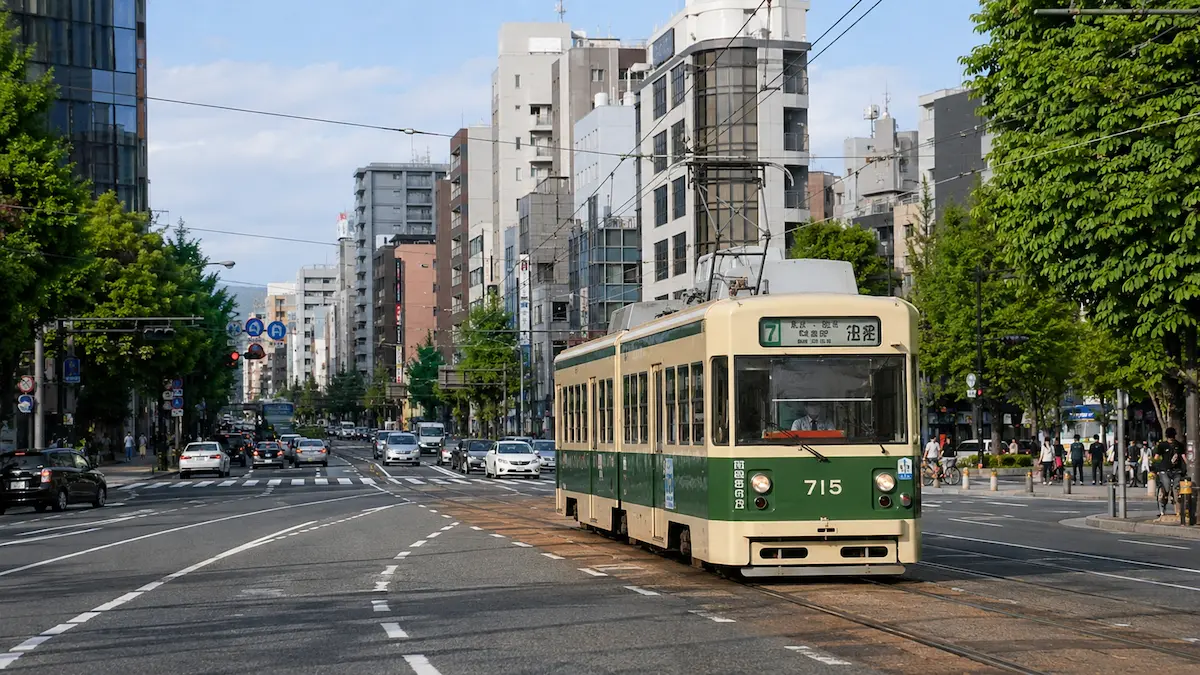
🚊 Hiroden Streetcar: Best Overall for Hatchobori, Kamiyacho, Hondori and Peace Memorial Park
Best value · No transfer for most downtown areas · IC cards accepted · Less comfortable with big luggage
The streetcar is the default recommendation for most visitors because it is cheap, frequent and easy to match with central Hiroshima’s main neighborhoods. The adult flat fare is ¥240, including Hiroshima Station to Genbaku Dome-mae. Children pay ¥120.
From Hiroshima Station, the most useful lines are:
- Line 1: useful for Hatchobori, Kamiyacho-higashi, Hondori, Fukuro-machi and Chuden-mae. Choose this for many hotels around Hondori and Peace Boulevard.
- Line 2: useful for Hatchobori, Kamiyacho and Genbaku Dome-mae, then continues toward Hiroden-miyajima-guchi. Choose this for the Atomic Bomb Dome side of the center.
- Line 6: follows the central corridor through Hatchobori and Kamiyacho to Genbaku Dome-mae before continuing toward Eba.
The new Ekimae Ohashi route shortened trips toward Hatchobori and Kamiyacho by about four minutes compared with the old alignment. In practical terms, allow roughly 10–15 minutes to Hatchobori or Kamiyacho and around 15–20 minutes to the Atomic Bomb Dome area, plus waiting and the walk from your stop to the hotel.
How boarding works: confirm the route number and destination, board through an available door, and tap your IC card when boarding and leaving. Cash passengers pay when getting off. Exit-door rules can differ by vehicle and payment method, so follow the signs and the driver’s instructions.
✅ What Other Travelers Say
Travelers consistently praise the streetcars for their low fare, frequent service and direct access to major sights. Reviews also describe the ride as part of the Hiroshima experience rather than merely a transfer. The recurring complaint is crowding: central routes can be busy, and boarding or exiting with luggage may take longer than expected.
⚠️ The Catch (Things to Keep in Mind)
The streetcar is not a luggage shuttle. There is no dedicated suitcase hold, and older or shorter vehicles can feel tight. If each person has a large roller case, the fare saving may not be worth the stress. Also, do not copy an old guide that tells you to walk outside to the former ground-level Hiroshima Station tram stop or to Enkobashicho; the terminal moved into the station building in August 2025.
My verdict: choose the streetcar when you have a backpack or one manageable suitcase each, your hotel is within a short walk of a named stop, and you arrive before the late-evening service tapers off.
🚌 Meipuru-pu Sightseeing Loop Bus: Best for a Daytime First Visit and JR Pass Holders
Direct to major sights · English information · JR Pass accepted · Limited to daytime service
The red Meipuru-pu sightseeing loop bus is useful when your first destination is the Atomic Bomb Dome, Peace Memorial Park, Hiroshima Castle or one of the city museums. It operates from the Hiroshima Station Shinkansen Entrance, which is convenient after arriving by bullet train but is on the opposite side from the streetcar terminal.
The official service currently runs approximately 9:00–18:00, generally every 10–15 minutes, with 42 daily departures. A single ride costs ¥240 for adults and ¥120 for children. A one-day ticket costs ¥600 for adults and ¥300 for children.
A valid nationwide Japan Rail Pass can be shown to the driver for the Meipuru-pu. Certain JR-West passes that are valid within Hiroshima Prefecture are also accepted. This is an important distinction: a JR Pass does not make the Hiroden streetcar free.
The bus is especially attractive for day-trippers who want to go directly from the Shinkansen side of Hiroshima Station to the Atomic Bomb Dome or Peace Memorial Park without first crossing to the tram terminal. On-board sightseeing information and English stop guidance make it less intimidating than an ordinary local bus.
✅ What Other Travelers Say
Visitors like the simple sightseeing-oriented route, the recognizable red buses and the ability to connect major attractions without decoding multiple local bus companies. JR Pass holders often view it as excellent value because the ride may already be covered.
⚠️ The Catch (Things to Keep in Mind)
This is not a late-night hotel transfer. It finishes far earlier than the streetcar network, and the loop direction can make a short-looking journey longer than expected. It is also not automatically best for hotels in Nagarekawa, southern Hondori or along Peace Boulevard. A bus stop may look close on a map but still leave an inconvenient walk with luggage.
Payment rules also differ from the streetcar. On Meipuru-pu, cash fare is paid when boarding, and change is not returned. Large ¥5,000 and ¥10,000 notes cannot be exchanged in the bus machine, so an IC card is the easiest option.
My verdict: use Meipuru-pu for sightseeing between 9:00 and 18:00, especially when your first stop is the Atomic Bomb Dome or Peace Memorial Park and you already hold an eligible JR pass. For a hotel check-in with large bags, compare the exact stop with a taxi before committing.
🚕 Taxi: Best for Heavy Luggage, Families, Small Groups and Late Arrivals
Door to door · Minimal walking · Best after the last tram · Traffic-dependent fare
A taxi is the option many budget guides dismiss too quickly. Hiroshima Station is close enough to downtown that the total fare is often reasonable, particularly when split between three or four people.
Hiroshima City’s standard taxi meter starts at approximately ¥800 for the first 1.45 kilometers, with distance and slow-traffic increments after that. For most central hotels, a sensible planning range is:
- Hatchobori or eastern Nagarekawa: often around ¥1,000–¥1,400.
- Kamiyacho, Hondori or central Peace Boulevard: often around ¥1,200–¥1,700.
- Peace Memorial Park or the western side of downtown: often around ¥1,400–¥2,000.
These are budgeting estimates, not fixed prices. Traffic lights, congestion, the exact hotel entrance, waiting time and late-night surcharges can increase the meter.
For two people, a ¥1,600 taxi is much more expensive than two ¥240 tram fares. For four people, however, that same taxi works out to ¥400 per person—only ¥160 more than the tram—while removing the walk, crowding and suitcase handling. That is often money well spent after a long Shinkansen journey.
Have the hotel name and address in Japanese ready on your phone. Many drivers can follow a map pin, but a Japanese address reduces misunderstanding, especially when a hotel has more than one entrance.
✅ What Other Travelers Say
Travelers staying around Hatchobori frequently describe taxis from Hiroshima Station as quick and affordable, especially with luggage. Families and small groups value arriving directly at the lobby rather than negotiating a busy tram and a final walk.
⚠️ The Catch (Things to Keep in Mind)
The fare is metered, not guaranteed. A short geographic distance can cost more during slow traffic. Standard taxis may also struggle with four passengers plus four large suitcases; luggage capacity, not seat count, is often the real limit. A larger vehicle booked through a taxi app or hotel may be necessary.
My verdict: take a taxi when you have more than one large suitcase per couple, are traveling with children or an older companion, arrive after the useful tram window, or can split the fare between three or four people.
🚶 Walking: Best for Backpackers, Station-Area Hotels and Good Weather
Free · No waiting · Good city orientation · Poor choice with heavy bags
Hiroshima is flatter and more walkable than many first-time visitors expect. If your luggage is light, walking gives you a useful feel for the city and avoids waiting for a vehicle. Approximate walking times are:
- Hatchobori: about 20–25 minutes.
- Eastern Nagarekawa: about 20–30 minutes, depending on the hotel.
- Hondori and Kamiyacho: about 25–35 minutes.
- Atomic Bomb Dome or Peace Memorial Park: about 30–40 minutes.
The route is urban rather than scenic for the entire distance, but you will see everyday Hiroshima, cross river channels and understand how the station connects to the commercial center. Walking can also be faster door to door when your hotel is only 15–20 minutes away and you would otherwise wait for a tram, ride a few stops and then walk again.
✅ What Other Travelers Say
Light-packing travelers often report that the walk to the Peace Memorial area is manageable and a pleasant introduction to the city. It is particularly appealing on a cool, dry morning when you are not rushing to check in.
⚠️ The Catch (Things to Keep in Mind)
Summer humidity changes the calculation completely. A 30-minute walk with a suitcase in August can feel much longer, and sudden rain makes rolling luggage unpleasant. Pedestrian crossings and bridge approaches also add small delays that map estimates may understate.
My verdict: walk with a backpack or small carry-on in mild weather. Do not choose it simply to save ¥240 if the walk will leave you tired before your day has started.
Which Option Is Best for Your Situation?
- Solo traveler with a backpack: streetcar, unless the hotel is within a comfortable 20-minute walk.
- Couple with one carry-on each: streetcar is usually fine; taxi is worth considering during rush hour or heavy rain.
- Couple with two large suitcases: taxi is often the least stressful choice.
- Family of four: compare the taxi fare per person. The difference from four tram fares may be surprisingly small.
- JR Pass holder going straight to the Atomic Bomb Dome: Meipuru-pu during operating hours.
- Hotel near Hondori or Peace Boulevard: Line 1 to Hondori, Fukuro-machi or Chuden-mae may leave less walking than Lines 2 or 6 to the Dome.
- Hotel near Hatchobori or Nagarekawa: Lines 1, 2 or 6 to Hatchobori, then check the final walk before deciding against a taxi.
- Arrival after 22:00: check the exact last tram immediately; take a taxi if the suitable service has ended.
Key FAQs
What is the best way to get from Hiroshima Station to Hiroshima city center with luggage?
With one small suitcase per person, the Hiroden streetcar is usually the best balance of cost and convenience. With two or more large suitcases, young children, limited mobility or three to four travelers sharing the fare, a taxi is usually the better real-world choice. The ride is short enough that door-to-door convenience often costs less than visitors expect.
Can I use a Japan Rail Pass from Hiroshima Station to the city center?
You can use a valid Japan Rail Pass on the Meipuru-pu sightseeing loop bus by showing it to the driver. Certain qualifying JR-West passes are also accepted. The JR Pass does not cover Hiroden streetcars. If your route planner recommends a tram, expect to pay the ¥240 fare or use a separate local transport pass.
How late do trams run from Hiroshima Station to downtown?
Useful downtown lines generally operate into the 22:00 hour, but last departures vary. Current published times from Hiroshima Station include Line 1 toward Hiroshima Port at 22:01, Line 2 toward Hiroden-miyajima-guchi at 22:31 and Line 6 toward Eba at 22:33, with some later short-working services. Do not assume the latest listed tram serves your stop; verify the route and destination on the day.
Final Verdict and Your Next Step
For most first-time visitors, the answer is simple: take the Hiroden streetcar and get off at the stop closest to your hotel—not the stop that sounds most famous. Hatchobori is best for much of the shopping and nightlife district, Kamiyacho or Hondori for the commercial core, Genbaku Dome-mae for the north side of Peace Memorial Park, and Fukuro-machi or Chuden-mae for many Peace Boulevard hotels.
However, the best practical choice changes once luggage and group size enter the equation. A taxi is usually the smarter option for families, three or four adults, late arrivals or anyone carrying several large bags. The Meipuru-pu bus is excellent for daytime sightseeing, especially for JR Pass holders, but it should not be treated as a universal hotel-transfer solution. Walking is rewarding only when the weather and your luggage make it genuinely comfortable.
Your next step is to check your hotel’s exact nearest stop before booking. Central Hiroshima rooms near Hatchobori, Hondori and Peace Memorial Park can sell out or become expensive on weekends, during cherry-blossom season and around major events, so reserve once your dates are fixed: