

💡 Key Takeaways
- For most travelers, take the Higashiyama Line. Fushimi is one stop and Sakae is two stops from Nagoya Station. The adult fare is ¥210, and there is no transfer.
- The five-minute train ride is not the whole journey. Finding the subway inside Nagoya Station and choosing the correct exit at Sakae can add another 10–20 minutes, especially with luggage.
- A taxi becomes good value for three or four people with large bags. It is also the sensible fallback after the last subway, but traffic, app pickup fees and the 22:00–05:00 night surcharge raise the real cost.
Getting from Nagoya Station to Nagoya city center looks almost too easy on a map. Then you step off the Shinkansen or the Meitetsu airport train, enter one of Japan’s busiest station complexes, and discover that “five minutes by subway” can involve a long indoor walk, crowded platforms, several ticket gates and a confusing choice of exits at the other end.
There is also an important naming trap. Nagoya Station is already a major downtown district, known locally as Meieki. When travelers search for “Nagoya city center,” they usually mean Fushimi, Nishiki, Sakae, Hisaya-odori or Yabacho, the shopping, dining and nightlife districts east of the station. “Main Station” is not the name used on signs or route planners, so search for Nagoya Station, Meitetsu Nagoya or Kintetsu Nagoya according to the train you arrive on.
If you have just come from Chubu Centrair Airport, the biggest mistake is assuming the airport train delivers you to your Sakae hotel. It delivers you to the Nagoya Station area. You may still need a subway, taxi, bus or 20–40 minute walk. The best choice depends less on the published ride time and more on your hotel’s exact entrance, your arrival hour, the number of people in your group and how much luggage you are dragging.
Fares and operating details in this guide were checked in August 2026. Always confirm the same-day timetable when arriving very early, late at night or during major events.
The 1-Min Cheat Sheet
- 🚇 Higashiyama Line subway — best overall: ¥210 per adult; about 3 minutes to Fushimi and 5 minutes to Sakae once on board. Choose this for one or two travelers with manageable luggage. No reservation is needed.
- 🚕 Taxi — best for heavy luggage, families and late arrivals: Roughly ¥900–¥1,400 to central Fushimi and around ¥1,600–¥2,200 to Sakae in normal daytime conditions. The per-person difference becomes reasonable when three or four people share.
- 🚌 C-758 city loop bus — best for a street-level sightseeing arrival: ¥210 flat fare. It serves Fushimi, Sakae, Yabacho and Osu, but it is slower, daytime-focused and vulnerable to traffic.
- 🚶 Walking — best for light packers in good weather: About 20–25 minutes to Fushimi and roughly 35–45 minutes to Sakae, depending on your exact start and finish. Free, but not truly free when heat, rain, fatigue or a wrong station exit is involved.
First, Choose the Right “Center”
Stay near Nagoya Station or Meieki when your priority is the Shinkansen, airport train, Takayama or Ise connections, an early departure, or a short one-night stop. You may not need to travel anywhere after arriving.
Stay around Fushimi or Nishiki for a useful compromise. Fushimi is only one subway stop from Nagoya Station, is walkable in decent weather, and sits between Meieki and Sakae. It is often the least troublesome choice for travelers who want restaurants and central access without being in the busiest nightlife blocks.
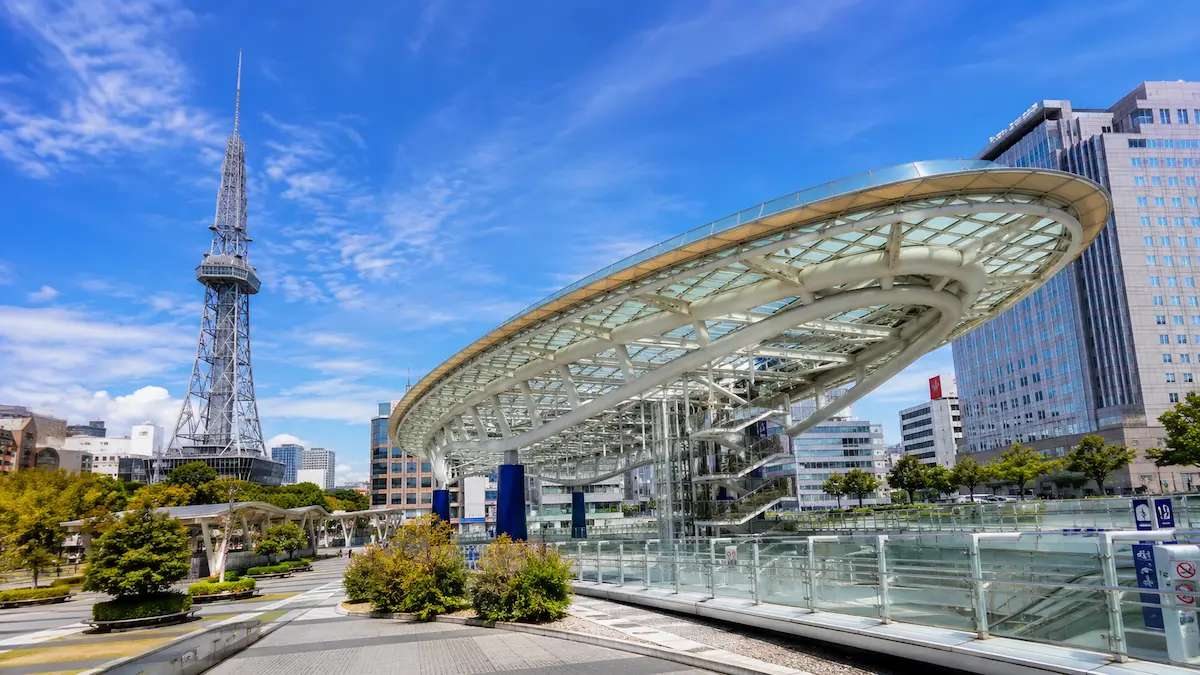
Stay around Sakae, Hisaya-odori or Oasis 21 for shopping, nightlife, restaurants and a more energetic city-center atmosphere. The subway is usually easiest, but your exit matters. Sakae Station has many exits, and a hotel described as “near Sakae” may still be a 10-minute underground-and-street walk from the platform.
Stay around Yabacho or Osu for shopping streets, cafes and a more local street scene. The C-758 bus can be useful in daytime, but the subway often requires a transfer or a longer final walk. With bulky bags, a taxi can save more effort than its price suggests.
Top Survival Tips
- Save the hotel name and address in Japanese. This matters most for taxis and for hotels with similar English names. A screenshot is more reliable than trying to pronounce a long property name after a flight.
- Count the station walk, not just the train ride. From a Shinkansen platform to the Higashiyama Line platform, allow roughly 10–15 minutes if you are unfamiliar with the station, and longer with children or several bags.
- For Sakae, board the Higashiyama Line toward Fujigaoka. Fushimi is H09 and Sakae is H10. Nagoya is H08. Going toward Takabata sends you in the wrong direction.
- Check the exit nearest your hotel before boarding. At Sakae, the wrong exit can leave you on the opposite side of a large intersection or force an unnecessary underground walk. Look for the hotel’s nearest numbered exit and whether that exit has an elevator.
- Avoid the busiest commuter periods with large suitcases when possible. The Higashiyama Line is fast but heavily used. During weekday morning and evening peaks, taking a taxi or waiting 20–30 minutes can be worth it.
- Do not buy a day pass automatically. A single Nagoya–Sakae ride costs ¥210. The ¥760 subway 24-hour ticket only starts saving money after several subway rides, not merely because you are staying for one day.
- Late-night arrivals need a backup plan. The final eastbound Higashiyama Line trains from Nagoya leave around midnight, but exact destinations and times vary. If your train reaches Nagoya Station close to midnight, head directly to the subway or use the taxi rank rather than stopping for food first.
- Use the east side of Nagoya Station for Fushimi and Sakae. The Sakura-dori side faces the city center. Exiting on the Taiko-dori side can add walking or road distance before you have even started.
The Full Experience
🚇 Higashiyama Line Subway: Best for Fushimi, Nishiki and Sakae
Feature tags: #FastestPublicTransport #NoTransfer #BudgetFriendly #BestForMostTravelers
This is the default answer for most visitors. From Nagoya Station, follow the yellow signs for the Higashiyama Line and take a train toward Fujigaoka. Get off at Fushimi, H09, for hotels around Fushimi, Nayabashi and the western side of Nishiki. Stay on one more stop to Sakae, H10, for Oasis 21, Chubu Electric Power MIRAI TOWER, central Sakae and many Nishiki hotels.
The adult fare from Nagoya to either Fushimi or Sakae is ¥210. The in-train time is about three minutes to Fushimi and five minutes to Sakae. Trains are frequent during the day, so checking a timetable is usually unnecessary unless you are traveling near the start or end of service.
You can use a regular ticket or a compatible Japanese transport IC card. The practical advantage of an IC card is not the price; it is avoiding the ticket machine while carrying bags. Tap in, tap out and let the gate calculate the fare.
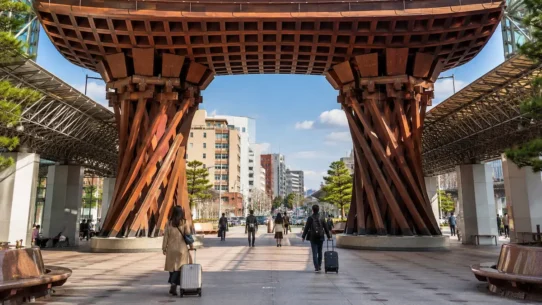
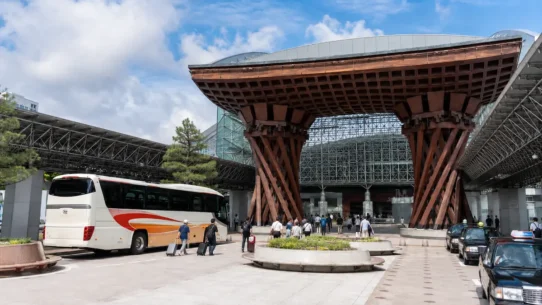
The hidden cost is effort. Nagoya Station is a collection of connected JR, Shinkansen, Meitetsu, Kintetsu, subway and bus facilities rather than one simple hall. If you arrive by Shinkansen, do not follow signs for Meitetsu or Kintetsu by accident. Keep looking for the yellow Higashiyama Line symbol and station code H08.
At Sakae, the exit is more important than the train. The station connects with a large underground network and has many street exits. A hotel near Oasis 21 may require a different exit from one near Sakae Mitsukoshi, Nishiki or Hisaya-odori Park. Check the numbered exit before you lose mobile signal or become disoriented underground.
✅ What Other Travelers Say
Travelers usually praise this route for being cheap, frequent and almost impossible to beat on journey time. People staying directly beside a suitable Sakae or Fushimi exit often reach their hotel quickly. The common complaint is not the subway itself; it is the long walk inside Nagoya Station, crowding with large bags and emerging from the wrong Sakae exit.
⚠️ The Catch (Things to Keep in Mind)
A five-minute subway ride can become a 25-minute door-to-door trip. Elevators exist, but they may not be beside the most convenient exit for your hotel. If each person has a large suitcase plus hand luggage, or if you are traveling with a stroller, elderly relatives or tired children, the physical hassle may outweigh the ¥210 fare.
Best decision: Use the subway when you can each control your own luggage and your hotel is genuinely close to Fushimi or Sakae Station. Use a taxi when the final walk is long, the platform is crowded or your group can split the fare.
Useful official checks: Nagoya City route planner, Nagoya subway station information, and Sakae Station information.
🚕 Taxi: Best for Heavy Luggage, Families and Arrivals After Midnight
Feature tags: #DoorToDoor #BestWithLuggage #GoodForGroups #LateNightBackup
A taxi is the easiest option once the luggage-to-person ratio becomes unreasonable. For Fushimi, a typical metered ride may be around ¥900–¥1,400. For central Sakae, budget roughly ¥1,600–¥2,200 in ordinary daytime traffic. These are realistic planning ranges, not fixed fares. Red lights, congestion, the exact hotel entrance and pickup charges can move the total.
For destinations east of Nagoya Station, the Sakura-dori Exit taxi rank is generally the most logical starting point. There is also a taxi rank on the Taiko-dori side, but that is the west side of the station and may create an unnecessary loop toward Fushimi or Sakae.
Show the driver your hotel’s Japanese address, not just “Sakae.” Sakae covers a broad area, and hotels in Nishiki, Higashi-sakura, Hisaya-odori and Yabacho may need different approaches. A pin on a map is helpful, but a Japanese address and phone number are better when road access is unusual.
The fare structure includes both distance and time at low speeds. Most Nagoya-area taxis also apply a 20% late-night surcharge from 22:00 to 05:00. Booking through an app can add a pickup or service fee, while a premium vehicle can cost substantially more. The cheapest taxi is often the ordinary cab already waiting at the official rank.
Standard Japanese taxis may fit three adults plus moderate luggage comfortably, or four adults with little luggage. Four people with four large suitcases can exceed the practical luggage capacity even if there are enough seats. Book a larger vehicle or private transfer rather than assuming every taxi has a van-sized boot.
✅ What Other Travelers Say
Families and small groups often say the taxi was worth the extra money after a long flight or Shinkansen journey, particularly when the hotel was not beside a subway elevator. Travelers also appreciate avoiding the wrong-exit problem and arriving at the actual hotel entrance rather than the nearest station.
⚠️ The Catch (Things to Keep in Mind)
The advertised “quick taxi” can slow dramatically in evening traffic, rain or event congestion. The meter continues to rise when the vehicle crawls. App users may also discover pickup fees only at the booking screen. For a solo traveler with one small bag during daytime, paying several times the subway fare rarely makes sense.
Best decision: Take a taxi when you are three or four people, have bulky luggage, arrive after the subway finishes, need step-free door-to-door travel, or are staying more than a short walk from the nearest station exit.
🚌 C-758 City Loop Bus: Best for Fushimi, Sakae, Yabacho and Osu in Daytime
Feature tags: #StreetLevel #SightseeingFriendly #FlatFare #TrafficSensitive
The C-758 city loop bus runs from Nagoya Station through central stops including Nayabashi, Hirokoji Fushimi, Hirokoji Sakae, Sakae Otsu, Yabacho and Osu before returning toward Nagoya Station. The adult fare is a flat ¥210, paid when boarding.
This bus is more useful than many quick comparison guides suggest, but only for the right traveler. It keeps you above ground, gives you a view of the city and may drop you closer to a hotel along Hirokoji-dori than the subway does. During the daytime core period, the official service is scheduled at roughly 10-minute intervals, while operating hours from Nagoya Station are broadly from the 09:00 hour to the 19:00 hour.
For Fushimi or Sakae, the bus usually takes longer than the subway even before traffic delays. Its real advantage is reducing underground navigation and possibly shortening the final walk. It can be pleasant when you have one compact suitcase, no urgent check-in time and want to understand the layout of central Nagoya.
Boarding location is the first trap. Nagoya Station has JR bus, Meitetsu bus, highway bus and city bus facilities. Do not assume every bus marked for Sakae is the C-758 or that every terminal is in the same building. Check the route number and the official Nagoya City bus stop information before walking away from the station.
The second trap is luggage. A city bus is not an airport coach. There is no guaranteed luggage hold, and large suitcases can block the aisle or occupy space needed by local passengers. If the bus is busy, boarding with several large bags can be uncomfortable for everyone.
✅ What Other Travelers Say
Travelers who enjoy the route tend to like the street-level view and convenient stops around Fushimi, Sakae, Yabacho and Osu. It feels less intimidating than navigating a large underground station, and the flat fare is easy to understand.
⚠️ The Catch (Things to Keep in Mind)
This is not the best choice for a tight schedule, a late arrival or multiple full-size suitcases. Road traffic can erase the benefit of a closer stop, and service ends much earlier than the subway. During festivals or pedestrian-zone events, central bus routes may be diverted.
Best decision: Choose the C-758 for a relaxed daytime arrival with light luggage when its stop is closer to your hotel than a subway exit. Otherwise, the subway is faster and a taxi is easier.
Check the current route and timetable on the official C-758 page.
🚶 Walking: Best for Fushimi, Light Luggage and Good Weather
Feature tags: #Free #NoWaiting #BestForLightPackers #WeatherDependent
Walking from Nagoya Station is realistic, especially to Fushimi. From the Sakura-dori side of the station, central Fushimi is roughly a 20–25 minute walk, while Sakae is commonly around 35–45 minutes depending on the hotel and route. The broad avenues are not difficult to follow, and walking can be faster than expected when roads are congested.
The simplest approach is to leave from the east side and walk toward the city center along a major eastbound street such as Sakura-dori or Hirokoji-dori. For hotels near Nayabashi or western Fushimi, walking may be more sensible than descending into the subway for one short stop.
The hidden cost is environmental. Nagoya summers are hot and humid, rain can be intense, and winter wind between large buildings can make a short distance feel much longer. Pavement quality is generally good, but traffic lights, pedestrian bridges, crowded crossings and the final block to your hotel all add time.
Luggage changes the equation completely. A 20-minute walk with a backpack is pleasant. The same walk with a 23-kilogram suitcase, cabin bag and shopping tote can damage wheels, tire your arms and leave you sweaty before check-in. Saving ¥210 is not a bargain when it costs energy you wanted for sightseeing.
Walking is also easy to misjudge because “Nagoya Station” is not a single point. Starting from the Shinkansen side adds distance compared with starting at the Sakura-dori Exit. Likewise, a Sakae hotel east of Hisaya-odori can be considerably farther than one on the western edge of Nishiki.
✅ What Other Travelers Say
Light packers often enjoy the walk because it reveals how Nagoya Station, Nayabashi, Fushimi and Sakae connect. The route is straightforward, and stopping for coffee or food turns the transfer into a first look at the city rather than a chore.
⚠️ The Catch (Things to Keep in Mind)
Distance estimates on a map rarely include the walk from your platform to the correct station exit. Add that indoor distance before deciding. In summer heat, heavy rain, after a long-haul flight or with wheeled luggage, the “free” option is often the least comfortable one.
Best decision: Walk to western Fushimi when the weather is comfortable and your luggage is light. For Sakae, walk only because you want the experience—not merely to save ¥210.
Which Option Fits Your Trip?
Solo traveler with a backpack: Take the Higashiyama Line. Walk to Fushimi only in good weather and when you are not tired.
Couple with one suitcase each: The subway is still the best-value choice outside commuter peaks. A taxi becomes attractive when the hotel is far from an elevator-equipped exit.
Family with children, stroller and bags: Use a taxi. The difference between a smooth hotel arrival and a stressful underground transfer is usually worth more than the fare saving.
Three or four adults: Compare the taxi fare per person. A ¥1,800 taxi shared by four costs ¥450 each—only ¥240 more per person than the subway, before valuing the saved walking and lifting.
Arrival close to midnight: Go directly to the Higashiyama Line if you are confident you can catch the last train. Otherwise, use the official taxi rank. Do not rely on the C-758 bus at night.
Hotel in Osu or Yabacho: The C-758 can work in daytime, but a taxi is usually better with luggage. The subway may involve a transfer or a less convenient final walk depending on the property.
Key FAQs
What is the easiest way to get from Nagoya Station to Sakae with luggage?
The easiest option is a taxi from the Sakura-dori side of Nagoya Station, especially for a family or a group of three or four. The cheapest easy option is the Higashiyama Line to Sakae, but check which exit has an elevator and is closest to your hotel before boarding.
How much is the subway from Nagoya Station to Sakae, and do I need to transfer?
The adult fare is ¥210. Take the Higashiyama Line toward Fujigaoka from Nagoya H08 to Sakae H10. It is a direct two-stop ride with no transfer and takes about five minutes on the train.
Can I walk from Nagoya Station to the city center?
Yes. Fushimi is usually around 20–25 minutes on foot, and Sakae is roughly 35–45 minutes. Walking is practical with light luggage and mild weather, but it is a poor choice in summer heat, heavy rain or after a tiring flight.
Final Verdict and Your Next Step
Choose the Higashiyama Line for the best balance of speed and price. It is the clear winner for most travelers heading from Nagoya Station to Fushimi or Sakae. Choose a taxi when your bags are heavy, your group can split the fare, you need step-free door-to-door transport or you arrive after the subway. Use the C-758 only when its street-level stop genuinely improves your route, and walk when the journey itself sounds enjoyable.
Your accommodation area should match the rest of your itinerary. Book Nagoya Station for transport convenience and early departures, Fushimi for a quieter central compromise, or Sakae for shopping, dining and nightlife. Check the hotel’s exact map pin and nearest station exit before paying—“near Sakae” is too vague to judge luggage convenience.
Compare current accommodation availability at Agoda hotels near Nagoya Station, Agoda hotels in Sakae, or Booking.com hotels in Nagoya City Centre. Reserve early for weekends, concerts, major events and peak travel periods, because a well-located hotel can save more time and walking than a small difference in room rate.
If you are still planning the airport leg, pre-book the Meitetsu airport train ticket on Klook. Groups with children or several suitcases can compare a Klook private airport transfer or a KKday private transfer from Chubu Centrair Airport. A direct airport-to-hotel ride can remove the Nagoya Station transfer entirely, but compare the total price against the airport train plus a short city taxi before booking.