

💡 Key Takeaways
- For most travelers with luggage, a regular taxi is the easiest value-for-effort choice. Jeju International Airport is already inside Jeju City, and the airport currently estimates a standard taxi to Jeju City Hall at about KRW 9,000, although traffic can change the final meter fare and journey time.
- For solo travelers with light bags, city buses are dramatically cheaper. Routes such as 303, 325 and 365 connect the airport with useful parts of Shinjeju, Dongmun Market, Jungang-ro and Jeju City Hall, but the best route depends on your exact hotel area.
- Do not blindly board Airport Limousine 600 just because it says “airport limousine.” It is primarily a Jungmun and Seogwipo service. It can be useful for a few Shinjeju hotel stops, but it is not the default bus for Dongmun Market, Tapdong or Jeju City Hall.
If you are trying to figure out how to get from Jeju Airport to Jeju City Center, the first thing to know is that “Jeju City center” is not one single neighborhood. Travelers often use the phrase for three different areas: Shinjeju around Yeondong and Nohyeong, the older downtown around Dongmun Market and Jungang-ro, or the Jeju City Hall area farther southeast. Choosing transport before checking which of those areas your hotel is in is the easiest way to create an unnecessary transfer, a long walk with suitcases, or a bus ride in the wrong direction.
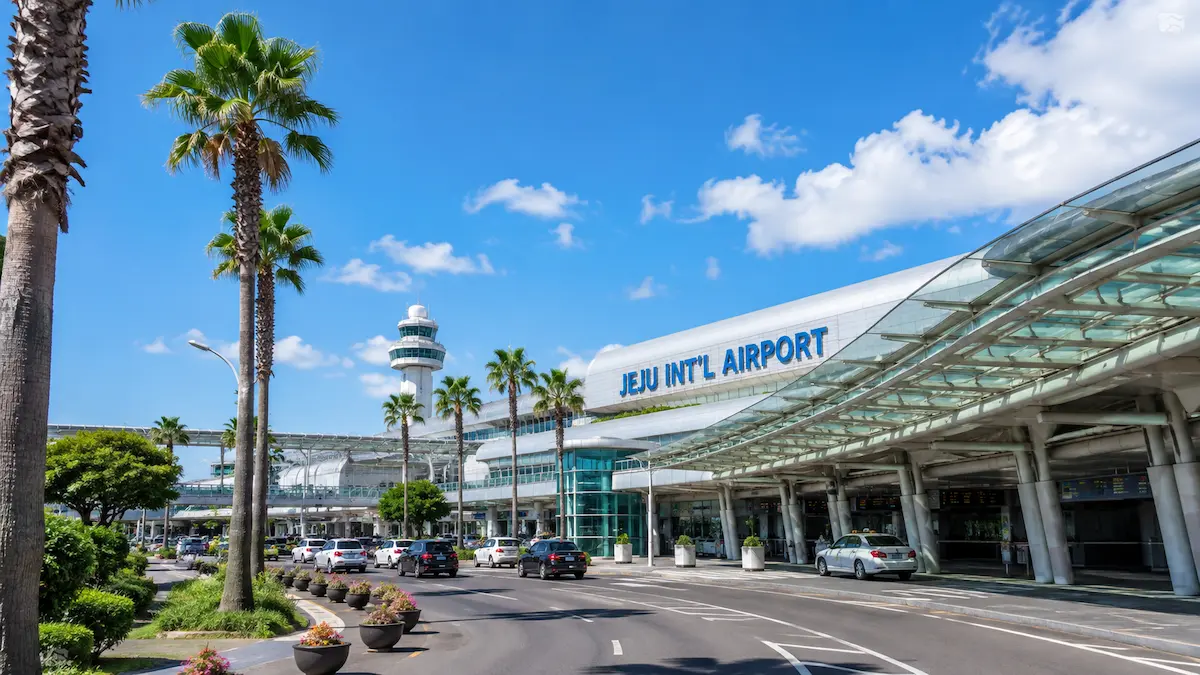
The good news is that Jeju International Airport is very close to the urban core. You do not need a complicated airport railway or multi-stage transfer. In practical terms, your decision is usually between saving money with a city bus, saving effort with a taxi, paying extra for a pre-booked private transfer, using Airport Limousine 600 only when its stops match your hotel, or collecting a rental car if you are heading straight into an island road trip.
Last checked: August 2026. Jeju bus routes and schedules can change, so use the route numbers below as a decision guide and confirm live departures on the official Jeju Bus Information System or a Korean navigation app before you leave the terminal.
The 1-Min Cheat Sheet
- City bus — best for solo travelers and light luggage: the cheapest option. Route 303 is especially useful for Shinjeju and Dongmun; 325 links the airport with Dongmun and Gwandeokjeong; 365 is useful for Jungang-ro and Jeju City Hall. Standard trunk/branch bus fares are currently KRW 1,150 by transit card or KRW 1,200 cash for adults, while express services use a different fare structure.
- Airport Limousine 600 — best only for selected Shinjeju stops: useful if your accommodation is near stops such as Jeju Sun Hotel, Sammu Park/Lotte City Hotel or Halla Hospital. The bus then continues toward Jungmun and Seogwipo, so it is a poor choice for most Old Downtown hotels.
- Taxi — best overall for 2–4 people, luggage or late arrivals: door-to-door, no navigation stress and often good value once the fare is split. Jeju Airport’s published estimate to Jeju City Hall is KRW 9,000 for a standard taxi and KRW 16,200 for a deluxe taxi.
- Pre-booked private transfer — best for families, oversized luggage and zero-arrival-stress trips: more expensive than a short city taxi ride, but you can reserve the vehicle size in advance and avoid negotiating luggage capacity after landing.
- Rental car — best only if the airport is the start of a wider Jeju road trip: not worth renting merely to reach a city-center hotel. Most rental depots require an additional shuttle ride from the airport, and international visitors need the correct driving documents.
Top Survival Tips
- Pin your hotel before choosing a bus. “Jeju City” on a hotel listing is too broad. Check whether you are actually staying in Yeondong/Shinjeju, Dongmun/Tapdong/Jungang-ro, or near Jeju City Hall.
- Use the bus route number, not just the destination name. Jeju buses can continue far beyond the city. Confirm the direction on the airport’s digital screens or a live map before boarding.
- Carry a T-money-compatible transit card if you plan to use buses. Jeju’s official tourism guidance shows T-money as a standard way to pay. It is faster than dealing with cash while holding luggage.
- Do not assume Airport Limousine 600 is automatically “better.” It costs more than a normal city bus and is designed mainly for the south of the island. It only makes sense for Jeju City if one of its early Shinjeju stops is genuinely close to your hotel.
- For two or more people with big suitcases, compare the total hassle, not just the fare. A cheap bus followed by a 12-minute walk, stairs and a second bus can be a false economy when a short taxi gets everyone directly to the lobby.
- If you land late, have a backup. Many city bus routes finish around the late evening, and individual route times vary. A taxi or pre-booked transfer is safer than planning around the final bus without checking that day’s timetable.
- Do not rent a car just to save an airport taxi fare. Rental pickup normally means finding the correct company shuttle, riding to an off-airport depot, completing paperwork and inspecting the car. Rent because you need a car for Jeju, not because the airport is far from town.
- If a taxi app feels complicated, use the airport taxi queue. Kakao T can be useful, but account or phone-number setup can be inconvenient for some visitors. At the airport, the physical taxi stand removes that problem.
The Full Experience
🚌 Jeju City Bus: Best for Solo Travelers, Backpackers and Tight Budgets
Tags: Cheapest · No reservation · Best with light luggage · Good for Dongmun, Jungang-ro and City Hall
For a cheap ride from Jeju Airport into the city, the regular bus network is hard to beat. The important part is not asking “Which bus goes to Jeju City?” but matching a route to your hotel district.
Route 303 is one of the most useful 2026 additions. Jeju introduced this city express route in June 2026. It links Halla Arboretum, Nohyeong Five-Way Intersection, Halla Hospital, Jeweon Apartments, Jeju Provincial Office/Shinjeju Rotary, Jeju International Airport, Seomun Market, Dongmun Rotary and onward toward Hamdeok. In plain English: it creates a very practical airport bridge between the Shinjeju hotel zone and the Dongmun side of the city.
Route 325 is another useful airport-to-old-town option. Its current route runs through Jeju Provincial Office, Jeju International Airport, Yongdam, Gwandeokjeong and Dongmun Rotary before continuing east. If your hotel is near Dongmun Market, Black Pork Street, Gwandeokjeong or the northern part of Old Downtown, this is often a more logical bus than heading toward City Hall first.
Route 365 is the one I would check first for Jungang-ro or Jeju City Hall. Its current route links Halla University, Nohyeong, Halla Hospital, Jeweon Apartments, Jeju Provincial Office, Jeju International Airport, Yongdam, Jungang-ro Intersection, Gwangyang and Jeju City Hall. The published weekday headway is roughly every 11–21 minutes, although the exact wait at the airport depends on traffic and the timetable.
If you are staying directly around Jeju City Hall, express route 181 can also be worth checking. Its route serves Jeju International Airport, Jeju Bus Terminal and Jeju City Hall before heading across the island toward Seogwipo. It may be quicker than a local bus when timing works, but express fares differ from normal city buses.
For adult passengers, Jeju’s current standard trunk/branch bus fare is KRW 1,150 with a transit card or KRW 1,200 in cash. Express buses start at a higher fare and use distance-based pricing. If your main goal is simply airport to downtown, the difference is still small compared with a taxi, but do not assume every bus costs exactly the same.
✅ What Other Travelers Say
Recent traveler discussions are generally positive about using Jeju buses when the route is simple and luggage is manageable. A recurring piece of advice is to use a live Korean map app for real-time arrivals instead of relying only on static timetables. Travelers also point out that the official timetable pages can be less friendly in English than the actual bus system is in practice.
⚠️ The Catch (Things to Keep in Mind)
The cheap fare hides the main cost: walking and decision-making. A bus that gets you “near” the hotel can still leave you dragging a suitcase across a large intersection, uphill street or several blocks. This matters more in summer humidity, rain, or after a late flight. If you have one cabin bag, the bus is excellent. If two people have two large suitcases each, a taxi can be a much better value even when it costs several times more.
Also check the direction carefully. The same route number may serve both sides of the airport in different directions. Before tapping your card, confirm that the next major stops match your district.
🚌 Airport Limousine 600: Best for Specific Shinjeju Hotels, Not the Whole City Center
Tags: Luggage-friendly · Fewer stops · Useful for selected hotels · Mainly a Jungmun/Seogwipo service
Airport Limousine 600 is often mentioned in Jeju transport guides, but it needs context. Its primary job is to connect Jeju Airport with Jungmun Tourism Complex and Seogwipo. The current airport schedule lists departures from about 06:30 to 22:20, with a published interval of roughly 16–40 minutes.
Why mention it in a Jeju City guide at all? Because before the bus heads south, it stops at several useful Shinjeju points, including Jeju Sun Hotel, Sammu Park/Lotte City Hotel, Halla Hospital and Jeongjon Village. If your hotel is practically beside one of those stops, the 600 can be a comfortable luggage-friendly option without needing a taxi.
But if you are staying near Dongmun Market, Tapdong, Black Pork Street, Jungang-ro or Jeju City Hall, do not choose the 600 simply because it looks like the airport’s premium bus. It is pointed toward the wrong side of the island for those neighborhoods.
Jeju’s fare system treats airport limousine services differently from normal local buses, with a higher base fare and distance-based pricing. That means you are paying for a more intercity-style service, not necessarily a better city-center connection.
✅ What Other Travelers Say
Travelers who like airport limousine buses usually praise the easier luggage handling and the ability to sit down without worrying about a crowded local bus. For a hotel directly on the route, that convenience is real. The problem is that travelers sometimes choose “airport limousine” as a category rather than checking whether the actual stop is close to their accommodation.
⚠️ The Catch (Things to Keep in Mind)
The 600 is a classic example of a transport option that looks better on paper than it is for the wrong hotel. If you miss your Shinjeju stop, you are not circling downtown — you are continuing south toward Jungmun. Check the stop name before boarding, keep your hotel name saved in Korean, and use this bus only when the route genuinely works door-to-door.
🚕 Taxi or Pre-Booked Private Transfer: Best for Luggage, Families and Late Arrivals
Tags: Easiest · Door-to-door · Best for 2–4 people · Lowest walking effort · Good late-night backup
For most first-time visitors, I would choose a regular taxi from Jeju Airport if I had a full-size suitcase. The airport is close enough to the city that a taxi is not the extravagant option it would be at airports located 40 or 60 kilometers from downtown.
Jeju International Airport currently publishes an estimated KRW 9,000 standard taxi fare to Jeju City Hall, with an estimated journey time of about 30 minutes. The same airport page lists a deluxe taxi estimate of KRW 16,200. These are planning estimates, not fixed fares; the actual meter can change with traffic, exact drop-off point and taxi type.
For Shinjeju hotels around Yeondong, the road distance can be even shorter than the trip to City Hall. Old Downtown destinations such as Dongmun Market are also close to the airport. This is why taxi value improves quickly when two, three or four travelers split the cost.
You can follow the taxi signs outside arrivals and join the airport queue. Kakao T is useful if your account is already working, but you do not need to solve an app-registration problem just to leave the airport.
A pre-booked private transfer is the higher-cost version of the same door-to-door idea. It becomes more attractive when you need a guaranteed larger vehicle, child-seat options, meet-and-greet service, or a driver waiting after a late arrival. It is usually overkill for one solo traveler heading to a central hotel, but much easier for a family with several checked bags.
✅ What Other Travelers Say
Recent travelers commonly describe airport-to-Jeju-City taxi rides as straightforward and inexpensive compared with longer trips around the island. At the same time, early-morning or app-booked taxis can occasionally be less predictable than simply using the airport rank. Private-transfer reviews on major booking platforms frequently praise punctual pickup and help with luggage, which is exactly what you are paying the premium for.
⚠️ The Catch (Things to Keep in Mind)
The biggest taxi mistake is assuming a normal sedan will comfortably swallow four adults plus four large suitcases. Passenger capacity and luggage capacity are not the same thing. If you are a group with bulky bags, reserve a larger vehicle in advance rather than hoping the next taxi in line has enough trunk space.
The private-transfer mistake is the opposite: paying a premium for a service you do not need. For a couple staying five to fifteen minutes from the airport, check the live private-transfer quote against the airport’s taxi estimate before booking.
🚗 Rental Car: Best If You Are Leaving Jeju City Immediately for an Island Road Trip
Tags: Best for island touring · Requires documents · Extra pickup time · Not necessary for a city-only stay
Jeju is one of the places in Korea where renting a car can genuinely transform a trip, especially if your itinerary includes rural beaches, oreum trails, cafes, coastal roads and attractions with infrequent buses. But that does not mean you should rent one just to cover the short airport-to-hotel journey.
Most airport rental operations use shuttle buses to take customers from Jeju Airport to off-airport rental depots. That adds a transfer, waiting time and paperwork before you even start driving. If your first night is in Jeju City and you do not need the car until the next morning, it can be less stressful to take a taxi to the hotel and collect a rental later.
International visitors should also prepare the correct documents before building a trip around a rental car. Korea Tourism Organization guidance states that foreign renters generally need a valid International Driving Permit issued in the same country as the driver’s licence, plus a passport, and rental companies can have additional age, driving-experience and credit-card requirements. Do not confuse an unofficial “international driving licence” translation product with a legally recognized International Driving Permit.
✅ What Other Travelers Say
Travelers who explore the whole island often say that having a car makes Jeju dramatically easier because you are not planning every attraction around bus intervals. The convenience is most noticeable outside Jeju City. For a short urban stay, however, many travelers rely on taxis and buses without any problem.
⚠️ The Catch (Things to Keep in Mind)
The hidden costs are not just the rental rate. Add shuttle time, insurance, fuel or charging, parking, navigation and the possibility of stricter rental-company document rules. If you are only sleeping in Jeju City, eating at Dongmun Market and joining organized day tours, a rental car may spend more time parked than moving.
Which Option Is Best for Your Jeju City Area?
Staying in Yeondong or Shinjeju near Shilla Duty Free, Grand Hyatt Jeju, Jeju Sun Hotel or Lotte City Hotel?
Taxi is the easiest default. If your hotel is close to one of Airport Limousine 600’s early stops, compare that route as well. Route 303 is also useful for Shinjeju because it serves Jeju Provincial Office/Shinjeju Rotary, Jeweon Apartments, Halla Hospital and Nohyeong before or after the airport depending on direction.
Staying near Dongmun Market, Black Pork Street, Gwandeokjeong or Tapdong?
Check routes 303 and 325 first if you want to save money. With a suitcase, a taxi is usually the cleanest choice because the old downtown street grid can turn a short “nearby” bus stop into an annoying walk.
Staying near Jungang-ro or Jeju City Hall?
Route 365 is particularly useful, and express route 181 can also serve the City Hall corridor. If your flight lands during rush hour or you are carrying heavy luggage, compare that against the convenience of a taxi.
Traveling as a family or group with three or more large suitcases?
Skip the “cheapest per person” calculation and focus on vehicle size. A pre-booked van transfer can be worth the premium if it prevents splitting the group into two taxis or discovering that the first sedan cannot fit your luggage.
Landing and driving straight to Aewol, Hallasan, Seongsan, Jungmun or rural Jeju?
A rental car may make sense from day one, but allow time for the rental shuttle and pickup process. If you are not comfortable driving immediately after a flight, a private transfer or taxi to your first accommodation is the lower-stress option.
Key FAQs
What is the cheapest way to get from Jeju Airport to Jeju City center?
A regular city bus is usually the cheapest choice. Jeju’s standard adult trunk/branch bus fare is currently KRW 1,150 with a transit card or KRW 1,200 cash. Routes 303, 325 and 365 are particularly relevant for common Jeju City hotel areas, but the best one depends on whether you are staying in Shinjeju, Old Downtown or near City Hall.
How much is a taxi from Jeju Airport to Jeju City center?
The official Jeju International Airport transport page currently estimates a standard taxi to Jeju City Hall at KRW 9,000 and a deluxe taxi at KRW 16,200, with an estimated journey time of around 30 minutes. Your final meter fare depends on your exact hotel, traffic and taxi type. For travelers staying closer to the airport in Shinjeju, the trip can be shorter than the City Hall example.
Which bus should I take from Jeju Airport to Dongmun Market or Jeju City Hall?
For Dongmun Market and the old downtown, check routes 303 and 325. For Jungang-ro and Jeju City Hall, route 365 is a strong option, while express route 181 can also serve City Hall. Because schedules and stop directions can change, confirm the live route after you land instead of relying on an old screenshot.
Final Verdict and Your Next Step
If you want the simplest answer: take a taxi if you have real luggage; take a city bus if you are traveling light and your hotel is directly on a useful route. Jeju Airport is close enough to the urban center that saving every last won is not always worth a long walk, a missed stop or a second transfer.
For Shinjeju/Yeondong, a taxi is usually easiest, with Airport Limousine 600 or route 303 worth checking when the stop matches your hotel. For Dongmun/Tapdong/Old Downtown, routes 303 and 325 are practical budget choices. For Jeju City Hall/Jungang-ro, route 365 is one of the most useful direct city buses. For families and heavy luggage, book a correctly sized private vehicle. For island-wide road trips, rent a car because you need it for the island, not merely because you landed at the airport.
If your arrival is late, your group is large, or you simply do not want to make transport decisions after a flight, reserving the door-to-door option in advance removes the most common arrival-day friction.
- Pre-book a Jeju Airport transfer on Klook: Check Jeju Airport transfer prices on Klook
- Compare a Jeju Airport private pickup on KKday: Check Jeju Airport private transfer options on KKday
- Compare Jeju City hotels on Booking.com: Browse Jeju City accommodation on Booking.com
- Compare Downtown Jeju hotels on Agoda: Browse Jeju accommodation on Agoda
Useful official checks before you travel: Jeju International Airport public transport information and Jeju Bus Information System schedules and fares.