


💡 Key Takeaways
- Jeonju Hanok Village is the easiest sightseeing base if your trip is mainly about the historic core, but it is not the easiest place for rolling large suitcases and some traditional rooms are much less comfortable than a modern hotel.
- Gaeksa and Gaekridan-gil are my best all-round alternative for travelers who want modern hotels, more evening food and shopping, and a more local city feel while staying reasonably close to the Hanok Village.
- Stay by Jeonju Station only when train convenience genuinely matters. It saves effort on arrival and departure, but you will commute to the sights every day instead of walking out into them.
- Stay near the Express/Intercity Bus Terminals if your itinerary is bus-heavy or you have an early departure. It is practical rather than pretty.
- Nambu Market is a smart compromise for food lovers: you are right beside the historic area without being buried deep inside the Hanok Village lanes, but the famous night market is mainly a Friday-and-Saturday attraction.
If you are deciding where to stay in Jeonju for the first time, the hard part is not finding a hotel. It is understanding how Jeonju is laid out. The KTX station, bus terminals, Hanok Village, Nambu Market and modern downtown are separate enough that a hotel can look “central” on a booking site yet still leave you taking buses or taxis every day. Add a heavy suitcase, a traditional hanok room with floor bedding, or a late-night arrival, and the wrong base becomes annoying very quickly. This guide focuses on the practical differences that actually affect a first trip: arrival logistics, walking, evening atmosphere, typical room prices, sightseeing convenience and the trade-offs that glossy destination pages usually skip.
Price note: Hotel prices below are broad planning ranges based on rates and listings checked on August 13, 2026, not guaranteed live quotes. Weekends, Korean holidays, festivals, room type and cancellation terms can change the price substantially. Traveler-feedback sections summarize recurring points from recent hotel reviews rather than reproducing individual reviews verbatim.
The 1-Min Cheat Sheet
- Jeonju Hanok Village — Best overall for a short first visit. Walk to Gyeonggijeon Shrine, Jeondong Cathedral, Omokdae and many restaurants. Choose it for atmosphere and minimal sightseeing transport; avoid it if you hate floor bedding, tight rooms, uneven lanes or carrying luggage through pedestrian-heavy alleys.
- Nambu Market & Pungnammun — Best for food and easy access to the historic core. Close enough to walk into the Hanok Village, with easier access to normal roads and a livelier Friday/Saturday evening scene. A very practical one- or two-night base.
- Gaeksa & Gaekridan-gil — Best modern city base. Better for cafes, restaurants, shopping, bars and conventional hotels. You trade doorstep heritage for a more flexible evening and usually easier luggage handling.
- Jeonju Station & Ua-dong — Best for KTX travelers with an early train. Excellent arrival/departure convenience; weak for sightseeing on foot. Pick it for logistics, not ambience.
- Express & Intercity Bus Terminal / Geumam-dong — Best for bus-heavy itineraries. Useful if you are arriving from Seoul by bus, leaving early or connecting onward. The neighborhood is functional and traffic-oriented, not somewhere I would choose for a romantic Jeonju stay.
- Deokjin Park & Jeonbuk National University — Best for quieter, more local stays. A calmer base with the park and university district nearby, often with solid modern rooms. Better for repeat visitors, families with a specific reason to be north of the center, or travelers who do not mind taxis.
Top Survival Tips
- Match the hotel to how you arrive, not just to the attraction map. Jeonju Station serves KTX and other rail services, while express and intercity buses use separate terminals. The official Jeonju tourism site notes that KTX from Seoul takes about 1 hour 40 minutes and that Jeonju-bound buses use the city’s bus terminals. If you arrive with a large suitcase at 9 p.m., one direct taxi to a hotel is easy; repeatedly commuting across town because you chose the wrong side of Jeonju is not. Check the official Jeonju transport guide before booking.
- Do not assume “Hanok Village” means suitcase-friendly. The area is wonderful on foot once you have checked in, but some guesthouses sit down narrow lanes where taxi drop-off is not directly at the door. Traditional thresholds, stone paving and compact courtyards are part of the charm until you are dragging a 23 kg suitcase in summer rain. If you have heavy luggage, choose a property on or near a main road, or message the property for the exact taxi drop-off point before arrival.
- Check the bed type before booking a traditional hanok. A beautiful room photo can hide the fact that the sleeping setup is a Korean-style floor mattress on an ondol-heated floor. Some travelers love that experience; others sleep badly after one night. Also check for a private bathroom, room size, soundproofing comments, stairs and whether the property has a staffed reception.
- Use short taxi rides strategically instead of forcing every city-bus connection. Jeonju’s official transport guide says major sights including Hanok Village, Gaekridan-gil and Deokjin Park are connected by city buses, but it also specifically recommends taxis when routes are ambiguous. Foreign-friendly options listed by the city include k.ride and Uber Taxi. This matters most when you have luggage, are traveling as two or more people, or need to reach the station early. See the official city-bus and taxi guidance.
- Do not book Nambu Market expecting a full night market every evening. The current official schedule lists the Hanok Village Night Market at Nambu Market on Friday and Saturday, 17:00 to 24:00. On other nights the location is still convenient and food-focused, but the atmosphere is much quieter. This is a classic planning mistake because older blogs and videos often make the market look like a nightly event.
- If nightlife and late dinner matter, choose Gaeksa over the deepest Hanok lanes. Gaekridan-gil is Jeonju’s modern old-downtown hotspot for cafes, restaurants and shops. The trade-off is obvious: you lose the “open the door and see hanok roofs” feeling, but gain a better evening routine and a wider choice of conventional hotels.
- For a one-night Jeonju stop, pay to reduce friction. Saving US$10 on a room is not a win if it adds four bus rides, two long walks and an inconvenient suitcase transfer. On a short stay, location has an unusually high value because most first-time sightseeing is concentrated around the Hanok Village, Nambu Market and nearby old downtown.
The Full Experience
📍 Jeonju Hanok Village: Best Overall for First-Time Visitors
Best for: first visits · 1–2 night stays · couples · culture · maximum sightseeing on foot
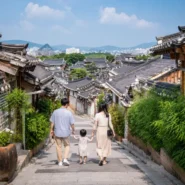
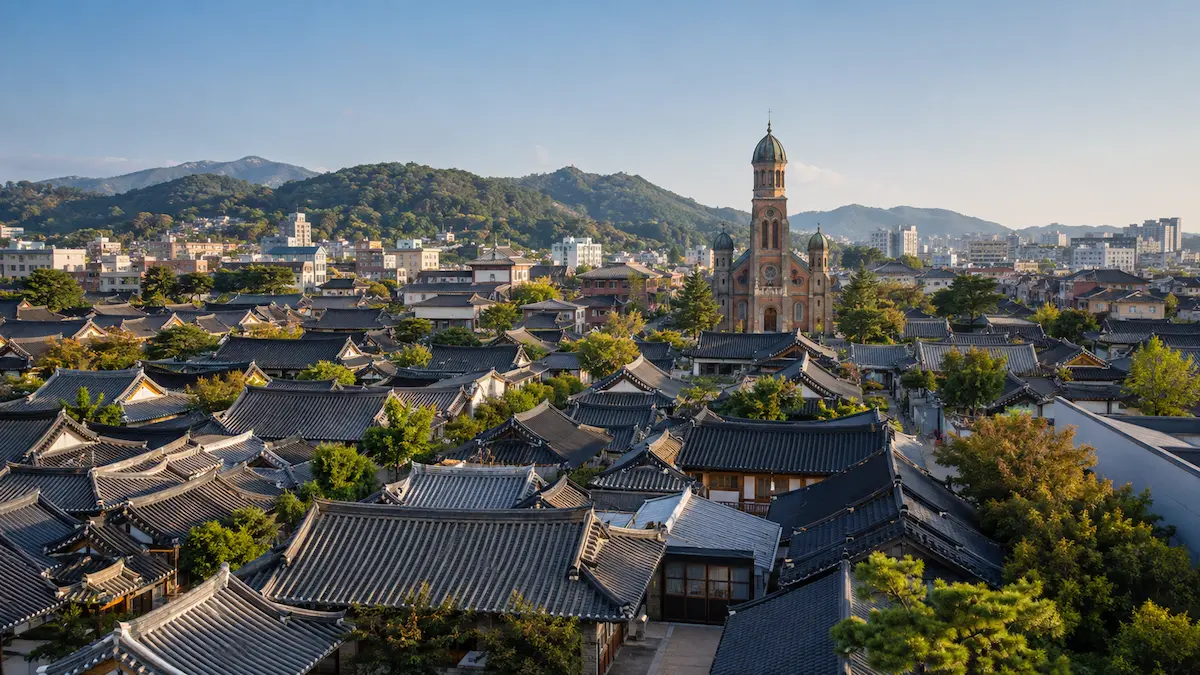
This is the obvious answer for many first-time visitors, and in this case the obvious answer is often the correct one. Jeonju Hanok Village contains more than 700 traditional hanok buildings, and the main sights are tightly grouped around Gyeonggijeon Shrine, Jeondong Cathedral, Omokdae, Jeonjuhyanggyo Confucian School and the surrounding lanes. Staying here lets you explore early in the morning and after day-trippers have left, which is a noticeably better experience than only visiting during the busy middle of the day.
Transport reality: the village is not beside Jeonju Station or the bus terminals. An official VisitKorea accommodation listing inside the village describes both Jeonju Station and Jeonju Express Bus Terminal as roughly 10–15 minutes away by car. That is why I usually prefer a taxi for first arrival with luggage. Once you are checked in, however, you can do a large part of a classic one-day Jeonju itinerary on foot.
Typical room price: roughly US$40–100+ for many well-located guesthouses and hotels, with very basic rooms sometimes lower and premium private hanok stays significantly higher. Current 2026 listings show budget guesthouses in the US$20s–50s and established hotels near the village around US$60–90 before peak-date increases.
Night environment: more atmospheric than lively. Main lanes remain pleasant for an evening walk, but many smaller alleys quiet down once shops close. This is ideal if you want a calm night; less ideal if your priority is bars, late shopping or a wide range of restaurants after 10 p.m.
✅ What Other Travelers Say
Recent reviews for major properties around the village repeatedly praise the ability to walk straight into the historic area and return to the hotel without planning transport. Guests at larger hotels also tend to value the combination of a conventional bed and bathroom with a Hanok Village location — useful if you like the scenery but do not actually want a traditional floor-sleeping experience.
⚠️ The Catch (Things to Keep in Mind)
The biggest trap is booking a “traditional” room for the photo and only later realizing that traditional can mean floor bedding, thinner walls, a compact bathroom and little space for open suitcases. Also check the exact map pin: a property can market itself as Hanok Village accommodation while sitting on the outer edge. For heavy luggage, I would happily sacrifice 100 metres of “perfect” location for direct taxi access.
Choose this area if: this is your first Jeonju trip, you only have one or two nights, and your priority is seeing the historic core with minimum transport.
Skip it if: you want a modern nightlife district, large Western-style rooms, or you have mobility issues and are uncomfortable with uneven lanes and traditional building layouts.
📍 Nambu Market & Pungnammun: Best for Food Lovers and a Short Stay
Best for: street food · weekend stays · easy Hanok Village access · travelers who want normal road access
Nambu Market sits immediately southwest of the Hanok Village around Pungnammun Gate, and for many travelers this is the sweet spot between atmosphere and convenience. Jeonju’s official tourism site describes the market as only a few minutes from the Hanok Village. In practical terms, that means you can walk to the heritage sights while staying closer to regular city streets, bus stops and modern hotel entrances.
The location is especially good if food is a major reason for your visit. Traditional market stalls, kongnamul gukbap, sundae and other local specialties give the area a more everyday feel than the most polished tourist streets inside the village. On Friday and Saturday evenings, the official Nambu Market Hanok Village Night Market currently runs from 17:00 to 24:00, which makes this the most energetic weekend base near the historic core.
Typical room price: around US$35–75 for many guesthouses and small-to-midrange hotels, though weekends and special dates can go higher.
Night environment: lively on night-market evenings and noticeably quieter on ordinary weekdays. The area around Pungnammun and the larger roads feels more open than the inner hanok lanes, while smaller market alleys can empty out quickly after businesses close.
✅ What Other Travelers Say
Reviews for hotels between Nambu Market, Gyeonggijeon and the city centre often highlight how much can be reached in a 5–10 minute walk. Travelers also like being close enough to the Hanok Village to sightsee on foot without committing to a traditional guesthouse.
⚠️ The Catch (Things to Keep in Mind)
Do not choose this area solely for the night market unless your stay includes Friday or Saturday. The daytime traditional market is still worthwhile, but the “festival street-food” atmosphere shown in many videos is not a seven-night-a-week experience. If you are a light sleeper, a room directly facing a busy market street can also be less peaceful on weekend evenings.
Choose this area if: you are in Jeonju for one or two nights, love food, and want a walkable base with slightly easier luggage logistics than deep inside Hanok Village.
Skip it if: you want an upscale resort-like stay or expect late-night entertainment every day of the week.
📍 Gaeksa & Gaekridan-gil: Best Modern Base for Food, Cafes and Evenings
Best for: modern hotels · couples · cafes · bars · shopping · longer stays
If you ask me where I would stay for two or three nights without caring about the novelty of sleeping in a hanok, I would look very seriously at Gaeksa. Gaekridan-gil grew out of Jeonju’s old downtown and is now one of the city’s better-known cafe, restaurant and shopping districts. It feels more like a lived-in Korean city neighborhood and less like a heritage attraction.
The advantage is balance. You are still reasonably close to the Hanok Village, Nambu Market and Jeolla Gamyeong, but you have a broader choice of modern hotels, elevators, larger bathrooms, familiar beds and late-evening food. Depending on the exact hotel, the historic area can be reached by a longer walk or a short bus/taxi ride. I would not obsess over shaving every minute off the walking time here; the real benefit is having a better base after sightseeing ends.
Typical room price: roughly US$40–90 for modern midrange accommodation, with good-value options below that on quieter dates.
Night environment: the liveliest of the areas I recommend for a first trip. Jeonju’s tourism office describes Gaekridan-gil as a hotspot filled with cafes, restaurants and shops, and the district is a better fit than Hanok Village if you like ending the day with drinks, dessert or a late meal.
✅ What Other Travelers Say
Recent city-centre hotel reviews commonly praise the combination of shopping, restaurants and access to the Hanok Village. Guests at modern chain-style properties also mention English-speaking staff, clean rooms and straightforward facilities — exactly the kind of practical advantages that matter after a long travel day.
⚠️ The Catch (Things to Keep in Mind)
You will not wake up inside the postcard view. If your entire reason for visiting Jeonju is to enjoy the hanok lanes at sunrise and late evening, stay in or beside the village instead. Also, Gaeksa covers a fairly broad downtown zone: a hotel on the far western or northern edge can add more walking than the booking-site map first suggests.
Choose this area if: you want a normal comfortable hotel, good evenings and enough proximity to the sights without living in the tourist zone.
Skip it if: your trip is only one night and you want every possible minute inside the Hanok Village.
📍 Jeonju Station & Ua-dong: Best for KTX Convenience
Best for: early trains · late train arrivals · heavy luggage · one-night transit stays
Jeonju Station is the correct base for a very specific traveler: someone who values train logistics more than sightseeing location. If you arrive late by KTX, leave early the next morning, have large luggage, or are using Jeonju as part of a multi-city rail trip, staying within a few minutes of the station can be wonderfully low-stress.
For a normal first-time sightseeing trip, though, I would not stay here simply because “station area” sounds central. It is not the historic center. You will take a bus or taxi to the Hanok Village, Nambu Market and Gaeksa rather than walking there. The good news is that the transfer is manageable: official accommodation information for the Hanok Village places Jeonju Station roughly 10–15 minutes away by car, and traveler reviews for station-side hotels frequently mention quick bus access to the Hanok Village.
Typical room price: around US$30–70 for many business-style and midrange rooms near the station, with newer or larger hotels higher.
Night environment: practical and transport-oriented. You will find restaurants, convenience stores and accommodation, but the district is not a substitute for the atmosphere of Hanok Village or the evening energy of Gaeksa.
✅ What Other Travelers Say
Guests staying near Jeonju Station repeatedly value the obvious things: short walks with luggage, easy train departures and direct bus connections toward the historic area. This is one of those neighborhoods where convenience can outweigh charm if your schedule is tight.
⚠️ The Catch (Things to Keep in Mind)
If you are staying two nights and visiting the historic core on both days, you may end up making the same cross-town journey several times. That erases much of the convenience you gained on arrival. For most first-time leisure travelers, I would rather take one taxi from the station to Hanok Village or Gaeksa and then stay close to the places I actually want to explore.
Choose this area if: your train schedule is awkward, you have heavy bags, or you are using Jeonju mainly as a transit stop.
Skip it if: you want a walk-out-the-door sightseeing experience.
📍 Express & Intercity Bus Terminal / Geumam-dong: Best for Bus Connections
Best for: Seoul bus arrivals · early departures · regional connections · practical budget stays
Jeonju has separate express and intercity bus facilities in the Geumam-dong area, and this is the base to consider when your itinerary is built around buses rather than trains. The official Jeonju tourism guide directs Seoul express-bus travelers to Jeonju Express Bus Terminal and intercity travelers to Jeonju Intercity Bus Terminal. Staying nearby removes the single most annoying part of an early bus departure: getting across town with luggage before breakfast.
The neighborhood works especially well for travelers arriving from Seoul’s Central City Terminal, connecting onward to another Korean city, or spending just one night in Jeonju between longer bus legs. It can also offer good-value modern rooms because you are outside the most tourist-heavy accommodation zone.
Typical room price: approximately US$35–70 for many practical hotels and motel-style properties, with some newer options higher.
Night environment: functional rather than charming. Expect bigger roads, transport traffic, convenience stores and straightforward restaurants. For a late arrival this is reassuringly easy; for a romantic weekend it is not where Jeonju looks its best.
✅ What Other Travelers Say
Recent reviews for hotels in this part of Jeonju often praise short access to the bus terminal and describe the location as comfortable for a brief stay. Some guests also note that the Hanok Village is still easy to reach by taxi or bus, so the area is not isolated — it is simply less walkable for sightseeing.
⚠️ The Catch (Things to Keep in Mind)
The terminal area can tempt budget travelers because rooms look cheaper and transport looks convenient. But if you spend two full days in the Hanok Village and downtown, you are paying back that saving in repeated local trips. I would choose Geumam-dong for a bus-specific reason, not because it is the “best central area.”
Choose this area if: you have an early bus, arrive late by bus, or are connecting onward the next day.
Skip it if: atmosphere, walking and evening sightseeing are central to your Jeonju trip.
📍 Deokjin Park & Jeonbuk National University: Best for a Quieter Local Stay
Best for: repeat visitors · park lovers · university visits · families with a specific north-Jeonju itinerary
Deokjin Park is one of Jeonju’s best-known green spaces, especially during lotus season, and the wider district around the park and Jeonbuk National University feels much more local than the heritage core. This is not the area I would automatically recommend to someone with only 24 hours in Jeonju, but it can be a pleasant base when you want space, modern accommodation and a quieter routine.
The location makes sense if Deokjin Park, the university, Jeonju Zoo or northern Jeonju are already part of your plans. Booking.com currently lists park-side accommodation within a few minutes’ walk of Deokjin Park, while the Hanok Village is around 5 km away for some properties. In other words, you are accepting a taxi or bus ride in exchange for being away from the tourist crowds.
Typical room price: roughly US$40–90, depending on hotel quality and date.
Night environment: calmer and more residential, with a university influence in parts of the district. Deokjin Park itself is also promoted by the city as a night-view attraction. It is a better fit for an evening walk than for a late-night tourist entertainment scene.
✅ What Other Travelers Say
Guests at well-rated modern hotels near Deokjin Park often focus more on room comfort, service and facilities than on tourist-location convenience. That tells you exactly what this area is good at: a comfortable local base rather than a heritage-first experience.
⚠️ The Catch (Things to Keep in Mind)
The Hanok Village is not next door. If this is your first trip and nearly everything on your list is around Gyeonggijeon, Nambu Market and the historic lanes, staying here adds unnecessary commuting. It becomes much more attractive on a second visit or when you have a car, a university reason, or a genuine interest in northern Jeonju.
Choose this area if: you want a quieter modern stay and are comfortable using taxis or buses.
Skip it if: you have only one night and want to maximize time in the historic center.
Key FAQs
What is the best area to stay in Jeonju for first-time visitors without a car?
For most first-time visitors, stay in Jeonju Hanok Village or just outside it around Nambu Market/Pungnammun. You can walk to most of the classic sights and only need a taxi or bus for arrival, departure and outlying attractions. If you prefer modern hotels and better evening dining, Gaeksa is the best compromise.
Is it better to stay near Jeonju Station or Jeonju Hanok Village?
Stay near Jeonju Station if you have an early train, late arrival or heavy luggage and are in town very briefly. Stay near Jeonju Hanok Village if sightseeing is the purpose of the trip. The station saves one transfer at the beginning and end; the Hanok Village saves transport repeatedly during the actual visit.
How many nights should a first-time visitor stay in Jeonju, and which area works best for a short trip?
One night is enough for a focused Hanok Village, Nambu Market and food trip if your Korea itinerary is tight; two nights gives you a much more relaxed pace and time for Deokjin Park, cafes or outlying sights. For one night, I would strongly favor Hanok Village or Nambu Market. For two nights, Gaeksa becomes more attractive because you can enjoy both the heritage core and the modern downtown without feeling rushed.
Final Verdict and Your Next Step
If this is your first trip and you want the least complicated answer, book Jeonju Hanok Village. It minimizes daily transport and gives you the best chance to enjoy the area before and after the daytime crowds. If you want a modern bed, better evening food and a more local city atmosphere, Gaeksa/Gaekridan-gil is the smarter all-round alternative. For food-focused weekend trips, Nambu Market/Pungnammun is an excellent compromise. Jeonju Station and the bus-terminal area should be chosen for a clear transport reason, while Deokjin Park is better for slower or repeat visits.
Whichever area you pick, book earlier than you think for Friday/Saturday stays, Korean public holidays and festival periods. Jeonju has plenty of accommodation, but the rooms that combine good location + private bathroom + comfortable bed + strong reviews disappear first, especially around the Hanok Village.
Compare current availability before committing: