
💡 Key Takeaways
- Do not let old guides send you to the wrong “Gyeongju Station.” The high-speed rail station formerly called Singyeongju was officially renamed Gyeongju Station in December 2023. The old downtown rail station stopped passenger service in 2021. Your KTX/SRT arrival is outside the historic center, so budget for the last-mile transfer.
- For most 1–3 day trips, a normal T-money or Cashbee card beats chasing an unlimited-ride pass. Adult city-bus fare is ₩1,450 by transport card versus ₩1,500 cash, and the card also gives you the useful transfer benefit when you tap out correctly.
- Never navigate Gyeongju from an old bus screenshot. The tourist-friendly 10/11 routes changed in early 2026, and several routes serving Gyeongju Station were rerouted on July 15, 2026. Use Naver Map or KakaoMap on the day you travel.
Fact-checked: August 2026. Gyeongju is easy to explore once you understand one thing: its attractions are split between a very walkable historic core and several outlying areas that are not. This Gyeongju transportation guide focuses on the decisions that actually save first-time visitors time, money and unnecessary walking — especially when you arrive with luggage, try to reach Bulguksa or Seokguram, or discover that “Gyeongju Station” is nowhere near Hwangnidan-gil.
The biggest mistake is treating every leg as a public-transport challenge that must be solved as cheaply as possible. A ₩1,450 bus is excellent when the route is direct and you are not hauling a suitcase. It is much less attractive after a long train ride when a missed connection can cost 30–40 minutes. The best Gyeongju transport strategy is usually a mix: train or intercity bus for the long haul, T-money for straightforward city buses, walking or cycling in the historic center, and selective taxi rides when they buy back meaningful time or save your legs.
The 1-Min Cheat Sheet
- 🚄 KTX/SRT — best for Seoul and travelers starting near Busan Station. Seoul to Gyeongju is roughly 2 hours 10 minutes by high-speed rail; Busan to Gyeongju is roughly half an hour. The catch is that Gyeongju Station sits outside the historic center, so the train time is not your true door-to-door time.
- 🚌 Intercity/Express Bus — best for a central arrival and many Busan/Gimhae Airport journeys. Gyeongju’s Intercity and Express terminals are next to each other near the central tourist area. From Busan Central Bus Terminal, the ride is roughly 50 minutes; from Gimhae Airport, direct bus services can be a very practical choice.
- 🚍 City Bus — best for budget travel to Bulguksa, Bomun and other major sights. Cheap and useful, but route direction matters. Buses 10 and 11 are especially relevant to visitors, while several other routes link Gyeongju Station with downtown. Always check the live route because 2026 brought significant changes.
- 🚕 Taxi/Ride-Hailing — best for luggage, families, late evenings and awkward attraction combinations. The standard taxi base fare became ₩4,500 for the first 1.7 km from February 1, 2026. For two to four people, a carefully chosen taxi leg can be far better value than losing an hour to a connection.
- 🚲 Walking/Bicycle — best for the historic core. Daereungwon, Hwangnidan-gil, Cheomseongdae, Gyochon, Woljeonggyo Bridge and Donggung Palace & Wolji are in the part of Gyeongju where your feet or a bike can outperform buses. Do not extend that logic to the KTX station, Bulguksa or Seokguram.
Top Survival Tips
- Save “경주역” as your rail-station search term. Old English-language content may still say Singyeongju Station. That is the former name of today’s high-speed Gyeongju Station. Meanwhile, the old downtown Gyeongju rail station no longer handles passenger trains. If a blog tells you that your KTX arrives within an easy walk of Hwangnidan-gil, it is outdated.
- Do not assume KTX is automatically the fastest option from Busan. Busan Station to Gyeongju Station is very fast by KTX, but you still need a bus or taxi into central Gyeongju. If you are already near Busan Central Bus Terminal at Nopo and your hotel is around Hwangnidan-gil or the bus terminals, the intercity bus can be simpler door to door.
- Use a transport card even though the cash discount looks tiny. The adult fare difference is only ₩50, but the real value is the transfer rule. With an accepted transport card such as T-money or Cashbee, you can receive one eligible free transfer when you tap out and board the next bus within 30 minutes. A transfer back onto the same route is not eligible. If you forget to tap out, do not expect the benefit.
- Families should not assume the 2026 youth/child free-fare policy automatically applies to a tourist’s card. Gyeongju introduced free city-bus rides for children and teenagers using correctly registered transport cards in 2026, while cash fares still apply. Registration conditions matter, so short-stay foreign visitors should not build a budget around receiving the free fare unless their card is properly registered.
- Bus 10 and Bus 11 are useful, but “take 10 out and 11 back” is not a universal rule. Their routes were reorganized in January 2026 around the new Hwangnidan-gil public parking area and serve the downtown–Bomun–Bulguksa corridor in different directions. Check which direction reaches your next stop with fewer intermediate stops instead of following an old itinerary blindly.
- Gyeongju Station bus routes changed again in July 2026. Routes including 50, 51, 70, 700, 710 and 711 were rerouted around the station-development area from July 15. Treat any saved stop screenshot from before that date as a clue, not a timetable.
- For Hwangnidan-gil, getting off near Seorabeol Intersection can be more useful than obsessing over a stop named after the street. Official visitor information lists routes such as 50, 51, 60, 61, 70, 710 and 711 from the KTX station area, with roughly a 30-minute bus journey plus a short walk depending on the service and traffic. Live navigation should make the final decision.
- Large suitcases change the calculation. Intercity coaches have proper luggage bays. City buses do not. Travelers occasionally report being refused with bulky luggage when a local bus is crowded or the driver considers it unsafe. After KTX arrival, a taxi to a central hotel is often the sensible splurge rather than a test of endurance.
- Do not mix up the Intercity Bus Terminal and Express Bus Terminal. They are adjacent in central Gyeongju, which is convenient once you know it — but they are separate buildings with different services. Check the terminal name on your ticket before standing in the wrong boarding hall.
- Naver Map and KakaoMap are still the safest default for live local routing. Google mapping in South Korea is evolving, but for local bus stops, Korean place names and live transit details, the two domestic apps remain the practical first choice. Save attractions in Korean as a backup when English search results look ambiguous.
- Use public transport for the long cheap leg, then a taxi for the awkward last leg. A classic example is Bulguksa plus Seokguram. City buses can get you to Bulguksa, while local Bus 12 or a taxi handles the climb toward Seokguram. Trying to force every connection into one rigid bus-only plan can waste a disproportionate amount of sightseeing time.
- Do not buy a rail or “unlimited” pass just because unlimited sounds safer. For a normal 1–3 day Gyeongju stay, pay-as-you-go city buses plus a few taxis are usually simpler. A KORAIL pass only deserves serious consideration if your wider Korea itinerary includes several expensive long-distance rail legs; compare the point-to-point fares first.
The Full Experience
🚄 KTX & SRT: Best for Fast Seoul–Gyeongju Travel, Not for a Door-to-Door Shortcut
FASTEST LONG-DISTANCE OPTION · BEST FOR SEOUL · LUGGAGE-FRIENDLY ON THE TRAIN · LAST-MILE TRANSFER REQUIRED
If you are coming from Seoul, high-speed rail is usually the cleanest decision. The journey to Gyeongju is around 2 hours 10 minutes, and you avoid highway traffic. From Busan Station, KTX can reach Gyeongju in roughly 30 minutes, making it attractive when you are already in the Busan Station area.
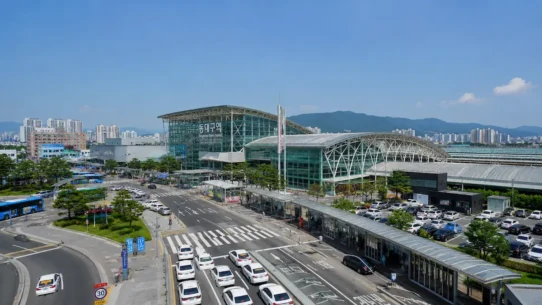
The part that first-time visitors underestimate is the arrival. Gyeongju Station is not in the historic downtown. Think of it as the city’s high-speed gateway rather than a central sightseeing station. From the station, buses take roughly half an hour or more to reach the Hwangnidan-gil area depending on the route, traffic and where you get off. A taxi is typically much quicker and is especially worthwhile with suitcases.
When booking, search for Gyeongju. If an old article tells you to book “Singyeongju,” understand that this was the station’s former name; it officially became Gyeongju Station on December 28, 2023. The old downtown Gyeongju Station ceased passenger operations in 2021. This naming history explains a lot of contradictory advice online.
For popular weekends and Korean holiday periods, book KTX/SRT early instead of assuming you can walk up and take the departure you want. KORAIL normally opens reservations in advance, but holiday sales and timetable changes can alter the usual release pattern.
✅ What Other Travelers Say
Travelers consistently like the speed, smooth ride and generous time savings from Seoul. The common surprise is not the train itself but the extra transfer after arrival. Visitors who expected to step off the KTX into the old downtown often describe the station location as the part they wish they had planned more carefully.
⚠️ The Catch (Things to Keep in Mind)
For a Busan trip, compare door-to-door time rather than station-to-station time. KTX is excellent from Busan Station, but an intercity bus can be more convenient if you start near Nopo and want to finish near Hwangnidan-gil. Also, never use an old screenshot to choose your station bus: several station-area bus routes changed on July 15, 2026.
🚌 Intercity & Express Buses: Best for a Central Arrival and Some Busan/Gimhae Trips
CENTRAL TERMINAL · GOOD FOR LARGE LUGGAGE · STRONG BUSAN OPTION · BOOKING PLATFORM CAN BE FIDDLY
Gyeongju’s long-distance buses are underrated because travelers naturally fixate on KTX. The important practical advantage is location: the Gyeongju Intercity Bus Terminal and Gyeongju Express Bus Terminal sit next to each other near the central city, much closer to Hwangnidan-gil and many hotels than the high-speed rail station.
From Busan Central Bus Terminal, the ride to Gyeongju is roughly 50 minutes. From Gimhae International Airport, a direct airport-to-Gyeongju bus can also be an efficient choice because it avoids heading into Busan just to backtrack. From Seoul, the express bus takes much longer than KTX, so the train usually wins when time matters.
Coaches are also friendlier to travelers with full-size luggage because bags can go in the underfloor compartment. That alone can make a bus arrival more pleasant than squeezing onto a local city bus after a train.
The complication is booking. Korea uses different platforms and terminal systems for express and intercity services, and foreign-card acceptance or English booking flows can vary by route and platform. If your preferred online site rejects payment, do not assume the bus is sold out. Check the correct operator/terminal, try an alternative official booking channel, or buy at the correct departure terminal when practical.
✅ What Other Travelers Say
Travelers who use the Busan–Gyeongju coach often praise the straightforward central-to-central journey and comfortable luggage handling. It is particularly well liked by people staying around Hwangnidan-gil because the arrival location reduces the need for a second transfer.
⚠️ The Catch (Things to Keep in Mind)
“Intercity” and “Express” are not interchangeable labels. The terminals in Gyeongju are beside each other, but your departure city may use a completely different terminal depending on the service. Read the ticket carefully. On Korean weekends and holidays, road traffic can also erase part of the bus’s convenience advantage.
🚍 Gyeongju City Buses: Best Value for Bulguksa, Bomun and Budget Travelers
LOWEST COST · T-MONEY/CASHBEE ACCEPTED · BEST FOR BULGUKSA & BOMUN · LIVE ROUTING ESSENTIAL
Gyeongju city buses are inexpensive enough that you do not need complicated fare optimization. As of 2026, the adult fare is ₩1,450 with a transport card or ₩1,500 in cash. The ₩50 saving is not the main reason to use T-money or Cashbee; the real advantage is the transfer system.
To qualify for an eligible free transfer, tap your card when you get off and board the next bus within 30 minutes. You get one transfer, and a same-route transfer does not qualify. This is the detail that matters when you are changing buses around the station or trying to connect toward an outlying sight.
For tourists, Bus 10 and Bus 11 are the routes worth understanding rather than memorizing. Following a January 2026 reorganization, they connect the Hwangnidan-gil public parking/central area with major zones including Bomun and Bulguksa in different directional patterns. If you are going from the historic center to Bulguksa, check both routes in a live app and take the one that makes sense at that moment instead of assuming a fixed “10 there, 11 back” formula.
From Gyeongju Station toward downtown, official visitor information lists services including 50, 51, 60, 61, 70, 710 and 711 for the Hwangnidan-gil/Seorabeol Intersection area. However, several station routes were rerouted in July 2026. The correct stop location is whatever your live app and on-site stop signage show that day.
For Seokguram, public transport generally requires reaching Bulguksa first, then using the local connection toward Seokguram — commonly Bus 12 — or taking a taxi for the uphill section. If your sightseeing day is already packed, the taxi portion is often a good place to spend rather than save.
✅ What Other Travelers Say
Budget travelers like how cheaply they can cover the city’s spread-out sights, and many visitors manage Bulguksa and Bomun perfectly well without a car. The strongest positive feedback comes from people who use live navigation rather than trying to memorize a timetable before the trip.
⚠️ The Catch (Things to Keep in Mind)
Frequency is not metro-like, and missing a bus can change the rhythm of your day. Crowded local buses are also not ideal with bulky suitcases. If you arrive at Gyeongju Station during bad weather, at night, or with heavy luggage, forcing yourself onto a city bus to save a few thousand won can be false economy.
🚕 Taxis & Ride-Hailing: Best for Luggage, Families and Time-Sensitive Transfers
BEST WITH LUGGAGE · GOOD VALUE FOR 2–4 PEOPLE · USEFUL AFTER DARK · AVOIDS WEAK CONNECTIONS
Taxis are not the “luxury option” in Gyeongju that some budget travelers imagine. They are a tool. From February 1, 2026, the standard Gyeongju taxi base fare is ₩4,500 for the first 1.7 km, with distance/time increments after that. Late-night and other legally applicable surcharges may increase the fare, so check the meter or app estimate rather than relying on an old blog price.
The best taxi use cases are obvious once you look at the map: Gyeongju Station to a central hotel with luggage; Bulguksa to Seokguram when timing is awkward; a late return after the illuminated Donggung Palace & Wolji area; or any trip where three or four people can split the fare.
Kakao T is the local default ride-hailing app, while Uber can also be useful as a backup interface in Korea. If you hail from a station or terminal taxi rank, make sure the meter is used. Keep the Korean destination name or address on your phone because similarly translated attraction names can create confusion.
Gyeongju city authorities have publicly addressed complaints such as short-distance refusal and improper fares, which is a good reason to use an app or official taxi stand when you can. Most rides are uneventful, but having the route visible on your phone adds reassurance.
✅ What Other Travelers Say
Many international visitors find Gyeongju taxis reasonably priced compared with taxis in major Western cities, especially when the fare is shared. Families repeatedly value the ability to skip a 20–30 minute wait or avoid carrying luggage through an unfamiliar bus transfer.
⚠️ The Catch (Things to Keep in Mind)
Taxis become expensive if you use them for every single sightseeing hop, and availability can tighten at peak times or after major events. The sweet spot is a hybrid plan: walk inside the historic core, take buses for direct longer legs, and use taxis to bridge the uncomfortable gaps.
🚲 Bicycles & Walking: Best for Gyeongju’s Historic Core, Not Its Outlying Sights
BEST FOR CENTRAL SIGHTS · FLAT HISTORIC DISTRICT · ZERO WAITING TIME · WEATHER-DEPENDENT
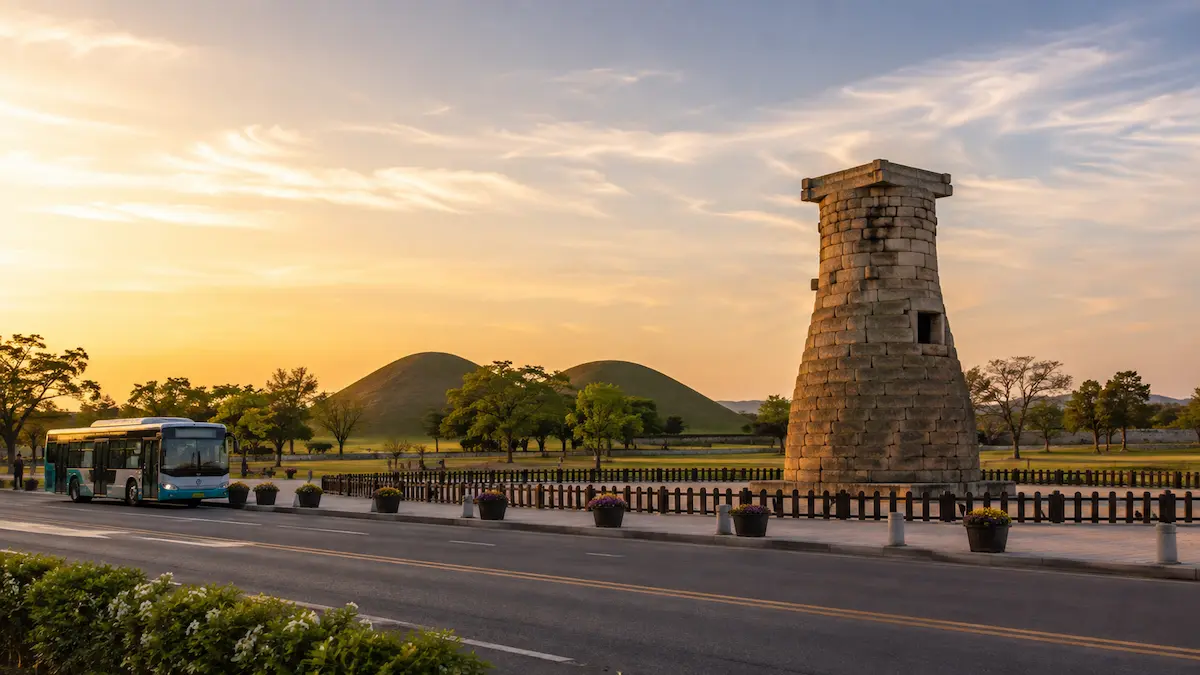
The central historic area is where Gyeongju feels beautifully simple. Daereungwon, Hwangnidan-gil, Cheomseongdae, Gyochon Traditional Village, Woljeonggyo Bridge and Donggung Palace & Wolji form a sightseeing cluster where walking is often faster than waiting for a bus. The terrain is generally flat, and cycling can turn the spaces between the monuments into part of the experience rather than dead travel time.
This is also where visitors overshoot. A bicycle is excellent for the central heritage belt and riverside paths, but it does not magically make every Gyeongju attraction close. Bulguksa, Seokguram and the KTX station are separate transport problems. Seokguram in particular involves a climb that ordinary sightseeing cyclists should not treat as a casual extension of a flat downtown ride.
A smart day often looks like this: walk or rent a bike around the central sights, then return it before taking a bus or taxi to an outer attraction. That avoids the worst combination — cycling long distances in heat or rain because you feel committed to getting “value” from a full-day rental.
✅ What Other Travelers Say
Visitors often describe cycling through the tomb and observatory area as one of the most enjoyable ways to experience Gyeongju because the city’s history unfolds continuously between stops. Walking is equally effective if you keep your central day geographically tight.
⚠️ The Catch (Things to Keep in Mind)
Summer heat, sudden rain, cherry-blossom crowds and winter cold can quickly change the appeal. Do not rent a bike purely because it looks charming on social media. If the weather is poor or your itinerary jumps between distant sights, a bus-and-taxi mix is more comfortable and often more efficient.
Which Gyeongju Transport “Pass” Is Actually Worth Buying?
For ordinary Gyeongju city sightseeing, start with no pass at all. A rechargeable T-money or Cashbee card is enough for most visitors. City-bus fares are low, and the transfer benefit already handles many simple connections. Buying a pass just to feel that transport is “covered” can push you into taking slower buses simply because you have already paid for unlimited rides.
A KORAIL pass is a separate decision from Gyeongju local transport. If your Korea itinerary includes several long-distance KTX journeys, compare the pass price with the exact point-to-point tickets you expect to buy. For a simple Seoul–Gyeongju round trip, do the arithmetic before assuming the pass saves money.
An organized day tour can be worth more than a transport pass when time is your scarce resource. If you are day-tripping from Busan and want Bulguksa, Seokguram, central heritage sights and evening illuminations in one day, public transport is possible but can make the itinerary fragile. A tour is less about “unlimited transport” and more about removing transfers, waiting and route planning. If you are staying two or three nights in Gyeongju, independent travel becomes much easier and usually better value.
Key FAQs
How do I get from Gyeongju KTX Station to Hwangnidan-gil?
The cheapest method is a city bus toward the Seorabeol Intersection/Hwangnidan-gil area; official visitor information lists routes such as 50, 51, 60, 61, 70, 710 and 711, with roughly 30 minutes of bus travel plus a short walk depending on the route. Because station-area routes changed in July 2026, check Naver Map or KakaoMap on arrival. With luggage, bad weather or two or more travelers, a taxi is often worth the extra cost and can save a meaningful amount of time.
Can I use T-money in Gyeongju, and is a Gyeongju transport pass worth it?
Yes. T-money and other accepted Korean transport cards such as Cashbee work on Gyeongju city buses. The adult bus fare is ₩1,450 by card versus ₩1,500 cash in 2026. Tap out to keep your transfer eligibility; one eligible transfer is available within 30 minutes, but transferring back onto the same route does not qualify. For most 1–3 day visitors, pay-as-you-go travel is more sensible than buying a local unlimited-ride product just for the sake of having a pass.
Is KTX or the bus better from Busan to Gyeongju?
It depends on where you start and where you sleep. From Busan Station, KTX is extremely fast at roughly 30 minutes to Gyeongju Station, but you still need a transfer into central Gyeongju. From Busan Central Bus Terminal at Nopo, the intercity bus takes roughly 50 minutes and drops you near the central Gyeongju terminals, close to Hwangnidan-gil. If your Busan hotel is near Busan Station, choose KTX; if you are near Nopo and staying centrally in Gyeongju, the bus may be simpler door to door.
Final Verdict and Your Next Step
The easiest Gyeongju transportation plan is not the one with the most passes or the fewest taxi rides. It is the one that matches the geography of your day.
- One-day visit from Seoul: take KTX, then use a taxi or direct bus into the city and be ruthless about how many outer sights you add.
- One-day trip from Busan: compare KTX against the central intercity bus based on your Busan starting point. If you want several far-apart attractions in one day, a guided coach tour can be genuinely time-efficient rather than merely convenient.
- Two or three nights in Gyeongju: stay around Hwangnidan-gil/the central terminal area, use T-money for direct buses, walk or cycle the historic core, and spend selectively on taxis for luggage or awkward links.
- Staying in Bomun: great for resort facilities, but accept that you will spend more time and money getting back to the central historic district. If your priority is sightseeing without a car, central accommodation is usually the easier base.
What should you book in advance? Reserve the things that can actually sell out or materially affect your day: long-distance KTX/SRT seats on busy dates, your hotel, and a day tour if you want one. You do not need to pre-buy an elaborate local bus pass for a normal Gyeongju stay.
Book a central Gyeongju hotel: Check Gyeongju accommodation on Booking.com. Prioritize Hwangnidan-gil, the central bus-terminal area or the historic core if you want to minimize transfers.
Prefer a one-day Gyeongju tour from Busan: Check the Gyeongju day tour on Klook or compare Gyeongju day-tour availability on KKday. These are most useful when your priority is fitting several widely separated sights into a single day without spending time decoding transfers.
Transport information changes. Before travel, re-check your exact departure in the live KORAIL/SRT booking system and your local bus in Naver Map, KakaoMap or the Gyeongju bus-information system. This is especially important because Gyeongju changed major tourist and station-area bus routes during 2026.