
💡 Key Takeaways
- Daejeon has two “centers.” Jungangno and Eunhaeng-dong are the old downtown and are only one metro stop—or roughly a 15–25 minute walk—from Daejeon Station. Dunsan-dong, City Hall and Government Complex form the newer business center about 13–15 minutes away by direct metro.
- The metro is the best default choice. Daejeon Metro Line 1 runs directly from Daejeon Station toward both Jungangno and Dunsan with no transfer. As checked on August 10, 2026, the adult base fare is ₩1,550 with a transport card or ₩1,700 for a regular single-use ticket.
- A taxi becomes good value surprisingly quickly when you have luggage. Daejeon’s regular taxi base fare is ₩4,300. A ride from Daejeon Station to City Hall is commonly around ₩10,000–₩12,000 before any late-night surcharge or heavy traffic, so two or three travelers can reasonably split the cost.
If you are trying to work out how to get from Daejeon Station to Daejeon city center, the first trap is assuming there is only one obvious downtown. There is not. Many leisure travelers mean the older Jungangno–Eunhaeng-dong area around Sungsimdang, Daejeon Skyroad and Jungang Market, while business travelers often mean Dunsan-dong around City Hall and Government Complex. Choosing the wrong “center” can turn an easy one-stop metro ride into an unnecessary taxi or a long walk with luggage.
This matters even more if you have just come from Incheon Airport via Seoul and KTX. After an airport train, a station transfer and a high-speed train, the last thing most travelers want is another complicated change while hauling suitcases. The good news is that Daejeon Station sits right on Metro Line 1, so the final leg is much simpler than it first appears.
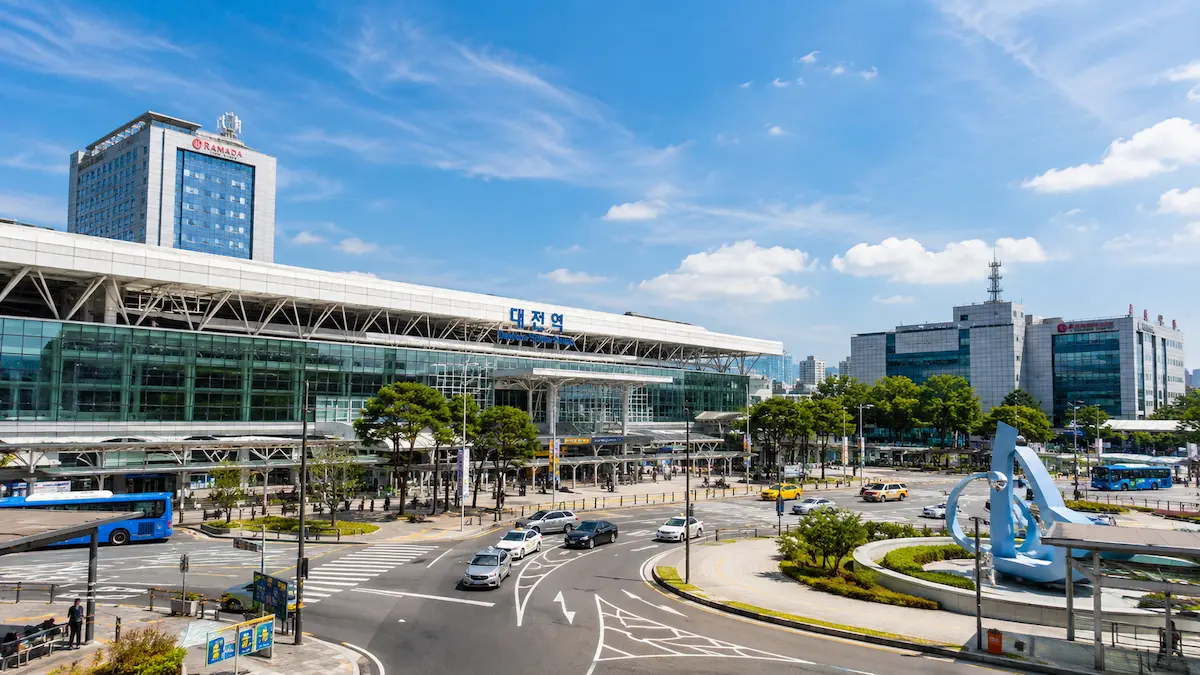
Important: this guide is about Daejeon Station (대전역), the main KTX station on the Seoul–Busan corridor. Do not confuse it with Seodaejeon Station (서대전역), which serves different rail services and is not directly connected to the metro in the same convenient way.
First, Decide Which “Daejeon City Center” You Actually Need
Choose Jungangno / Eunhaeng-dong if your hotel is near Sungsimdang Main Store, Daejeon Skyroad, Jungang Market or the older shopping streets. This is the easiest part of central Daejeon to reach from the main station. Jungangno is just one Metro Line 1 stop away, and confident walkers with light bags can simply walk.
Choose Dunsan-dong / City Hall / Government Complex if you are staying around the modern commercial district, government offices, department stores or many of Daejeon’s business hotels. From Daejeon Station, take Metro Line 1 toward Banseok and stay on the train for seven stops to City Hall or eight stops to Government Complex. No transfer is needed.
Choose Yuseong only if your hotel is actually in Yuseong, near the hot springs, KAIST side of town or western Daejeon. It is farther than what most visitors mean by “city center,” although it is still on the same metro line.
The 1-Min Cheat Sheet
- 🚇 Metro Line 1 — Best overall: ₩1,550 with a transport card for the base fare. One stop to Jungangno; about 13 minutes to City Hall. No transfers. Best for solo travelers, first-time visitors and anyone staying near a metro station.
- 🚕 Taxi — Best with suitcases, children or 2–4 people: Regular taxis start at ₩4,300. Roughly ₩10,000–₩12,000 to City Hall is a reasonable current reference point, with higher fares in traffic or late at night. Best door-to-door option.
- 🚶 Walk — Best for Jungangno and the old downtown: Free and often 15–25 minutes depending on your exact destination and pace. Excellent with a daypack; much less attractive with a large rolling suitcase in summer, rain or snow.
- 🚌 City bus — Best when your hotel is closer to a bus stop than a metro exit: Adult fare is ₩1,500 with a transport card or ₩1,700 cash. Routes 102 and 605 are useful for the Government Complex side. Cheaper than a taxi, but traffic and luggage make it less predictable.
Time reality check: the numbers above are ride or walk times between areas, not guaranteed hotel-door-to-hotel-door times. Add time for finding the metro entrance, waiting for a train, exiting through the right gate and walking the final block. With luggage, that “last 500 meters” is often what decides whether a route feels easy or annoying.
Top Survival Tips
- Check the Korean name of your hotel before you leave the station. Save the hotel name and address in Hangul. Taxi drivers and local map apps are much more reliable with the Korean address than with a translated English hotel name.
- For navigation, use Naver Map or KakaoMap instead of relying only on Google Maps. In Korea, local apps generally give better public-transport routing, exit numbers and bus-stop detail.
- Use a T-money or compatible transport card if you will take more than one ride. The card fare is lower than cash or a regular metro ticket, and eligible bus–metro transfers are easier to handle.
- On buses, tap when you get off as well as when you board. This matters for transfer discounts and correct fare handling.
- Do not take a bus just because it is ₩50 cheaper than the metro. The bus adult card fare is ₩1,500 versus ₩1,550 for the metro base fare. That tiny saving is rarely worth a slower, more traffic-sensitive ride if the metro already goes near your hotel.
- Do not assume walking is automatically easiest because the old downtown is close. A 20-minute city walk with two 23 kg suitcases is a completely different journey from the same walk with a backpack.
- If you arrive close to midnight, check the last train before leaving the KTX concourse. Daejeon city’s current direction page lists the first train from Daejeon Station at 05:36 and the last at 23:45 for the City Hall direction. Timetables can change, so verify on the day.
- Expect a 20% regular-taxi night surcharge from 23:00 to 04:00 under Daejeon’s current fare rules. At that hour, a taxi may still be the sensible option because the alternative is waiting until morning.
- If you are heading to Sungsimdang only, do not overcomplicate it. There is a Sungsimdang branch inside Daejeon Station itself. If your goal is simply buying bread before your next train, you may not need to enter the city at all.
The Full Experience
🚇 Daejeon Metro Line 1: Best for Jungangno, City Hall and Dunsan
Feature tags: Cheapest hassle-free option · No transfer · English-friendly signage · Best solo choice · Predictable travel time
For most travelers, this is the answer. The metro station is connected with Daejeon Station, and Line 1 runs in a straight line across the parts of the city visitors most often need. You do not have to decode a multi-line subway network like Seoul’s.
For Jungangno, Sungsimdang Main Store, Daejeon Skyroad and Eunhaeng-dong, board a train toward Banseok (반석) and get off at Jungangno, the very next stop. From there, walk to your exact hotel or attraction.
For Dunsan-dong and City Hall, stay on the same train to City Hall Station. Current route information puts the train ride at about 13 minutes. For hotels nearer the government offices or intercity bus stop, continue one more stop to Government Complex Daejeon.
Current adult fare checked August 10, 2026: ₩1,550 with a transport card for the first fare zone, or ₩1,700 for a regular ticket. A second fare zone costs slightly more on longer journeys, but the central routes discussed here normally sit within the basic urban trip travelers are making.
Best for: one or two travelers, light-to-medium luggage, hotels within an easy walk of Jungangno, City Hall or Government Complex stations, and anyone who wants a predictable journey during rush hour.
✅ What Other Travelers Say
Daejeon Metro consistently gets positive traveler feedback for being clean, simple and easy to understand. Reviews commonly mention clear exit numbering, English signage and English announcements. One practical point that matters for visitors with luggage: travelers have also noted luggage racks above seats, something you will appreciate more after a long KTX journey.
⚠️ The Catch (Things to Keep in Mind)
The train ride may be easy, but your final walk may not be. If your hotel is 700–900 meters from City Hall Station, the total effort can be greater than the 13-minute train time suggests. Some exits are more luggage-friendly than others, so do not blindly follow the shortest walking route if it sends you up a long staircase. Look for elevator signs and check your exact exit in Naver Map or KakaoMap.
The other limitation is timing. The metro is not a 24-hour system. If your KTX arrives after the last useful connection, your realistic choices are a taxi or waiting until morning.
🚕 Metered Taxi or App-Booked Taxi: Best for Heavy Luggage and Late Arrivals
Feature tags: Door-to-door · Best with 2–4 people · Zero transfers · Easiest with big luggage · Best after metro hours
A regular metered taxi is the option I would seriously consider after a long travel day, especially if your hotel is in Dunsan rather than right beside a metro exit. Daejeon’s current regular taxi fare starts at ₩4,300 for the first 1.8 km, with additional distance and time charges after that.
As a practical benchmark, a Daejeon Station to City Hall taxi is currently quoted at roughly ₩10,000–₩12,000 in normal conditions, with a driving time that can be around 7–15 minutes when traffic is flowing. Treat that as a planning range, not a fixed price: congestion, red lights and the late-night surcharge can push the meter higher.
If there are three of you, the cost per person can be close enough to public transport that the convenience becomes easy to justify. The biggest advantage is not speed; it is eliminating the station exit, platform walk and final hotel walk entirely.
You can queue for a regular taxi outside the station or use an app. Uber currently offers licensed taxi requesting in Daejeon, and Kakao T is also widely used in major Korean cities. The most important trick is to enter the destination in the app or show the driver the hotel’s Korean address rather than trying to pronounce an English hotel name.
Best for: families, couples with two large suitcases, groups of three or four, travelers arriving late, anyone with mobility limitations, and hotels that are not close to a metro exit.
✅ What Other Travelers Say
The recurring benefit travelers mention with Korean taxis is straightforward: once the destination is correctly entered, the ride removes almost all navigation stress. App booking is especially useful for visitors who do not speak Korean because the pickup point and destination are already stored digitally. For a short city ride, that convenience is often worth more than shaving a few thousand won from the fare.
⚠️ The Catch (Things to Keep in Mind)
Daejeon taxis are metered, so traffic is the hidden cost. A ride that looks like an obvious time-saver can slow down at weekday rush hour while the metro keeps moving. Regular taxis also carry a 20% night surcharge from 23:00 to 04:00 under Daejeon’s current fare structure.
Also remember the luggage-versus-passenger trade-off. A standard taxi may technically seat up to four passengers, but four adults plus four large suitcases can exceed practical trunk space. If your group is heavily packed, split into two taxis rather than discovering at the curb that the bags do not fit.
Video note: the linked popular Daejeon taxi video features the city’s special “Bread Taxi” tourism concept rather than an ordinary station transfer, but it gives a current look at Daejeon taxi vehicles and local taxi culture.
🚶 Walking to Jungangno: Best if Your Hotel Is in the Old Downtown and Your Bag Is Light
Feature tags: Free · No waiting · Best for Sungsimdang and Jungang Market · Weather-sensitive · Bad with heavy luggage
Walking is the most underrated option—but only for the right destination. Daejeon Station is already on the edge of the old downtown. If you are staying around Jungangno, Eunhaeng-dong, Sungsimdang Main Store or Daejeon Skyroad, you can often reach your destination on foot in roughly 15–25 minutes.
Part of the central shopping area can also be approached through the underground shopping network, which stretches from the Daejeon Station side toward Jungangno and helps on very hot, rainy or cold days. That said, underground routes can introduce their own problem: stairs, confusing exits and a longer-feeling walk when you are towing luggage.
Walking makes most sense when you are sightseeing immediately rather than simply trying to check in. You pass straight into the older commercial core, so the journey itself becomes part of the visit instead of dead transfer time.
Best for: solo travelers with a backpack, day-trippers, anyone staying near Jungang Market or Sungsimdang, and travelers arriving in comfortable weather with no urgent check-in.
✅ What Other Travelers Say
Travelers doing bakery or market-focused Daejeon day trips regularly describe the old downtown as very accessible from the station. Korea Tourism Organization even promotes a walking course beginning around Daejeon Station and continuing through nearby local sights, which matches the experience on the ground: this is one of the rare major Korean rail stations where “just walk into downtown” is genuinely reasonable.
⚠️ The Catch (Things to Keep in Mind)
The problem is not distance; it is friction. Crossings, curb cuts, crowds, underground stairs and rougher pavement all matter when a suitcase is involved. In July or August humidity, a “free 20-minute walk” can mean arriving at your hotel hot and tired. In winter, icy pavement can make the same shortcut a poor trade.
My rule: backpack = walk; one small spinner = maybe; two big suitcases = take the metro or taxi.
🚌 Daejeon City Bus: Best When the Stop Is Closer to Your Hotel Than the Metro
Feature tags: Low fare · Broad coverage · Direct options to Government Complex · Traffic-sensitive · Least luggage-friendly
Daejeon’s buses fill the gaps the single metro line cannot cover. For the Government Complex area, official government directions specifically list bus 102 and bus 605 from Daejeon Station as useful direct routes.
As of August 10, 2026, the regular adult city-bus fare is ₩1,500 with a transport card or ₩1,700 cash. That makes the bus fractionally cheaper than the metro with a card, but the difference is only ₩50. Choose the bus because it drops you closer to your hotel—not because you are trying to save fifty won.
Bus journey time depends heavily on traffic and where exactly you board and alight. For Dunsan and Government Complex, I would budget roughly 25–40 minutes door to door rather than fixating on a perfect timetable. Daejeon’s own bus operator warns that peak-hour traffic can delay services.
Best for: travelers whose hotel is directly beside a useful bus stop, people already comfortable with Korean bus systems, and destinations beyond convenient walking distance from Metro Line 1.
✅ What Other Travelers Say
Visitors generally like that buses cover far more of Daejeon than the one-line metro. The bus is especially useful once you start exploring beyond the central corridor. Experienced Korea travelers also appreciate the integrated transport-card transfer system, because a bus can become a cheap final hop after the metro.
⚠️ The Catch (Things to Keep in Mind)
This is the least forgiving option with luggage. You may have to lift a suitcase onto a busy bus, stand through part of the ride, watch for the correct stop and move toward the door before the bus arrives. First-time visitors also find Korean bus stop names harder to follow than metro stations.
Use the bus when it clearly solves a last-mile problem. Do not choose it by default when a direct metro already serves your destination.
Which Option Should You Choose?
If you are staying near Sungsimdang Main Store or Jungangno: walk if you have light luggage and the weather is comfortable. Otherwise, take the metro one stop. A taxi is only worth it if your bags are heavy, you are tired or your accommodation is awkwardly placed.
If you are staying in Dunsan near City Hall: take the metro unless you have large luggage or two or more people splitting a taxi. The metro is direct and avoids road traffic; a taxi wins on door-to-door convenience.
If you are staying near Government Complex: metro is still the easiest default. Buses 102 and 605 can be useful if the stop is closer to your exact hotel entrance. Taxi is the best low-effort choice after a long KTX journey.
If you arrive after roughly 23:45: assume you may need a taxi. Do not plan a late-night trip around the last metro without checking the live timetable on your travel date.
If there are three or four of you: compare the total taxi fare, not the per-person headline price of public transport. A ₩10,000–₩12,000 taxi split three ways can be an excellent value if it saves everyone a station walk with luggage.
Key FAQs
How do I get from Daejeon Station to Sungsimdang Main Store?
The easiest route is Metro Line 1 from Daejeon Station toward Banseok for one stop to Jungangno, then walk a few minutes to Sungsimdang Main Store. If you have only a backpack, walking the whole way takes roughly 15–25 minutes depending on pace and route. If you only want to buy Sungsimdang bread and are continuing by train, there is also a branch inside Daejeon Station, so you may not need to travel into downtown at all.
How do I get from Daejeon Station to Dunsan-dong or Daejeon City Hall?
Take Daejeon Metro Line 1 toward Banseok and get off at City Hall Station. It is a direct ride of about 13 minutes with no transfer. Continue one more stop to Government Complex Daejeon if your hotel is closer to the government-office side of Dunsan.
How much is a taxi from Daejeon Station to the city center?
It depends which center you mean. A very short ride to Jungangno can stay close to the base-fare range, while Daejeon Station to City Hall is currently a useful planning estimate of about ₩10,000–₩12,000 in normal traffic. Daejeon’s regular taxi base fare is ₩4,300 for the first 1.8 km, and a 20% surcharge applies from 23:00 to 04:00.
Final Verdict and Your Next Step
For the majority of travelers, Metro Line 1 is the best way from Daejeon Station to the city center. It is cheap, direct, easy to understand and not affected by road traffic. If your destination is the old downtown around Jungangno, the city is so close that walking becomes a genuine option. If you are carrying big luggage, traveling with children or arriving late, take a taxi and save your energy for the trip itself.
The biggest mistake is paying for convenience you do not need—or saving a tiny amount of money at the cost of a miserable luggage transfer. A ₩50 bus saving is meaningless if the bus stop is harder to find. A taxi is not “expensive” if three people split it and avoid a 900-meter hotel walk. And walking is not “free” if it leaves you exhausted before check-in.
You do not need to pre-book the Daejeon metro or ordinary city bus. What is worth booking ahead is your accommodation—so you know which center you are actually heading to—and any private sightseeing transport you want after arrival.
- Check Daejeon hotels on Booking.com — useful for comparing stays around Daejeon Station, Jungangno, Dunsan and Yuseong.
- Compare Daejeon hotel prices on Agoda — another useful check before deciding whether you actually need the old downtown or Dunsan.
- See Daejeon private taxi tours on Klook — relevant if you want door-to-door sightseeing around Daejeon after check-in rather than piecing together buses.
- See Daejeon day-tour options on KKday — useful if you are still deciding whether to visit Daejeon independently or as a guided day trip.
Best simple decision: Jungangno with a backpack = walk or one metro stop. Dunsan solo = metro. Two or more people with big bags = compare a taxi. Late-night arrival = taxi.
Fact-check note
Fares, operating information and booking pages in this guide were checked on August 10, 2026. Transport fares and timetables can change. For the latest information, check the Daejeon Transportation Corporation, Daejeon Metropolitan City public-transport fares, and the live route shown in Naver Map or KakaoMap on your travel day.