
💡 Key Takeaways
- There is no subway station inside Daegu Airport. Ayanggyo Station on Line 1 is about 1.8 km away, so a “subway from the airport” still requires a bus or taxi connection first.
- For one traveler with light luggage, the direct city bus is the value winner. Buses 101, 401 and Express 1 serve central areas including Daegu Station and Dongseongno, with official 2026 adult fares starting at KRW 1,500 by transportation card.
- With two or more people, large suitcases, children, a tight KTX connection or a late arrival, a taxi often gives better real-world value. Daegu Airport is close enough to the urban core that paying a little more can eliminate the most annoying part of the journey.
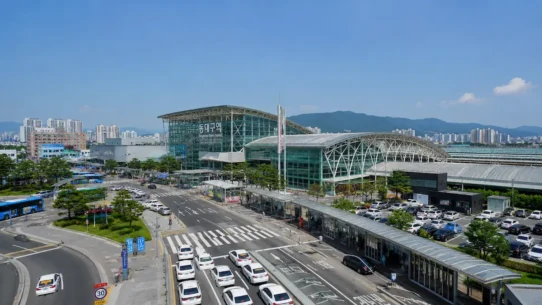
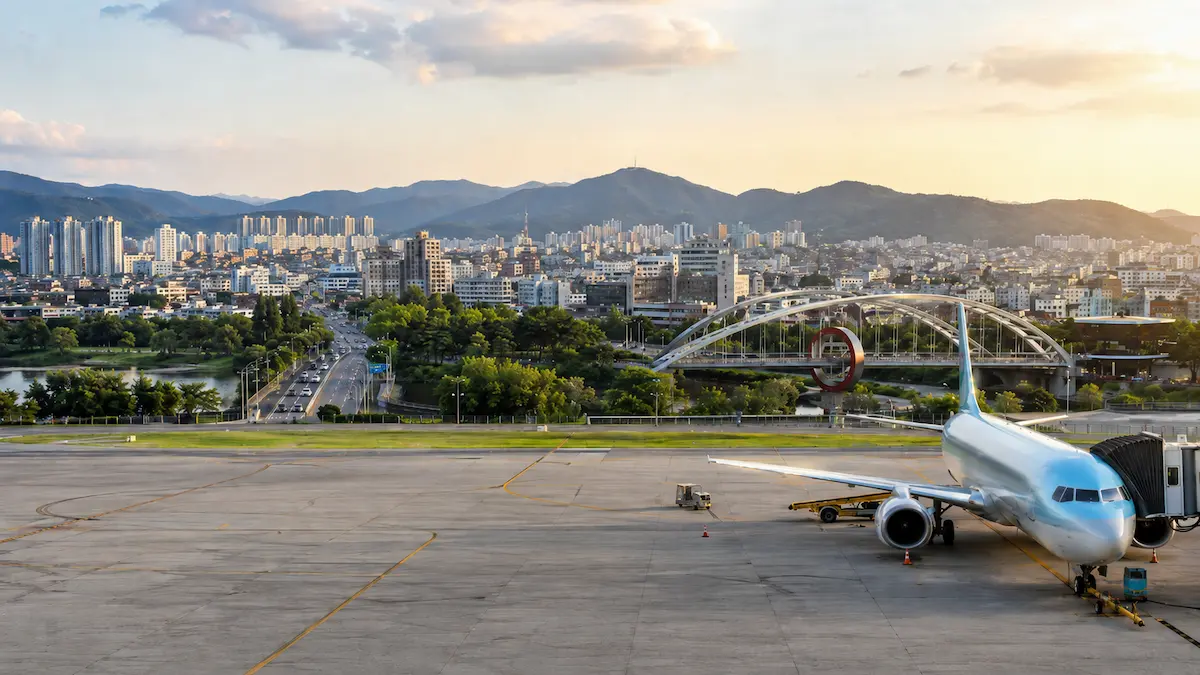
If you are trying to work out how to get from Daegu Airport to the city center, the biggest trap is assuming the subway is automatically the easiest option just because Daegu has a good metro system. It is not. Daegu International Airport (TAE) has no station attached to the terminal, and the nearest Line 1 stop, Ayanggyo, is still about 1.8 km away. That extra connection is exactly the kind of detail that looks harmless on a map but becomes irritating when you are pulling a 20 kg suitcase, arriving in summer humidity, traveling with children, or trying to reach a hotel before reception closes.
The good news is that Daegu is one of Korea’s easier airports for reaching the city. Direct city buses connect the terminal with central Daegu, taxis are relatively painless for a short urban airport run, and the metro can still be useful when your hotel sits directly on a convenient subway line. The best choice depends less on a headline travel time and more on where you are actually staying: Dongseongno, Banwoldang, Daegu Station, Dongdaegu Station, Seomun Market or Suseong.
Checked for August 2026: route guidance and fares below were cross-checked against Daegu International Airport, Daegu Metropolitan City and VISITKOREA. Transit operations can still change, so use Naver Map or KakaoMap for the exact stop and live arrival time on your travel day.
The 1-Min Cheat Sheet
- Direct city bus — best for solo travelers and small bags. Expect roughly 30 minutes to central Daegu in normal conditions. Regular adult fare: KRW 1,500 with a transportation card or KRW 1,700 cash. Express bus: KRW 1,950 by card or KRW 2,200 cash. Routes 101, 401 and Express 1 are the key airport-to-central-Daegu services.
- Taxi — best all-round option with luggage. Official taxis wait across the crosswalk outside Gate 3. VISITKOREA gives about 25 minutes to Daegu Station or Dongseongno and about 35 minutes to Seomun Market or Suseongmot. The meter, traffic and exact hotel determine the final fare.
- Ride-hailing or pre-booked transfer — best for families, groups and awkward arrival times. This is not always the cheapest option, but it removes language friction, reduces luggage handling and can be worth paying for when four people can share the vehicle cost.
- Ayanggyo + Metro Line 1 — best only when the metro solves your second half. You still need a feeder bus or short taxi between the terminal and Ayanggyo Station. Do not choose this just because “subway” sounds simpler.
Top Survival Tips
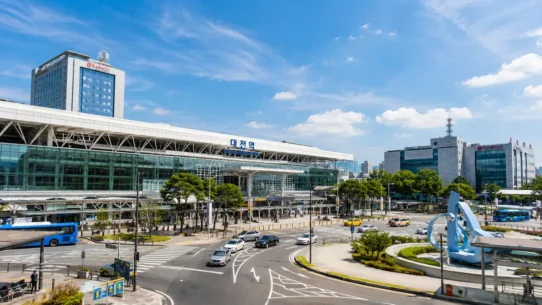
- Decide by neighborhood, not by “downtown.” Dongseongno/Jungangno/Banwoldang is the classic shopping-and-dining center. Daegu Station is also central. Dongdaegu Station, however, is an eastern transport hub for KTX and intercity connections rather than the same downtown zone.
- Do not walk to Ayanggyo with luggage just to save a fare. The airport itself states the station is about 1.8 km away. A short feeder bus or taxi is the sensible connection.
- If you use a transportation card, tap when you get off the bus. Daegu’s official transfer system allows qualifying bus/subway transfers within 30 minutes, but you need to tap at the rear reader before exiting to receive the benefit.
- Do not rely on an overseas credit card as your city-bus plan. VISITKOREA notes that international cards are not accepted for city-bus payment. A Korean transportation card such as T-money is more dependable; cash availability can vary by route, so carry a fallback.
- Large luggage changes the calculation. These are ordinary city buses, not airport limousine coaches with underfloor baggage holds. One cabin-size bag is usually manageable; two large suitcases during commuting hours can make the cheapest option feel very expensive in effort.
- For a KTX connection at Dongdaegu Station, protect your buffer. If your train departure matters, a taxi is usually a better risk-management decision than saving a few thousand won and waiting for a bus.
- Late arrival? Check live bus times before leaving the terminal. Daegu city buses are not a 24-hour airport service. If your flight lands late enough that missing one bus could leave you stranded, use the official taxi rank or pre-book a transfer.
- Save your hotel name and address in Korean. Even when you use an app, showing the Korean address removes ambiguity between similarly named hotels and branches.
The Full Experience
🚌 Direct City Bus: Best for Dongseongno, Daegu Station and Budget Travelers
CheapestNo rail transferBest with light luggage~30 min to central Daegu
For most solo travelers, the direct city bus is the strongest budget choice because it avoids the fake simplicity of taking a bus or taxi to a subway station and then transferring again. According to VISITKOREA, city buses from Daegu Airport reach downtown in about 30 minutes, and routes 101, 401 and Express 1 serve Daegu Station and the Dongseongno area.
The airport bus stops are not hidden inside a giant transport center. After leaving the terminal, cross the road and continue beyond the parking area outside Gates 3 and 4. Check the direction carefully in Naver Map or KakaoMap before boarding, because the same route number naturally operates in both directions.
Current adult fares: Daegu Metropolitan City lists regular buses at KRW 1,500 with a transportation card or KRW 1,700 cash, and express buses at KRW 1,950 by card or KRW 2,200 cash. If you already have T-money, Cashbee or another supported Korean transportation card, this is the cleanest way to pay and also preserves transfer discounts.
Where this works especially well: if your hotel is around Dongseongno, Jungangno, Daegu Station or the central shopping streets, you may be able to get off close enough to walk the final few minutes. Express 1 is particularly worth checking for Dongseongno, while 101 and 401 also serve central Daegu. For Banwoldang, check 401 and current routing in your map app.
✅ What Other Travelers Say
Recent traveler discussions generally agree on the same practical point: the airport is close to the city, so the bus is a genuinely useful low-cost option rather than a long suburban crawl. Travelers also repeatedly recommend Korean mapping apps over Google Maps for live transit navigation. That feedback matches the official routing: central Daegu is reachable directly without first going to a metro station.
⚠️ The Catch (Things to Keep in Mind)
- It is a city bus, not a luggage-friendly airport coach. Big suitcases can block aisles or be difficult to control when the bus is busy.
- A quoted “30 minutes” is not a promise. Traffic, waiting time and the number of stops matter.
- If your hotel is not close to the bus route, the cheap fare can be cancelled out by a tiring walk or another transfer at the end.
- Do not assume your foreign bank card will tap successfully. Use a Korean transportation card or have a practical fallback.
Best-value rule: choose the bus when you are traveling alone, have no more than one manageable suitcase, arrive while normal services are running, and your hotel is within an easy walk of the route. The moment two of those conditions fail, compare a taxi.
🚕 Taxi, Ride-Hailing or Pre-Booked Transfer: Best for Luggage, Families and Late Arrivals
Door to doorLeast walkingBest for 2–4 travelersBest for KTX connections
Daegu is one of those cities where the taxi option deserves more respect than a price-first guide usually gives it. The airport is close to urban Daegu, so a metered taxi can turn a multi-step journey into one simple ride: terminal, trunk, hotel door. That matters when you have just come off a flight and the alternative is waiting for a bus, lifting bags aboard, checking stops and then walking several blocks.
The official taxi stand is across the crosswalk outside Gate 3. VISITKOREA estimates approximately 25 minutes to Daegu Station or Dongseongno and around 35 minutes to Seomun Market or Suseongmot. These are useful planning times, not guarantees; rush-hour traffic can change them.
Daegu Airport’s official taxi page lists the standard medium-taxi meter at KRW 4,000 for the first 2 km, followed by distance/time increments. There is therefore no honest single “airport-to-downtown taxi price.” For trip planning, a central-Daegu ride is commonly budgeted at roughly KRW 10,000–18,000, but treat that as an estimate rather than a fixed fare. Your exact destination, traffic, vehicle type and any applicable surcharge determine what you pay.
Dongdaegu Station is the case where I would lean taxi fastest. If you are connecting to a KTX train, hauling luggage onto a bus to save a modest amount of money is rarely worth the stress of watching the departure clock. If you are not in a rush and your bags are light, buses such as 101 or 401 can still be reasonable.
Ride-hailing can also reduce language friction. In Korea, Kakao T and foreigner-oriented services such as k.ride may be useful, while availability and payment setup can vary. The safest low-tech fallback is still the regulated taxi rank at the airport. Have your hotel’s Korean address ready.
For families or larger groups, a pre-booked private transfer can be worth comparing with two taxis. The important fine print is not only the headline price: check vehicle size, luggage allowance, child-seat availability, included waiting time, after-hours fees and what happens if your flight is delayed.
Check Daegu Airport transfers on Klook
Compare Daegu Airport transfers on KKday
✅ What Other Travelers Say
Recent traveler reports often describe taxis as the low-friction choice precisely because Daegu Airport is unusually close to the city’s main transport and downtown areas. Some travelers have reported inexpensive rides to Dongdaegu and successful use of app-based taxi services in Daegu. Individual fare reports are anecdotes rather than guarantees, but the overall pattern is useful: once two people are sharing the fare, the convenience premium can become surprisingly small.
⚠️ The Catch (Things to Keep in Mind)
- The meter means traffic is a hidden cost. A short distance is not always a short fare during congestion.
- A private transfer can be poor value for one light-packing traveler arriving in the daytime.
- Do not book the smallest vehicle blindly. Three adults plus three large suitcases may need a larger car even if the passenger count technically fits.
- With ride-hailing, app registration and payment can occasionally be the most annoying part. The airport taxi rank requires almost no setup.
My “pay to remove friction” threshold: if you have two large suitcases, a stroller, an elderly companion, three or more travelers, a train connection, heavy rain, or a late arrival, I would stop optimizing for the absolute cheapest fare and take a taxi or pre-booked transfer.
🚇 Ayanggyo + Daegu Metro Line 1: Best for Hotels Directly on a Metro Line, Not as the Default Airport Route
Useful for onward metro travelRequires feeder connection1.8 km from airportNot luggage-friendly
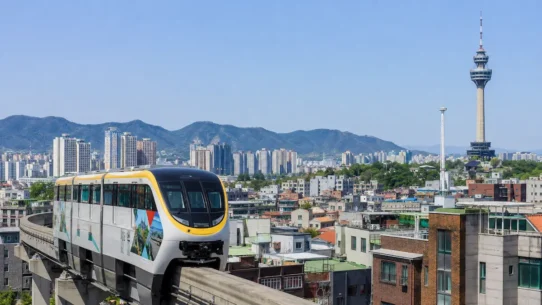
This is the option most likely to be misunderstood in other airport guides. Daegu Metro Line 1 does pass through Ayanggyo, Dongdaegu Station, Daegu Station, Jungangno and Banwoldang, which makes the map look perfect. But Ayanggyo is not an airport station. Daegu International Airport’s own instructions say to get off at Ayanggyo and transfer by bus — Express 1, Palgong 1, 401 or 101-1 — or by taxi. The airport states the gap is about 1.8 km.
That means the metro makes sense when it solves a specific onward journey. For example, if your accommodation is beside a Line 1 station beyond the central bus corridor, or you need an easy metro interchange at Banwoldang, using Ayanggyo may produce a predictable second half. But if you are simply going to Dongseongno or Daegu Station, a direct bus can remove an entire transfer. If you have heavy luggage, a direct taxi can remove all of them.
If you do choose this route, use a short bus or taxi between the airport and Ayanggyo rather than treating the 1.8 km as a pleasant airport walk. Korean summers can be hot and humid, winters can be bitter, and much of the “saving” disappears if you arrive at the station tired before your actual metro trip has even started.
A transportation card is particularly useful here. Daegu Metropolitan City says eligible transfers between buses and the subway can be free within 30 minutes of getting off the previous service, provided you tap correctly when exiting the bus. An extra difference can apply when transferring to an express bus.
✅ What Other Travelers Say
Traveler discussions frequently warn newcomers not to think of Ayanggyo as if it were attached to the terminal. That anecdotal advice lines up exactly with the airport’s official 1.8 km figure. The metro itself is easy once you reach it; the weak point is the airport-to-station gap.
⚠️ The Catch (Things to Keep in Mind)
- You are adding a transfer before you even board the train.
- Walking 1.8 km with luggage can wipe out the comfort advantage of rail.
- If your destination is already on a direct airport bus route, the metro can be slower door to door despite feeling more “organized.”
- For Dongdaegu Station, compare the feeder time against simply taking a bus or taxi there directly.
Which Option Should You Choose for Each Daegu Area?
- Dongseongno / Jungangno: take a direct bus if you are solo and lightly packed; take a taxi if you have large luggage or two or more travelers. This is the easiest area for avoiding unnecessary transfers.
- Banwoldang: check the current 401 route or use a taxi. Metro can make sense only if you were already planning to connect through Ayanggyo for another Line 1/Line 2 journey.
- Daegu Station: direct city bus is excellent value; taxi is the low-effort choice. Do not detour to Ayanggyo just to ride one or two metro segments unless live routing gives you a clear benefit.
- Dongdaegu Station / KTX: taxi is the stress-minimizing choice when a train connection matters. Bus is fine when you have a comfortable time buffer and manageable luggage.
- Seomun Market: taxi is simplest with luggage. If your accommodation is elsewhere and you are only sightseeing later, go to your hotel first rather than dragging bags through the market area.
- Suseongmot / Suseong-gu: taxi is usually the cleanest arrival-day choice because a public-transport trip can require more route planning. VISITKOREA estimates about 35 minutes by taxi to Suseongmot.
Key FAQs
What is the cheapest way to get from Daegu Airport to the city center?
A direct city bus is usually the cheapest practical option. As of August 2026, Daegu Metropolitan City lists adult fares at KRW 1,500 by transportation card or KRW 1,700 cash for regular buses, and KRW 1,950 by card or KRW 2,200 cash for express buses. Routes 101, 401 and Express 1 serve central Daegu. The cheapest route is not automatically the best one if you then need a long walk or another fare to reach your hotel.
Is there a subway from Daegu Airport to Dongseongno or Daegu Station?
Not directly. There is no metro station inside Daegu Airport. The nearest useful Line 1 station is Ayanggyo, about 1.8 km away, and the airport officially recommends connecting there by bus or taxi. For Dongseongno or Daegu Station, a direct bus is often simpler because it avoids that extra transfer.
How much is a taxi from Daegu Airport to downtown Daegu, and is it worth it?
Taxis are metered rather than fixed-price. Daegu Airport lists the standard medium-taxi base fare at KRW 4,000 for the first 2 km. For planning, roughly KRW 10,000–18,000 is a reasonable ballpark for many central destinations, but traffic, exact location and surcharges can move the total. It is especially worth considering for two or more travelers, large luggage, late arrivals, bad weather or a tight KTX connection.
Final Verdict and Your Next Step
If I were choosing without overthinking it: I would take the direct city bus to Dongseongno or Daegu Station when traveling solo with a small bag. I would take a taxi to Dongdaegu Station if I had a KTX connection, and I would choose a taxi or private transfer for two or more people with substantial luggage. I would only build a journey around Ayanggyo Station when my hotel or onward route genuinely benefits from Daegu Metro Line 1.
The mistake to avoid is optimizing only for the lowest ticket price. Saving a few thousand won is not a win if it costs you a 1.8 km luggage drag, an extra transfer, a missed train or 30 minutes standing at a bus stop after a long flight.
If you have not booked your hotel yet, choose the neighborhood before you choose the airport transfer. Staying around Dongseongno/Jungangno gives first-time visitors the easiest access to food, shopping and central sights, while Dongdaegu is more practical when KTX travel is a major part of your itinerary.
Check central Daegu hotels on Agoda
Compare Daegu hotels on Booking.com
Pre-book a Daegu Airport transfer on Klook
Check Daegu Airport transfers on KKday
One final recommendation: if your arrival is late, you are traveling during a holiday period, or you need a specific vehicle size, book the transfer before departure rather than trying to solve it after landing. For ordinary daytime arrivals, check your hotel against routes 101, 401 and Express 1 first; if the bus stop is not conveniently close, the taxi premium is often money well spent.
Primary fact-check sources:
Daegu International Airport public transportation,
Daegu International Airport taxi fares,
Daegu Metropolitan City transportation fares and transfer rules, and
VISITKOREA airport transportation guide.