


💡 Key Takeaways
- For most first-time visitors, stay in or beside Jeonju Hanok Village if sightseeing atmosphere matters most; choose Gaeksa instead if you want a normal hotel room, easier luggage handling and better evening options.
- Do not assume “near Jeonju Station” means “central.” The KTX station sits away from the historic core, and Jeonju is a bus-and-taxi city rather than a subway city. Station hotels are excellent for train logistics, not for maximizing sightseeing time.
- A traditional hanok stay is not automatically the most comfortable stay. Check the actual bed type, room size, private bathroom, soundproofing, stairs and vehicle access before booking—especially if you have large luggage, bad knees or light sleep.
Choosing among the best areas to stay in Jeonju looks simple on a booking map until you notice that the city’s KTX station, bus terminals, old downtown and Hanok Village are not one compact transport hub. A hotel can be “convenient” for your arrival yet inconvenient for almost everything you came to see. At the other extreme, the prettiest hanok guesthouse may place you right inside the historic lanes but leave you dragging a suitcase over an awkward final stretch, sleeping on a thin floor mattress or listening to the next room through traditional-style walls. The right Jeonju base is therefore less about finding the most famous neighborhood and more about matching your arrival route, walking tolerance, sleep preferences and evening plans to the right part of town.
This guide compares the five areas that make the most sense for most independent travelers: Jeonju Hanok Village, Nambu Market & Pungnammun, Gaeksa & Gaekridan-gil, Jeonju Station, and Deokjin Park & Jeonbuk National University. The goal is practical: fewer unnecessary taxi rides, less luggage hauling, fewer “this looked closer on the map” surprises, and a better chance that the neighborhood still works for you after the attractions close.
The 1-Min Cheat Sheet
- Jeonju Hanok Village — best for first-timers, couples and cultural atmosphere. You can walk out into the lanes before the day-trip crowds arrive and stay out after they leave. The trade-off is that traditional guesthouses vary enormously in comfort, room size, bedding and car access.
- Nambu Market & Pungnammun — best for food-focused travelers and a smart edge-of-Hanok location. You are only a very short walk from the historic core, with the market and gate on your doorstep. It is especially appealing on Friday and Saturday when the night market operates, but do not choose it solely for that experience on other nights.
- Gaeksa & Gaekridan-gil — best all-rounder for modern comfort, cafes and nightlife. This old-downtown area gives you conventional hotels, restaurants and evening energy while keeping Hanok Village reasonably accessible. It is the strongest compromise if you dislike floor bedding or want a more “normal city” base.
- Jeonju Station — best for late arrivals, early departures and heavy luggage. If your trip revolves around KTX timing, staying near the station can remove a stressful transfer. For sightseeing, however, you will spend more time on buses or in taxis because the main historic sights are elsewhere.
- Deokjin Park & Jeonbuk National University — best for quieter local stays, student food and longer trips. You get park walks and a less touristy rhythm, often with good-value modern rooms. The downside is straightforward: this is not the place to stay if you want to step outside and immediately be in Hanok Village.
Top Survival Tips
- Choose your area from your arrival point, not from the word “terminal.” Jeonju Station, the express bus terminal, intercity bus terminal and airport-limousine stop are in different locations. Before paying for a non-refundable room, pin both your arrival point and hotel on a map. This one check can prevent an unnecessary luggage transfer across town.
- Remember that Jeonju has no subway network to rescue a badly chosen hotel. Local buses and taxis are useful, but they are not the same as stepping onto a metro every five minutes. If your priority is walking to the historic sights, book accordingly.
- “Hanok stay” describes a style, not a comfort standard. Some properties combine traditional architecture with excellent private bathrooms and comfortable bedding; others are intentionally simple. Read the room description for Western bed vs. futon/floor bedding, private vs. shared bathroom, room size, air-conditioning, heating and luggage storage.
- With large suitcases, staying on the edge of Hanok Village can beat staying deep inside it. Narrow lanes and vehicle restrictions can make the final approach less convenient than the map suggests. A modern hotel or guesthouse near a main road can preserve walkability without forcing you to haul bags through the prettiest—but least luggage-friendly—lanes.
- Do not book Nambu Market only for the night market unless your dates match. The current official schedule is Friday and Saturday evenings. Nambu is still useful on other days, but the nighttime food-stall atmosphere is not an everyday event.
- For two nights, changing hotels inside Jeonju is usually wasted effort. The city is compact enough to explore from one well-chosen base. If you want both tradition and comfort, choose a comfortable hanok from the start or stay in Gaeksa and visit the village early in the morning and again after dinner.
- Families, older travelers and anyone with back or knee issues should prioritize bed type over Instagram appeal. A beautiful floor-sleeping room is a poor bargain if getting up from the floor is painful. A modern hotel near Gaeksa or a Western-bed property on the Hanok edge is often the safer choice.
- Self-driving? Verify parking before you book. “Parking nearby” can mean something very different from an on-site space. This matters most around traditional lanes and busy market streets.
- Jeonju Station is undergoing a major improvement project in 2026. The station remains usable, but construction can make the immediate station environment less polished and potentially less straightforward for pickup, drop-off or parking than a finished transport hub. Build in a little extra buffer if you have a fixed train.
- Weekend demand changes the value equation. Hanok stays and well-located city-center hotels can fill earlier on busy weekends, holidays and festival periods. If your dates are fixed, secure a cancellable room first and keep comparing rather than waiting for the “perfect” last-minute deal.
The Full Experience
🏯 Jeonju Hanok Village: Best for First-Time Visitors and Cultural Atmosphere
Feature tags: Walkable Sights · Traditional Stays · Best Atmosphere · Higher Weekend Demand
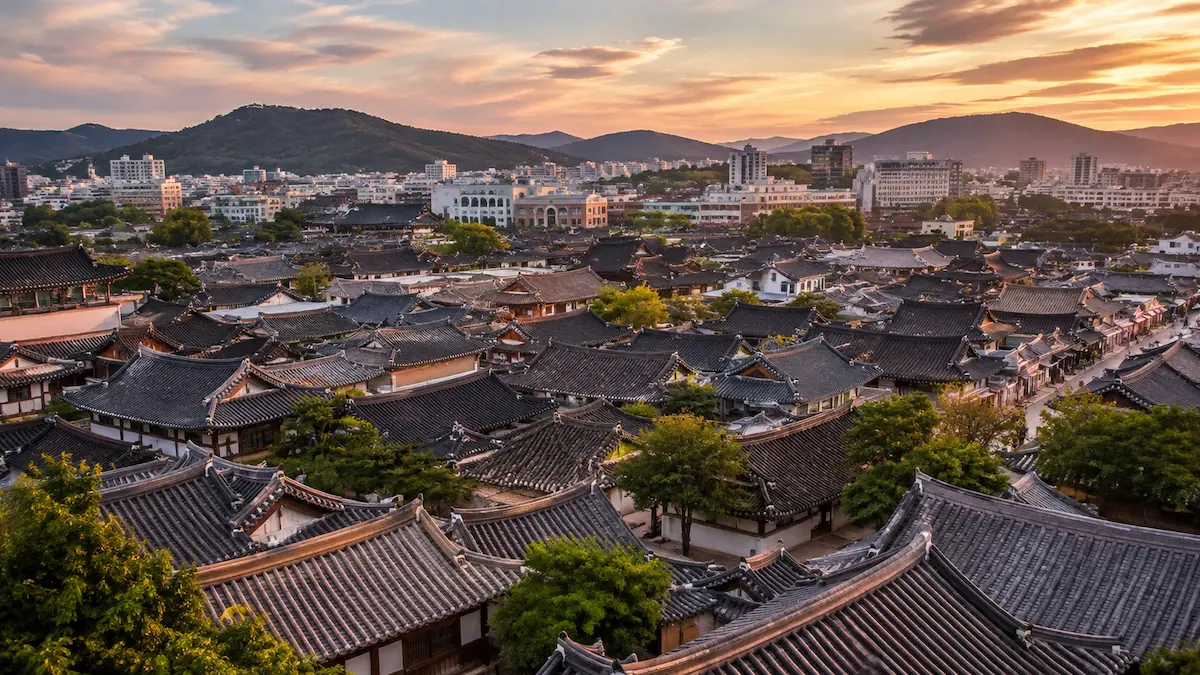
If your mental picture of Jeonju is tiled roofs, narrow lanes, hanbok rentals, bibimbap, traditional tea houses and waking up inside the historic district, this is the obvious base. Staying in Jeonju Hanok Village removes the daily commute to the city’s headline sights. You can wander out early, return to your room during the hottest part of the day, and come back outside when the lanes feel calmer in the evening.
The biggest advantage is not simply “being close to attractions.” It is having control over timing. Day visitors naturally concentrate in the busiest daylight hours. Overnight guests can experience the village before shops fully open and after many visitors have left. For photographers, couples and first-time visitors with only one night, that difference is meaningful.
It also works well for travelers who prefer to build a day around walking rather than public transport. Jeondong Cathedral, Gyeonggijeon, Omokdae, the mural-village side of the historic district and Nambu Market are all part of the same broader sightseeing zone. You will still use a taxi or bus when arriving from Jeonju Station, but once you have dropped your luggage, many of your main activities are on foot.
Who should book here? First-time visitors, couples, photographers, cultural travelers, anyone spending just one sightseeing-heavy night, and travelers who genuinely want the experience of sleeping in a hanok rather than merely taking photos of one.
Where inside the area? If you travel light and want maximum atmosphere, a guesthouse deeper inside the lanes can be lovely. If you have a roller suitcase, stroller or mobility concerns, favor the edge of the village near a vehicle-accessible road. You may sacrifice a tiny bit of postcard charm outside your door, but arrivals and departures become much easier.
✅ What Other Travelers Say
Recent guest feedback across several hanok properties shows a very consistent pattern: travelers love being able to walk straight into the village, appreciate the quiet early-morning and evening atmosphere, and often describe the traditional sleeping experience as a memorable part of the trip. Properties that combine hanok character with a clean private bathroom tend to receive especially positive comments.
But reviews also reveal why you should not book by exterior photos alone. Some guests are perfectly happy on a floor futon; others find the mattress thin. Some rooms are intentionally compact, and sound insulation can be lighter than in a modern concrete hotel. These are not necessarily defects in every hanok—they are differences you should choose knowingly.
⚠️ The Catch (Things to Keep in Mind)
The romance can become inconvenient when you add luggage, sleep sensitivity or mobility issues. Traditional-style rooms may have floor bedding, low furniture, limited storage and smaller bathrooms. Narrow streets can also mean your taxi cannot stop directly at the door. If you need a Western mattress, elevator, large suitcase space or guaranteed curbside access, filter for those features rather than assuming every “hanok hotel” provides them.
There is also a price-versus-experience question. On popular weekends, you may pay a premium for location and character while receiving less floor area than you would in Gaeksa. That can still be excellent value if the atmosphere is the reason you came. If you mainly need a comfortable room after sightseeing, a modern hotel outside the lanes may suit you better.
Bottom line: For a first Jeonju trip, Hanok Village is the strongest choice when atmosphere and walking access outrank room size. Book the specific room type, not the fantasy implied by the property photos.
🍜 Nambu Market & Pungnammun: Best for Foodies and Weekend Night Market
Feature tags: Street Food · Friday–Saturday Night Market · Hanok Edge · Good Value
Nambu Market and Pungnammun sit right beside the Hanok sightseeing zone, making this one of Jeonju’s smartest “almost inside the village” bases. The official tourism site describes Nambu Market and Pungnammun as only a few minutes on foot from Hanok Village, which is exactly why this area works: you can reach the historic lanes quickly but return to a neighborhood with a more practical market-and-city feel.
Food is the obvious draw. Nambu is a long-established traditional market, and the surrounding blocks put local snacks, casual meals and market browsing close to your room. If your stay includes Friday or Saturday evening, the night market adds a different layer of energy. Travelers who plan their day around eating rather than shopping for souvenirs may prefer this edge location to being deeper inside the Hanok Village lanes.
There is also a luggage advantage if you choose carefully. Properties near Pungnammun or a larger road can be easier for taxis to reach than guesthouses hidden in the interior lanes. You still retain easy access to Jeondong Cathedral and the western side of Hanok Village, so the compromise is small.
Who should book here? Foodies, repeat visitors, weekend travelers, budget-conscious couples, travelers who want to be close to Hanok Village without paying only for “inside the village” atmosphere, and anyone who likes stepping into a real market district in the morning.
✅ What Other Travelers Say
Traveler feedback frequently highlights the same strengths: proximity to Pungnammun, Jeondong Cathedral and Hanok Village, easy access to inexpensive food, and the convenience of having both tourist sights and everyday city functions nearby. For visitors who like browsing markets, the neighborhood feels useful rather than decorative.
Guests staying around this side of the old center also tend to appreciate that they can walk to much of the sightseeing core without being committed to a traditional floor-sleeping property. That matters for travelers who want atmosphere outside but a conventional room at night.
⚠️ The Catch (Things to Keep in Mind)
The night market is not nightly. If that is your main reason for choosing Nambu, make sure your dates include Friday or Saturday. On other evenings, the area can feel much calmer than glossy night-market photos imply.
A market district also has a different rhythm from a boutique cafe street. Some blocks are busiest earlier in the day; others wake up around evening food service. If your ideal night is cocktail bars and late cafes, Gaeksa is a better fit. If you want total silence and polished resort-style surroundings, neither Nambu nor the central historic zone should be your first choice.
Bottom line: Nambu Market & Pungnammun is the best strategic edge-of-Hanok base for food-focused travelers, especially on a Friday–Saturday stay. It gives up a little storybook immersion in exchange for practicality and local flavor.
☕ Gaeksa & Gaekridan-gil: Best for Modern Comfort, Cafes and Nightlife
Feature tags: Modern Hotels · Cafes & Bars · Central Balance · Western Beds
If you want Jeonju’s culture during the day but do not necessarily want to sleep in a traditional room, Gaeksa, Gaekridan-gil and the surrounding Jungang-dong old downtown form the most balanced base in the city. The official tourism site describes Gaekridan-gil as part of the old downtown, with cafes and restaurants growing around the Gaeksa streets, while nearby Cinema Street adds pedestrian activity and evening life.
This is where Jeonju starts to feel like a functioning contemporary city rather than a destination built around one historic quarter. You have modern hotels, familiar beds, elevators, convenience stores, cafes, restaurants and more evening choice. Hanok Village remains accessible—walkable for travelers who do not mind a longer stroll, and an easy short taxi ride when you are tired or carrying shopping.
For many travelers, this is the best overall compromise. You avoid commuting all the way from Jeonju Station, but you are not locked into the physical quirks of a traditional guesthouse. If your group includes one person who wants hanok sightseeing and another who wants a large modern bathroom and mattress, Gaeksa often ends the argument.
Who should book here? Couples who like cafes and bars, friends traveling together, solo travelers who want evening activity, anyone sensitive to floor bedding, families wanting a modern hotel, and repeat visitors who have already experienced a hanok stay.
Location strategy: Favor the side of Gaeksa/Jungang-dong that keeps you oriented toward the old downtown and Hanok Village rather than drifting too far west or north just to save a small amount. A lower room rate is not a bargain if it adds a taxi to every sightseeing block.
✅ What Other Travelers Say
Reviews of well-located modern hotels around Jungang-dong repeatedly praise the ability to walk to restaurants and central attractions, along with clean rooms and more conventional beds. Guests often describe the location as a good balance between the Hanok sightseeing area and the city’s dining and shopping streets.
This is also the area where travelers who were unsure about a traditional room tend to feel safest: the hotel experience is predictable, while Jeonju’s historic core is still close enough that you do not feel disconnected from the reason you visited.
⚠️ The Catch (Things to Keep in Mind)
Gaeksa is not Hanok Village. You will not open your window to the same roofscape, and the first few minutes of your morning are more likely to feature cafes, shops or urban streets than traditional lanes. If “sleeping inside old Jeonju” is a bucket-list experience, staying here may feel too ordinary.
Nightlife is another trade-off. Being near Cinema Street, bars and busy dining blocks is convenient until your room faces a noisy street on a weekend. Read recent room-specific noise comments and ask for a higher or quieter room if you are a light sleeper.
Bottom line: Gaeksa is my default recommendation for travelers who want the least complicated Jeonju stay. It is not the most romantic choice, but it is often the easiest place to combine sightseeing, food, comfortable sleep and manageable luggage.
🚉 Jeonju Station: Best for Early Trains, Late Arrivals and Heavy Luggage
Feature tags: KTX Access · Low Luggage Hassle · One-Night Stops · Less Tourist Atmosphere
There is one situation where staying near Jeonju Station is unquestionably sensible: when the train itself is the stressful part of your trip. A late arrival, an early KTX departure, multiple heavy suitcases, young children or a tight onward connection can make a station hotel worth more than a prettier neighborhood.
The mistake is assuming that the station is Jeonju’s sightseeing center. It is not. The Hanok Village and old downtown sit elsewhere, so a station-area stay normally means using a city bus or taxi for your main sightseeing sessions. Because Jeonju has no subway network, you cannot simply ride a metro a few stops and forget about the distance.
That does not make the area “bad.” It makes it purpose-built. Travelers arriving exhausted from Seoul can walk or take a very short ride to a nearby hotel, sleep, leave bags at reception the next morning and then head into the city. Likewise, if your KTX leaves early, returning to the station area the night before removes the risk of a traffic delay at the worst possible moment.
Who should book here? One-night rail stopovers, late arrivals, early departures, business travelers, people with bulky luggage, families prioritizing transfer simplicity, and anyone whose Jeonju visit is only one piece of a multi-city train itinerary.
✅ What Other Travelers Say
Recent hotel reviews near Jeonju Station consistently praise transportation convenience: guests like being close to the train, having bus stops nearby and avoiding a cross-city transfer with luggage. This is exactly the benefit you are paying for.
For travelers who arrive late, the area can also feel reassuringly straightforward. You are not trying to locate a small guesthouse in unfamiliar historic lanes after dark; you are simply getting off the train and checking in.
⚠️ The Catch (Things to Keep in Mind)
You will trade sightseeing convenience for transport convenience. If your itinerary is two full days of Hanok Village, cafes and old-town food, repeatedly returning to the station area is inefficient. A cheap station hotel can end up costing more in time and taxi fares than a slightly pricier central room.
There is a second, current consideration: Jeonju Station is in the middle of a major improvement project in 2026, with completion pushed beyond the original schedule. Construction does not stop the station from functioning, but the surrounding environment may be less attractive or frictionless than finished-station photos suggest.
Bottom line: Choose Jeonju Station because you need the train—not because the word “station” sounds central. For an ordinary two-night sightseeing trip, Hanok Village or Gaeksa usually saves more time overall.
🌿 Deokjin Park & Jeonbuk National University: Best for Quiet Local Stays and Value
Feature tags: Local Feel · Park Walks · Student Eats · Quieter Nights
Deokjin Park and the Jeonbuk National University area are for travelers who are willing to give up doorstep access to Hanok Village in exchange for a more local, spacious and slower-feeling base. The park is one of Jeonju’s best-known green spaces and is particularly associated with its lotus scenery, while the university adds inexpensive restaurants, cafes and student-oriented services to the surrounding district.
This area makes more sense on a longer stay than on a one-night first visit. If you have three or more nights, are visiting the university, want morning park walks, or simply dislike staying in the thick of a tourist zone, the change of pace can be refreshing. You can visit the historic core by bus or taxi during the day and return to a neighborhood where normal local life is more visible.
It can also be attractive for travelers who care about room value. Modern lodging away from the most famous tourist blocks may give you more space or parking for the same budget, although hotel quality varies and should be judged property by property.
Who should book here? Longer-stay travelers, repeat visitors, university visitors, people with a car, budget-focused travelers who want modern rooms, and anyone who values parks and quiet mornings more than instant access to the historic center.
✅ What Other Travelers Say
Visitors commonly praise Deokjin Park for relaxed walks and seasonal scenery, and hotel guests in the surrounding area often value the quieter location, access to the university district and easier parking. For travelers who have already seen Jeonju’s headline sights, this part of town can feel more lived-in and less staged.
The university presence is a practical bonus: casual meals and cafes tend to be easier to find without paying for a tourist-zone setting, which can matter on a multi-night stay.
⚠️ The Catch (Things to Keep in Mind)
The distance is real. You should not stay here and then complain that Hanok Village is not outside your door. This is a deliberate trade: quieter surroundings and local atmosphere in exchange for buses or taxis to the historic core.
Hotel standards are also less uniform than the neighborhood label might suggest. Some properties earn strong comments for cleanliness, views and convenience; others are more functional than stylish. Read recent reviews carefully instead of assuming “near the park” guarantees a scenic or upscale room.
Bottom line: Deokjin is a good alternative for the right traveler, but not the default first-timer choice. Pick it when the park, university, parking or local pace is part of your plan—not simply because the room is cheaper.
Key FAQs
What is the best area to stay in Jeonju for first-time visitors?
For most first-time visitors, Jeonju Hanok Village is the best area if atmosphere and walking access are the priorities. You can experience the historic lanes early and late without commuting. If you want a Western bed, bigger room, elevator and livelier modern evenings, Gaeksa is the better all-round alternative while still keeping the main sightseeing zone accessible.
Is it better to stay near Jeonju Station or Jeonju Hanok Village?
Stay near Jeonju Station if you have a late train, early departure, tight connection or heavy luggage. Stay near Jeonju Hanok Village if the purpose of your trip is sightseeing. The station is not the historic center, and because Jeonju does not have a subway system, staying there means relying more on buses or taxis whenever you head to the old town.
How many nights should I stay in Jeonju, and is a hanok stay worth it?
One night can cover the highlights if your schedule is tight, while two nights gives you a much better pace for food, cafes and seeing the Hanok Village outside peak daytime hours. A hanok stay is worth it if you genuinely want the traditional experience and are comfortable with the room’s actual bedding and layout. If floor sleeping sounds uncomfortable, do not force it for the photo—stay in a modern hotel and spend your days exploring traditional Jeonju instead.
Final Verdict and Your Next Step
If this is your first visit and you want Jeonju to feel different from another Korean city break, book Hanok Village—but inspect the room details carefully. If you want the easiest balance of sightseeing, proper beds, cafes and nightlife, book Gaeksa. Food-first travelers visiting on Friday or Saturday should seriously consider Nambu Market & Pungnammun. Use Jeonju Station when train logistics dominate the trip, and choose Deokjin Park & Jeonbuk National University when you deliberately want a quieter, more local base.
For a normal two-night trip, I would choose one base and keep it. Moving hotels within Jeonju usually creates more luggage work than benefit. The decision I would make for most travelers is simple: Hanok Village for atmosphere; Gaeksa for comfort and flexibility.
Once your dates are fixed, book a cancellable room early—especially for weekends, holidays and festival periods—then keep an eye on rates. The best-located rooms are the ones that save you taxi rides, long walks with luggage and wasted sightseeing time, so the cheapest room on the map is not always the cheapest trip.