



💡 Key Takeaways
- The 100-baht Phuket Smart Bus is the value winner for solo travelers staying along the west coast, but it is not a door-to-door service and its timetable matters more than the low fare.
- Do not assume every “airport bus” goes to Patong. Bus 8411 is primarily the airport-to-Phuket-Town service; the Smart Bus is the one designed for Patong, Karon, Kata and Rawai.
- For two or more people with luggage, compare the total price—not the headline fare. A pre-booked transfer or app ride can be worth the premium when it removes a long walk, a transfer and an hour of uncertainty after a late flight.
Last checked: August 2026. Fares, pickup zones and bus timetables can change, so use the official links in this guide for a final same-day check.
A good Phuket transportation guide needs to start with one uncomfortable truth: Phuket is not a compact beach town where everything is ten minutes away. The airport is in the north, Phuket Old Town is on the southeast side of the island, and Patong, Karon, Kata and Rawai stretch down the west and south coasts. A transport choice that looks cheap on paper can become a miserable one if it leaves you dragging a suitcase along a hot roadside, waiting an hour for the next bus or backtracking through Phuket Town just to reach the next beach.
The good news is that you do not need to rent a scooter to enjoy Phuket, and you do not need to pay taxi prices for every trip either. The trick is to use different modes for different jobs: public transport when the route lines up with your hotel, ride-hailing for awkward cross-island journeys, and a pre-booked transfer when your arrival time or luggage makes certainty more valuable than saving a few hundred baht.
The 1-Min Cheat Sheet
- Phuket Smart Bus — best budget choice for Airport → Surin/Kamala/Patong/Karon/Kata/Rawai: 100 THB flat fare on Route 1. Excellent for solo travelers and light luggage. Poor choice if your hotel is far uphill or well away from the main road.
- Airport Bus 8411 — best for Airport → Phuket Old Town / Phuket Town: up to 100 THB. Air-conditioned and straightforward if the town is your actual destination. It is not the bus I would use for a direct beach-hotel arrival.
- Grab, Bolt, airport taxi or private transfer — best for luggage, families and late arrivals: costs more, but usually wins on door-to-door convenience. Compare the live app quote against the airport counter or your pre-booked rate before committing.
- Blue songthaews/local buses — best for very cheap daytime trips between Phuket Town and beaches: often around 30–50 THB. Great when the route fits; frustrating when it does not, because the network is town-centered rather than a simple beach-to-beach grid.
- Rental car or scooter — best for maximum freedom: only worth it if you are legally licensed, properly insured and genuinely confident in Phuket traffic. A scooter is not a sensible “money-saving hack” for an inexperienced rider.
Top Survival Tips
- Match your airport bus to your hotel area before you land. For Patong, Karon, Kata or Rawai, look first at the Phuket Smart Bus. For Phuket Town or Old Town, Bus 8411 is usually the cleaner fit. Mixing these up can add an unnecessary transfer.
- Do not buy an unlimited Smart Bus pass just because “unlimited” sounds convenient. Route 1 costs 100 THB per single ride. The official 2026 passes are 299 THB for 1 day, 499 THB for 3 days, 799 THB for 7 days, 1,000 THB for 10 days and 1,990 THB for 30 days. In pure fare terms, the pass only starts beating single tickets at roughly 3 rides in one day, 5 rides in three days, 8 rides in seven days, 11 rides in ten days or 20 rides in thirty days. If you plan to spend most days on one beach, pay as you go.
- A cheap bus is only cheap if the final walk is reasonable. Before choosing it, pin your hotel and the nearest stop on Google Maps. A 700-meter flat walk with a backpack is fine; the same distance uphill in 32°C heat with two suitcases is a different decision.
- Do not trust old blog posts for the last bus. The current Smart Bus timetable is not the same as many older guides still circulating online. Check the official Phuket Smart Bus timetable and, when possible, its live GPS tracker on the day you travel.
- At Phuket Airport, follow the transport mode’s actual pickup instructions—not the nearest person calling “taxi.” AOT lists bus, taxi, limousine, rental car and Grab among arrival transport options. Ride-hailing pickup points can move, so the live app directions should beat an old screenshot.
- Screenshot your destination in Thai and English. This is especially useful for smaller hotels, villas, piers and hillside properties. Many misunderstandings are not scams; they are simply two people using different place names.
- Use Grab or Bolt as a price reference even if you plan to take a tuk-tuk. Phuket tuk-tuks are fun, but they are not metered. Knowing the app price gives you a reality check before agreeing to a fare.
- Build a traffic buffer into airport runs. Phuket’s beach roads and approaches to Patong can slow badly. For a departure flight, I would rather spend extra time airside than gamble on a perfect drive time from Kata, Karon, Patong or Rawai.
- Do not rent a scooter because taxis feel expensive. Foreign visitors need a licence valid for use in Thailand; official Thai guidance recognizes an International Driving Permit under the applicable convention, and the Royal Thai Embassy also advises carrying it together with your passport and national licence. For a motorcycle, your licence/permit must actually cover motorcycles.
The Full Experience
🚌 Phuket Smart Bus: Best Cheap Ride from the Airport to the West-Coast Beaches
Best for: Solo travelers, light luggage, Patong/Karon/Kata/Rawai stays · Fare: 100 THB flat on Route 1 · Comfort: Air-conditioned · Verdict: Best value when your hotel is near the route
This is the first option I would check for a budget arrival to Phuket’s west coast. The official Route 1 runs from Phuket International Airport through Cherng Talay, Surin, Kamala, Patong, Karon and Kata before continuing toward Rawai and Promthep Cape. The fare is currently a flat 100 THB, so a solo traveler can save a substantial amount compared with a private car.
The bus is also easier to pay for than many first-timers expect. Phuket Smart Bus currently accepts contactless Visa, Mastercard and JCB, as well as Apple Pay, Google Pay, Thai PromptPay and cash. Exact cash is appreciated. Children under six ride free with a paying adult. You can verify the current options on the official payment page.
The practical issue is not the fare; it is the timetable and the last-mile walk. The official 2026 timetable currently shows roughly hourly Route 1 departures, with Airport → Rawai service published from 06:30 to 17:30 and Rawai → Airport from 06:00 to 17:00. Traffic can shift actual arrival times, which is why the operator itself recommends checking live tracking. If your flight lands in the evening, do not build your plan around an old article claiming the bus runs late into the night.
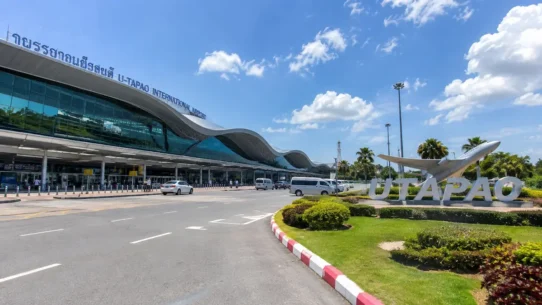
Airport survival detail: Phuket Airport’s own transport information places the Smart Bus at the Domestic Terminal area near the arrivals side. If you arrive internationally, expect a short terminal-to-terminal walk rather than assuming the first curb outside customs is your stop. Follow the current Smart Bus/AOT signs once landside.
✅ What Other Travelers Say
Recent traveler reports are very consistent on the core trade-off: the Smart Bus is repeatedly praised as the 100-baht budget choice to Patong and other west-coast stops, especially for solo travelers, while users also warn that it can take much longer than a car. One recent Patong-to-airport report described a journey of almost 90 minutes despite the bus reaching the Patong stop close to schedule. That is exactly how I would frame it: excellent value, but not something to use with a tight flight connection.
⚠️ The Catch (Things to Keep in Mind)
The bus does not take you to your hotel lobby. In Patong, Kata or Karon, the “last 500 meters” can be the part that ruins the experience if your property sits uphill, down a side road or across a busy multi-lane street. Also remember that Route 1 is a north-south coastal service; it is not a magical island-wide pass. If your sightseeing plan repeatedly cuts across the island to Old Town, Chalong or remote viewpoints, unlimited rides may still be poor value because the route itself is wrong for your itinerary.
Pass verdict: buy a Route 1 pass only after counting realistic rides, not hypothetical ones. The 1-day 299 THB pass is barely cheaper than three 100-baht rides. The 3-day 499 THB pass only wins once you reach five rides. For a typical beach holiday with an airport ride on Day 1, one beach-change day and a return to the airport several days later, single fares are often the smarter buy.
🟠 Airport Bus 8411: Best for Phuket Town and Old Town, Not the Beach Strip
Best for: Phuket Town/Old Town · Fare: Up to 100 THB · Frequency: Multiple daily departures · Verdict: Excellent if the town is your destination
Bus 8411 is the option many first-time visitors accidentally confuse with the Smart Bus. Its core job is simple: connect Phuket International Airport with Phuket Town and Bus Terminal 1. The current official fare table charges 100 THB for the full airport-to-town journey, with cheaper 30–70 THB intermediate fares on shorter sectors.
The 2026 timetable is much broader than the Smart Bus Route 1 timetable. The official schedule currently lists airport departures from 06:30 through 22:30 and Bus Terminal 1 departures from 05:00 through 20:00. Scheduled end-to-end running times are roughly 75–100 minutes depending on the departure, before allowing for unusual traffic.
One small but important airport detail is easy to miss: the operator states that the airport stop is directly at the departure terminal. If you walk out of arrivals and stand at the first bus-looking curb you see, you may be waiting in the wrong place. Check the current stop instructions on Airport Bus Phuket before you start walking with luggage.
✅ What Other Travelers Say
Travelers who use the service for the job it was designed to do generally describe it as an inexpensive, convenient connection to town. The recurring complaints are less about the fare and more about waiting, schedule uncertainty and service experience. In other words, it works best for travelers who have time and know exactly where they are getting off—not for someone landing exhausted and still unsure whether their hotel is in Phuket Town, Patong or “Phuket” more generally.
⚠️ The Catch (Things to Keep in Mind)
“Phuket” on a hotel booking does not mean Phuket Town. If your hotel is in Patong, Karon, Kata, Kamala or Rawai, taking 8411 into town can send you away from the simplest route and force another transfer. The bus website lists connecting points to beach areas, but that is not the same thing as a one-seat airport-to-beach ride.
For Old Town, however, this bus makes a lot of sense. It stops around central Phuket Town areas including Rang Hill, the district office/Soi Rommanee area and Bus Terminal 1. If your hotel is walkable from one of those stops, this can be one of the cleanest low-cost airport transfers on the island.
🚕 Grab, Bolt, Airport Taxi and Private Transfer: Best for Door-to-Door Certainty
Best for: Families, groups, heavy luggage, late arrivals · Fare: Dynamic or pre-booked · Comfort: Highest · Verdict: Pay more when certainty saves a bad first night
This is where “cheapest” and “best value” stop being the same thing. If you are two adults with two large suitcases, a toddler and a hotel ten minutes uphill from the Smart Bus stop, paying for a car can be the rational budget decision because it removes a bus wait, a hot walk and a second local ride.
Phuket Airport’s official arrival information lists Grab among its transport options, and Grab has documented an official airport pickup system with in-app directions. Bolt also currently advertises Phuket Airport pickup, but states that HKT pickup points may change and should be checked inside the app. That is the right mindset for any ride-hailing service at an airport: trust the live pickup pin and signage, not a two-year-old blog screenshot.
For comparison, one AOT-listed airport limousine/minibus operator currently publishes reference fares of 650 THB to Phuket Town, 800 THB to Patong, 1,000 THB to Kata and 900 THB to Rawai. Treat those as that operator’s published rates, not as a universal island-wide taxi tariff. App prices vary with demand, vehicle type, traffic and pickup conditions.
A pre-booked private transfer is the option I like most for a first visit after a long-haul flight, especially if you land late, travel as a family or need a child seat/large vehicle. The real value is not luxury. It is knowing that someone is expecting your flight, you have a defined meeting process, and you are not price-shopping while jet-lagged.
✅ What Other Travelers Say
Recent Klook airport-transfer reviews repeatedly praise drivers arriving on time or early, clean vehicles and easy coordination at the meeting point. Current Phuket discussions also tend to describe Grab as straightforward but often pricier, while Bolt can be cheaper but more variable depending on pickup location and driver acceptance. Keeping both apps installed gives you a useful live comparison instead of assuming one service is always cheaper.
⚠️ The Catch (Things to Keep in Mind)
Do not accept an app ride and then casually agree to a much higher cash price outside the app. Recent traveler reports describe occasional airport pickup friction and drivers asking for more than the displayed Bolt fare. If the terms change, cancel through the app and use another option rather than turning a transparent quote into an unrecorded negotiation.
Also compare per vehicle, not per person. Four people paying 100 THB each for a bus may only be a few hundred baht away from a direct private car after you account for a last-mile taxi. For a group, the convenience premium can shrink quickly.
🚍 Blue Songthaews and Local Buses: Best for Cheap Daytime Trips from Phuket Town
Best for: Budget sightseeing, Phuket Town ↔ beach routes · Typical fare: About 30–50 THB · Comfort: Basic/open-air · Verdict: Brilliant when the route lines up, clumsy when it does not
The blue local buses—often called songthaews—are one of Phuket’s best bargains and one of its easiest systems to misunderstand. They generally radiate out from Phuket Town toward beach areas rather than forming a neat network linking one beach directly to the next. That explains the classic first-timer mistake: looking at Kata and Patong on a map, seeing they are both on the west coast and assuming the cheapest bus will simply run along the coast between them.
Current local guides put typical fares around 30–50 THB, and services are primarily useful in daylight. Vehicles are basic and often open-sided, with no expectation of air-conditioned coach comfort. On the right day, that is part of the charm; with luggage in heavy rain, it is not.
The biggest advantage is that you can move between Phuket Town and major beach areas for a fraction of a taxi fare. The biggest disadvantage is route geometry. If the direct local route does not exist, the “cheap” solution may require going back toward Phuket Town and then outward again.
✅ What Other Travelers Say
Budget travelers consistently describe the blue songthaew as one of the cheapest ways to get around, with recent discussions quoting around 40 THB for some trips. Travelers who enjoy it tend to be flexible on time and comfortable asking where to board. People in a hurry are less enthusiastic because waiting and route changes can erase the savings.
⚠️ The Catch (Things to Keep in Mind)
Do not design a packed sightseeing day around a chain of perfectly timed songthaews. Frequencies and stopping behavior are not metro-like, and Google Maps may not model every local movement perfectly. Use them for one or two low-stakes daytime legs, then switch to Grab/Bolt when a missed connection would cost you a sunset, ferry or dinner reservation.
And remember: Phuket Town is the hub. This one fact explains most of the network. If you are staying in Old Town, local buses become far more useful. If you are beach-hopping all day between Kamala, Patong, Karon and Kata, the Smart Bus or ride-hailing is usually easier.
🛺 Phuket Tuk-Tuks: Best for Short, Fun Rides—Not Budget Commuting
Best for: Short evening rides, small groups, the experience · Typical fare: Often 200–400 THB for short beach-area trips · Meter: No · Verdict: Fun once; expensive as your default transport
First surprise: Phuket tuk-tuks are usually not the tiny three-wheeled vehicles associated with Bangkok. Here you will commonly see brightly colored modified mini-trucks with bench seating, sometimes with lights and loud sound systems. They are easy to find around Patong and other tourist centers and can be genuinely convenient for a short hop when you do not want to wait for an app car.
The key rule is simple: agree the total fare before you get in. Phuket tuk-tuks are not metered. A current Phuket transport guide written by a long-term local source puts many short trips within a beach area around 200–400 THB and longer inter-beach rides around 500–800 THB or more. Those are realistic reference ranges, not guaranteed tariffs.
✅ What Other Travelers Say
Travelers tend to split into two camps. Some love the convenience, music and novelty, especially when a group can split the fare. Others complain that tuk-tuk quotes are far above Grab or Bolt for the same short trip. Recent Phuket traveler reports include examples where an app ride cost well under half the tuk-tuk quote on a similar route.
⚠️ The Catch (Things to Keep in Mind)
Do not start the ride with “How much?” left unresolved. State the destination, confirm whether the price is for the whole vehicle, and repeat the agreed total before boarding. If the quote feels high, check Grab/Bolt and politely walk away. The goal is not to win a five-minute negotiation; it is to avoid a five-minute argument at the destination.
Tuk-tuks make more sense for three or four friends splitting a short nighttime ride than for a solo traveler using them six times a day. If you want the experience, take one deliberately. Do not accidentally turn the experience into your transport budget.
🚗 Rental Car or Scooter: Best for Freedom, Only If You Are Properly Licensed and Confident
Best for: Remote beaches, families, multi-stop days · Freedom: Highest · Risk: Highest on a scooter · Verdict: Car for confident drivers; scooter only for experienced licensed riders
A rental vehicle changes Phuket completely. You can reach viewpoints early, stop at quieter beaches, leave when rain starts and avoid stacking app fares throughout the day. Phuket Airport has multiple rental companies on site, making airport pickup and return straightforward for travelers who want a car for the whole stay.
For most first-time visitors who want independence, I would choose a car over a scooter if the budget allows. You get weather protection, luggage space and a much larger safety margin. The downsides are traffic, parking in busy areas such as Patong and Old Town, and the stress of driving on unfamiliar roads.
A scooter is cheaper and easier to park, but that does not make it beginner-friendly. Thai government guidance says foreign tourists wishing to drive must hold a licence valid for use in Thailand, such as an accepted International Driving Permit where applicable. The Royal Thai Embassy additionally advises carrying the international permit with your passport and national licence. If you are riding a motorcycle, the licence entitlement needs to cover motorcycles; a car-only licence does not become a motorcycle licence because a rental shop hands you a key.
✅ What Other Travelers Say
Experienced riders often say a scooter is the fastest way to unlock Phuket’s smaller roads and short-distance freedom. At the same time, even positive traveler reports usually add the same qualifier: they were already comfortable riding. That distinction matters. “Everyone rents one” is not evidence that learning to ride in Phuket traffic is a good holiday plan.
⚠️ The Catch (Things to Keep in Mind)
Wear a proper helmet, confirm your insurance actually covers the vehicle class you are riding, photograph the rental vehicle before departure and do not treat police checks as the main risk. The bigger risks are wet roads, steep gradients, blind corners, unfamiliar left-side traffic and other drivers. If you have to ask whether Phuket is a good place to learn to ride, my answer is no.
Which Phuket Transport Passes Are Actually Worth Buying?
Phuket is not a city where every visitor needs a transport card. There is no single island-wide pass that magically covers Smart Bus, songthaews, Grab, Bolt, tuk-tuks and airport buses. Treat each system separately.
For Smart Bus Route 1: single rides cost 100 THB, while unlimited passes cost 299 THB for 1 day, 499 THB for 3 days, 799 THB for 7 days, 1,000 THB for 10 days and 1,990 THB for 30 days. The 1-day pass makes sense for an intentional bus-hopping day—say Patong → Kata → Rawai → back north—not for a beach day with one outbound and one return ride.
For Smart Bus Route 2 (Bus Terminal ↔ Patong): the single fare is currently 50 THB. The official pass page lists 159 THB for 1 day, 299 THB for 3 days, 499 THB for 7 days, 699 THB for 10 days and 1,590 THB for 30 days. A one-day Route 2 pass only beats paying 50 THB per ride once you make four rides, so again, do the arithmetic before buying.
For most first-time tourists: I would start with pay-as-you-go fares and only buy a pass after the first day if your real behavior proves you are using the same bus repeatedly. It is better to spend an extra 1–50 baht because you underestimated usage than to buy “unlimited” access to a route you barely use.
Airport Arrival Playbook: What I Would Choose by Situation
- Solo traveler landing before late afternoon, hotel near Patong/Karon/Kata main road: Smart Bus first.
- Solo traveler staying in Phuket Old Town: Airport Bus 8411 first.
- Couple with two large suitcases staying in a hillside hotel: compare Grab/Bolt with a pre-booked transfer; the door-to-door premium is often worth it.
- Family of four after a long-haul flight: pre-book a private transfer or take an official airport car. Splitting the cost across four people makes the convenience easier to justify.
- Arrival after the Smart Bus has finished: do not improvise around a timetable that no longer operates. Use an app, airport taxi or booked transfer.
- Hotel says “Phuket” but you are not sure where it is: confirm the actual neighborhood before choosing transport. “Phuket” can mean the province, island, city or a hotel marketing label.
Key FAQs
What is the cheapest way to get from Phuket Airport to Patong Beach in 2026?
For most solo travelers, the Phuket Smart Bus is the cheapest straightforward option at 100 THB on the Airport–Patong–Karon–Kata–Rawai route. It works best when your flight arrives during operating hours and your hotel is within a manageable walk of the stop. If you are a group of three or four, compare the total bus cost plus any last-mile ride against a direct car before deciding.
Is Grab or Bolt better for getting around Phuket?
Keep both. Grab has a well-documented airport pickup setup and is often the easier choice when reliability matters, while Bolt can show lower fares on many island trips. Prices and driver availability change by time and location, so the smartest habit is to compare both apps for the same route. At the airport, follow the live pickup instructions in the app because designated pickup areas can change.
Can I get around Phuket without renting a scooter?
Yes. A practical no-scooter strategy is Smart Bus for airport/west-coast travel, Bus 8411 for the airport-to-town corridor, songthaews for cheap daytime town-to-beach trips, and Grab/Bolt for awkward cross-island legs or nighttime travel. It may cost more than a scooter on paper, but it removes licensing, insurance, parking and road-safety concerns.
Final Verdict and Your Next Step
For a first Phuket trip, I would not try to find one transport mode that does everything. Use the Smart Bus when the route is naturally on your way, use 8411 when Phuket Town is the destination, and pay for a door-to-door car when luggage, timing or a difficult hotel location makes the bus false economy. Save the blue songthaew for flexible daytime exploring, and treat tuk-tuks as a convenient experience rather than your default budget option.
The decision I would make before flying is the airport transfer. That first ride has the most luggage, the least local knowledge and the highest chance of a tired mistake. If your arrival is late, you are traveling with children, or your hotel is not an easy walk from a bus stop, book the transfer in advance and remove the problem completely.
Book or compare before you land:
- Check Phuket Airport private transfers on Klook
- Check Phuket Airport private transfers on KKday
- Compare Phuket hotels on Booking.com — before booking, zoom in on the exact hotel location and check its distance from the bus stop you plan to use.
- Compare Phuket hotels on Agoda — useful for checking whether a cheaper hotel will quietly cost you more in daily transport.
One final rule: in Phuket, location is part of your transport budget. Paying slightly more for a hotel that is walkable to the beach, restaurants and a useful bus stop can save more money—and far more holiday time—than chasing the cheapest room rate on the other side of the island.
Official references checked for this guide: Phuket Smart Bus, Airport Bus Phuket 8411, Phuket International Airport transportation, and Thailand government driving-licence guidance. Always recheck same-day operating times before a flight-critical journey.