
💡 Key Takeaways
- Check the arrival station on your ticket. This guide starts at Krung Thep Aphiwat Central Terminal, also called Bang Sue Grand Station; Hua Lamphong is a different station, closer to Chinatown.
- Use MRT Bang Sue for hotels near the Blue Line. For Siam, an MRT-to-BTS connection can work well. Khao San Road and many riverside hotels need a less direct final connection.
- With several people, bulky luggage or an arrival outside rail hours, compare the total group rail cost and walking with one suitable taxi or app-booked car. Road travel remains vulnerable to congestion.
Working out how to get from the main station to Bangkok city center is less about finding a single express train and more about identifying your hotel’s real location. Bangkok has several centers: Siam’s shopping district, Sukhumvit’s hotel corridor, Silom and Sathorn, Chinatown and the historic Old Town. They do not share one ideal arrival route.
This guide starts at the railway terminal. If you have arrived on a sleeper or intercity train, confirm the station printed on the ticket before ordering a car. Arrivals at Suvarnabhumi or Don Mueang Airport need airport-specific directions instead.
Research checked in October 2026. Times below are planning allowances, including typical station access and connections where stated, not guaranteed timetables. Fare allowances are budgets rather than live quotes. Approximate USD conversions use US$1 ≈ THB 33.5, rounded from the Bank of Thailand’s September 24, 2026 published rates; see the official exchange-rate page.
First, Which “Main Station” and Which City Center?
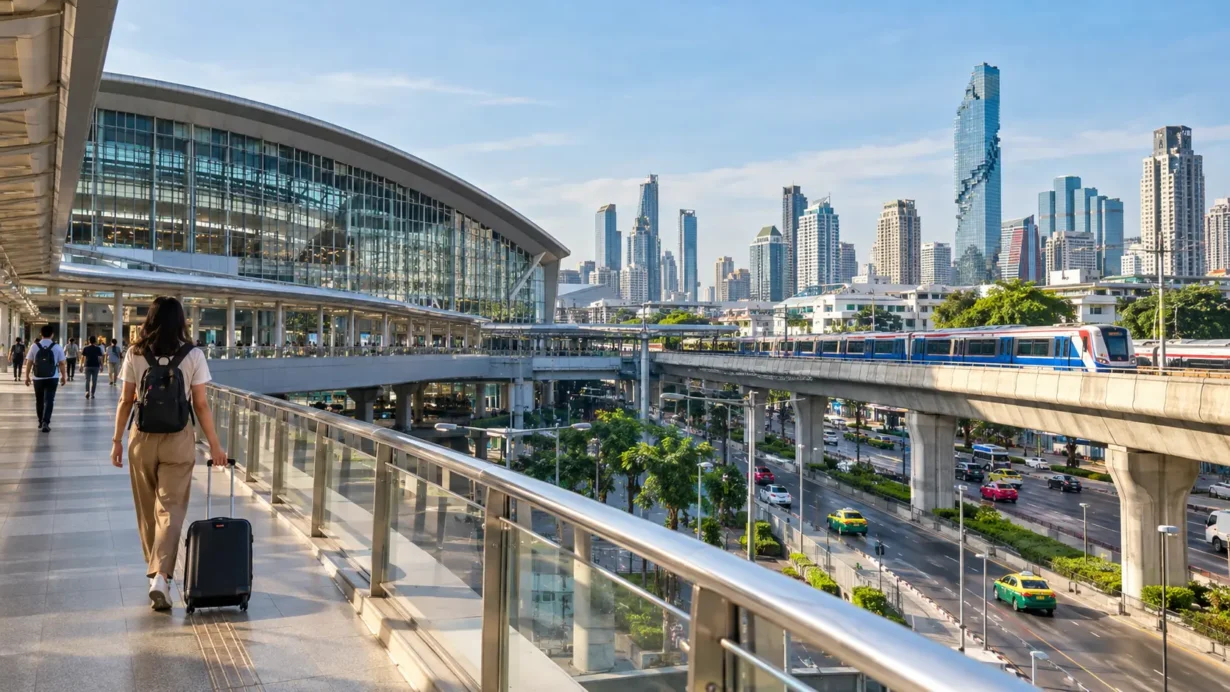
Krung Thep Aphiwat Central Terminal is the station addressed here. It is north of the main tourist hotel districts. The State Railway of Thailand’s official timetable distinguishes Bangkok (Krung Thep Aphiwat) from Bangkok (Hua Lamphong). Your train’s ticket and current timetable are the deciding evidence.
Hua Lamphong remains a separate arrival point. If your ticket says Hua Lamphong, you are already near Chinatown and have an MRT station of that name. Do not travel north to Krung Thep Aphiwat simply to follow these directions. Similar station names on a map do not mean the same entrance.
The 1-Min Cheat Sheet
- Direct MRT Blue Line: best for a hotel genuinely near Sukhumvit/Asok, Si Lom, Sam Yan or Chinatown. Set aside THB 50, about US$1.50, per person for the MRT ticket; the actual fare depends on destination. Allow roughly 45–75 minutes from the intercity arrival area to many central hotels, with substantial variation for walking.
- MRT plus BTS: useful for Siam, Ratchathewi, Chit Lom and some Sukhumvit hotels. A THB 100 allowance, about US$3 per person, gives a simple starting budget for the two rail tickets on a central journey. Allow around 45–75 minutes and check both operators’ actual fares and last trains.
- Metered taxi: practical for a small group, Khao San Road or a hotel far from rail. Use THB 150–400, about US$4.50–12, as a broad central-city planning allowance per car, before any applicable extras. A 25–60 minute road journey can become much longer in bad traffic; add time to find the queue.
- App-booked car: useful when you want the destination entered before boarding. Compare the live fare and vehicle size in the app. THB 200–500+, about US$6–15+, is a conservative planning envelope per car rather than a quote. Waiting, demand, tolls and the specific product affect the result.
Rail allowances are deliberately rounded for planning. Consult MRTA’s official fare information and the BTS route and fare planner before travel. A pass or payment card for one system does not automatically cover a separate network.
Top Survival Tips
- Save the hotel pin and Thai address. Similar hotel names and long roads make a neighborhood name inadequate. Check the correct branch, entrance and nearest useful station before you arrive.
- Follow MRT signs inside the terminal. The station is large. Do not assume the shortest outdoor route shown by a mapping app is the correct pedestrian connection. Ask staff for the accessible route if you need lifts.
- Budget for the final walk. A station can be convenient for sightseeing but awkward for a particular hotel entrance. Check crossings, pavements, heat and rain rather than relying only on straight-line distance.
- Check first and last trains for your direction. An early sleeper arrival can precede metro operation. Near the end of service, both legs of an MRT–BTS journey must still be running. Use the operator’s station information, not a general “midnight” assumption.
- Compare a group fairly. Three separate two-system rail tickets can narrow the gap with a car. Suitcases also need boot space; three passengers and three large cases may require a larger vehicle.
- Prepare mobile data and payment. Set up a ride app before arrival and keep small baht notes available. Avoid waiting until a driver has arrived to discover that your selected payment method fails.
The Full Experience
🚇 MRT Blue Line: Best for Asok, Silom and Chinatown Hotels Near a Station
Traffic-independent journey • Low fare per person • Final walk matters
Video context: TinWanders’ 2025 walk shows the connection in the reverse direction, from Bang Sue MRT to the terminal. Use it to recognize the setting; follow current signs for your direction.
From the intercity arrival area, follow signs to MRT Bang Sue, station BL11. BEM’s official Bang Sue station information identifies exit 3 with the grand station and lists lifts at exits 1 and 3. Allow time for the terminal walk rather than treating the train’s arrival time as your metro boarding time.
For Sukhumvit, Si Lom, Sam Yan, Hua Lamphong or Wat Mangkon, use the Blue Line direction through Chatuchak Park and Sukhumvit. Confirm the platform with staff or the map. The line’s shape can make an apparently plausible opposite direction less convenient. Stay aboard for your chosen station, then follow the correct exit toward your hotel.
This suits one or two people traveling light during busy road hours. “Sukhumvit” covers a long hotel corridor, though; a property in a deep side street can add a tiring final leg.
✅ What Other Travelers Say
A 2025 traveler discussion about the station walk describes confusing map directions and a long outdoor detour. That is a dated anecdote, not evidence that the detour is necessary; the practical lesson is to locate the signed connection instead of following an unverified road route.
⚠️ The Catch (Things to Keep in Mind)
A cheap ticket does not eliminate walking, security checks or station exits. If you need step-free access throughout, check the exit at the destination as well as Bang Sue. Do not assume every entrance is equally suitable for a suitcase.
🚆 MRT and BTS: Best for Siam and Hotels on the Skytrain Corridor
Broader hotel coverage • Separate tickets • One purposeful interchange
Video context: this 2019 BTS/MRT guide provides general visual orientation. It predates current fares and some network changes; do not copy its prices or assume screens remain identical.
For Siam and nearby Sukhumvit Line stops, a useful route is MRT Bang Sue to Chatuchak Park, then the pedestrian interchange to BTS Mo Chit and a train toward Siam. For a hotel farther east, compare that route with staying on MRT to Sukhumvit and changing to BTS Asok. The official network map shows the connections.
Choose the interchange around the hotel. Allow for leaving one paid area, buying another ticket and finding the connection. One planned interchange with a compact case is manageable; two unnecessary changes after a night train are harder to justify.
✅ What Other Travelers Say
A traveler forum question about transferring with a suitcase highlights that the easiest interchange depends on where the journey starts. It is not a representative review survey. For your arrival, the useful comparison is the number of level changes and the final walk to your own hotel.
⚠️ The Catch (Things to Keep in Mind)
Two low fares still add up across a group, and a BTS pass does not remove the MRT fare. Crowded periods can make a suitcase inconvenient even when the route is technically straightforward. Check the final train on both systems if arriving late.
🚕 Metered Taxi: Best for Khao San Road, Doorstep Access and Small Groups
Door-to-door • Fare shared by the car • Traffic risk
Video context: Learn Thai with Mod’s taxi-language lesson covers communication, including asking about the meter. It is not a terminal pickup walkthrough or a current fare guide.
Follow the terminal’s current taxi signs and use the designated pickup arrangement. Show the full hotel address and confirm metered charging before the journey starts. Ask about any separate charge and discuss toll-road use if suggested. The Thai government’s taxi-fare information explains that Bangkok metered fares have distance and traffic-related components; a whole-trip quote cannot be inferred from the starting meter charge alone.
A taxi deserves serious consideration for Khao San Road, where rail still leaves a final connection, or for a riverside property whose entrance is far from the nearest station. Tell the driver the hotel, rather than requesting an abstract “city center.”
✅ What Other Travelers Say
A 2025 discussion of Bangkok metered taxis contains contrasting experiences about finding drivers willing to use the meter. Treat those accounts as individual experiences. Confirm the payment arrangement yourself and choose another authorized option if it is unclear.
⚠️ The Catch (Things to Keep in Mind)
Road travel is unpredictable during rain and busy periods. An airport surcharge rule should not simply be copied into a station-transfer estimate; ask staff what applies at this pickup. Check boot space before loading, and keep essential valuables with you.
🚗 App-Booked Car: Best for a Clear Destination and a Live Fare Comparison
Destination entered in advance • Vehicle options • Pickup coordination needed
Video context: BigGoose Adventures’ July 2026 video demonstrates a Grab journey from Suvarnabhumi Airport. It illustrates the app-based travel experience, not the station’s pickup location or station-specific charges.
Open your app, select the correct terminal pickup point and enter the exact hotel. Compare the available products, passenger capacity, luggage space, payment method and quoted inclusions. A fixed-fare car product and an app-booked metered taxi can have different charging structures; read the product shown rather than assuming everything uses one price model.
Grab’s official booking guidance specifically notes that stations can have multiple entrances and advises choosing the exact pickup point. Reach the designated point when practical, use in-app messaging and check the vehicle and plate against the booking.
✅ What Other Travelers Say
The linked creator’s July 2026 video documents one airport-to-hotel Grab journey. It is a useful individual example of booking and riding, but cannot establish expected waiting times or fares at Krung Thep Aphiwat.
⚠️ The Catch (Things to Keep in Mind)
The nearest-looking car on the map may need a longer approach. Fares and availability vary with demand, and tolls or other permitted charges may need checking separately. If a pickup pin is inaccessible, agree on a safe authorized location through the app instead of wandering across traffic with luggage.
Key FAQs
How do I get from Krung Thep Aphiwat to Siam?
Use the MRT connection at Bang Sue, travel to Chatuchak Park and interchange to BTS Mo Chit for Siam. Confirm the current route and fares with the official planners. With heavy luggage, compare that complete journey with one suitable car to your hotel.
Is there a direct train from Bangkok’s main station to Khao San Road?
No rail station delivers you directly to Khao San Road. A rail-based journey still needs an onward walk or ride. For a station arrival with luggage, a taxi or suitable app-booked car is often worth comparing before committing to extra changes.
Can I use the MRT after an early-morning sleeper arrival?
Possibly, depending on the actual arrival and first train in your direction. Check Bang Sue’s current first-train information. If you arrive before service begins, decide whether waiting in the terminal or using a car fits your energy level and hotel’s check-in arrangements.
Final Verdict and Your Next Step
Choose direct MRT for a hotel close to the Blue Line, MRT plus BTS for a well-placed Skytrain address, and a suitable car when the final walk or group luggage makes rail awkward. Confirm the station on your ticket, save your hotel address and make the final choice using the actual arrival time and live road conditions.
Before booking, compare Bangkok hotels on Booking.com for your exact dates, then inspect each property’s station access and recent comments about the walk. Reserve a convenient room early when the total price and cancellation terms work for you. A slightly better hotel location can simplify both this arrival and every sightseeing day afterward.