


💡 Key Takeaways
- December–February is the strongest default for a first heritage trip: the station record shows much less rain than in the wetter months, although afternoons still reach roughly 31–34°C on average.
- March–April requires a heat-first itinerary. April’s mean daily maximum is 38.0°C in the local record; an all-day bicycle plan is a poor starting point.
- Choose November deliberately for Loy Krathong or deliberately outside its busiest event dates. Better seasonal weather does not guarantee cheaper rooms, empty paths or an available show seat.
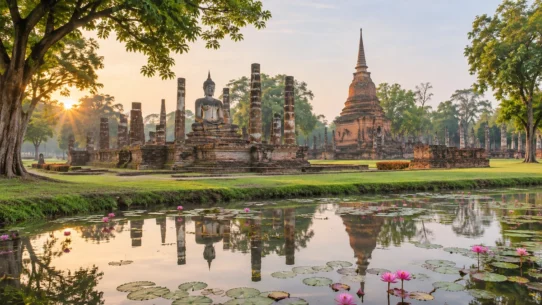
The best time to visit Sukhothai depends on what would spoil your trip: exhausting heat, a rigid schedule during rain, or discovering that your peaceful ruin break coincides with a major festival. Most of the signature sights are outdoors. A modest change of month can therefore matter more than an extra attraction on your list.
For a first visit focused on walking and cycling, start with December–February. Consider November if its festival atmosphere is a reason to go, and May–October if you can rearrange outdoor time around conditions. March–April can work for early starts and long rests, but deserves the most careful adjustment for heat.
The numbers below come from the Thai Meteorological Department’s Sukhothai station 48372 climatological record, on PDF page 25, printed page 19. This particular station table covers 1999–2020, despite the wider compilation’s title. It describes historical averages, not the forecast for your dates. A recorded rainy day also does not mean rain fell all day.
The 1-Min Cheat Sheet
- December–February: easiest default for outdoor heritage. December averages 8.7mm of rain; January and February about 13mm each. Winter afternoons remain warm, so retain a lunch break.
- March–April: best only if you accept the heat trade-off. Mean daily maximum temperatures rise from 36.0°C in March to 38.0°C in April. Songkran is a separate reason to choose April, rather than an escape from hot weather.
- May–June: workable with flexibility. Monthly rainfall averages about 185–191mm, with roughly 14–16 rainy days. Short outdoor blocks and a museum visit make more sense than a fixed countryside cycling marathon.
- July–October: allow the most weather slack. September has the highest monthly rainfall in this record, at 254.5mm; October still averages 195.5mm. Do not assume October has already become reliably dry.
- November: promising weather, potentially complicated bookings. Rain drops to 30.4mm in the record, but Loy Krathong changes the planning equation. For 2026, check the specifically announced show dates and your accommodation total.
Top Survival Tips
- Book the base before building early starts. Muang Kao is the historic-park area, around 12km west of modern Sukhothai. A room in New Sukhothai means arranging that journey before your first temple; a cheap room loses some appeal if you need repeated private rides.
- Use the right opening window. The park operator’s current visitor page lists central-zone hours of 06:30–19:30, extended to 21:00 on Saturdays. The north is 07:30–17:30 and the west 08:00–16:30. Central-zone dawn access does not establish dawn access everywhere.
- Plan a real midday alternative. The Ramkhamhaeng National Museum lists daily opening from 09:00 to 16:00. It offers a useful indoor change of activity, but it is not an evening fallback after a late return.
- Separate climate from air quality. Check the TMD provincial forecast close to departure and use current official air-quality reporting when haze matters to you. Neither a blue-sky travel video nor a station’s count of hazy days measures the PM2.5 exposure on your visit.
- Compare actual totals before calling a month cheap. Request the same room type, cancellation terms, transfer and baggage allowance for several dates. A wetter month may produce an attractive offer, but there is no verified universal discount or cheapest-month guarantee here.
- Keep regional days movable. Si Satchanalai is a separate park about 55km from modern Sukhothai. Give its road journey and outdoor visit their own day; avoid coupling it to an essential same-day flight or long-distance departure.
- Pay for the itinerary you will use. Current foreign visitor references are THB200 for the central zone, THB120 north and THB120 west, or THB400 combined. Ask about validity before splitting zones across days. The museum, regional parks and bicycle rental are separate decisions.
The Full Experience
☀️ December to February: Best for Outdoor Heritage, with Warm Afternoons
Video context: A Sukhothai Historical Park recording explicitly dated 26 December 2025 in its title; a dated winter visit, rather than evidence of every winter day. By Masami Yoshida.
This is the period to prioritize when the trip revolves around time among the ruins. December’s 8.7mm rainfall average and approximately 1.4 rainy days make it a very different proposition from September. January and February are similarly dry in the record. Mean daily minimum temperatures of 18.6–20.1°C in January–February can make an early departure more comfortable than an April start.
The useful word is “comfortable,” not “cold.” Mean daily maxima are 31.0°C in December, 31.4°C in January and 33.5°C in February. Start with the central park, take a proper lunch break, and leave space for a second, shorter outing. A hat and water still earn their place in the day bag.
For two sightseeing days, use one for the central zone and museum, and the other for the northern monuments, with a western visit only if your interest and energy justify it. You do not need to buy every zone just because the weather is favorable. The central area alone can support an unhurried first introduction.
Christmas, New Year and other holiday overlaps deserve a dated room-and-transport comparison. They do not make every winter night unaffordable, but they are reasons to verify availability before buying a nonrefundable connection. If dates are flexible, compare nearby weekdays rather than assuming the season has a single price.
✅ What Other Travelers Say
Masami Yoshida labels the linked park visit with its exact December date. That gives a relevant winter reference, but the title supplies no general verdict on hotel value or crowd levels. Use the station record for the seasonal comparison and the film as an individual visit.
⚠️ The Catch (Things to Keep in Mind)
A dry historical average cannot promise a dry travel day or clear air. February is also warmer than December in the record. Travelers who struggle with heat should still favor the first outdoor hours and avoid turning the best season into an overfilled itinerary.
🔥 March to April: Choose Early Starts or Come Specifically for Songkran
Video context: The creator identifies this as Songkran 2024 in Sukhothai, with the description locating the street celebration in Thani. It is not a current event timetable. By Chanya & Wazza's Thailand.
March–April is the least convincing choice for a traveler who wants to cycle for most of the day. The station’s mean daily maximum reaches 36.0°C in March and 38.0°C in April. These are monthly averages of daily maxima, not the hottest temperatures that might occur. A hotel pool photograph does not solve the exposure between widely spaced monuments.
Build a small morning plan instead: central-zone access after opening, two or three selected temple groups, then breakfast or an early lunch and a long rest. Put the museum into its actual opening window if you want more history. Arrange a car and shorter walks for the northern zone when cycling would make the day unpleasant. Skip the western hill ascent if it would become an endurance exercise.
Songkran changes April’s appeal for people who actively want a water-festival experience. The street celebration and a quiet archaeological visit serve different moods, and activities in modern Sukhothai are not automatically at your Muang Kao hotel. Ask your accommodation about the current program, pickup access and where you can store luggage securely.
Do not book April merely because you expect fewer visitors or lower prices. Compare the exact holiday dates, room total and transfer availability. A saving is useful only if the heat-adjusted itinerary still delivers the trip you wanted.
✅ What Other Travelers Say
Chanya & Wazza’s Thailand describes its 2024 Songkran outing as hot, loud and full of water fights, traffic and parking searches. That enthusiastic individual account is useful evidence of the festival trade-off for someone seeking either a party or a quiet break.
⚠️ The Catch (Things to Keep in Mind)
Songkran does not remove the heat, and its street atmosphere is not representative of every April day. Keep phones and travel documents protected, establish a workable pickup location, and confirm this year’s arrangements rather than treating a 2024 route as a guaranteed program.
🌦️ May to June: Best for Flexible Travelers Who Can Shorten a Day
Video context: Scene Walking explicitly records 13 May 2022 at 19:00 in the description. Old prices in that description are not used as current visitor information. By Scene Walking.
May–June requires a different rhythm rather than automatic cancellation. The station record shows rainfall averages of 184.8mm in May and 190.9mm in June, with roughly 14.1 and 16.3 rainy days. Mean daily maxima remain 35.9°C and 34.1°C. A rain shower therefore does not necessarily turn the day into cool walking weather.
Choose a hotel location that makes changing your mind inexpensive. In Muang Kao, it is easier to replace a long cycle loop with a short central visit and return to your room. From modern Sukhothai, establish both outward and return transport before leaving, particularly when a storm might cause you to finish early.
Keep the museum for a period when it is open and you actually want the collection, rather than treating it as an unlimited shelter. Carry a rain cover, protect electronics, and use footwear that remains secure on wet surfaces. Avoid placing a single essential photograph or a countryside excursion in a narrow nonrefundable window.
For value, compare a refundable room with your preferred drier-season dates. The useful saving is the final total after transfers and any changed activities. If your only available time is two short afternoons between long journeys, the flexibility that makes this period workable may be missing.
✅ What Other Travelers Say
Scene Walking’s description identifies a specific May evening recording and remarks on daytime heat. It supports including an evening-oriented visit as one traveler’s example. Its older THB100 entry figure is superseded by the current operator information used here.
⚠️ The Catch (Things to Keep in Mind)
A film shot at 19:00 does not establish evening access to the north or west. Use each zone’s actual hours, and check conditions before setting off. A forecast of showers also does not tell you exactly which hour or path will be affected.
🌧️ July to October: Best for Spare Time, Not a Rigid Temple Checklist
Video context: A walk explicitly identified as September 2023 at Wat Si Chum and nearby ruins. One recorded outing cannot describe an entire rainy season. By bangkok_as_is.
This long period contains meaningful variation. The record averages 140.5mm of rain in July, 191.9mm in August, 254.5mm in September and 195.5mm in October. September is the wettest month by total rainfall in this station table, while August and September both average around 18 rainy days. October still needs a rain plan.
The practical consequence is extra choice, not an assumption that the historical parks close for months. Check the current forecast, local notices and access conditions. After heavy rain, ask about the specific paths or road you intend to use; do not translate a regional weather report into either “everything is flooded” or “all routes are fine.”
A three-night stay can absorb a reshuffled outing better than a one-night stop, provided the extra night fits your broader trip. Keep central and northern sightseeing as separate, movable blocks. Treat Si Satchanalai as optional until the road plan and conditions are satisfactory, and agree with a driver what happens if the regional visit must change.
This is also a sensible time to question whether you need every viewpoint. A short, worthwhile encounter with Wat Mahathat or Wat Si Chum can be better than completing a long list while uncomfortable. Carrying an umbrella does not make wet stone steps or an exposed cycle ride equally suitable for every traveler.
✅ What Other Travelers Say
bangkok_as_is identifies the linked outing as a September 2023 walk around Wat Si Chum and nearby ruins. That is a relevant example of a visit during the wetter part of the year; the description does not establish typical rain duration, current access or a general safety verdict.
⚠️ The Catch (Things to Keep in Mind)
Cheap-looking dates are poor value if an inflexible schedule forces you to lose the activity that brought you here. Travelers with only one tightly timed outdoor session should give the drier months stronger consideration. Do not expect October to behave like December.
🕯️ November: Best for Loy Krathong if You Plan Around the Event
Video context: A Loy Krathong account published in November 2024. Its described performances and food are historical festival context, not a promise about the 2026 program. By The Country Collectors.
November combines a marked drop in historical rainfall with Sukhothai’s best-known festival planning question. The station averages 30.4mm of rain and 3.2 rainy days, with a mean daily maximum of 32.4°C and minimum of 22.0°C. That makes it a promising transition toward drier outdoor conditions, without a weather guarantee.
If the festival is the goal, secure the room, event information and return transport as a connected plan. The government’s 2026 show announcement specifies 15–24 November at 19:00, plus an additional 20:30 show on 24 November, with advertised seat tiers of THB500, THB900 and THB1,200. These are dated show details, not a permanent annual calendar or a guarantee of available seats.
The notice’s May–June early-bird period has already expired. Do not include that reduction in a new booking budget. Confirm the active seller, chosen performance, seating and admission arrangements through the event’s current information. An ordinary park ticket should not be assumed to include a paid show.
If quiet archaeology matters more than festivities, compare dates outside the announced event period and ask the hotel about nearby preparations or access changes. Plan the ruins and an evening performance as two parts of a day, with a rest between them. A late finish is a poor partner for an unnecessarily early onward connection.
✅ What Other Travelers Say
The Country Collectors describes its Loy Krathong experience through cultural performances, a light-and-sound show, fireworks and street food, with an enthusiastic personal verdict. Those are reasons a festival-focused traveler may value November; they do not guarantee identical activities in a later year.
⚠️ The Catch (Things to Keep in Mind)
Festival dates follow a changing annual calendar. Show tickets, park admission, accommodation and transport may all be separate. Reserve early when the event is the reason to travel, and read the cancellation terms before making the rest of the itinerary depend on one performance.
Key FAQs
What is the best month to visit Sukhothai for cycling and fewer weather disruptions?
Start by comparing December and January. Their rainfall averages are low in the local record, and daily maximum temperatures are lower than in March–April. That does not establish which week has the fewest visitors or cheapest rooms. Choose dates after checking holidays, your hotel total and the near-term forecast.
Is Sukhothai worth visiting in the rainy season?
Yes, when you can move outdoor sessions, keep an indoor alternative and accept that a regional excursion might change. May–October should not be treated as identical, and September has the highest rainfall total in this record. A very short, fixed outdoor stop carries more weather risk than a flexible stay.
Should I visit Sukhothai during Loy Krathong or avoid it?
Choose it for the festival experience; compare other dates for a simpler heritage trip. For 2026, the verified announcement gives specific shows on 15–24 November. Check the latest program and availability rather than reusing those dates in another year or expecting ordinary park admission to cover every event.
Final Verdict and Your Next Step
For most first-time heritage travelers, choose December–February and retain a midday break. For festival enthusiasts, November can justify extra booking work. For flexible travelers comparing value, May–October is an option if the whole trip allows changes. March–April deserves a deliberate heat plan, especially for anyone counting on long bicycle outings.
Compare a few date pairs in an actual booking engine before committing. Check Sriwilai Sukhothai’s official room reservation page for one Muang Kao-area option, then compare its final dated total with other suitable accommodation. This is a real property booking page, not a claim that the hotel is the right price or layout for every traveler. Confirm the room, cancellation terms and transfers before paying.
If a guided ride is central to your trip, send Cycling Sukhothai a dated reservation request and ask about the route, weather adjustments, pickup and total cost. The form is a request, so wait for a clear confirmation. Choose the season first, but let the actual forecast shape the day.