




💡 Key Takeaways
- November to January is the strongest first-visit window. December and January favor comfortable sightseeing, but holiday demand makes advance reservations worthwhile.
- February to April requires a separate air-quality decision. Dry weather can coincide with heavy smoke; a cheap room cannot rescue a mountain holiday with poor visibility.
- May–June and October can reward flexible travelers. July–September suits a slower green-season trip, provided heavy rain, access changes and a lost outdoor day fit the plan.
The best time to visit Chiang Rai depends on what would disappoint you most: smoke obscuring the hills, rain disrupting a rural excursion, or a busy holiday pushing your preferred hotel beyond budget. The famous temples remain the reason many people book, but the province’s mountain roads, tea country and long excursions make the calendar consequential.
For a first visit with fixed dates, start with November through January, especially December or January outside major holiday peaks. For better value, compare May–June and October while keeping the daily route adjustable. Be particularly cautious about February–April if clear views and lengthy outdoor activities are priorities.
This guide uses primary weather and pollution information checked in October 2026. Climate averages describe a pattern, not your travel week’s forecast. Price and crowd assessments below are planning judgments; they are not live hotel quotes or promises of a particular discount.
The 1-Min Cheat Sheet
- November–January: best overall. Choose temples, tea-country excursions and cooler evenings. Expect stronger demand around year-end and popular winter weekends. Reserve the hotel and important transport once dates are firm.
- February–April: highest smoke-and-heat compromise. February can still feel comfortable early and late in the day, while March and April need more heat breaks. Check local PM2.5 before committing to outdoor-heavy plans.
- May–June: a flexible value candidate. Plan shorter outdoor blocks, covered lunch stops and a central base. Early rain does not mean every day is lost, or that the air has automatically cleared.
- July–September: green landscapes, substantial rain exposure. Best for an unhurried stay with spare time. Avoid making a distant viewpoint, waterfall or river trip the one indispensable activity.
- October: promising shoulder season. Keep rain flexibility, particularly early in the month, and check the holiday calendar. Later dates may offer a useful balance, without a guaranteed dry-season switch.
Top Survival Tips
- Check air and weather separately. A sunshine icon says nothing about fine particles. Use the Pollution Control Department’s monitoring portal or Air4Thai, choose a relevant Chiang Rai station and read the timestamp. A city reading cannot describe every valley or mountain.
- Use the forecast for decisions near departure. Open TMD’s Chiang Rai forecast before travel and again before a rural outing. Ask the hotel or operator about the actual approach road, trail and attraction. A forecast for town is not an access clearance for a remote hillside.
- Protect one flexible block. Put the most weather-dependent excursion early enough to move it. On a three-day stay, leave one afternoon uncommitted. A packed checklist leaves no room for a storm, a rest or changing your mind.
- Check holiday dates before comparing room rates. The Bank of Thailand holiday calendar is a useful starting point. In 2026 it lists 13–15 April for Songkran and Friday 23 October for Chulalongkorn Day. A bank holiday does not establish a temple’s opening hours; contact the attraction separately.
- Price the whole day. A quieter-season room can be offset by extra car journeys, a distant hotel or unused prepaid activities. Compare the same room type, cancellation deadline, breakfast and transfer arrangements across dates. Keep a screenshot of the final terms.
- Pack for the outing. Winter sunrise trips need warmer layers than a town afternoon. Wet-season plans need a rain layer, a waterproof bag for essentials and footwear with grip. Keep temple clothing appropriate in every season.
The Full Experience
These five seasonal reviews combine primary records with named creators’ published accounts. Videos show particular visits or regional planning advice; they cannot establish current air quality, access or universal traveler opinion.
🧥 November to January: Best Overall, With a Holiday Premium
Video context: Ride with Gabi’s explicitly dated December 2022 Chiang Rai vlog. Treat it as a historical town visit, not a current crowd count.
TAT highlights December–January as the coolest winter window. TMD’s Chiang Rai 1991–2020 station normals give January mean daily highs/lows of 28.6°C/13.8°C. That supports a full sightseeing day with layers for the morning, rather than assuming northern Thailand is uniformly tropical at every hour.
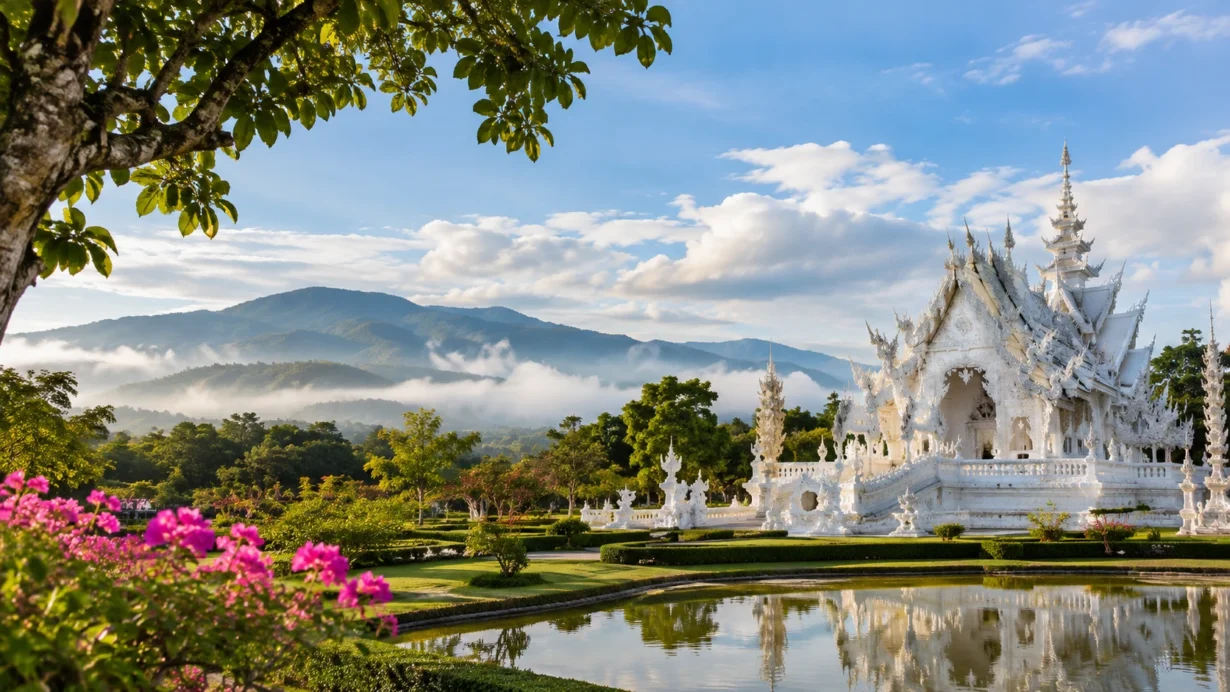
November is useful when you want a wider choice of dates before the year-end rush, but retain a rain backup. December and January are the clearest default for travelers balancing town sights with a rural day. Put the White Temple early, keep lunch unhurried and allow daylight for the return from distant stops.
For a flower festival, select the event before the flight. The official 2025 festival announcement covered 18 December 2025–7 January 2026 at the main riverside venue. Those dates are historical; they do not confirm the next edition. A garden trip still works without building the whole holiday around an unannounced program.
✅ What Other Travelers Say
Ride with Gabi documents Chiang Rai in December and the journey from Chiang Mai. The dated account is useful for previewing a winter town visit; one creator’s experience cannot predict how busy your hotel or temple will be.
⚠️ The Catch (Things to Keep in Mind)
Reserve first-choice rooms and drivers early for Christmas, New Year and holiday weekends. Compare a normal midweek stay before paying a peak-date premium. Cool weather also does not guarantee clean air or an unobstructed sunrise.
🌫️ February to April: Dry Days Can Hide the Biggest Compromise
Video context: Laura und Finn’s Chiang Rai burning-season account, published April 2023, includes a smoke discussion around 09:46. Its conditions are historical.
Do not combine these months into a simple “dry season equals best” recommendation. TMD normals rise to an April mean daily maximum of 34.7°C. More consequential for many trips, the station records an average 25.2 haze days in March; that meteorological observation is not a count of unhealthy PM2.5 days.
The pollution risk is practical, not merely photographic. In a 5 April 2026 PCD regional warning, Mueang Chiang Rai registered a 24-hour PM2.5 concentration of 182.3 µg/m³, with red-category conditions persisting for ten consecutive days. This is a dated example, not today’s reading or a forecast for next April.
February remains a conditional option if your dates are fixed and monitoring supports the visit. March–April is a weaker choice for a first trip centered on hills, hiking or clear views. If you go, choose accommodation suitable for spending time indoors, keep outdoor blocks short when official advisories warrant it and retain a route-change option.
✅ What Other Travelers Say
Laura und Finn explicitly describe how severe burning-season smog can affect a Chiang Rai visit. Their individual account supports checking pollution before booking an outdoor-focused holiday; it does not mean every February day repeats their experience.
⚠️ The Catch (Things to Keep in Mind)
Songkran can create a busy April travel window despite the heat. A TAT account identifies the 2026 festivities as 13–15 April. Confirm the program for your year and locality; water celebrations do not remove air-quality or heat concerns.
🌦️ May to June: Worth Comparing for Value, If You Can Adapt
Video context: NickGoesAsia’s Thailand-wide rainy-season guide discusses May–July planning and includes Chiang Rai in a northern chapter covering August–October. It is regional advice, not footage verified as a May–June Chiang Rai visit.
These months suit someone happy to trade a rigid rural itinerary for a flexible town base. TMD normals put May–June daily highs around 32–34°C, so a rain shower does not turn sightseeing into a cool-weather holiday. Keep the first attraction close enough that a change in conditions does not strand the whole day’s plan.
Build a morning around one temple, take a seated lunch and decide the afternoon after checking conditions. Ask whether a museum’s displays are covered; Baan Dam has outdoor grounds and is not a completely sheltered substitute. Keep a café or hotel rest as a legitimate option.
Compare refundable hotel offers with winter dates rather than assuming a fixed percentage saving. A central room can be worth more than a cheaper remote resort when rain adds vehicle journeys. Favor a room you would enjoy during an unexpected indoor afternoon.
✅ What Other Travelers Say
NickGoesAsia presents rainy-season travel as something that needs regional planning. The inclusion of Chiang Rai is useful, but the northern chapter concerns later months; use this as preparation for flexible wet-weather travel, not proof of June conditions.
⚠️ The Catch (Things to Keep in Mind)
Do not assume the first shower ends haze or that rain arrives only after lunch. Check live monitoring and the short-range forecast. Reserve weather-dependent excursions with clear change and cancellation terms.
🌧️ July to September: Best for Green Scenery and a Slower Stay
Video context: tripgether’s Chiang Rai rainy-season itinerary, published 1 September 2023, combines temples, cafés and coffee-country stops. The exact filming dates are not established.
This is the strongest green-season choice for travelers who enjoy the setting without requiring uninterrupted outdoor time. TAT’s northern green-season guide includes Chiang Rai’s Doi Mae Salong. The appeal is a different landscape and slower rhythm, not a promise that every road and attraction operates normally.
August’s TMD rainfall normal is about 373 mm, compared with roughly 21 mm in December. A monthly total cannot tell you which afternoon gets wet. Give the trip more room than a one-night temple dash, and keep any rural day dependent on local access advice.
Before paying for an excursion, ask what happens if heavy rain affects the route. Clarify whether the operator offers a replacement stop, date change or refund, and whether your hotel pickup remains feasible. Leave extra time before a flight rather than scheduling the farthest outing on departure day.
✅ What Other Travelers Say
tripgether frames its three-day Chiang Rai wet-season trip around mist, temples and café stops. That published itinerary demonstrates a slower travel style to consider, not a consensus that monsoon conditions are easy for everyone.
⚠️ The Catch (Things to Keep in Mind)
Heavy rain can make hillside and waterside plans unsuitable. Follow current warnings and closures; do not cross floodwater or treat a dramatic waterfall photograph as an access recommendation. Keep shoes and essentials dry enough for the following day.
🍃 October: A Useful Shoulder Season, With Rain Still in the Deal
Video context: Natalie’s Passport’s Golden Triangle vlog was published in October 2022 and describes changing from a motorbike plan to a car because of rain. Publication month does not establish its filming dates.
October is a sensible comparison for travelers whose budget or leave dates rule out midwinter. TMD’s monthly rainfall normal falls to about 124 mm, with a mean daily high near 31°C. It is a transition rather than a calendar guarantee: keep a wet-weather plan throughout the month.
Choose later October when it fits your plans, but book on the strength of flexible terms and a workable itinerary. Keep the Golden Triangle or tea-country drive movable. Make the day after arrival a short temple-and-town circuit, then decide the longer trip with recent local information.
✅ What Other Travelers Say
Natalie’s Passport explains that rain changed the planned Golden Triangle transport from a motorbike to a rental car. That concrete account illustrates the value of adapting transport; its older rental price is not used as a current quote.
⚠️ The Catch (Things to Keep in Mind)
Check long weekends before labeling October cheap. In 2026, the 23 October Friday holiday creates a three-day weekend for many travelers. Confirm your own year’s dates and compare adjacent weekdays; do not assume every business closes.
Key FAQs
What is the best month to visit Chiang Rai for a first trip?
January is a strong starting choice for a balanced temple-and-countryside visit. December is similarly appealing. Compare normal weekdays outside the year-end holiday peak, then check current air quality and the forecast before departure. Neither month guarantees perfect visibility.
When is the cheapest time to visit Chiang Rai without the worst compromises?
Compare May–June and October first if you accept occasional disruption. July–September can also suit a flexible stay. There is no universal cheapest month: flights, holidays, room category, cancellation terms and extra transport can outweigh a lower nightly rate.
Should I avoid Chiang Rai in March because of burning season?
For a fixed, outdoor-focused first visit, another season is usually the stronger choice. If March is unavoidable, monitor actual Chiang Rai PM2.5 and official advice, keep reservations flexible and prepare to change the route. A single clear photograph or old video cannot settle the decision.
Final Verdict and Your Next Step
Choose November–January for the strongest overall balance, compare May–June or October for flexible value, and allow extra time for July–September. Treat February–April as an air-quality decision before treating it as a weather bargain.
Once dates are firm, reserve a suitable hotel and the transport that matters most. Compare this verified Chiang Rai private-car charter, then confirm your route, pickup, weather-change terms and mountain-area surcharges before paying. This is an affiliate link. A car reservation provides transport; it cannot guarantee a viewpoint, open road or clear sky.