

💡 Key Takeaways
- For most first-time visitors, a normal T-money or Cashbee card is more useful than an unlimited pass. Busan’s 1-day and 3-day metro passes cover the urban rail network only, not city buses, the Donghae Line or the Busan-Gimhae Light Rail. If your itinerary mixes beaches, temples, hillside sights and airport travel, flexibility usually beats “unlimited rides.”
- Busan is easy to navigate but very spread out. The expensive mistake is not the fare—it is crossing the city repeatedly. Group Nampo and Gamcheon together, Seomyeon with central stops, and Haeundae, Songjeong, Osiria and Gijang on the same side of your itinerary whenever possible.
- Luggage changes the best route. The cheapest airport route is usually the light rail plus metro, but a direct airport limousine or taxi can be much better with large suitcases, children or a hotel far from a station. Do not save a few thousand won only to add two transfers and a long walk with bags.
Last fact-checked: August 7, 2026. Fares, airport bus services and temporary luggage rules can change, so time-sensitive details below are dated where necessary.
The biggest challenge in any Busan transportation guide is not explaining how a subway works. It is helping you avoid the small decisions that make a first trip unnecessarily tiring: choosing a hotel on the wrong side of the city, taking a metro to a station that still leaves a steep uphill walk, buying a pass that does not cover the transport you actually use, or dragging a suitcase through a transfer when a direct bus would have been worth the extra fare.
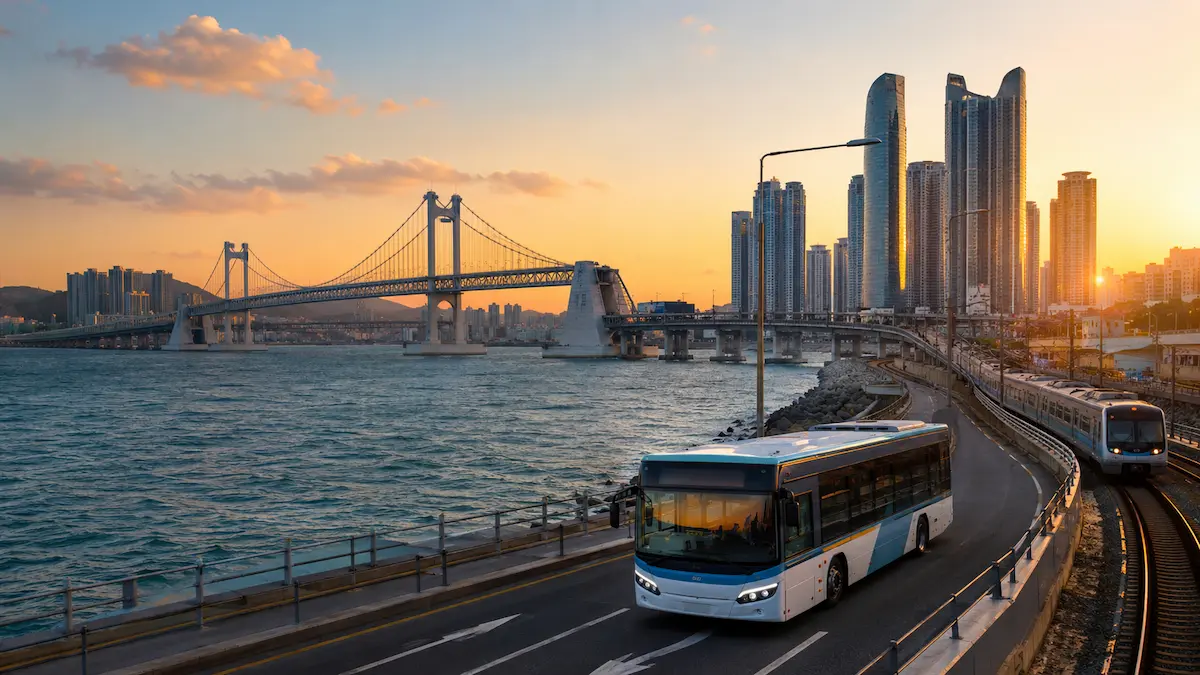
Busan’s public transport is generally reliable and affordable, but the city stretches along the coast and around hills. Haeundae, Nampo, Gamcheon, Seomyeon, Gwangalli, Songjeong and Gijang are not one compact sightseeing zone. A route that looks simple on a map can still mean 45 to 70 minutes door to door once you include station entrances, platform changes, waiting time and the final walk.
This guide focuses on the decisions that matter in real travel: when to use the metro, when a bus saves you from a long walk, when the Donghae Line is faster for the east coast, when a taxi is sensible rather than “wasteful,” and when an attraction or transport pass is genuinely worth buying.
The 1-Min Cheat Sheet
- 🚇 Busan Metro — best default for first-timers: Fast, predictable and easy for Busan Station, Nampo, Seomyeon, Gwangan and Haeundae. Adult transit-card fares are currently ₩1,600 for Section 1 and ₩1,800 for Section 2. Best when both your hotel and destination are close to stations.
- 🚌 City Bus — best for the last mile and places away from stations: Useful for hillside and coastal sights where the metro gets you only part of the way. Standard city-bus adult transit-card fare is currently ₩1,550. Buses are cheap, but traffic, luggage and stop recognition make them less beginner-friendly than the metro.
- 🚆 Donghae Line — best for Songjeong, Osiria and Gijang: Often a smarter east-coast shortcut than staying on Metro Line 2 and changing to a bus. It is a Korail commuter line, not part of the Busan Metro day-pass coverage.
- ✈️ Airport Light Rail / Limousine — best depends on luggage: The Busan-Gimhae Light Rail is the budget option. The airport limousine is more comfortable for Haeundae or Seomyeon when you have suitcases and want fewer transfers.
- 🚕 Taxi — best as a strategic shortcut: Use it for steep hills, awkward final legs, late arrivals, groups or heavy luggage. The current standard base fare is ₩4,800 for the first 2 km, with late-night surcharges after 11 p.m.
Top Survival Tips
- Plan by district, not by attraction ranking. Busan punishes zig-zag itineraries. A morning in Gamcheon followed by lunch in Haeundae and sunset back near Nampo can burn hours in transit. Put geographically close sights on the same day even if a social-media list ranks them separately.
- Station exits matter more than most first-timers expect. At larger stations, the “wrong” exit can add a long underground walk, a road crossing or an unnecessary flight of stairs. Before leaving the train, check the recommended exit in Naver Map or KakaoMap and look for the elevator icon if you have luggage.
- Do not assume “transport card function” means “free transport.” The physical Visit Busan Pass can be topped up and used like a transportation card, but the fare balance is separate from the attraction pass. Its mobile version does not provide the physical transit-card function. Buy the pass for attraction value, not because you think Busan buses and subways are included.
- The metro day pass is not automatically a bargain. The adult 1-day pass is ₩6,000 and the 3-day pass is ₩13,000. At a normal ₩1,600 Section 1 ride, the 1-day pass starts to make financial sense at roughly four metro rides in one day. The 3-day pass needs roughly eight Section 1 metro rides across the validity period. More importantly, neither pass covers city buses, the Donghae Line or the Busan-Gimhae Light Rail, so a mixed itinerary can make a normal stored-value card cheaper and easier.
- Use a transit card if you plan to transfer. Busan’s transfer system works with compatible transit cards, and transfers generally need to be made within 30 minutes. Cash fares do not receive the same transfer discount. On buses, tap when boarding and tap again when getting off so the system can calculate the transfer correctly.
- Do not force the metro to do a taxi’s job. A short taxi from a station to a steep or awkward sight can save more energy than it costs. This is especially true for families, groups of three or four, travelers with large bags, and anyone trying to fit several districts into one day.
- Be cautious with “airport bus” advice from older blogs. Busan’s airport limousine network has changed several times. As of 2026, official services include a Haeundae/Gijang route and a Seomyeon/Bujeon route, with different fares, journey times and operating windows. Always check the current airport or Busan City information shortly before travel.
- Large luggage on ordinary city buses is not a guaranteed right. As of August 2026, Busan is running a temporary luggage pilot through September 30, 2026. Route 307, which connects Gimhae Airport with Centum, Haeundae and Songjeong, allows one suitcase up to 30 inches per passenger during the pilot. Treat this as a temporary exception and recheck the rule if you travel after the pilot period.
- Do not confuse Haeundae Metro Station with Sinhaeundae Station. Haeundae Station is on Metro Line 2 near the main beach area. Sinhaeundae is on the Donghae Line and is in a different location. Choosing the wrong one can create an annoying bus or taxi correction at the end.
- Keep late-night timing in mind. A route that works beautifully at 7 p.m. may become inconvenient close to the last train. Donghae Line services are less frequent than the core metro, and final-train times vary by direction. Check the actual departure before committing to a late dinner far from your hotel.
The Full Experience
🚇 Busan Metro: Best for Busan Station, Nampo, Seomyeon, Gwangalli and Haeundae
🏷️ Feature tags: First-timer friendly · Predictable travel time · Low cost · Luggage manageable outside rush hour · Best everyday backbone
Video fact-check: This older video is useful for seeing the station and ticketing flow, but the day-pass price shown on screen is outdated. The current adult 1-day Busan Metro pass is ₩6,000 as of August 2026.
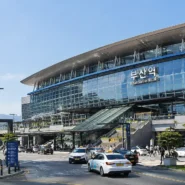
If you are visiting Busan for the first time, the metro should be your default mental map. Line 1 connects Busan Station, Nampo and Seomyeon. Line 2 connects Seomyeon with Gwangan and Haeundae. That alone covers a large share of a typical first trip without needing to understand Busan’s entire transport network on day one.
The current adult transit-card fare is ₩1,600 for a Section 1 journey of up to 10 km and ₩1,800 for Section 2. A one-use QR ticket costs slightly more at ₩1,700 or ₩1,900. If you are making several journeys, a T-money or other accepted transit card is not just more convenient; it also makes transfers simpler and avoids repeatedly buying single tickets.
What the metro does not solve is distance from the station entrance to your actual destination. Haeundae Beach is straightforward. Gamcheon Culture Village is not a metro stop. Haedong Yonggungsa is not a metro stop. Some coastal viewpoints and hillside neighborhoods need a bus or taxi after the rail portion. That is why “I will only use the subway” is often a false economy in Busan.
Best practical use: use the metro for the long, predictable part of the journey, then decide whether the final 10 to 20 minutes should be a bus, a taxi or a walk. When traveling with luggage, check not only the station but the exit. An elevator on the opposite side of a large station can still be the better choice than carrying a suitcase up multiple staircases.
Should you buy the metro day pass? The 1-day pass costs ₩6,000 and the 3-day pass costs ₩13,000. They can be excellent for a metro-heavy city day, but they are not a universal Busan pass. They do not cover city buses, the Donghae Line or the Busan-Gimhae Light Rail. If your day includes Haeundae plus Osiria, a temple, a hillside village or the airport, calculate your likely rail rides before buying.
✅ What Other Travelers Say
Recent traveler discussions are broadly positive about Busan’s rail system and repeatedly recommend using Naver Map or KakaoMap rather than relying only on a generic map app. A particularly useful tip from repeat visitors is to check the recommended station exit—and sometimes even the best carriage position—before arrival. That small step can save a surprising amount of walking in large interchange stations.
⚠️ The Catch (Things to Keep in Mind)
The metro is easy, but Busan is not compact. A journey can look like “just a few stops” yet still require a long transfer or walk. Rush-hour carriages are also a poor place for oversized luggage. If you are arriving with two large suitcases, paying for a more direct airport bus or taxi can be the more traveler-friendly decision even when the metro fare is lower.
🚌 Busan City Buses: Best for Hills, Coastal Sights and the Last Mile
🏷️ Feature tags: Excellent coverage · Cheap · Best for non-metro sights · Traffic-sensitive · Harder with large luggage
Video fact-check: The video is useful as a visual introduction to Busan buses, but it is from 2015. Treat any fare or route details shown in the video as historical; the current figures in this guide take priority.
Busan’s buses become much more valuable once you stop thinking of them as a second-choice version of the metro. They solve a different problem: reaching places where rail lines do not go conveniently.
For a standard city bus, the current adult transit-card fare is ₩1,550, while the cash fare is ₩1,700. Express buses cost more. The important practical difference is that cash is not the smart choice if you are transferring. A compatible transit card lets the transfer system recognize your journey; you should tap when boarding and tap again when leaving the bus.
Buses are especially useful for the approach to sights such as Gamcheon Culture Village, Taejongdae, Oryukdo and parts of the eastern coast. However, they require more attention than the subway because you need to recognize your stop, traffic can change the timing, and the ride can be uncomfortable with luggage during busy periods.
For airport luggage, read this carefully: as of August 7, 2026, Busan is running a luggage pilot through September 30, 2026. Route 307—serving the airport, Centum, Haeundae and Songjeong corridor—allows one suitcase up to 30 inches per passenger during this pilot. That is unusually useful for budget travelers staying along the east side of Busan, but it is a time-limited policy. Do not assume the same rule applies to every city bus or after the pilot ends.
Best practical use: take the bus when it removes an uphill walk or an awkward rail detour. If the bus requires standing with a suitcase in peak traffic, reconsider. A short taxi can be a better use of your holiday budget than turning a 12-minute final leg into a stressful one-hour experience.
✅ What Other Travelers Say
Travelers who become comfortable with Naver Map or KakaoMap often find Busan’s bus network much easier than expected. The common pattern is to use rail for the main cross-city leg and buses for the final connection. Visitors also frequently describe public transport as good overall, with taxis acting as a reasonably priced backup when a bus connection becomes inconvenient.
⚠️ The Catch (Things to Keep in Mind)
Bus stops with similar names, multiple route numbers, road traffic and the need to watch for your stop make buses more demanding for a first-day arrival. They are also the transport mode most affected by luggage uncertainty. If you are carrying a large suitcase, never plan around the assumption that any ordinary bus will happily take it—check the current rule for your specific route.
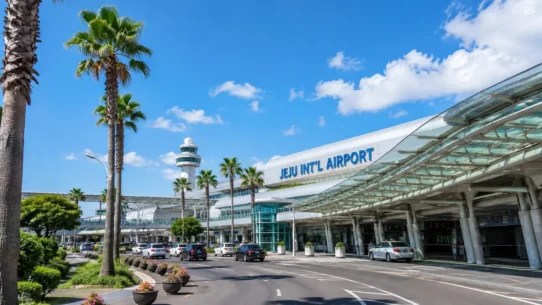
✈️ Gimhae Airport Connections: Best Route Depends on Your Hotel and Your Luggage
🏷️ Feature tags: Light rail for budget · Limousine for luggage · Direct options to Haeundae and Seomyeon · Taxi for late arrivals or groups
Why this video is useful: It shows the real airport-to-rail flow, including the light-rail station and transfers toward central Busan. Always use current fares and service times rather than assuming every detail in a travel video remains unchanged.
There is no single “best” Gimhae Airport transfer. The right choice depends mainly on where you sleep and how much you are carrying.
Cheapest for light luggage: Busan-Gimhae Light Rail. From the airport, the light rail connects to Sasang for Metro Line 2 and Daejeo for Metro Line 3. Current adult transit-card fares on the light rail are ₩1,300 for Section 1 and ₩1,500 for Section 2. For Seomyeon, Gwangalli or Haeundae, changing at Sasang to Line 2 is the obvious budget route. It is economical, but you will still need to move luggage through at least one transfer.
Best for Haeundae with suitcases: Airport Limousine Route 1. The 2026 Haeundae/Gijang limousine serves major east-Busan stops including Haeundae Beach, Park Hyatt, BEXCO, Centum and the Osiria area. The adult fare is ₩9,500. Official journey estimates are roughly 90 minutes between the Jangsan/Haeundae area and the airport, and about 110 minutes from the Gijang side, depending on the stop and traffic.
The key benefit is not speed; it is avoiding transfers. The official luggage allowance permits up to two pieces with a combined weight under 30 kg, with larger bags stored in the underfloor compartment. For a couple arriving with full-size suitcases, that can be worth far more than the fare difference compared with a rail transfer.
Best for central Busan with luggage: Airport Limousine Route 2. The Seomyeon/Bujeon route costs ₩6,000 for an adult and the official journey is around 50 minutes. As of the 2026 timetable, service from the airport runs within a defined operating window rather than around the clock. This route is useful if your hotel is near Seomyeon or Bujeon and you value a direct ride over the absolute lowest fare.
Important payment detail: these airport limousine routes do not provide free transfer benefits. Official information also states that cash is not accepted; use an accepted transit/credit-card payment method or the designated reservation/ticketing channel. If you land close to the final service, do not build a tight connection around the bus—have a taxi or private transfer as Plan B.
When a taxi wins: late-night arrival, three or four people sharing, multiple heavy suitcases, a child who is already exhausted, or accommodation that requires another bus after the metro. The “cheapest fare” is not always the cheapest travel decision once you count a 20-minute luggage walk and the risk of missing the last connection.
✅ What Other Travelers Say
Recent traveler reports confirm that the re-established airport limousine routes are a practical option, especially for Haeundae. The consistent advantage mentioned by luggage-heavy travelers is the direct ride and storage space. Budget travelers still favor the light rail because the airport station is straightforward and the transfer at Sasang opens access to Line 2.
⚠️ The Catch (Things to Keep in Mind)
Airport bus information goes stale quickly. Routes have changed in recent years, so a blog post or video from an older trip may list a service that no longer operates in the same form. For a 2026 trip, check the official Gimhae Airport or Busan City timetable again a few days before arrival, especially if your flight lands early in the morning or late at night.
🚆 Donghae Line: Best for Songjeong, Osiria and Gijang
🏷️ Feature tags: East-coast shortcut · Good for Osiria · Separate from Busan Metro · Less frequent · Not covered by metro day passes
Video context: This recent Donghae Line video is useful for understanding the railway environment and east-coast connection. For actual trip planning, use the current timetable for your travel date because service frequency and last-train times are not the same as the core metro.
The Donghae Line is one of the most useful pieces of Busan transport that first-time visitors overlook. It runs through stations including Bujeon, BEXCO, Sinhaeundae, Songjeong, Osiria and Gijang before continuing toward Ulsan. If your day is focused on eastern Busan, it can remove a slow bus connection or a long detour.
Osiria is the obvious example. The area contains major attractions and shopping, and the Donghae Line is often the cleanest rail approach. Songjeong and Gijang also become much easier to pair with an east-coast day when you understand this line.
The crucial catch is that the Donghae Line is operated as a Korail commuter railway, not simply another colored Busan Metro line. Your ordinary transit card can be used, and transfers with Busan urban rail are supported under the applicable fare system, but Busan Metro’s 1-day and 3-day passes do not cover Donghae Line rides.
Another common trap is station naming. Sinhaeundae Station is not Haeundae Metro Station. If your hotel is beside Haeundae Beach, arriving at Sinhaeundae may still require a bus or taxi. At BEXCO, you can connect between the Donghae Line and Metro Line 2, but allow walking and transfer time rather than treating it as an instant platform change.
Best practical use: build an east-Busan day around the line instead of using it for only one isolated attraction. For example, Songjeong plus Osiria or Gijang is a much more logical combination than returning to central Busan between each stop.
✅ What Other Travelers Say
Experienced Busan visitors often recommend the Donghae Line specifically for east-coast itineraries because it avoids some of the slower road travel. Recent traveler timetable discussions also emphasize a useful warning: service is less frequent than the main metro and final departures can differ by direction, so checking the timetable matters much more here than it does for a midday Line 1 or Line 2 ride.
⚠️ The Catch (Things to Keep in Mind)
Do not arrive at a Donghae Line platform assuming another train will appear in a few minutes. Missing one can affect your entire sequence of attractions. Also do not buy a Busan Metro unlimited pass specifically for an Osiria-heavy day and then discover that the train you actually need is outside the pass.
🚕 Busan Taxis and Ride-Hailing: Best for Hills, Luggage and Time-Saving Shortcuts
🏷️ Feature tags: Door-to-door · Excellent for groups · Useful late at night · Metered fare · Best as a strategic supplement
Video fact-check: This older taxi guide is useful for visual orientation, but do not use its historical fares. Current official Busan taxi rates are summarized below.
A taxi should not be your default for every journey, but refusing to use one on principle can waste a surprising amount of time in Busan. The city’s hills, coast and dispersed attractions create many situations where a short taxi ride is the most rational option.
The current standard taxi base fare is ₩4,800 for the first 2 km. After that, the meter increases by distance or time. Late-night surcharges apply: 20% from 11 p.m. to midnight, 30% from midnight to 2 a.m., and 20% from 2 a.m. to 4 a.m. Deluxe and large taxis start at a higher base fare, so check the vehicle type if budget matters.
Where taxis make the most sense: the final leg to a hillside attraction, moving between two nearby sights that require an awkward bus transfer, getting to a hotel with large luggage, returning after the last convenient train, or splitting the cost between several travelers.
For destination communication, having the Korean name and address of your hotel or attraction on your phone is still a good habit. App-based booking can reduce language friction, but vehicle size for multiple large suitcases is not always guaranteed. If you need a larger car for an airport run, asking your hotel to help arrange one can be safer than assuming any standard taxi will fit four travelers and four full-size cases.
Busan introduced bilingual taxi receipts in 2026 partly to make fares clearer for international visitors. Use the meter, keep the receipt, and do not agree casually to an unexplained flat fare for an ordinary city ride. Most trips are uneventful, but transparent pricing is exactly why the meter and receipt exist.
✅ What Other Travelers Say
A common traveler view is that Busan taxis are reasonably affordable when used selectively, especially when shared by a small group. Visitors who rely mainly on public transport often still use a taxi for one or two awkward legs rather than spending an extra hour on transfers.
⚠️ The Catch (Things to Keep in Mind)
Traffic can erase the time advantage during busy periods, and the final fare depends on both distance and time. Late-night surcharges also make a post-midnight ride noticeably more expensive. For airport travel with many bags, vehicle capacity matters as much as price, so arrange a suitable car rather than simply ordering the first available sedan.
🎫 T-money, Metro Passes and Visit Busan Pass: Best for Avoiding the Wrong Ticket
🏷️ Feature tags: T-money for flexibility · Metro passes for rail-heavy days · Visit Busan Pass for attractions · Beware of coverage assumptions
Video fact-check: This popular Visit Busan Pass video is useful for understanding the attraction-pass concept, but products and prices change. Use current 2026 pass terms when deciding whether to buy.
If you want the least complicated answer, buy or reuse a T-money card. Cashbee and other accepted Korean transit cards also work, but T-money is a simple choice for travelers who may already have one from Seoul. You can use an accepted transit card across Busan’s core public-transport systems and benefit from the transfer rules when you tap correctly.
Choose a normal transit card if: your itinerary mixes metro, buses, Donghae Line and airport light rail; you are staying several days but taking only two or three rides on some days; or you prefer not to calculate whether every ride is covered by a special pass.
Choose the ₩6,000 1-day Busan Metro pass if: you are genuinely planning at least about four paid metro rides in one day and most of your destinations sit close to metro stations. The pass can also be valuable for a day when you expect to make spontaneous rail stops without worrying about each fare.
Choose the ₩13,000 3-day Busan Metro pass if: you expect roughly eight or more normal Section 1 metro rides during the three-day validity period and you are not relying heavily on buses or the Donghae Line. The lower per-day threshold can work well for visitors staying near Line 1 or Line 2 and sightseeing mainly along those corridors.
Do not buy a metro pass for the word “unlimited.” Unlimited rides are only valuable if the unlimited network is the network you will actually use. A first-timer visiting Gamcheon, Haedong Yonggungsa, Osiria and the airport can easily spend much of the trip on transport that the metro pass does not cover.
Visit Busan Pass is a different product. It is primarily an attraction pass. The physical version has a transportation-card function after you add your own transit balance, but that does not mean normal bus and subway fares are included in the attraction-pass price. The mobile pass does not provide the physical card’s transport-card functionality. In other words: buy Visit Busan Pass because the included attractions save you money, not because you want “free transport.”
A sensible test is to list the paid attractions you will realistically visit—not every attraction you could theoretically squeeze in. If four or five expensive attractions already beat the pass price and fit naturally into your route, the pass may be worthwhile. If you are buying it mainly for one observation deck and the hope of unlimited transport, skip it.
Busan Pay also offers foreign visitors a way to purchase the 1-day and 3-day Busan Metro QR passes. Again, the important word is Metro. It does not magically expand the pass to unrelated rail or bus networks.
✅ What Other Travelers Say
Traveler feedback on Visit Busan Pass tends to be positive when the buyer already has a dense attraction plan. The less satisfied pattern is usually the opposite: people buy first, then try to force their itinerary around the pass. For transport alone, experienced visitors commonly prefer a standard transit card because it works across more of the journeys a normal Busan trip actually requires.
⚠️ The Catch (Things to Keep in Mind)
The phrase “transportation card” is easy to misunderstand. A physical card that can store transit value is not the same as a pass with transit fares included. Also remember that the 1-day and 3-day Busan Metro products are limited to the urban rail network. Always check the exact coverage before paying for any “unlimited” product.
Key FAQs
Can I use my Seoul T-money card in Busan for the subway and buses?
Yes. T-money is accepted on Busan’s major public-transport systems, so most travelers do not need to buy a new card just because they arrived from Seoul. Keep enough stored value on the card, tap correctly when entering and leaving where required, and remember that special Seoul-only passes are not the same thing as the nationwide T-money stored-value function.
What is the best way to get from Gimhae Airport to Haeundae with luggage?
For one light suitcase, the Busan-Gimhae Light Rail to Sasang and Metro Line 2 to Haeundae is the budget choice. For large luggage, the 2026 Haeundae/Gijang airport limousine is usually more comfortable because it avoids the rail transfer and provides luggage storage; the adult fare is ₩9,500. A taxi or pre-booked transfer becomes more attractive for late arrivals, families or groups with several large bags.
Is the Busan metro day pass or Visit Busan Pass worth it for transportation?
The ₩6,000 1-day metro pass is worth considering if you will take around four or more metro rides that day and do not need many buses or Donghae Line journeys. The Visit Busan Pass should be evaluated as an attraction pass, not a transportation pass. Its physical card can be reloaded for transit, but the transit fare comes from your added balance rather than being included automatically.
Final Verdict and Your Next Step
For most first-time visitors, the smartest Busan setup is simple: use T-money or another accepted stored-value transit card, plan each day by district, take the metro for the long predictable sections, and spend a little on buses or taxis when they remove a bad last-mile connection. This keeps your transport flexible without paying for unlimited rides you may never use.
If you are staying around Seomyeon, Nampo or Haeundae, choose accommodation close to a useful station entrance rather than choosing only by hotel rating. Saving 10 minutes of walking twice a day matters more over a four-night trip than many travelers expect—especially after shopping or in summer humidity.
If your flight arrives with large luggage, decide your airport transfer before landing. The light rail is excellent value, but the direct Haeundae or Seomyeon limousine can save a transfer, stairs and a long street walk. For very late arrivals, families or groups with several suitcases, a pre-arranged shuttle or suitable taxi may be the least stressful choice.
Useful booking links:
- Check Gimhae Airport to Busan shuttle options on Klook
- Check the current Visit Busan Pass on Klook
- Check the current Visit Busan Pass on KKday
- Compare Busan hotels on Booking.com
- Compare Busan hotels on Agoda
One final rule: do not optimize a Busan trip for the lowest possible fare. Optimize it for the best combination of cost, walking, transfers and time. A ₩1,550 bus is not a bargain if it adds 45 minutes and leaves you hauling luggage uphill. Likewise, a ₩6,000 unlimited metro pass is not a saving if half your itinerary sits outside the metro network. The best Busan transportation plan is the one that matches the places you are actually going.
Official Sources Used for Fact-Checking
Transport information was cross-checked against official Busan City, Busan Transportation Corporation, Busan-Gimhae Light Rail, Visit Busan and booking-provider pages available on August 7, 2026. Time-sensitive rules should be rechecked before publication or travel.
- Busan Metropolitan City — Public Transportation
- Busan Transportation Corporation — Fare Guide
- Busan Transportation Corporation — Season / Multi-Day Tickets
- Busan Transportation Corporation — Transfer Information
- Busan City — 2026 Airport Limousine Route Information
- Busan City — 2026 City-Bus Luggage Pilot
- Busan Pay — Visitor Payment and Metro Pass Information
- Visit Busan — Transportation Cards and Visitor Transport Information