



💡 Key Takeaways
- Santa Maria Novella is already central Florence. Choose the actual hotel entrance and station side before paying for a generic “city center transfer.”
- Walk when the complete luggage route is practical. Use a suitable tram or bus only when its stop and final approach simplify the journey; current urban fare is €2 before required bag tickets.
- A local taxi is a separate fare decision. Airport fixed fares do not price the station-to-hotel ride. Confirm the actual address, baggage, vehicle and any arranged pickup.
A Florence station transfer usually means the short final connection from Firenze Santa Maria Novella, or Firenze S.M.N., to your accommodation. The main station is already in the central city. Some hotels are a sensible walk away; others are better served by a useful tram, bus or licensed road vehicle. The right choice depends on the bags and actual entrance as much as the distance.
Confirm the train’s station before using this guide. Firenze Campo di Marte, Firenze Rifredi and Santa Maria Novella are different arrivals. A ticket or app saying only “Florence” is not enough to choose the hotel connection. Save the full address, reception instructions and any annex information before leaving the train.
The 1-Min Cheat Sheet
- Walking: best for a genuinely practical nearby property and a group that can manage the cases, weather and surface. It avoids another ticket, but the hotel’s advertised station walk may start at the exit rather than your platform.
- Tram or city bus: best when the correct direction, stop and final walk solve the awkward part. Ordinary Florence urban fare is €2 for 90 minutes, with luggage limits and supplementary tickets where required.
- Licensed taxi or accepted arranged car: best for an uncomfortable final approach, heavy equipment or an arrival when another connection is poor. Use the local fare basis or written private quote, not the airport tariff.
Top Survival Tips
- Choose the exit with the hotel address visible. Via Luigi Alamanni and the station’s other approaches lead to different street routes. Leaving first and navigating later can create a needless circuit with bags.
- Keep platform time separate from street time. The arrival platform, concourse, crossing and final reception are all part of the journey. A short owner-published walk is not an exact train-to-room promise.
- Check the accommodation’s own access. A nearby door can still have stairs, an upstairs reception or a separate apartment entry. Ask about the particular room and approach when stairs or lifting bags matter.
- Check bags before choosing public transport. GEST’s tram limits differ from simply carrying a case on your intercity train. Buying an extra ticket does not permit an oversized or overweight case.
- Use an actual stop and direction. T1 and T2 share parts of the station area but have different destinations. A tram marked for the airport is not a general ride toward every central hotel.
- Give a road pickup a named meeting point. If you arrange a car, agree the station side, contact method and delayed-train policy. “At the station” is too vague when the driver and party can be waiting in different places.
- Settle early or late room access in advance. Train arrival does not establish check-in time or accepted luggage storage. Confirm reception arrangements rather than reaching a locked apartment door with a full day’s bags.
- Plan the departure independently. Allow time back through the station to the actual train. Your successful arrival route is useful context, but it is not a boarding buffer or protection from a service change.
The Full Experience
🚶 Walking: Best for a Practical Nearby Hotel and the Right Station Side
Leonard Shea published this Santa Maria Novella walkthrough in December 2020. It is dated station-layout context; the old shop, storage and service arrangements shown are not present operating guarantees.
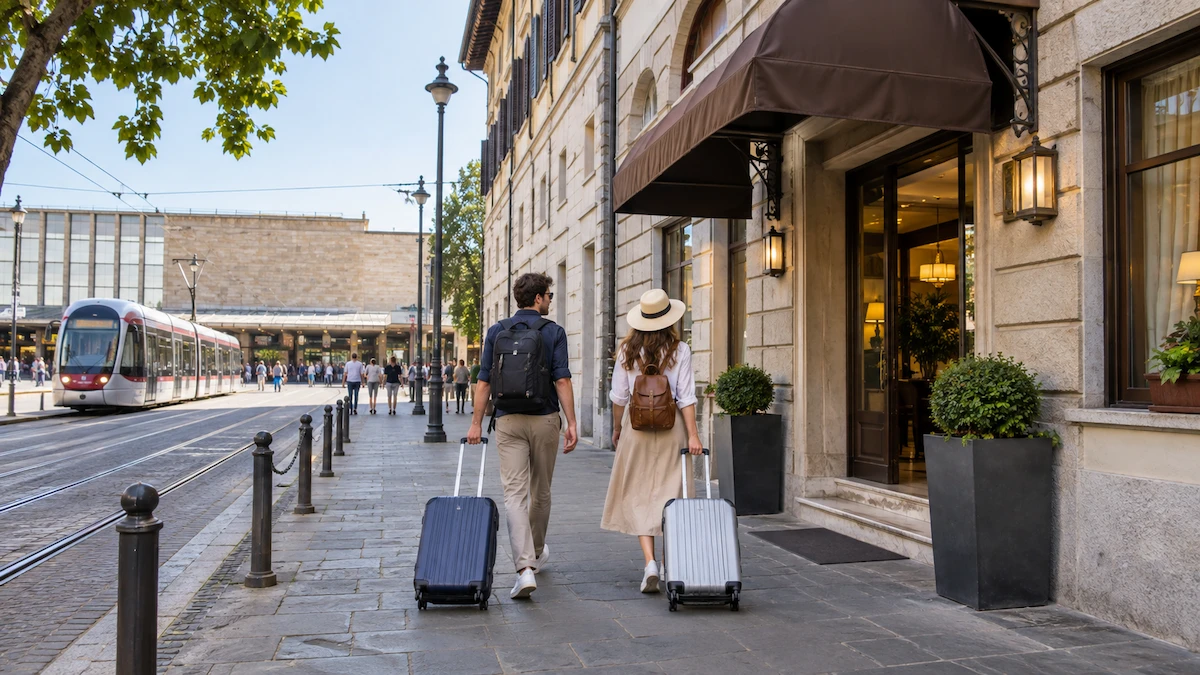
Walking is often the cleanest choice when the hotel is actually nearby. It avoids another queue, timetable and luggage handover. Make that judgment from the route your group can use, including the station exit, crossings and reception, rather than treating the whole historic center as equally close.
Reach the concourse, check the street side and confirm the hotel pin before committing to the outdoor walk. Via Luigi Alamanni and Piazza della Stazione are useful labels to recognize. Follow current signs and crossings; a map’s direct line across a road or tram track is not a permitted walking path.
Ask the property which entrance to use if it has another wing or an apartment elsewhere. A station-side brand name does not mean the assigned room is in the building nearest the station. Carry the reception address separately from the booking platform’s district description.
For a central example, Hotel Spadai’s actual owner website identifies its Via dei Martelli location by the Duomo. That is a different final walk from a hotel immediately beside the station. Use the full street address and the owner’s arrival instructions; do not interpret “central Florence” as a single stop or promise the same bag-carrying effort to every property.
RFI’s Santa Maria Novella accessibility information lists barrier-free paths by level route or ramp to its specified passenger platforms, while warning that equipment outages and the train/platform height relationship can alter usability. This is railway-access information, not a guarantee of a step-free street-to-hotel route. Arrange rail assistance under the actual conditions when needed, then confirm the separate street and property approach.
With manageable cases, a dry route and a useful nearby entrance, the absence of another transfer is a real advantage. In rain or heat, or with a traveler who cannot comfortably pull a bag over the route, revisit the choice. The correct walking distance is the one the whole party can manage without compromising the rest of the day.
For departure, leave enough time to find the actual platform, observe the station’s current access arrangements and board calmly. The train-to-hotel walk on arrival does not include the time needed to identify a different train or reach a different platform on the return.
✅ What Other Travelers Say Shea presents a station walkthrough for visitors, covering layout and travel services as they appeared in 2020. It can help you visualize the building, but it is not a measured current hotel walk or an access inspection for your particular train and luggage.
⚠️ The Catch (Things to Keep in Mind) “Near the station” does not settle the final door, stairs or reception. Confirm all three before using a short walk as the deciding reason to book a room.
🚊 Tram or City Bus: Best for a Useful Stop and a Manageable Final Walk
The current channel name on this August 2024 public-transport guide is AmjadPlays; search snapshots may show its former Amjad Vibes name. The guide predates the San Marco extension and August 2026 fare update.
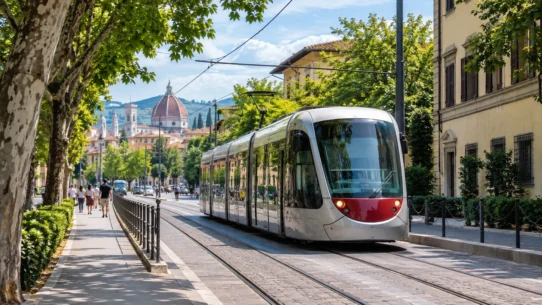
A tram is useful when it takes you toward the actual accommodation, rather than simply moving you away from the train station. Confirm the destination on the vehicle and the relevant platform. T1 and T2 share station-area infrastructure, but the line you need depends on where the hotel actually is.
The current T2 continues toward San Marco–Università; it is not permanently ending at the old Unità terminus shown in many older guides. A San Marco-area hotel may suit that connection. T1 links the Careggi and Villa Costanza directions. Neither line takes every traveler to the Duomo, Santa Croce or an Oltrarno hotel door; use the current route planner and compare the final walk.
GEST’s current ticket page lists the ordinary €2 urban ticket with 90-minute validity. A train ticket into Florence should not be treated as an automatic city-transport entitlement: check any explicit bundle or pass you bought, and otherwise obtain the appropriate urban ticket. Do not borrow an old €1.70 fare from the video.
Autolinee Toscane’s travel instructions require validation or activation at first use and describe contactless confirmation by a green OK screen. Keep the paper or working digital entitlement available throughout the journey. A digital ticket needs the phone that holds it, with enough battery to display it; a purchase confirmation is not a substitute for completing the required activation.
A permitted connection within the urban ticket’s validity does not always require a fresh ticket for each boarding. Equally, an urban fare is not permission to board any regional or extraurban service. Use the operator’s planner for the actual origin and destination when a bus extends beyond the urban area, and check the current stop if construction or a diversion affects the route.
For the tram, GEST’s airport page lists one free bag within 55 × 40 × 20 cm and 10 kg, while its general service page gives 50 × 30 × 25 cm and 10 kg. Confirm the current allowance with the operator using your actual measurements. The airport page requires a supplementary ticket for larger admitted bags, at most two per person and within 80 × 45 × 25 cm and 20 kg. There is no dedicated luggage-storage area, and paying does not admit an oversized case. Check the selected bus operator’s conditions separately when a bus forms part of the connection.
For example, two adults needing one urban ticket each and one supplementary tram-bag ticket each spend €8 for that ticket period, rather than €4. That is a bag-qualified calculation, not a taxi quote. If the cases exceed the maximum, extra money does not solve the problem; choose a suitable vehicle.
Use the actual GEST timetable for your direction and current service notices for the travel date. A late train delay can turn an otherwise sensible transfer into a poor connection. Have a fallback that works with the bags instead of assuming the same frequency runs throughout the night.
✅ What Other Travelers Say The creator frames the 2024 guide around ticket buying, validation and bus/tram orientation. It is an individual dated explanation, not evidence of today’s price, endpoint or a working route to every hotel.
⚠️ The Catch (Things to Keep in Mind) A cheap ride can still leave the hardest walk at the end. Count the destination stop, crossings, cases and reception approach before choosing public transport solely for its ticket price.
🚕 Licensed Local Taxi or Arranged Car: Best for a Difficult Final Approach
ExcitingEurope’s June 2026 guide includes airport taxis and a station-orientation chapter. Its airport fare discussion is a contrast to this local journey, not footage proving a Santa Maria Novella-to-hotel price; its outdated tram fare is not used.
A licensed taxi can be worth considering when heavy bags, rain, an awkward hotel approach or an access need makes the walking and public-transport chain unattractive. Follow the station’s current taxi signs or use a recognized operator’s accepted request. Ask staff if you need help finding the official arrangement rather than following an unsolicited offer.
This is a local station-to-hotel journey. The airport fixed tariff does not establish its price. The municipal tariff schedule effective 1 May 2024 lists urban minimum fares of €5.80 weekday daytime, €8.10 holiday daytime and €9.70 at night, with the meter and applicable supplements determining the actual journey. A minimum is not a quote to your door.
The same tariff lists bag and additional-passenger charges, and radio-call conditions have their own treatment. Ask the driver or operator to explain the applicable fare basis for the actual pickup. Do not combine a start charge, minimum and airport base as if all three are separate items to be added to one local ride.
Provide the exact accommodation address and reception entrance before leaving. Road access restrictions or a pedestrian approach can prevent an ordinary vehicle from reaching the literal front step. Confirm the closest usable drop-off with the property and driver when the remaining walk matters; a direct road ride does not erase every staircase.
If the party has several cases, a stroller, seating equipment or mobility equipment, tell the operator what must fit. A vehicle sized for the passenger count alone may not solve the baggage problem. Taxi 4242’s real website provides request channels; use them to describe the actual need, rather than treating a generic app estimate as a confirmed vehicle allocation.
A separately prebooked car follows its own accepted quote and meeting rules. Agree which station side to use, how the driver will identify the party and what happens if the train is delayed. Keep the train number and a working contact method available. An advance booking is only as useful as the collection plan both sides can follow.
For a small nearby hotel journey, waiting for a vehicle may exceed the walking effort you hoped to avoid. For a difficult arrival, the vehicle may be the best money spent that day. Make the choice from the party’s condition and route, without claiming that either option always wins.
✅ What Other Travelers Say The selected airport guide is a dated commercial-content overview, with affiliate shopping links. It distinguishes transport choices but is not an independent quote for this station ride. Current municipal rules and the accepted local arrangement should control the decision.
⚠️ The Catch (Things to Keep in Mind) Do not apply airport pricing to a local journey or assume a prebooked private car has the same tariff as a taxi. Confirm the unit, supplements, capacity and meeting point for the service you actually choose.
When the Room Is Not Ready
Ask the accommodation whether it accepts bags before check-in or after checkout and during which hours. A late-train apartment arrival may need a different key handover from a staffed hotel. Keep that arrangement in the arrival message so the transfer ends at a useful door.
The station’s RFI information page lists luggage storage among its services, but do not infer a free or round-the-clock service from that icon. Check the actual operator’s current opening, price unit, prohibited items and collection cutoff before leaving a bag. Storage at the station also means returning to that location; it does not deliver the case to a distant hotel.
Key FAQs
Do I need transport from Florence main station to the city center?
Santa Maria Novella is already central. You need a connection to the actual hotel or destination, which can be a practical walk, a useful urban ride or a road vehicle. First confirm that your train really arrives at Firenze S.M.N.
Can I use the Florence airport tram for my station-to-hotel transfer?
T2 may help if the actual stop and direction suit the accommodation, including its continuation toward San Marco. It is not a universal city-center shuttle. Compare the full route and permitted bags with walking.
How much is a taxi from Santa Maria Novella to my Florence hotel?
Use the local meter or accepted private quote for the exact address, time and party. The published minimum is not the trip price, and the airport fixed tariff does not apply merely because the destination is a central hotel.
Final Verdict and Your Next Step
Start with the correct arrival station and hotel entrance. Walk when that whole route is comfortable, use the right urban connection when it genuinely simplifies the journey, or pay for a suitable vehicle when the bags or access need it. Check the current urban-ticket purchase options, the licensed operator’s actual request channels and the accommodation’s own arrival information before the train pulls in.