

💡 Key Takeaways
- For most travelers, take Busan Metro Line 1 directly from Busan Station to Seomyeon. The train ride is only about 10–11 minutes and there is no line change. The part that takes effort is getting from the KTX platform to the metro and then from the correct Seomyeon exit to your hotel.
- Do not choose the city bus just to save money. A standard adult city-bus fare by transportation card is only about ₩50 less than the one-zone metro fare, while traffic and longer waiting times can easily cost you 20–30 extra minutes. Large suitcases can also be a real problem on ordinary city buses.
- A taxi becomes surprisingly sensible for two or three people with luggage. Expect roughly ₩9,500–₩12,000 to central Seomyeon in normal conditions, but allow more for congestion, larger vehicles and the official late-night surcharge between 23:00 and 04:00.
If you have just stepped off a KTX train and are searching for the easiest way to get from Busan Station to city center, the first thing to know is that Busan does not have one single downtown in the way some cities do. For most first-time visitors, Seomyeon is the practical “city center”: it is a major shopping, dining and nightlife district and the interchange between Metro Lines 1 and 2. But if your hotel is in Nampo, Gwangalli or Haeundae, blindly following directions to Seomyeon can send you the wrong way.
This guide therefore uses Busan Station (the main KTX railway station) as the starting point and Seomyeon as the main downtown reference. It is not an airport transfer guide: if you are arriving at Gimhae International Airport, you need a different route. The recommendations below focus on what matters after a long train journey—how much walking you will actually do, whether you can manage the route with suitcases, what happens late at night, and when spending a little more saves enough stress to be worth it.
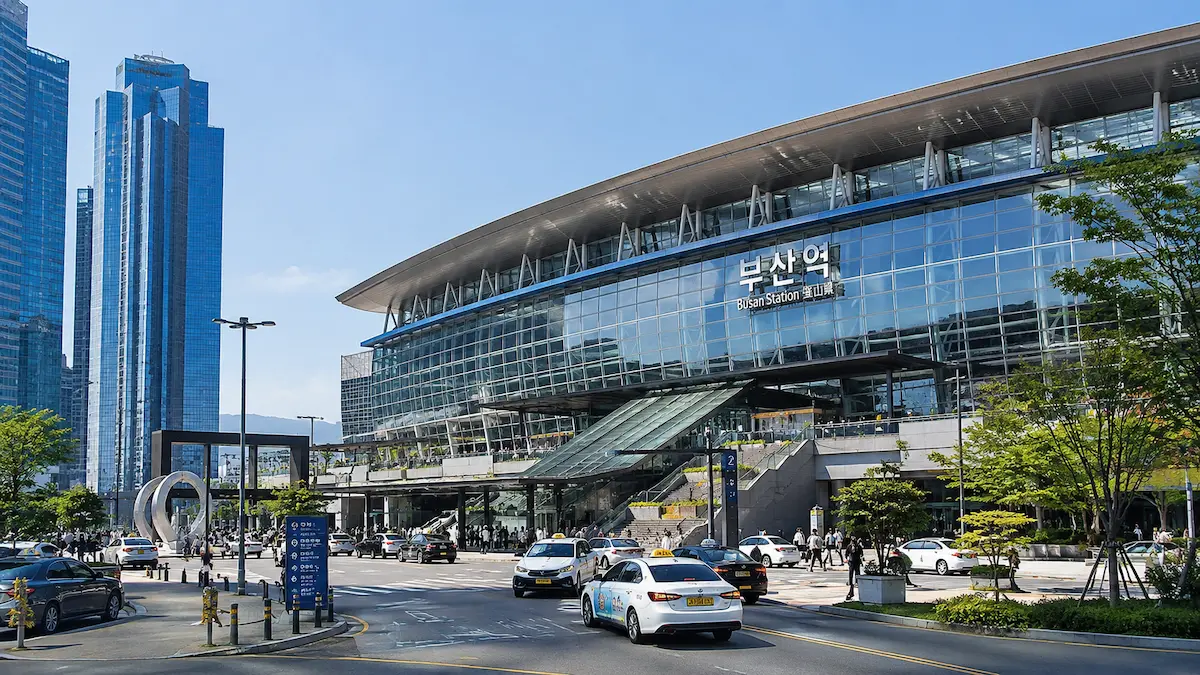
Reality check before you move: the KTX station and Busan Metro Station are connected by an underground passage. The connection includes a moving walkway, escalators and an elevator, but it is still not an instant platform-to-platform transfer. With luggage, I would budget roughly 5–10 minutes just to follow the signs and reach the metro area before counting the train ride itself.
Fare check: Prices and official taxi surcharge rules in this guide were checked on August 7, 2026 against Busan Metropolitan City transport information. Fares, routes and last-train times can change, so check your navigation app again on the day you travel.
The 1-Min Cheat Sheet
- 🚇 Metro Line 1 — Best overall: About 10–11 minutes on the train, around ₩1,600 with a transportation card for a one-zone adult journey. No transfer to Seomyeon. Best for solo travelers, couples and anyone with manageable luggage.
- 🚌 City Bus — Best only when the bus stop is closer to your hotel: Around ₩1,550 with a transportation card, but the total journey can be 25–45+ minutes depending on waiting and traffic. A poor choice with large suitcases.
- 🚕 Taxi / Taxi App — Best with heavy luggage, kids or late arrival: Roughly ₩9,500–₩12,000 to central Seomyeon in ordinary conditions. Door-to-door convenience can easily justify the extra cost when split between two or three people.
My default recommendation: use the metro if your hotel is within about a 5–8 minute walk of Seomyeon Station and you have one manageable suitcase each. Take a taxi if your hotel is farther from the station, your bag is heavy, you are traveling with children or an older family member, or you arrive tired enough that another 10-minute walk sounds miserable.
Top Survival Tips
- Check the hotel pin, not just the neighborhood name. “Seomyeon” covers a large area. A hotel that advertises itself as Seomyeon can still be a long walk from the station, especially with luggage.
- For Seomyeon, take Line 1 toward Nopo. From Busan Station, you stay on Line 1 all the way to Seomyeon—no interchange is required.
- If you are staying in Nampo, do not go to Seomyeon first. Take Line 1 in the opposite direction, toward Dadaepo Beach, and get off around Jungang/Nampo depending on your hotel.
- If you are staying in Haeundae or Gwangalli, Seomyeon is a transfer point, not your final destination. You will normally change from Line 1 to Line 2 at Seomyeon, which means more walking with luggage. For a group, a taxi from Busan Station becomes more attractive.
- Large luggage and ordinary city buses are a bad combination. Travelers have reported being refused boarding with large suitcases on regular Korean city buses, including in Busan. Treat the bus as a backpack/carry-on option, not a guaranteed checked-luggage solution.
- Use a transportation card if you already have one. T-money and other compatible cards can be used on Busan public transport; tapping is faster than stopping to buy a one-time ticket after a long KTX journey.
- For taxis, check the estimated fare before getting in. Apps such as k.ride, Kakao T or Uber Taxi can help confirm the destination and give you a price reference. If hailing a street taxi, use the meter rather than accepting an unexplained tourist-area fixed price.
- Late-night taxi costs are not a scam by themselves. Busan’s official surcharge is +20% from 23:00–00:00, +30% from 00:00–02:00 and +20% from 02:00–04:00 for standard taxis. The red flag is an arbitrary price that does not match the meter or app.
- Do not obsess over the “fastest” vehicle time. A taxi may drive to Seomyeon in around 10 minutes in light traffic, but queuing, loading luggage and congestion can change that quickly. The metro is more predictable during rush hour.
The Full Experience
🚇 Busan Metro Line 1: Best for Most Travelers Going to Seomyeon
Best overall · No transfer · Predictable time · Budget-friendly
For a first-time visitor arriving by KTX, this is the route I would choose unless luggage or mobility changes the calculation. Follow signs from the KTX arrival area for Busan Metro / Line 1. The underground passage between the train station and metro station means you do not need to drag your suitcase across the outdoor station square.
At the metro, take Line 1 toward Nopo and ride directly to Seomyeon Station. The rail journey is roughly 10–11 minutes. Current Busan fare information lists a one-zone adult fare of ₩1,600 by transportation card/mobile payment or ₩1,700 for a one-time QR ticket.
The headline “11 minutes” can be misleading, though. Your real door-to-door time from the KTX platform to a Seomyeon hotel is more likely around 20–35 minutes once you include the station connection, waiting for a train, finding the correct exit and walking from the exit to your accommodation.
Why it works so well: there is no traffic risk, no transfer and no need to explain your hotel name to a driver. If you are traveling alone, it is very hard to beat on value.
✅ What Other Travelers Say
Travelers generally describe the Busan subway as straightforward, and the Busan Station–Seomyeon route is one of the easiest because it stays on Line 1. The recurring complaint is not the train itself—it is the walking inside stations and dealing with stairs, escalators or elevators while pulling a heavy suitcase. That is an important distinction: a route can be simple on a metro map and still be tiring in real life.
⚠️ The Catch (Things to Keep in Mind)
Seomyeon Station is large. The wrong exit can add a surprisingly annoying street-level walk. Before you leave the paid area, search your exact hotel in Naver Map or Kakao Map and note the recommended exit number. If your hotel is 800 meters away, the “cheap and easy” metro can suddenly mean another 10–15 minutes of hauling luggage.
Rush hour is the other issue. Even though the ride is short, a crowded train is not fun with a 28-inch suitcase. If you arrive during the evening commute with multiple large bags, I would seriously compare the cost of a taxi before automatically choosing the metro.
Best for: solo travelers, couples, budget travelers, light-to-medium luggage, and hotels genuinely close to Seomyeon Station.
Skip it when: you have several large suitcases, limited mobility, exhausted children, or a hotel that is technically “Seomyeon” but far from a convenient station exit.
Check the official Busan metro fare information.
🚌 City Bus: Best Only When It Drops You Closer to Your Hotel
Lowest headline fare · No underground station · Traffic-sensitive · Not for large luggage
Busan city buses can look tempting because they keep you above ground and the standard adult fare is only ₩1,550 with a transportation card. Routes including Bus 88 serve the Busan Station–Seomyeon corridor, although exact stop patterns and real-time arrivals should always be checked on the day.
Here is the important part: the bus is not meaningfully cheaper than the metro. You are saving about ₩50 on the basic adult card fare. That is not enough savings to justify a longer, more traffic-dependent journey unless the bus stop happens to be much closer to your hotel door than a Seomyeon metro exit.
The ride may take around 25–40 minutes depending on route, waiting time and road conditions. At busy times, it can take longer. Busan traffic can be slow, and the time displayed when you first search is not a promise.
✅ What Other Travelers Say
Travelers who like Busan buses tend to value the dense route network and the ability to reach places that are awkward by subway. For a small backpack or cabin bag, buses can be convenient once you understand the stop announcements and have live navigation open on your phone.
But recent traveler discussions repeatedly warn about large suitcases on normal city buses. Some visitors report drivers refusing boarding when bags are considered too large or unsafe in the aisle. That means the bus can be fine for day-to-day sightseeing but a poor bet for the first transfer after a KTX journey with checked luggage.
⚠️ The Catch (Things to Keep in Mind)
The biggest hidden cost is uncertainty. You need to find the correct street-level bus stop, make sure you are traveling in the correct direction, watch for your stop, deal with traffic, and possibly stand with your bag. If the bus is crowded, luggage becomes everyone’s problem—not just yours.
Also remember that paying cash costs more and does not give the same transfer-discount advantages as a transportation card. If you do use the bus, tap your card and use a live Korean navigation app rather than relying on a static timetable screenshot.
Best for: travelers with backpacks or small carry-ons whose hotel is directly beside a useful bus stop.
Skip it when: you have a large suitcase, you are arriving at rush hour, you are tired after a long KTX ride, or you are choosing it only because you think it saves a meaningful amount of money.
Check Busan Metropolitan City public-transport fare information.
🚕 Taxi, k.ride or Uber Taxi: Best for Heavy Luggage, Families and Late Arrivals
Door-to-door · Best with luggage · Good value for 2–3 people · Late-night surcharge applies
A standard taxi from Busan Station to central Seomyeon is usually the most painless option. The distance is only around 5–6 km, and a typical fare estimate is roughly ₩9,500–₩12,000 in normal conditions. For two travelers, that can be around ₩5,000–₩6,000 each; for three, the per-person difference versus the metro is small enough that comfort may win.
The official Busan standard-taxi meter starts at ₩4,800 for the first 2 km. Late at night, the city applies surcharges: +20% from 23:00 to midnight, +30% from midnight to 02:00, and +20% from 02:00 to 04:00. Congestion and waiting time also affect the meter, so do not treat any internet estimate as a guaranteed fixed fare.
If you do not want to explain your hotel in Korean, taxi apps are useful. Kakao Mobility’s k.ride is designed for international travelers and offers multilingual destination search plus estimated fares. Kakao T and Uber Taxi can also be useful depending on your account and payment setup. If you have several large suitcases, choose a larger vehicle where available rather than hoping everything will fit in a standard sedan.
✅ What Other Travelers Say
Travelers commonly say taxis in Korea feel affordable compared with many major international cities, especially when sharing the ride. Recent trip reports also highlight a practical problem: a normal taxi may not fit three people plus several large suitcases, and drivers may cancel if the luggage load is unrealistic for the vehicle. For families, preselecting a larger vehicle or arranging a suitable car through the hotel can remove that uncertainty.
There are also traveler reports of occasional attempts to overcharge foreign visitors in tourist areas. The sensible response is not to avoid every taxi; it is to check the estimated fare and route before you ride, use an app where practical, and make sure a street-hailed taxi uses the meter.
⚠️ The Catch (Things to Keep in Mind)
The taxi’s advantage disappears in heavy traffic. During busy commuter periods, the metro can be faster and more predictable. App-based options can also carry a higher price than simply hailing a standard metered taxi, depending on the vehicle class and service you choose.
Do not assume that “four passengers” means “four passengers plus four full-size suitcases.” Vehicle capacity and luggage capacity are different. If you are a group with several checked bags, book a van-size option or split into two taxis.
Best for: two or three travelers sharing the fare, families, travelers with large luggage, limited mobility, rainy weather, and arrivals after the metro becomes inconvenient.
Skip it when: you are traveling solo on a tight budget during normal metro hours, or road traffic is clearly severe.
Check k.ride for a current taxi estimate.
So, Is Seomyeon Really the Right “Busan City Center” for You?
This is the detail many transport guides miss. Busan is long and spread out, and the best arrival route depends on where you are sleeping—not on what a generic article calls “downtown.”
- Staying in Seomyeon: Take Line 1 toward Nopo. This is the cleanest, simplest public-transport choice.
- Staying in Nampo, Jagalchi or BIFF Square: Stay on Line 1 but go the opposite direction, toward Dadaepo Beach. Do not detour through Seomyeon.
- Staying in Haeundae: Metro means Line 1 to Seomyeon, then Line 2 east. It is economical but involves a transfer and a much longer ride. With heavy luggage or a group, compare a taxi.
- Staying in Gwangalli: You will also normally change to Line 2 at Seomyeon. Again, the transfer is easy on paper but less pleasant with several suitcases.
- Staying around Choryang or directly beside Busan Station: You may not need transport at all. A short walk can beat entering the metro for one tiny hop.
If this is your first Busan trip and you have not booked a hotel yet, Seomyeon is a strong base when you want balanced access to both western sights such as Nampo/Gamcheon and eastern areas such as Gwangalli/Haeundae. The smarter booking move is to choose a hotel genuinely close to a useful Seomyeon exit, not merely one that uses “Seomyeon” in its marketing.
Key FAQs
What is the easiest way to get from Busan Station to Seomyeon with luggage?
For one manageable suitcase per person, Metro Line 1 is usually easiest: there is no transfer, and the Busan KTX station connects to the metro by an underground passage. If you have multiple large suitcases, children, an older traveler or a hotel far from the station exit, take a taxi and pay for the door-to-door convenience.
How much is a taxi from Busan Station to Seomyeon city center?
A normal daytime estimate is roughly ₩9,500–₩12,000 to central Seomyeon, but traffic, waiting time and vehicle type can increase the fare. Standard Busan taxis also have official late-night surcharges between 23:00 and 04:00, with the highest surcharge applying from midnight to 02:00.
Is there a direct subway from Busan Station to Seomyeon?
Yes. Take Busan Metro Line 1 from Busan Station toward Nopo and get off at Seomyeon. You do not need to change lines. The train ride is about 10–11 minutes, although the full KTX-platform-to-hotel journey takes longer because of station walking and the final walk from the Seomyeon exit.
Final Verdict and Your Next Step
Choose the metro if you are traveling alone or as a couple, arriving during normal operating hours, and your hotel is close to Seomyeon Station. It is fast, predictable and inexpensive, and the route could hardly be simpler.
Choose a taxi if you have heavy luggage, two or three people to split the fare, young children, an older companion, bad weather, or a hotel that is a frustrating walk from the station. The extra spend is often modest compared with the amount of energy it saves at the end of a travel day.
Choose the bus only for a specific reason—usually because a direct bus stop is much closer to your accommodation and you are carrying only a small bag. Do not take a regular city bus with a large suitcase simply to save ₩50 over the metro. That is the definition of false economy.
And before you commit to any route, double-check your hotel area. If the booking says Nampo, Jagalchi, Haeundae or Gwangalli, your best route is not the same as a Seomyeon transfer. A five-minute location check before arrival can save a pointless cross-city detour.
Book the part that actually benefits from advance planning
You do not need to pre-book the metro or a normal city bus. What is worth booking in advance is your accommodation—ideally near the station exit you will actually use—and, for families or groups who want to start sightseeing immediately after arriving by KTX, a suitable private vehicle.
Check Seomyeon hotels on Agoda
·
Compare Seomyeon hotels on Booking.com
If you want a private vehicle for a full sightseeing day rather than a simple station-to-hotel ride, compare the vehicle size, included hours and pickup conditions before paying. Confirm Busan Station pickup with the operator if that is where you want to start.
Check a Busan private car charter on Klook
·
Check a Busan private charter on KKday
Useful official references: Busan Metro fares · Busan public transportation and taxi fares · Busan Station underground metro connection.