




💡 Key Takeaways
- The biggest trap is the name itself: there is no normal commercial passenger airport in Jeonju today. Do not build an itinerary around the old CHN airport code as if you can fly there on a regular scheduled passenger flight.
- For most international visitors, the direct Incheon Airport to Jeonju intercity bus is the best overall choice. It avoids hauling luggage through Seoul, costs less than a train combination, and currently runs frequently.
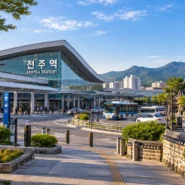
- Your final destination matters. Jeonju Intercity Bus Terminal and Jeonju Station are not the Hanok Village. With large suitcases, a short taxi for the last leg is usually money well spent.
If you are searching for Jeonju Airport to city center transport, there is an important correction to make before comparing buses, trains and taxis: Jeonju does not currently have a commercial passenger airport used by ordinary travelers. That misleading “Jeonju Airport” label can send first-time visitors down the wrong rabbit hole, especially when old airport codes or third-party flight pages appear in search results. In practice, most overseas travelers reach Jeonju from Incheon International Airport (ICN), while a smaller number arrive through Gunsan Airport (KUV) or Cheongju International Airport (CJJ).
So what should you book? If you land at Incheon with a suitcase, take the direct intercity bus unless you have a strong reason to use KTX. If you are actually flying into Gunsan, use the limited airport-to-Jeonju bus when its schedule matches your flight. If you are a family or group carrying multiple large bags, a pre-arranged door-to-door transfer may be worth the premium.
Fact-check note: Korea Airports Corporation’s current passenger-airport network includes Gunsan Airport but does not operate a commercial passenger terminal called Jeonju Airport. Jeonju City’s own visitor transport guide directs airport arrivals from places such as Incheon rather than from a local Jeonju passenger airport. Check the Korea Airports Corporation Gunsan Airport site and the official Visit Jeonju transportation guide when planning.
The 1-Min Cheat Sheet
- Best for most travelers — Direct Incheon Airport → Jeonju intercity bus: roughly 3–3.5 hours depending on terminal and traffic. Current August 2026 schedule data for Terminal 2 shows frequent departures and a premium intercity fare of about ₩30,700. One seat, luggage in the hold, minimal walking.
- Best for predictable rail travel — Incheon Airport → Gwangmyeong → KTX to Jeonju: usually faster on the long-distance rail segment, but you must make a timed connection and handle your own luggage during the transfer. Better for light packers who already prefer KTX.
- Best for 3–4 people with heavy luggage — Private transfer or long-distance taxi: door to door and no terminal change. The downside is price, which can be several times the bus fare, so confirm a fixed total including tolls and any late-night surcharge before paying.
- Best if you actually fly into the closest passenger airport — Gunsan Airport → Jeonju bus: the road distance is much shorter than from Incheon, but the airport bus timetable is sparse. It is excellent when your flight and bus connect cleanly, annoying when they do not.
Top Survival Tips
- Do not book around “CHN” without checking what you are looking at. An old or military-airfield reference is not the same thing as a current bookable passenger airport.
- At Incheon, give yourself a real arrival buffer. Incheon Airport itself advises passengers booking onward public transport to consider roughly 1–2 hours for immigration after landing. A delayed flight plus a non-refundable onward ticket is an avoidable way to start a trip.
- Use your actual airport code when searching: ICN for Incheon, KUV for Gunsan and CJJ for Cheongju. “Jeonju Airport” is too ambiguous to use for live transport planning.
- If you have two big suitcases, value transfers differently. A theoretically faster train route can become the worse choice when you have to drag luggage through a station, find the correct platform and make a timed connection.
- Save your hotel name and address in Korean before you travel. This makes the final taxi ride much easier, especially for hanok stays hidden inside narrow lanes where English hotel names may not match the local listing.
- Do not assume “Jeonju city center” means one place. Hanok Village, Gaeksa/Jungang-dong, Jeonju Station and the intercity bus terminal are separate arrival zones. Choose your airport route based on where you are sleeping, not just which line looks fastest on paper.
- For Hanok Village with luggage, take a taxi for the final leg. Jeonju’s city buses are useful and inexpensive, but saving a few thousand won is rarely worth hauling a 20 kg suitcase on and off a local bus after a long flight.
- Check same-day or next-day schedules before leaving the airport. Korean intercity timetables can change by season, holiday period and operator. Use the airport ticket counter, T-money intercity booking, Bustago or the official terminal information as your final check.
The Full Experience
🚌 Direct Incheon Airport to Jeonju Intercity Bus: Best Overall for Most Travelers
Best for: first-time visitors, solo travelers, couples, large suitcases, Hanok Village stays | Typical cost: about ₩30,700 for a premium intercity seat on current schedules | Typical time: about 3–3.5 hours | Transfers: none until you reach Jeonju
This is the route I would choose for most people landing at Incheon. The bus removes the most tiring part of the journey: navigating Seoul with luggage after an international flight. You load your large bag underneath, sit down, and stay on the same vehicle until Jeonju.
As of the schedule data checked in August 2026, Incheon Airport Terminal 2 has around 22 Jeonju departures a day, with services spread from early morning until late evening. The premium intercity fare is around ₩30,700, with the late-night service slightly higher. Terminal 1 departures occur on the same route but at different times, so check your own terminal rather than copying a timetable from a blog written for the other terminal.
Jeonju City’s official tourism website says airport bus tickets can be purchased at the airport and identifies the provincial bus boarding areas for both terminals. At Terminal 1, look for the provincial bus zone around platforms 12–13; at Terminal 2, the current city guide points travelers to platform 8 in the B1 transportation center. Always confirm the platform on your ticket because airport bay assignments can change.
What happens when you arrive? The bus takes you to a Jeonju bus-terminal stop, not directly to your hanok or hotel. If you are staying around Jeonju Hanok Village, Gaeksa or Nambu Market, the simplest finish is usually a taxi. It turns a potentially awkward local-bus transfer into a short, low-stress last leg.
✅ What Other Travelers Say
Traveler reports about the Incheon–Jeonju bus are generally positive for the exact reasons that matter after a flight: comfortable reclining seats, luggage storage below the coach and no need to change trains in Seoul. The recurring advice is also very practical—buy the correct Jeonju ticket at the airport and verify the departure bay instead of wandering outside and guessing.
⚠️ The Catch (Things to Keep in Mind)
Road traffic is the main variable. A bus that looks only slightly slower than KTX on paper can lose time in congestion, especially around holiday periods. Seats can also tighten during Korean public holidays and peak travel weekends. If your flight lands close to the final departure, do not book an onward bus with an unrealistic immigration buffer.
My pick: Choose this route if you have checked luggage, are arriving during normal operating hours and want the best balance of cost, comfort and simplicity. For many visitors, the saved transfer is more valuable than shaving a few minutes off the journey.
🚆 Incheon Airport to Gwangmyeong + KTX to Jeonju: Best for Rail Comfort and Predictability
Best for: light packers, KTX fans, travelers who dislike highway traffic | Typical cost: higher than the direct bus once the airport connection and KTX fare are combined | Typical time: competitive when the connection lines up | Transfers: at least one, plus a local transfer in Jeonju
The smartest rail version is usually not “AREX into central Seoul and then figure it out.” That can create unnecessary backtracking. Instead, use the airport connection to Gwangmyeong KTX Station and take a Jeolla-line KTX service that stops at Jeonju.
KORAIL currently lists the Gwangmyeong Station airport-bus connection, and the adult fare between Incheon Airport and Gwangmyeong is around ₩16,000. From Gwangmyeong, direct KTX services to Jeonju are available, but the exact departure pattern varies. This is why I would book the train first, then build the airport-bus connection around it—not the other way around.
The rail ride itself is excellent: reserved seating, no highway congestion and a predictable arrival at Jeonju Station. The downside becomes obvious when you are carrying luggage. You still need to unload at Gwangmyeong, enter the station, find your platform and then arrange another bus or taxi after reaching Jeonju.
For travelers heading to Hanok Village, a taxi from Jeonju Station is usually the sensible finish. Current journey planners put the taxi ride at roughly 8–15 minutes depending on traffic and the exact entrance to your accommodation.
✅ What Other Travelers Say
Travelers consistently praise KTX for clean, comfortable and fast intercity travel. The route is especially attractive to people already using rail passes or continuing to other Korean cities. It also avoids the uncertainty of highway congestion, which matters during busy weekends and holiday periods.
⚠️ The Catch (Things to Keep in Mind)
The hidden cost is not only money—it is transfer friction. A missed KTX connection can wipe out the theoretical time saving, and popular trains can sell out on weekends. Large suitcases also make the Gwangmyeong transfer more annoying than it looks on a route planner. If you are exhausted after a long-haul flight, the direct bus is often the calmer choice.
My pick: Use KTX if you pack light, can secure a sensible connection in advance, or care more about schedule predictability than door-to-door simplicity.
🚖 Private Transfer or Long-Distance Taxi: Best for Families, Groups and Heavy Luggage
Best for: 3–4 travelers sharing the cost, children, seniors, mobility needs, late arrivals, multiple suitcases | Typical cost: high and highly variable | Typical time: around 3 hours in normal road conditions from Incheon | Transfers: none
A private transfer solves almost every physical inconvenience in one move: no ticket machine, no platform change, no suitcase wrestling, and no final taxi from a Jeonju terminal. The driver meets you at the airport and takes you straight to your hotel or the nearest vehicle-access point for your hanok stay.
This option starts making more sense when the price is split between several people. A solo traveler will almost never get good value compared with the direct bus. A family of four with two children, a stroller and four pieces of luggage may reach the opposite conclusion.
If you book a private car, insist on seeing the total fixed price before confirming. Ask whether tolls, airport waiting time, parking, late-night charges and oversized luggage are included. “From” prices are not useful if you discover the extras after landing.
✅ What Other Travelers Say
The strongest positive feedback is about mental load rather than speed. Travelers with children or a lot of baggage value walking out of arrivals and being finished with transport decisions for the day. Groups also like knowing that the vehicle goes directly to the accommodation instead of dropping everyone at a terminal.
⚠️ The Catch (Things to Keep in Mind)
Price is the obvious downside, and highway traffic still applies. A private car is not magically immune to congestion. Vehicle size is another trap: four adults plus four hard-shell suitcases may not fit into a standard sedan, so confirm both passenger capacity and luggage capacity before paying.
My pick: Consider this when comfort matters more than budget, especially for a group. For one or two adults with normal luggage, the direct intercity bus is usually the better value.
✈️ Gunsan Airport to Jeonju Intercity Bus: Best if You Actually Fly Into the Closest Passenger Airport
Best for: domestic arrivals, especially travelers connecting from Jeju | Typical cost: around ₩9,200 on the Jeonju–Gunsan Airport intercity route | Typical time: roughly 1–1.25 hours by airport bus | Transfers: none when the direct airport bus matches your flight
Gunsan Airport is the closest practical passenger airport to Jeonju, roughly 50–60 km away by road depending on your destination. Korea Airports Corporation confirms a bus stop just to the right of the terminal building, and local transport information lists intercity services linking the airport with Iksan and Jeonju.
This sounds like the obvious winner until you look at the timetable. The direct airport bus runs only a few times a day, so the flight-to-bus connection matters far more than the distance. When the timing works, it is an easy and inexpensive ride. When it does not, you can lose enough time waiting that the “nearest airport” advantage disappears.
If the direct bus does not match your arrival, alternatives can involve a taxi toward Gunsan or Iksan and then onward rail or bus. At that point, compare the total hassle—not just the map distance. For two or more travelers, a taxi connection may be reasonable; for a solo budget traveler, waiting for the direct bus may still make sense.
✅ What Other Travelers Say
Travelers using Gunsan often like it precisely because the airport is small and the journey to Jeonju is geographically short. For Jeju connections, it can be a neat way to avoid returning through Seoul. The simple terminal layout is also much less intimidating than a major international hub.
⚠️ The Catch (Things to Keep in Mind)
The timetable is the weak point. Do not assume there will be a bus waiting for every flight. Seasonal flight changes can also shift the usefulness of the route. Check both your flight and the current airport-bus departure before choosing Gunsan purely because it looks closest on a map.
My pick: Excellent when the schedules align; mediocre when they do not. Treat Gunsan as a flight-and-bus pair, not as two independent bookings.
Key FAQs
Is there actually a Jeonju Airport for commercial passenger flights?
No—not in the way most travelers mean when they search for an airport. Jeonju does not currently have a normal commercial passenger terminal in Korea Airports Corporation’s public airport network. The airport that most closely serves the area for scheduled passenger flights is Gunsan Airport (KUV), while most international visitors still arrive through Incheon (ICN). If a search engine shows “Jeonju Airport” or CHN, do not assume you can book a regular tourist flight there.
What is the easiest way to get from Incheon Airport to Jeonju Hanok Village with luggage?
Take the direct intercity bus from Incheon Airport to Jeonju, then use a taxi for the final ride to your hanok or hotel. This avoids dragging luggage through Gwangmyeong or central Seoul and is usually the best balance of price and effort. The bus terminal is not inside Hanok Village, so budget a small amount for the final taxi rather than treating the intercity ticket as door to door.
Is KTX faster than the direct airport bus from Incheon to Jeonju?
The train itself is faster and more predictable, but your real journey includes the airport-to-Gwangmyeong transfer, connection buffer, platform change and final ride from Jeonju Station. If the timings line up, KTX can win. If you have heavy bags or a risky connection, the direct bus is often the better real-world option even when its scheduled journey is longer.
Final Verdict and Your Next Step
If I were landing at Incheon with a normal suitcase, I would take the direct bus. It is the least stressful route, keeps your luggage handling to a minimum and drops you in Jeonju without making you navigate Seoul after a flight. I would switch to KTX only if I had a well-timed Gwangmyeong connection, light luggage or a strong preference for rail.
If you are flying from Jeju or another domestic point into Gunsan, check the airport bus before you book the flight. The direct Gunsan Airport–Jeonju bus can be excellent value, but its low frequency means a bad connection can turn the closest airport into the most annoying option.
If you are traveling as a family or group with lots of luggage, price the door-to-door option before dismissing it. Four individual tickets, a final taxi, luggage effort and the cost of a missed connection all have value. Sometimes the premium is worth it; sometimes it clearly is not.
Whichever route you choose, book the parts that can sell out before peak weekends and Korean public holidays. KTX reserved seats and popular intercity departures are the two areas where “we will just buy it when we arrive” can backfire.
- Check Korea intercity bus options: Klook Korea Intercity Bus
- Book a KORAIL Pass if your Korea trip includes several long-distance train rides: Klook KORAIL Pass or KKday KORAIL Pass
- Compare Jeonju hotels before choosing your arrival terminal: Booking.com Jeonju hotels or Agoda Jeonju hotels
- Check official train schedules and fares: KORAIL
- Check official Incheon Airport bus information: Incheon Airport Bus Search
Bottom line: do not waste time trying to solve a “Jeonju Airport to downtown” route that does not exist as a normal commercial-airport transfer. Start with the airport you are actually landing at, then optimize for your luggage, hotel location, arrival time and number of travelers. That one correction will save you more hassle than any clever transfer trick.