



💡 Key Takeaways
- Choose your airport train by hotel district, not by which train looks fastest. Nankai is usually the cleanest choice for Namba and Dotonbori; JR is usually better for Tennoji, Osaka Station, Shin-Osaka and Kyoto.
- “Umeda,” “Osaka,” “Namba” and “Shin-Osaka” are not interchangeable station names. They can refer to separate operators, platforms, gates and underground complexes. The wrong exit can add a 15- to 30-minute walk with luggage.
- Do not buy an unlimited pass before pricing your actual itinerary. ICOCA or another compatible IC card is the safest default; the Osaka Amazing Pass only wins when you will genuinely use its included attractions.
The first challenge in any Osaka Transportation Guide is not explaining how to tap through a ticket gate. That part is easy. The real problem is helping a first-time visitor understand which company runs which train, why several stations with similar names are not the same place, and how a route that looks efficient on a map can turn into a long underground walk while pulling a suitcase.
Osaka has an excellent public transport network, but it is fragmented between Osaka Metro, JR West, Nankai, Hankyu, Hanshin, Keihan, Kintetsu, buses and airport services. Most navigation mistakes happen at the boundaries between these systems. A pass may cover one railway but not the next. A “transfer” may involve leaving the gates and walking through a shopping mall. A hotel described as “near Namba Station” may be convenient for one Namba operator and awkward for another.
This guide focuses on those real-world decisions: which airport route fits your hotel, when an IC card is better than a pass, how to survive Umeda and Namba, and where paying slightly more can save a great deal of time and walking.
Fares and pass conditions in this guide were checked on August 4, 2026. Transport rules can change, so confirm service status and final prices before travel.
The 1-Min Cheat Sheet
- For most city sightseeing: Use an ICOCA or another compatible Japanese IC card and ride Osaka Metro. It is the least stressful option when your days include food, shopping and walking rather than nonstop train rides.
- For Kansai Airport to Namba, Dotonbori or Shinsaibashi: Take Nankai. Choose the reserved-seat Rapi:t for comfort and luggage space, or the Airport Express when saving money matters more than having a guaranteed seat.
- For Kansai Airport to Tennoji, Osaka Station, Shin-Osaka or Kyoto: JR Haruka is usually the most logical direct service. Do not take it simply because it is an airport express; take it because its stops match your accommodation.
- For USJ, Osaka Station and JR-based day trips: Use JR. Universal City is on the JR Yumesaki Line, normally reached via Nishikujo unless your train runs through directly.
- For a luggage-heavy arrival, late flight or family group: Compare an airport limousine bus or pre-booked transfer with the train. A slower vehicle can be the better choice when it eliminates two transfers, stairs and a long final walk.
Top Survival Tips
- Pick a hub before you pick a ticket. Osaka’s two most useful visitor bases are the Umeda/Osaka Station area in the north and Namba in the south. Umeda is stronger for JR, Kyoto, Kobe and Shin-Osaka connections. Namba is stronger for Dotonbori nightlife, Nankai airport access and Kintetsu trains to Nara.
- Save your hotel’s correct station, gate and exit before landing. “Five minutes from Namba” is incomplete information. Check whether the hotel means Osaka Metro Namba, Nankai Namba, Osaka-Namba on Kintetsu/Hanshin, or JR Namba at OCAT. These stations connect underground, but the walk can be substantial.
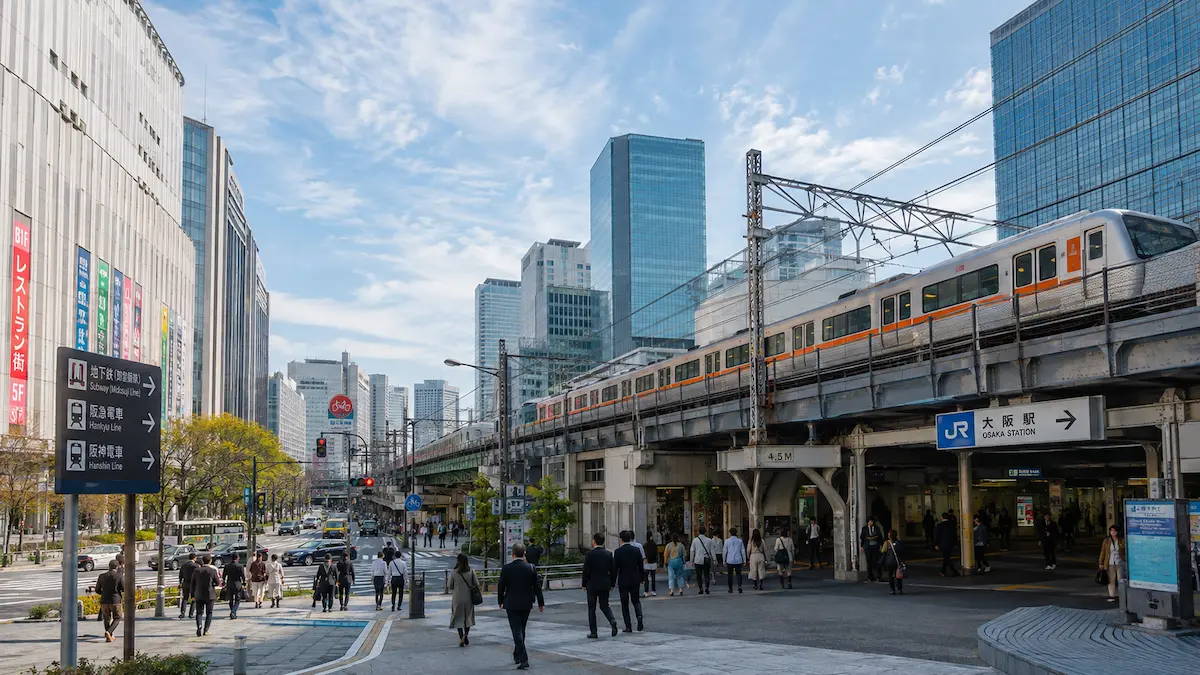
- At Umeda, follow the railway company first and the destination second. JR Osaka Station, Osaka Metro Umeda, Higashi-Umeda, Nishi-Umeda, Hankyu Osaka-Umeda and Hanshin Osaka-Umeda form one enormous district, not one simple station. Look for the operator logo and line colour before following a platform number.
- Do not confuse Osaka Station with Shin-Osaka Station. Osaka Station is the main northern city hub. Shin-Osaka is the Shinkansen station north of central Osaka. They are linked by JR, but they are not walkable substitutes.
- Use exit numbers as part of the address. In Namba, Umeda and Shinsaibashi, a wrong exit can put a wide road, canal, department store or multiple underground blocks between you and the hotel. Screenshot the exit number and a street-level landmark.
- Add a transfer buffer that reflects your luggage. A route planner may allow five minutes between trains. That can be fine for a local commuter who knows the station, but not for a visitor looking for an elevator. Add at least 10 to 15 minutes at major hubs and more when transferring between operators.
- Do not stand beside a ticket gate to reorganise bags. Move to the wall first. Osaka Metro also asks passengers to keep luggage out of other passengers’ way and not stop near gates or ticket machines.
- Avoid weekday commuter peaks with large suitcases where possible. The Midosuji Line and trains around Osaka/Umeda can become extremely crowded. Arriving 30 minutes later may be worth more than saving a few hundred yen on a rigid ticket.
- Check the destination display, not only the line name. JR and private railways operate rapid, local, limited express and through-running services. Two trains on the same platform may skip different stations or continue onto another company’s tracks.
- Do not assume “contactless card accepted” means universal coverage. Osaka Metro accepts supported contactless bank cards and devices, but that does not make the same card a seamless substitute across every JR and private railway journey. A Japanese IC card remains the more dependable all-network tool.
- Keep your phone alive if you use a digital pass. The Osaka Amazing Pass and Kansai Railway Pass Lite rely on a working phone, browser and network connection. Screenshots are not accepted. Carry a power bank and do not activate a pass until you are ready to use it.
- Check the last train on the same day. “Around midnight” is not a safe plan. Final departures vary by line, station and day. A late dinner in Dotonbori can turn a simple Metro ride into an expensive taxi if you miss the last connection.
The Full Experience
✈️ Kansai Airport Trains and Buses: Best for Starting With the Right Osaka Hub
Best for: KIX arrivalsReserved seats availableLuggage-friendly choicesBook ahead at peak times
The best airport transport is the service that leaves you closest to your hotel. Saving six minutes on the train is meaningless if you then spend 25 minutes dragging luggage through a station complex.
Nankai is the natural airport railway for southern Osaka. The Limited Express Rapi:t connects Kansai Airport with Nankai Namba in as little as 34 minutes. Its reserved seating, overhead space and luggage areas make it comfortable after a long flight. As of August 2026, Nankai’s official digital ticket costs ¥1,410 for a regular seat and ¥1,590 for a Super Seat. The cheaper Airport Express takes roughly 45 minutes and needs only the ordinary fare, but seats are not reserved.
Choose Nankai when you are staying near Nankai Namba, Dotonbori, Kuromon Market, Nipponbashi, Shinsaibashi, Daikokucho or along a convenient Osaka Metro connection from Namba or Tengachaya. Check the hotel map carefully: JR Namba and OCAT are on the western side of the wider Namba district, so Nankai Namba is not always the shortest walk.
JR Haruka is the stronger airport option for Tennoji, Osaka Station, Shin-Osaka and Kyoto. It avoids the unnecessary detour of going to Namba first. The train is especially useful when your next journey is a Shinkansen from Shin-Osaka or when your hotel sits on the JR side of Umeda. Reserved seating can be arranged, and discounted visitor tickets are often sold through authorised booking platforms.
The Kansai Airport Rapid Service is the budget JR alternative. It is useful for Tennoji and Osaka Station, but it is an ordinary commuter-style service rather than a dedicated premium airport train. It can become crowded, seats are not guaranteed, and luggage may be awkward during busy periods.
Airport limousine buses deserve more respect than they get. They are not always the fastest option, but a direct bus to a stop beside your hotel can beat a train route involving two transfers and a long underground walk. Buses are particularly sensible for families, travellers with several large bags, or hotels near OCAT, major Umeda bus stops and selected large hotels.
A taxi or private transfer is a convenience purchase, not a budget strategy. It makes the most sense after a late arrival, for four people sharing the cost, for travellers with mobility needs, or when the hotel is poorly connected to an airport station. Road traffic can be unpredictable, so do not book a tight onward connection based on the fastest advertised driving time.
✅ What Other Travelers Say
Traveler feedback consistently praises the Rapi:t for its guaranteed seat, simple airport boarding and comfortable luggage storage. Haruka users value the direct access to Tennoji, Osaka Station, Shin-Osaka and Kyoto. The main positive theme is not raw speed; it is avoiding an exhausting transfer after immigration and baggage claim.
⚠️ The Catch (Things to Keep in Mind)
- Rapi:t is excellent for Namba but inconvenient if your hotel is near Osaka Station or Shin-Osaka.
- Haruka is not the right train for Dotonbori unless you have a clear onward route from Tennoji or another JR stop.
- The Nankai Airport Express can be crowded, and a large suitcase does not guarantee you extra space.
- A flight delay can make a reserved departure inconvenient. Check the ticket’s change, cancellation and redemption rules before buying.
- Terminal 2 passengers must allow time for the airport shuttle to the rail station area.
- For return journeys, confirm the exact airport train station and terminal transfer time rather than copying your arrival schedule in reverse.
🚇 Osaka Metro: Best for Namba, Umeda, Shinsaibashi, Tennoji and City Sightseeing
Best city networkEasy IC-card travelExit planning essentialStrong value on busy days
For a first visit focused on central Osaka, Osaka Metro will probably carry you more often than any other operator. The Midosuji Line is the backbone: it links Shin-Osaka, Umeda, Honmachi, Shinsaibashi, Namba and Tennoji. If your hotel and main sights sit near this line, your trip becomes much easier.
Other useful lines include the Tanimachi Line for Higashi-Umeda, Temmabashi and the Osaka Castle area; the Chuo Line for Honmachi, Osaka Bay and eastern connections; the Sakaisuji Line for Nipponbashi, Ebisucho and through services toward Hankyu territory; and the Yotsubashi Line as a quieter north-south alternative on the western side of central Osaka.
The trains themselves are easy to use. Stations have line letters, numbers, colours and multilingual signs. The difficulty begins after you leave the platform. Large stations can have many exits linked to underground shopping streets and separate buildings. Navigation apps often know the exit number, but they cannot always tell you whether that exit has an elevator or whether construction has changed the best path.
Pay-as-you-go with an IC card is the default recommendation. Tap in and tap out; the system calculates the fare. Osaka Metro also accepts supported contactless credit, debit and prepaid cards or linked devices at dedicated readers. However, contactless travel is charged at the regular adult fare, even when used by a child, and it is not as universally useful across Kansai as ICOCA.
The Enjoy Eco Card is the simple Metro day pass. It costs ¥820 on weekdays and ¥620 on Saturdays, Sundays and holidays for adults, with unlimited Osaka Metro and Osaka City Bus travel for one day. Yumeshima Station and a small number of bus services are excluded. The pass also provides discounts at selected attractions.
My practical rule: on a weekend, the Enjoy Eco Card becomes attractive when you expect at least three to four separate Metro rides. On a weekday, it is more convincing on a genuinely transport-heavy day. A day spent walking between Namba, Dotonbori, Shinsaibashi and Amerikamura may involve fewer rides than your itinerary appears to show.
Umeda has a special transfer trap. Osaka Metro treats Umeda, Higashi-Umeda and Nishi-Umeda as connected transfer stations, but the walk takes place outside the gates. For pay-as-you-go cards and ordinary tickets, the recognised transfer generally must be completed within 30 minutes. Do not use that window for shopping or a long meal.
✅ What Other Travelers Say
Most visitors find the Metro cleaner and easier than expected once they understand the line colours and station numbers. The repeated complaint is not the trains; it is finding the correct station entrance and emerging from the correct exit. Visitors staying on the Midosuji Line often report that Osaka feels much simpler than the network map initially suggests.
⚠️ The Catch (Things to Keep in Mind)
- An Osaka Metro pass does not automatically cover JR, Nankai, Hankyu, Hanshin, Keihan or Kintetsu.
- Some trains continue beyond the Metro network onto a private railway. A Metro-only pass may require an additional fare outside its covered section.
- Not every exit has an elevator. Follow accessibility signs even when the route is slightly longer.
- Contactless bank-card gates are not necessarily available at every gate lane. Look for the dedicated reader.
- The Midosuji Line is convenient but crowded. The Yotsubashi or Tanimachi Line can sometimes save energy even when it adds a few minutes.
- Do not buy the Enjoy Eco Card merely because it sounds cheap. Count rides, not attractions on your wish list.
🚆 JR Trains: Best for Osaka Station, USJ and Regional Day Trips
Best for USJStrong for day tripsAirport optionsNot covered by Metro passes
JR is essential when your itinerary includes Universal Studios Japan, Osaka Station, Shin-Osaka, Kyoto, Kobe, Himeji or JR-based airport travel. It is less useful for some inner-city trips where Osaka Metro has stations closer to the actual attraction.
The Osaka Loop Line is useful, but do not treat it like a simple tourist circle. Platforms may serve local, rapid and through-running trains with different destinations. Read the departure board and listen for station names rather than boarding any train displaying the Loop Line colour.
For Universal Studios Japan, head to Universal City Station. The usual route from Osaka Station uses the Osaka Loop Line to Nishikujo and then the JR Yumesaki Line, although some trains run through directly. During busy periods, follow the crowd only after confirming the train display; many people at Nishikujo are transferring, but not every train serves Universal City.
Osaka Station and Shin-Osaka serve different purposes. Osaka Station is the large city-centre hub attached to Umeda. Shin-Osaka is the Shinkansen station. When a hotel advertises “easy access to Shin-Osaka,” check whether that means one direct Metro ride, one JR ride or a walk from the station. The difference matters when carrying luggage.
JR day-trip passes can be excellent when the itinerary is truly JR-heavy. The JR West Kansai Area Pass costs ¥2,800 for one day, ¥4,800 for two days, ¥5,800 for three days and ¥7,000 for four days. It covers local, rapid and Special Rapid JR services in the valid area and reserved seats on the Kansai Airport Express Haruka. It does not cover the Shinkansen.
The JR Kansai Mini Pass is another option: ¥3,000 for three consecutive days, covering JR local and rapid services around Osaka, Kyoto, Kobe and Nara. Haruka and other limited express trains require additional tickets. This pass can be excellent value for the right route pattern, but it does nothing for Osaka Metro or private railways.
✅ What Other Travelers Say
Visitors appreciate JR when it gives a direct, familiar route to USJ, Kyoto or Kobe. They become frustrated when they buy a JR pass and then discover that their Osaka hotel, restaurants and attractions are closer to Metro or private-railway stations. The happiest JR pass users usually planned multiple regional journeys, not just one city day.
⚠️ The Catch (Things to Keep in Mind)
- A nationwide or regional JR pass does not cover Osaka Metro or most private railways.
- JR Namba is not the same station as Nankai Namba, and it is not the most convenient station for every part of Dotonbori.
- Limited express, reserved-seat and premium seating rules vary. Do not assume an unlimited pass includes every train you see.
- The Shinkansen does not depart from Osaka Station; it departs from Shin-Osaka.
- A JR route can be faster on the train but slower door to door if the station is farther from your hotel or attraction.
- On USJ days, crowding starts before the park opens and returns after closing. Allow time for queues at Universal City and Nishikujo.
🚉 Private Railways: Best for Kyoto, Nara, Kobe and Koyasan
Best regional shortcutsMultiple operatorsIC cards acceptedExpress supplements may apply
Private railways are where Osaka transport becomes powerful—and where first-time visitors make expensive assumptions. These companies often provide the most direct route to a specific district, but their stations, fares and limited express rules are separate from JR.
Hankyu is excellent from Osaka-Umeda to Kyoto and Kobe. It is often the best choice for central Kyoto areas near Karasuma or Kawaramachi and for Kobe-Sannomiya. Osaka-Umeda Station is beside the wider Umeda complex but is not inside JR Osaka Station.
Hanshin is useful for Kobe and through services toward Osaka-Namba. It can be convenient when your trip begins on the southern side of central Osaka rather than Umeda.
Keihan is the strategic choice for eastern Kyoto. From Yodoyabashi or Kyobashi, it serves areas such as Gion-Shijo, Sanjo and Fushimi-Inari. For some Kyoto itineraries, it delivers you closer to the sights than JR Kyoto Station.
Kintetsu is usually the most convenient railway from Osaka-Namba or Tsuruhashi to Nara. Kintetsu Nara Station is closer to Nara Park and the central sightseeing area than JR Nara Station, which can save walking and bus time.
Nankai handles Namba to Kansai Airport and Koyasan routes. Koyasan journeys normally involve a train to Gokurakubashi followed by the cable car and a bus. Do not compare the trip only by rail time; the final connections determine how tiring the day feels.
IC cards make private railways easy because you do not need to understand each fare chart. The complication comes when you board a reserved-seat or limited express service that requires a supplement. An IC tap pays the base fare, but it may not include the premium seat ticket.
✅ What Other Travelers Say
Travelers who choose the railway based on the exact district—not merely the city name—save the most time. Kintetsu to Nara and Keihan to eastern Kyoto are frequently praised because they reduce the final bus or walking segment. The recurring complaint is buying a pass tied to one operator and then discovering that another company serves the planned sights better.
⚠️ The Catch (Things to Keep in Mind)
- “Kyoto” is not one destination. JR Kyoto, Kyoto-Kawaramachi, Gion-Shijo and Sanjo serve different parts of the city.
- Some limited express and reserved-seat trains require a separate supplement even when your base fare or pass is valid.
- Through-running trains may change operator without requiring you to leave the train, but the fare still crosses company boundaries.
- Private-railway stations in Umeda and Namba can be connected underground yet remain a long walk apart.
- Do not buy a private-railway pass until you know the exact station pair for each day trip.
- For a round trip to only one nearby city, ordinary IC-card fares can be cheaper than a multi-day regional pass.
💳 ICOCA and Transport Passes: Best for Avoiding Ticket-Machine Stress Without Overspending
Best default: ICOCAPasses need calculationDigital-ticket battery riskAttraction bundles are not universal
ICOCA is the safest starting point for most first-time visitors. It is a stored-value IC card, not an unlimited pass. Load money, tap in and tap out. It works across Osaka Metro, JR and most major private railways and buses in Kansai, and compatible IC cards from other Japanese regions generally work in the same way.
A standard physical ICOCA is typically sold for ¥2,000, including a ¥500 refundable deposit. The tourist-oriented KANSAI ONE PASS costs ¥3,000 and functions as a prepaid IC card with visitor benefits; it is not unlimited travel. Buy it for convenience or perks, not because you expect discounted train fares.
The Osaka Amazing Pass should be judged as an attraction pass with transport attached. For the 2026–2027 edition, the standard pass costs ¥3,500 for one day and ¥5,000 for two consecutive days. It includes unlimited travel on Osaka Metro, city buses and selected private-railway sections, plus admission to roughly 40 participating attractions. JR is not included.
The pass is worth considering when your day contains several included paid attractions—such as observation decks, cruises, museums or landmark admissions—plus multiple transport rides. It is poor value for a USJ day, a food-and-shopping day, a relaxed neighbourhood day, or an itinerary where you will visit only one included attraction.
Do the arithmetic with your real pace. Many pass calculations assume that you will move perfectly between four or five attractions. In reality, queues, heat, rain, lunch, tired children and sold-out reservation slots reduce the number of places you can visit. A pass that saves ¥1,000 on paper but forces you to rush is not automatically a good purchase.
The digital Osaka Amazing Pass has several practical restrictions. It needs a working smartphone, browser, network connection and camera access. Screenshots and printouts are not accepted. Some stations require staff assistance when a QR-compatible gate is unavailable. Once activated or used, refunds are heavily restricted, and transport disruption or bad weather does not guarantee compensation.
The Kansai Railway Pass Lite is a specialist product, not a universal Kansai pass. The 2026 edition costs ¥5,200 for two days and ¥6,500 for three days. It covers participating private railways and metros across Kansai, but excludes JR, Kyoto City Subway, buses, Randen and some Keihan services. The 2026 sales period ends September 30, with final validity in early October, so check whether a current edition exists for your travel dates.
The best pass decision can be “no pass.” For mixed days involving Metro, JR, private railways, walking and taxis, an IC card often costs slightly more in theory but saves time, avoids coverage mistakes and lets you change plans without feeling forced to “get value” from a prepaid product.
✅ What Other Travelers Say
Travelers consistently praise IC cards for removing ticket-machine stress. Reviews of the Osaka Amazing Pass are strongest from visitors who packed several included attractions into one or two days. Negative experiences usually come from weak phone connectivity, activating too early, misunderstanding the coverage, or buying the pass for a slow-paced itinerary.
⚠️ The Catch (Things to Keep in Mind)
- ICOCA and KANSAI ONE PASS are stored-value cards, not unlimited passes.
- The Osaka Amazing Pass does not cover JR and may not cover the full private-railway journey you want.
- The Amazing Pass is based on a service day, not a rolling 24- or 48-hour period.
- Some included attractions require advance reservations or have limited admission windows.
- A screenshot of a digital pass is not a valid backup. Carry a charged power bank and working data connection.
- Regional passes often exclude premium trains, reserved seats or specific branches even when the operator appears on the map.
- Children may have lower ordinary fares, while some tourist passes charge the same price as adults. Calculate separately for each family member.
Key FAQs
What is the best transport card for tourists in Osaka?
For most visitors, ICOCA or another compatible Japanese IC card is the best default. It works across Osaka Metro, JR and major private railways, so you can follow the best route without worrying about pass coverage. A contactless bank card is convenient on Osaka Metro, but it is not as dependable across the entire Kansai network.
Is the Osaka Amazing Pass worth it for two days?
It can be worth it when you will use several included attractions on both consecutive days and travel frequently within the covered Osaka area. It is usually not worth it for a USJ day, a Kyoto or Nara day trip, a relaxed food itinerary, or any plan where you mainly walk. Price the attractions you genuinely expect to visit—not the maximum number you could theoretically squeeze in.
What is the easiest way to get from Kansai Airport to Osaka with luggage?
Choose by hotel district. Use Nankai Rapi:t for Namba and the southern city centre, JR Haruka for Tennoji, Osaka Station, Shin-Osaka or Kyoto, and consider a limousine bus when it stops close to your hotel. A private transfer becomes reasonable for late arrivals, larger groups, mobility needs or multiple heavy bags.
Final Verdict and Your Next Step
Osaka transport becomes manageable when you stop searching for one ticket that covers everything. Start with the hotel location, identify the nearest operator and station exit, then choose the simplest route for each day. For most travellers, that means an IC card for ordinary journeys, a separately booked airport train, and only one carefully chosen pass on a day when the numbers clearly work.
Book airport tickets in advance when you want a reserved seat, are travelling during a busy holiday period, or do not want to solve ticket options after a long flight. The Nankai Rapi:t is the practical choice for Namba, while JR Haruka is better aligned with Tennoji, Osaka Station, Shin-Osaka and Kyoto:
Buy the Osaka Amazing Pass only after confirming that its included attractions match your route and opening times. Do not activate it until the morning you intend to use it, and keep a power bank with you:
The final anti-trap checklist is simple: save the correct station name, save the exit number, charge your phone, leave extra transfer time with luggage, and never buy an unlimited pass merely because “unlimited” sounds reassuring.