
💡 Key Takeaways
- The subway is usually the best airport transfer only if you arrive at the Domestic Terminal. International passengers must first take the free inter-terminal shuttle, or use a direct bus or taxi.
- An IC card is the safest default for most city trips. The ¥640 subway day pass can be good value, but the ¥2,500–¥2,800 Tourist City Pass needs a carefully planned, transport-heavy day to pay off.
- Hakata, Tenjin, Tenjin-minami and Nishitetsu Fukuoka (Tenjin) are not interchangeable names. Choosing the wrong station or exit can add a long underground walk while you are dragging luggage.
Fukuoka looks easy on a map, and compared with Tokyo or Osaka, it is. The trap is that the city uses several separate operators, station complexes have similarly named sections, and the airport’s international terminal is not directly connected to the subway. A first-time visitor can save five minutes on the train and then lose twenty minutes underground looking for the correct exit.
This Fukuoka transportation guide is designed around the decisions that actually matter: which airport route works with luggage, when a bus beats the subway, whether an unlimited pass will really save money, and how to avoid turning a simple Dazaifu or Itoshima day trip into a chain of wrong platforms and unnecessary transfers. Fares and pass conditions in this guide were checked in August 2026, but always recheck operator timetables for your exact travel date.
The 1-Min Cheat Sheet
- Fukuoka City Subway: Best for Fukuoka Airport Domestic Terminal, Hakata, Tenjin, Ohori Park and western city districts. Fast, frequent and traffic-free. Airport to Hakata takes about five minutes; airport to Tenjin about eleven minutes. Both are currently ¥260 one way.
- Nishitetsu City Bus: Best for Fukuoka Tower, Momochi Seaside Park, PayPay Dome, Hakata Port and hotels that are awkwardly far from a station. More direct than rail in the right situation, but slower and less predictable during traffic.
- JR Kyushu: Best for regional trips from Hakata to places such as Kokura, Yufuin, Nagasaki, Kumamoto and parts of the Itoshima or Uminonakamichi routes. It is not the main way to move between central Fukuoka neighbourhoods.
- Nishitetsu Train: Best for Dazaifu and Yanagawa. Trains leave from Nishitetsu Fukuoka (Tenjin) Station, not JR Hakata Station and not the subway platform at Tenjin.
- Taxi or private transfer: Best for three or four people sharing the fare, bulky luggage, young children, reduced mobility, late-night arrivals or hotels with an inconvenient final walk. It is usually unnecessary for a solo traveller staying beside Hakata or Tenjin Station.
Top Survival Tips
- Check your airport terminal before choosing the subway. Fukuoka Airport Station is directly connected to the Domestic Terminal. From the International Terminal, follow signs to the free shuttle bus and allow time for waiting, loading bags, the ride around the airfield and walking down to the subway. For an international arrival, the famous “five minutes to Hakata” describes only the train ride, not the full door-to-platform journey.
- Use the direct airport bus when it removes a difficult transfer. The direct Nishitetsu bus between Fukuoka Airport International Terminal and Hakata Station is currently ¥400 and scheduled at about 18 minutes in normal conditions. It can be easier than shuttle-plus-subway when you have a large suitcase, although road congestion can erase the time advantage. Check where the bus drops you: the Hakata airport bus uses the Chikushi side, which may be the wrong side for your hotel.
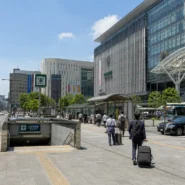
- At Hakata Station, memorise “Hakata Exit” versus “Chikushi Exit.” The Hakata Exit is on the west, city-centre side, toward Gion and Canal City. The Chikushi Exit is on the east side, closer to many business hotels and airport-bus stops. The station is large enough that choosing the wrong side can mean a long indoor crossing with luggage. Save your hotel’s nearest exit number, not just its distance from “Hakata Station.”
- Do not treat the three Tenjin stations as one platform. Subway Tenjin Station serves the Airport Line. Tenjin-minami serves the Nanakuma Line. Nishitetsu Fukuoka (Tenjin) Station serves Nishitetsu trains to Dazaifu and Yanagawa. They are connected through the underground district, but the walk can feel much longer with bags, crowds or a tight departure time.
- An IC card is usually better than buying single tickets. HAYAKAKEN, SUGOCA and nimoca are the local cards, while major compatible cards such as Suica, PASMO and ICOCA also work on most city subways, Nishitetsu buses and trains. Tap at both ends where required. Keep some cash because card recharging is commonly cash-based and not every tourist bus, ferry or rural service accepts the same payment methods.
- Do not buy an unlimited pass because the word “unlimited” feels safe. The subway day pass costs ¥640. It normally pays off with three medium-distance rides or four very short rides, but not with a simple airport-to-hotel trip followed by walking around Tenjin. The Tourist City Pass costs much more and only works financially when your day genuinely combines several covered operators or a Dazaifu trip.
- On Nishitetsu buses, board and pay the local way. For most city buses, board through the centre door. Tap your IC card when boarding and again when leaving. Cash users take a numbered ticket, watch the front fare display, then pay at the front when getting off. The machine can change a ¥1,000 note, but carrying smaller money avoids an awkward queue behind you.
- Read the train destination, not just the platform. Some Airport Line trains continue beyond Meinohama onto the JR Chikuhi Line toward Itoshima, while others terminate earlier. A route app may show a “direct” service that exists only at specific times. Missing that train can add a transfer at Meinohama, so check the displayed destination before boarding.
- Reserve popular JR limited expresses early. Tourist trains and popular limited expresses can sell out, particularly on weekends and holidays. JR Kyushu normally opens reserved-seat sales at 10:00 JST one month before departure. A rail pass does not create a seat when the train is full, and some passes cover only non-reserved seats.
- Let your hotel location decide your transport strategy. Hakata is best for JR day trips, Shinkansen travel and the fastest airport connection. Tenjin is better for shopping, nightlife, Nishitetsu trains and many city buses. Nakasu sits between them and is walkable to both in good weather, but cobbled streets, bridges and crowds are less pleasant with rolling luggage.
Which Fukuoka Transport Pass Is Actually Worth It?
IC Card: Best Default for Most First-Time Visitors
Verdict: Buy or use one unless your itinerary clearly proves that a day pass is cheaper. An IC card removes the need to calculate fares at every machine and works across competing operators. It is convenience, not a discount pass.
Best for: Two to four city rides per day, mixed subway and bus use, and travellers continuing to other Japanese cities.
Watch out: A ¥500 deposit applies when buying many physical cards. Mobile cards can be convenient, but phone compatibility and foreign-card top-ups vary. Never rely on a foreign contactless bank card as your only transport payment method across every operator.
Fukuoka City Subway 1-Day Pass: Good, but Only on a Subway-Heavy Day
The official adult price is ¥640, with unlimited travel on the Airport, Hakozaki and Nanakuma lines for the date of use. It is one of the few passes with a low, realistic break-even point.
Good example: Airport or Hakata to Ohori Park, then Tenjin, then Ropponmatsu, then back to Hakata. Bad example: Airport to Hakata, one ride to Tenjin, then walking for the rest of the day.
Important: It does not cover Nishitetsu buses, Nishitetsu trains, JR trains or the airport’s direct bus.
Fukuoka Tourist City Pass: Broad Coverage, High Break-Even Point
The current official prices are ¥2,500 for Fukuoka City and ¥2,800 for Fukuoka City plus Dazaifu. The pass can cover a mix of subway, selected buses, local JR, Nishitetsu train and ferry services within the stated area, plus selected attraction benefits.
Verdict: It is not a sensible default for a normal Hakata–Tenjin–Ohori itinerary. It becomes interesting when you deliberately build a full day around distant attractions, several operators and a ferry or Dazaifu. The Dazaifu version covers the specified Nishitetsu train area but does not cover the Dazaifu Liner Bus “Tabito.”
Before buying: Add the point-to-point fares for your real route. Do not count theoretical rides you are unlikely to take just to make the pass look worthwhile.
Nishitetsu Fukuoka City One-Day Bus Pass: Useful for a Bus-Heavy Sightseeing Day
The paper pass is currently ¥1,200 for adults and covers local Nishitetsu buses within Fukuoka City. It can save money on a day linking waterfront attractions, the port, museums and neighbourhoods away from subway stations.
Verdict: Skip it if your main journeys are only Hakata–Tenjin, currently a low flat bus fare, or if you will use the subway for most of the day. Consider it for a Fukuoka Tower–Momochi–Hakata Port–city-centre route with several paid bus legs.
JR Kyushu Passes: Valuable for Regional Travel, Pointless for City Sightseeing
The JR Kyushu Mobile Pass is currently ¥3,500 for two consecutive days in its eligible Fukuoka and Saga area and covers non-reserved seating only. The standard Northern Kyushu Rail Pass is currently ¥15,000 for three days or ¥17,000 for five days, with lower limited-time online pricing sometimes offered.
Verdict: The mobile pass can work well for two back-to-back JR day trips within its coverage. The Northern Kyushu pass needs expensive intercity journeys, such as combinations involving Nagasaki, Kumamoto, Yufuin or Beppu. It does not cover Fukuoka City Subway, Nishitetsu trains or city buses.
The Full Experience
🚇 Fukuoka City Subway: Best for the Airport, Hakata, Tenjin and Ohori Park
Fast · Traffic-free · Best city backbone · Easy with moderate luggage
The Airport Line is the transport spine most visitors use. It links Fukuoka Airport Domestic Terminal with Hakata, Gion, Nakasu-Kawabata, Tenjin, Ohori Park, Nishijin and Meinohama. The Nanakuma Line now reaches Hakata directly, which is useful for Canal City’s Kushida Shrine area, Yakuin, Ropponmatsu and southern neighbourhoods. The short Hakozaki Line matters mainly for eastern districts and connections toward Kaizuka.
For a domestic arrival, the subway is hard to beat: the station is beneath the terminal and the ride to Hakata is about five minutes. For an international arrival, the decision is less obvious. You must first use the free inter-terminal shuttle, which runs frequently during the day, then reach the underground station. With a large suitcase, a direct bus or taxi can be less tiring even when the train itself is faster.
How to use it without wasting time
- Use an IC card and avoid the ticket machine unless you specifically need the ¥640 day pass.
- At Hakata, decide your exit before reaching the concourse. “Nearest station” is not enough; save the exact exit number from your hotel directions.
- For Tenjin-minami, Yakuin or Ropponmatsu from the airport, compare changing at Hakata with walking through the Tenjin underground complex. Hakata is often simpler with luggage.
- For Itoshima, check whether your Airport Line train continues onto the JR Chikuhi Line or terminates at Meinohama.
✅ What Other Travelers Say
Recent traveller feedback consistently praises the airport line for speed, frequency and simple station numbering. The most common positive reaction is that central Fukuoka feels unusually close to the airport. Families also appreciate elevators and platform gates, although peak-hour trains can be tight for multiple suitcases.
⚠️ The Catch (Things to Keep in Mind)
The International Terminal connection is the main hidden cost in time and effort. Another common mistake is assuming Tenjin Station and Tenjin-minami are a quick same-platform transfer. They are linked by a long underground shopping corridor. Also, a subway day pass does not cover JR or Nishitetsu services, even when those lines appear connected on the same map.
Pass verdict
Use an IC card for one or two rides. Buy the subway day pass for a genuine three-to-four-ride subway day. Do not upgrade to the much more expensive Tourist City Pass unless other covered operators are central to your plan.
🚌 Nishitetsu City Buses: Best for Fukuoka Tower, Momochi and Places Away from Stations
Wide coverage · Useful for waterfront sights · Direct routes · Traffic-sensitive
Fukuoka’s bus network fills the gaps left by the subway. It is often the best answer for Fukuoka Tower, Momochi Seaside Park, PayPay Dome, Hakata Port and smaller neighbourhoods. A bus can save a long final walk, but only when you choose the correct stop and direction. Around Hakata and Tenjin, several stops with similar names may be spread across different streets or building levels.
Board through the centre door on standard city routes. Tap an IC card when boarding and again when leaving. Cash passengers take a numbered ticket and pay at the front. The next stop and fare are shown on the front monitor. Press the stop button after your stop is announced.
When the bus beats the subway
- Your hotel is beside a bus stop but more than ten minutes from a station.
- You are visiting Momochi, Fukuoka Tower or the dome, where the final walk from rail can be inconvenient.
- You arrive at the International Terminal and a direct airport bus serves your destination.
- You are travelling between Hakata and Tenjin without a strict schedule and prefer a street-level ride.
✅ What Other Travelers Say
Travellers like the network’s reach and the convenience of direct airport or sightseeing routes. Recent airport-bus reviews often mention that the ride is simple and clean, with no rail transfer. The repeated complaint is that seats can fill at busy times and journey times vary with traffic.
⚠️ The Catch (Things to Keep in Mind)
Google Maps may show several buses arriving at different nearby stops, and the stop pin is not always obvious inside a large terminal. At Hakata Bus Terminal, some routes depart from upper floors, not from the roadside. During rain, events or rush hour, a journey that looks efficient on paper can become slower than subway plus walking.
Pass verdict
Pay by IC card for occasional rides. The ¥1,200 city bus day pass makes sense only when your itinerary is bus-heavy. The ¥2,100 city-plus-Dazaifu Tabito pass can be useful for a full bus day that includes Dazaifu, but compare it with the direct fare and your actual city rides.
🚆 JR Kyushu Trains: Best for Regional Day Trips and Fast Intercity Travel
Regional reach · Shinkansen access · Reserved-seat planning · Best from Hakata
JR Kyushu matters when you leave central Fukuoka. Hakata Station is the gateway for Shinkansen and limited-express travel toward Kokura, Kumamoto, Nagasaki, Yufuin, Beppu and beyond. JR also serves useful local destinations, but inside central Fukuoka it is rarely as convenient as the subway or bus.
The station’s biggest beginner trap is not the train system itself; it is the number of ticket products. A basic fare ticket, a limited-express ticket, a reserved-seat ticket and a rail pass are not interchangeable concepts. When using a standard point-to-point booking, confirm that the price shown includes the required limited-express or Shinkansen supplement.
How to choose between single tickets and a pass
- Buy single tickets for one major day trip or when your other days are spent inside Fukuoka City.
- Consider the two-day JR Kyushu Mobile Pass for two consecutive eligible Fukuoka/Saga JR days, especially when non-reserved seats are acceptable.
- Consider the Northern Kyushu Rail Pass only when your itinerary contains several expensive intercity journeys within three or five consecutive days.
- Reserve early for Yufuin no Mori and other popular limited expresses. A pass holder still needs a valid seat reservation where the service requires it.
✅ What Other Travelers Say
Travellers value the comfort, punctuality and distinctive Kyushu sightseeing trains. Rail-pass users often report strong savings on multi-city itineraries. The less positive feedback usually comes from people who bought a broad pass for a Fukuoka-only trip, then discovered that the subway, Nishitetsu and buses were excluded.
⚠️ The Catch (Things to Keep in Mind)
The Shinkansen between Hakata and Kokura is operated by JR West, so some JR Kyushu passes do not cover that segment even though both stations are in Kyushu. Read the pass exclusion list rather than assuming every train marked “JR” is included. Also remember that the mobile pass covers non-reserved seats; it is not a shortcut into a sold-out reserved train.
Pass verdict
For a city break with one day trip, single tickets usually win. For a regional loop with multiple long-distance journeys, calculate the normal fares, then compare the pass. Never include city subway rides in your savings calculation because JR passes do not cover them.
🚉 Nishitetsu Trains: Best for Dazaifu and Yanagawa from Tenjin
Best for Dazaifu · Direct to Yanagawa · Budget-friendly · Tenjin departure
Nishitetsu is the private railway most tourists use for Dazaifu and Yanagawa. The key fact is simple but often missed: trains depart from Nishitetsu Fukuoka (Tenjin) Station. This is inside the Tenjin commercial district and separate from JR Hakata Station.
For Dazaifu, take a limited express or express toward Nishitetsu Futsukaichi, then change to the short Dazaifu Line. The official fastest example is about 13 minutes from Tenjin to Futsukaichi before the transfer. For Yanagawa, a limited express from Tenjin takes about 45 minutes.
Hakata to Dazaifu: train or direct bus?
- Choose the Tabito bus when you are starting at Hakata Bus Terminal, want no rail transfer and traffic is not a major concern. The current one-way fare from Hakata is ¥800 cash or ¥780 by IC/contactless payment.
- Choose Nishitetsu train when you are already in Tenjin, want more predictable timing, or plan to continue to Yanagawa.
- Avoid the “subway to Tenjin, long underground walk, then two trains” route with heavy luggage unless your hotel or next destination makes it worthwhile.
✅ What Other Travelers Say
Visitors generally find the Dazaifu transfer easy once they reach Nishitetsu Fukuoka (Tenjin). The railway is praised for frequency and value. The recurring confusion is station naming: “Tenjin” on a route app can refer to the subway station, Tenjin-minami or the Nishitetsu terminal.
⚠️ The Catch (Things to Keep in Mind)
Local, express and limited-express trains share the line. A local train can add many stops, while some faster services may require a transfer depending on the destination. At Futsukaichi, follow Dazaifu Line signs rather than simply following the largest crowd. On the return journey, confirm that your train goes to Nishitetsu Fukuoka (Tenjin), not another branch destination.
Pass verdict
For Dazaifu only, compare a normal return fare or a themed Nishitetsu ticket with the ¥2,800 Tourist City Pass. The Tourist City Pass becomes more convincing only if you also use several covered city services. For a Dazaifu-and-Yanagawa day, check Nishitetsu’s dedicated sightseeing tickets before buying a city-wide pass.
🚕 Taxis and Private Transfers: Best for Heavy Luggage, Families and Late Arrivals
Door-to-door · Best for groups · Late-night option · Higher cost
Fukuoka’s compact centre makes taxis more reasonable than many visitors expect, especially when three or four people share the fare. They are most valuable when the alternative involves an airport shuttle, subway, station crossing and a final ten-minute walk. That is a lot of friction after a long flight.
Official taxi stands are available at both airport terminals and outside major stations. The GO taxi app operates in Fukuoka and supports advance reservation in eligible situations; Uber can also request local taxis in the city. App bookings may add pickup or service fees, so compare the estimate with taking a taxi from a staffed rank.
When paying more is rational
- You have two large suitcases plus children or a stroller.
- Your hotel is far from the correct Hakata or Tenjin exit.
- You land after regular public transport or have an early flight.
- You are a group sharing one vehicle.
- You have mobility limitations or want to avoid stairs and long underground corridors.
✅ What Other Travelers Say
Travellers regularly describe Fukuoka taxis as clean, professional and useful for short central trips. App users appreciate entering the destination before boarding and paying without a language-heavy exchange. Families often feel the cost is justified when compared with moving several bags through the International-to-Domestic shuttle connection.
⚠️ The Catch (Things to Keep in Mind)
Road traffic can be slow around Tenjin, Hakata and major events. App dispatch charges can raise the final price, and a pre-booked private transfer can cost far more than a normal metered taxi for a simple airport-to-centre trip. Check vehicle and luggage capacity; a standard Japanese taxi may not fit four adults plus four large suitcases.
Pass verdict
No pass applies. Treat a taxi as a time-and-energy purchase rather than a transport bargain. For a group, compare the total taxi quote with four separate bus or subway fares plus the inconvenience of transfers.
A Practical Airport Decision Guide
Arriving at the Domestic Terminal
Take the subway for Hakata, Gion, Nakasu, Tenjin, Ohori Park or a hotel close to those stations. Choose a taxi only when your hotel is far from the correct exit, you have excessive luggage or public transport has ended.
Arriving at the International Terminal
Choose the free shuttle plus subway when you are travelling light, want the lowest predictable fare and your hotel is close to a subway exit. Choose the direct bus when it serves the correct side of Hakata or your destination without another transfer. Choose a taxi or pre-booked transfer when luggage, children, mobility or arrival time matter more than saving a modest amount.
Departing from Fukuoka Airport
Do not navigate to “Fukuoka Airport” without checking the terminal. International departures require extra transfer time if you arrive by subway at the Domestic Terminal. Build in a buffer for the free shuttle and terminal walk. A taxi to the International Terminal can be the safer choice for an early flight or a group with heavy bags.
Key FAQs
What is the best way to get from Fukuoka Airport to Hakata Station with luggage?
From the Domestic Terminal, the subway is normally fastest and cheapest: about five minutes and ¥260. From the International Terminal, compare the direct ¥400 airport bus with the free shuttle plus subway. The bus is easier with a large suitcase; the subway is more reliable when roads are congested. A taxi is reasonable for a group or a hotel far from Hakata’s Chikushi-side drop-off.
Is the Fukuoka Subway 1-Day Pass worth it for tourists?
Yes, when you make at least three medium-distance subway rides or four short rides in one day. At ¥640, it has a realistic break-even point. It is not worth buying for only airport-to-hotel plus one extra ride, and it does not cover buses, JR or Nishitetsu trains.
Should I stay near Hakata Station or Tenjin for easier transportation?
Stay near Hakata for airport access, Shinkansen journeys, JR day trips and early regional departures. Stay near Tenjin for shopping, nightlife, Nishitetsu trains to Dazaifu or Yanagawa, and a wider choice of city buses. Whichever area you choose, prioritise a hotel near the correct station exit rather than one that is merely advertised as “near Hakata” or “near Tenjin.”
Final Verdict and Your Next Step
For most first-time visitors, the winning setup is simple: stay near Hakata or Tenjin, use an IC card for ordinary journeys, buy the ¥640 subway day pass only on a clearly subway-heavy day, and reserve JR trains only when your regional itinerary requires them. Avoid the expensive Tourist City Pass unless your route calculation proves that you will use several covered operators.
Your biggest transport saving will often come from choosing the right hotel location, not the cleverest pass. A room two minutes from the correct station exit can save more time and energy than an unlimited ticket that forces you to use inconvenient routes.
Book accommodation near the transport hub that matches your itinerary:
Check Fukuoka hotels on Booking.com
Compare Fukuoka hotel locations on Agoda
Pre-book only the transport product that matches your real route:
Book the Fukuoka City Subway 1-Day Pass on Klook
Book the Fukuoka Airport–Hakata Nishitetsu Bus ticket on Klook
Book the Fukuoka City Subway 1-Day Pass on KKday
Reserve early for weekends, Japanese public holidays, cherry-blossom season and popular limited-express trains. For ordinary city travel, however, do not over-plan: an IC card, the correct station exit and a screenshot of your hotel’s Japanese address solve more problems than most expensive passes.