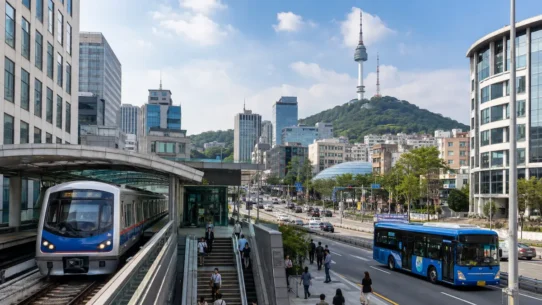

💡 Key Takeaways
- There is no single “Seoul city center” station. Myeongdong, City Hall, Namdaemun, Euljiro and Jongno are different areas, so the best route depends on your hotel’s exact address.
- The subway is cheapest, but the train ride is not the tiring part. The long station walk, stairs, wrong exit and final walk to your hotel can matter more than the two- to five-minute ride.
- For two to four travelers with several suitcases, a regular metered taxi is often better value than expected. Splitting a short central-Seoul fare can save energy for only a modest extra cost.
Getting from Seoul Station to Seoul city center sounds simple because Seoul Station is already on the western edge of central Seoul. The confusing part is that “city center” is not one destination. A hotel near Namdaemun may be walkable, Myeongdong is easiest on Line 4, City Hall is one stop on Line 1, and an accommodation in Insadong or Jongno may require a different platform entirely.
This is where many first-time visitors make an avoidable mistake. They compare only the advertised train time and forget the less glamorous parts: walking through a huge station, finding the correct subway line, waiting for an elevator, carrying luggage through a crowded carriage, choosing the correct exit and then pulling a suitcase for another ten minutes over uneven pavement.
If you arrived from Incheon Airport on the AREX Express, or from Busan on the KTX, do not automatically assume that the subway is always the smartest final leg. This guide compares the real door-to-door experience so you can choose based on your hotel location, arrival time, group size, luggage and budget.
Fare information and transport rules were checked against Seoul Metropolitan Government sources in August 2026. Journey times below are realistic planning ranges, not guarantees; traffic, platform location and your hotel’s exact entrance can change the total.
The 1-Min Cheat Sheet
- Subway: best for solo travelers and light luggage. Expect a base fare of ₩1,550 with a transport card or ₩1,650 for a single-journey ticket. The ride itself is very fast, but allow roughly 10–20 minutes door to door within the central districts.
- Regular taxi: best for two to four people, families and heavy luggage. A short daytime ride to City Hall, Myeongdong or Namdaemun will often land around ₩4,800–₩9,000, depending on distance and traffic.
- City bus: best only when one direct bus stops close to your hotel. The standard adult fare is generally ₩1,500, but finding the correct stop island and managing large bags can erase the convenience.
- Walking: best for Namdaemun and some City Hall hotels in good weather. It costs nothing and can be pleasant, but Seoul Station’s roads, crossings and gradients make a “short” map distance feel longer with luggage.
First, Identify Your Actual “City Center”
Before choosing transport, search your hotel’s Korean address in NAVER Map and identify the nearest subway station and exit. The neighborhood name alone is not precise enough. A property marketed as “Myeongdong” may actually sit closer to Hoehyeon, Euljiro 1-ga, Chungmuro or City Hall.
- Namdaemun Market / Hoehyeon: often walkable or one stop on Line 4.
- Myeongdong Station: two stops on Line 4 toward Jinjeop, passing Hoehyeon.
- City Hall / Deoksugung: one stop on Line 1 toward City Hall, or a manageable walk without heavy bags.
- Euljiro 1-ga / Lotte Department Store: sometimes easier by taxi or direct bus than by making a short but annoying subway transfer.
- Jonggak / Jongno / Insadong: Line 1 is usually the most logical subway corridor, followed by a walk to the hotel.
- Gwanghwamun: taxi or a direct bus can beat subway-plus-walking when you have luggage.
Editorial recommendation: pin the hotel entrance, not just the hotel name. Large hotels may have a driveway on a different street from the map marker, and some guesthouses sit up narrow lanes where a taxi cannot stop directly outside.
Top Survival Tips
- Budget time for the station, not just the train. From an AREX platform or a distant KTX carriage, reaching the subway platform can take longer than the subway ride itself. Allow an extra 10–15 minutes when carrying bags.
- Check the direction before entering. For Myeongdong, take Line 4 toward Jinjeop. For City Hall and Jongno, take Line 1 in the City Hall/Cheongnyangni direction.
- Know your exit number before boarding. The wrong exit can place you across a major road, at the bottom of a staircase or several hundred meters from the hotel.
- Do not assume every exit has an elevator. Follow accessibility symbols inside the station, even if the elevator route looks longer. A five-minute detour is better than carrying a 23 kg suitcase up a long staircase.
- Avoid the subway at peak commuter times when possible. Roughly 7:30–9:30 a.m. and 5:30–7:30 p.m. can be uncomfortable with large luggage, especially on Line 1 and Line 4.
- Keep some Korean won available. Many transport-card top-up machines and convenience-store reloads still rely on cash, even when the card itself is used for cashless travel.
- Use NAVER Map for the final decision. Check the live bus arrival, station exit, walking route and hotel entrance shortly before departure rather than relying on a screenshot made months earlier.
- For taxis, show the Korean address. A hotel’s English name may be ambiguous. Save the address and phone number in Korean, then confirm the destination in the app before the car moves.
- Do not take an unofficial ride offer inside or outside the station. Use the official taxi queue or a recognized app, and make sure a regular street taxi uses the meter.
The Full Experience
🚇 Seoul Subway: Best for Myeongdong, City Hall and Jongno on a Budget
Tags: Cheapest • Frequent • Fast train time • Moderate luggage effort • Rush-hour crowding
The subway is the default choice for good reason. Seoul Station connects directly to Line 1 and Line 4, the two lines most useful for the historic central districts. With a T-money or compatible transport card, the adult base fare is ₩1,550. A single-journey ticket costs ₩1,650, and the ticket machine also requires a refundable deposit.
For Myeongdong, follow signs for Line 4 and board a northbound train toward Jinjeop. Hoehyeon is the first stop and Myeongdong is the second. The train portion takes only a few minutes, but a realistic total from the main concourse to street level is closer to 12–20 minutes when you include walking and waiting.
For City Hall, take Line 1 one stop in the northbound direction. For Jonggak, Jongno 3-ga or Dongdaemun, stay on the same Line 1 corridor. This is usually easier than transferring through another station, especially with luggage.
Who should choose it: solo travelers, couples with one manageable suitcase each, backpackers, daytime arrivals and anyone staying very close to a suitable station exit.
Real cost: ₩1,550 with a transport card for a typical central ride, or ₩1,650 with a single-use ticket. The hidden cost is physical effort rather than money.
Realistic door-to-door time: approximately 10–20 minutes to City Hall, Hoehyeon or Myeongdong; approximately 15–25 minutes to central Jongno, depending on the walk at each end.
✅ What Other Travelers Say
Travelers consistently like the low price, clear bilingual signs and short ride. The most common positive surprise is how quickly Line 4 reaches Myeongdong once they are actually on the platform. The most common complaint is that Seoul Station feels much larger with luggage than it looked on the route map.
⚠️ The Catch (Things to Keep in Mind)
- The transfer from AREX or KTX to the metro can involve long corridors and several level changes.
- Elevators may not sit on the most direct path, so following only the shortest signs can lead you to stairs.
- A two-stop ride does not guarantee a two-minute journey; platform access and the final hotel walk dominate the total.
- Line 1 can be particularly busy and visually confusing because multiple service patterns share the corridor. Read the platform direction carefully.
- If each person has a large suitcase plus a carry-on, the savings over a shared taxi may not justify the hassle.
Bottom line: Choose the subway when your group is small, your bags are manageable and your hotel is genuinely close to the correct exit. Do not choose it merely because the map shows “two stops.”
🚕 Metered Taxi or Taxi App: Best for Heavy Luggage, Families and Late Arrivals
Tags: Door to door • Low walking effort • Best for groups • Traffic-sensitive • Night surcharge
A regular taxi is often the most sensible option from Seoul Station, not a luxury splurge. Central destinations are close enough that the fare can remain modest, especially when divided among two, three or four passengers.
Seoul’s regular sedan taxi daytime base fare is ₩4,800 for the first 1.6 km, with additional distance and low-speed time charges. For a typical short trip, plan roughly ₩4,800–₩6,500 to City Hall or nearby Namdaemun hotels, ₩5,500–₩8,000 to Myeongdong, and ₩7,000–₩11,000 to Jongno, Insadong or Gwanghwamun. These are planning estimates, not fixed prices.
Late-night pricing matters. Regular taxis apply surcharges from 10 p.m. to 4 a.m., with the highest surcharge generally between 11 p.m. and 2 a.m. Traffic also affects the meter when the vehicle moves slowly.
Who should choose it: families, older travelers, anyone with mobility concerns, groups with several suitcases, late arrivals and travelers staying far from a convenient station exit.
Real cost: usually low enough that a group of three may pay only slightly more per person than public transport for the final leg. Larger app-booked vehicles cost more but may be necessary when standard sedan trunks cannot hold the luggage.
Realistic door-to-door time: around 5–15 minutes for nearby central districts in light traffic, but 15–30 minutes during congestion or when the driver must approach a hotel through one-way streets.
✅ What Other Travelers Say
Travelers with children or multiple large suitcases usually describe the short taxi ride as money well spent. They value arriving at the hotel entrance rather than negotiating stairs and crowded platforms. App users also appreciate seeing the destination and estimated fare before departure.
⚠️ The Catch (Things to Keep in Mind)
- A standard sedan may not fit four adults and four large suitcases. Passenger capacity and luggage capacity are not the same thing.
- The station taxi queue can be busy after major KTX arrivals, during rain and late at night.
- Road traffic can make a short geographic distance surprisingly slow.
- Premium, large or app-dispatched vehicles may have different pricing from ordinary metered taxis.
- Confirm the hotel’s Korean address. Similar English hotel names can send the driver to the wrong property.
Bottom line: For two or more travelers with serious luggage, compare the taxi fare per person rather than the total fare. The convenience-to-cost ratio is often excellent for this short journey.
🚌 Seoul City Bus: Best When It Is Truly a One-Seat Ride to Your Hotel
Tags: Low fare • Street-level views • Direct-route potential • Harder with luggage • Stop selection matters
City buses can be the hidden winner when a direct route runs from Seoul Station Bus Transfer Center to a stop beside your hotel. The standard adult fare on trunk and branch buses is generally ₩1,500, and a transport card allows integrated transfers when the rules are followed.
The problem is not the bus itself. The problem is choosing the correct boarding island, direction and stop while tired. Seoul Station has multiple road-level stops, and boarding the correct bus number on the wrong side of the road can send you away from the center.
Rather than memorizing a bus number from an old blog post, open NAVER Map shortly before travel. Enter the exact hotel entrance and choose a route only if it offers a single bus with a short walk at both ends. If the suggested journey requires a transfer, the subway or taxi is normally easier with luggage.
Who should choose it: repeat visitors, light packers, travelers comfortable using live navigation and anyone whose hotel sits directly on a convenient bus corridor toward Gwanghwamun, Euljiro or Jongno.
Real cost: around ₩1,500 for a standard adult city-bus ride. Tap when boarding and again when alighting to preserve transfer benefits.
Realistic door-to-door time: roughly 15–35 minutes, depending on waiting time, traffic and the number of stops.
✅ What Other Travelers Say
Confident Seoul visitors often prefer the bus because it avoids underground corridors and provides a direct street-level ride. They also like seeing where they are. First-time visitors are more divided: some find it easy with live navigation, while others find the transfer center stressful after a flight or long train journey.
⚠️ The Catch (Things to Keep in Mind)
- City buses do not provide airport-bus-style luggage holds. Large suitcases can obstruct the aisle and become difficult to control when the bus brakes.
- You may need to move quickly when boarding and alighting.
- Traffic makes arrival time less predictable than the subway.
- Route numbers, boarding locations and stop arrangements can change, so live navigation is more reliable than a static article.
- Missing your stop creates more hassle than missing a subway station because the next stop may be farther away.
Bottom line: Use the bus only when the live route is direct and the destination stop is genuinely close to the hotel. It is a smart option for the right address, but not the universal budget choice.
🚶 Walking From Seoul Station: Best for Namdaemun and Some City Hall Hotels
Tags: Free • No waiting • Good for light bags • Weather-dependent • Longer than it looks
Walking can be faster than entering the subway when your hotel is near Namdaemun, Hoehyeon or the western side of City Hall. It also gives you an immediate feel for central Seoul and removes the risk of taking the wrong line.
As a broad guide, allow around 10–15 minutes to the Namdaemun area, 18–25 minutes to City Hall, and 20–30 minutes to parts of Myeongdong. The exact time varies sharply because “Myeongdong” covers a wide area and pedestrian crossings may force detours.
Who should choose it: light packers, backpackers, travelers arriving in mild weather and guests whose accommodation lies on the station-facing side of Namdaemun or City Hall.
Real cost: free, unless the walk convinces you to stop for coffee before check-in.
Realistic door-to-door time: 10–30 minutes for the practical central walking zone.
✅ What Other Travelers Say
Travelers without heavy bags often enjoy the walk through Namdaemun and appreciate avoiding another transport step. Those pulling large suitcases commonly say the route felt longer than expected because of crossings, curbs, crowds and pavement changes.
⚠️ The Catch (Things to Keep in Mind)
- Summer heat, monsoon rain, winter cold and poor air quality can turn a pleasant walk into a bad first impression.
- Some routes include slopes, long traffic-light waits, curb cuts and crowded market streets.
- Navigation can be less intuitive around large road junctions and underground shopping entrances.
- A 1.5 km walk is very different with a backpack than with two wheeled suitcases.
- After dark, choose well-lit main streets rather than blindly following a narrow shortcut.
Bottom line: Walk to Namdaemun with light luggage and good weather. For deeper Myeongdong, Gwanghwamun or Jongno, save your legs for sightseeing unless you genuinely enjoy urban walking.
Which Option Should You Choose?
Choose the subway when you are traveling alone, carrying one manageable bag and staying close to Myeongdong Station, City Hall Station, Jonggak or another direct Line 1/Line 4 stop.
Choose a regular taxi when two to four people can split the fare, when anyone has mobility limitations, when you have multiple large suitcases, or when the hotel is awkwardly placed between stations.
Choose a city bus when NAVER Map shows a direct one-seat journey and the destination stop is within a few minutes of the hotel. Skip it when a transfer is required.
Choose walking for Namdaemun and selected City Hall properties when the weather is comfortable and your bags are light.
My practical default: one traveler with a cabin bag should take the subway; two travelers with one large suitcase each should compare subway effort against a taxi; a family or group with three or more large bags should usually take a taxi.
Common Mistakes That Waste Time
- Searching only “Myeongdong” instead of the hotel address. The suggested station may differ depending on which side of the district the property occupies.
- Counting stops instead of counting walking minutes. A one-stop ride can still involve a long platform transfer and a difficult station exit.
- Following the first “Way Out” sign. Exit numbers in Seoul matter; the wrong exit may place a major road between you and the hotel.
- Putting four large suitcases into a standard taxi booking. Reserve a larger vehicle or split into two cars when baggage exceeds trunk capacity.
- Using an old bus number from a blog screenshot. Always confirm the live route and boarding stop on the day.
- Walking because the map says 1.2 km. Check weather, gradients and pedestrian crossings before deciding.
Key FAQs
What is the easiest way to get from Seoul Station to Myeongdong with luggage?
For one traveler with a small or medium bag, Line 4 toward Jinjeop is the easiest budget choice: Myeongdong is two stops away. For two or more travelers with large suitcases, a metered taxi is usually more comfortable and may cost only a few thousand won more per person.
How much is a taxi from Seoul Station to Seoul city center?
For nearby areas such as Namdaemun, City Hall and Myeongdong, a regular daytime taxi will often cost approximately ₩4,800–₩9,000. Trips to Jongno, Insadong or Gwanghwamun may be closer to ₩7,000–₩11,000. Traffic, waiting time, vehicle type and late-night surcharges can increase the fare.
Can I walk from Seoul Station to Myeongdong or City Hall?
Yes. City Hall and parts of Myeongdong are generally within about 20–30 minutes on foot, while Namdaemun is closer. Walking is sensible with light luggage and comfortable weather, but a taxi or subway is better when you are tired, carrying heavy bags or arriving during rain, summer heat or winter cold.
Final Verdict and Your Next Step
There is no single best answer for every traveler. Seoul Station is close to the historic center, but the easiest last leg depends more on your hotel entrance and luggage than on the number of subway stops.
For Myeongdong near Line 4, take the subway when traveling light and a taxi when carrying multiple bags. For City Hall and Namdaemun, walking can work in good weather, while a short taxi is the least stressful option. For Jongno and Insadong, Line 1 is efficient when your hotel is near a station; otherwise, a taxi avoids a tiring final walk. For Gwanghwamun or an Euljiro hotel between stations, compare a direct bus and taxi rather than forcing a subway transfer.
Before booking accommodation, check the walking route from the nearest station exit—not merely the distance from the station pin. A hotel that costs slightly more but sits beside an elevator-equipped exit may save time and energy every day of the trip.
- Compare Seoul hotels on Agoda
- Compare Seoul hotels on Booking.com
- Pre-order a T-money card on Klook
- Book a direct Incheon Airport-to-Seoul transfer on Klook
- Check private airport transfer options on KKday
If your flight arrives late, your group has several large suitcases, or your hotel is far from an easy station exit, book the transfer before travel. Waiting until you are tired at Seoul Station is exactly when the cheapest-looking option can become the most inconvenient one.
Useful official references: Seoul subway fares and Seoul taxi fares and surcharge rules.