

💡 Key Takeaways
- Buy a regular T-money card by default. Choose a short-term Climate Card only when your itinerary stays mostly inside its coverage area and you will ride enough to beat the pass price.
- The fastest airport train is not automatically the easiest. AREX Express is best for Seoul Station, while the All-Stop Train is usually more practical for Hongdae or Gongdeok. A limousine bus can save your back when its stop is near your hotel.
- Your station exit matters almost as much as your station. A wrong exit can add stairs, road crossings and a long suitcase drag. Check the exit number and elevator route before you board.
A good Seoul Transportation Guide should do more than tell you that the city has a subway, buses and taxis. The real problems begin after that: choosing the wrong airport train, following a route with a brutal transfer, buying an “unlimited” pass that does not cover your day trip, or emerging from the correct station through the worst possible exit with a 23-kilogram suitcase.
Seoul is easy to move around once you understand its logic, but first-time visitors often underestimate three things: stations can be physically huge, different operators share the network, and the route with the shortest travel time may involve the most walking. This guide focuses on the decisions that save time, money and energy in real travel situations.
Fare and service details were reviewed on August 7, 2026. Transport rules and timetables can change, so confirm your final airport departure and last-train plan shortly before travel.
The 1-Minute Cheat Sheet
- AREX Express: Best when you are going to or from Seoul Station and want a reserved seat, predictable timing and minimal stops. Not ideal when your hotel is in Hongdae, Gangnam or far from Seoul Station.
- AREX All-Stop Train: Best-value airport option for Hongdae, Gongdeok and travelers who prefer using a T-money card. It is cheaper but has regular commuter seating and becomes uncomfortable with large luggage during busy periods.
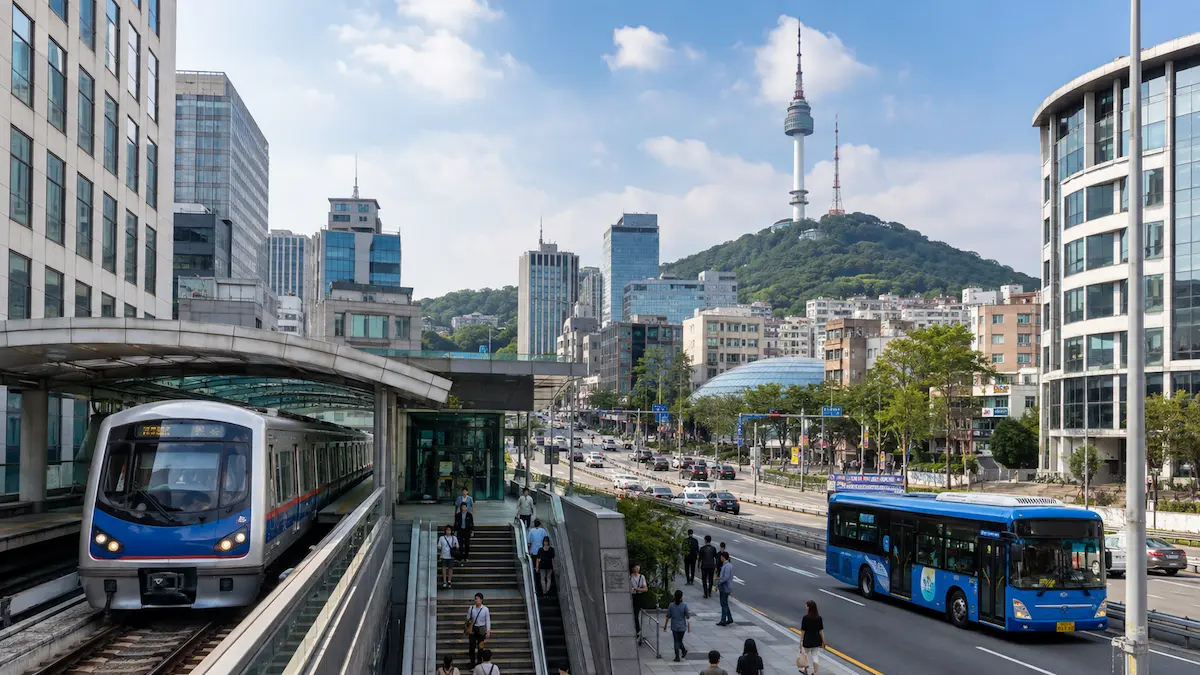
- Seoul Subway: Usually the fastest way across the city. Excellent for sightseeing, but long transfers, deep platforms and inconvenient elevator routes can turn a “quick” journey into a workout.
- City Bus: Often better than the subway for short cross-neighborhood trips, hills and destinations far from a station. It is less forgiving if you miss your stop or board the correct number in the wrong direction.
- Taxi or Ride-Hailing App: Worth considering late at night, in bad weather, with children, after shopping, or when splitting the fare among three or four people. Always compare the convenience against rush-hour road traffic.
Top Survival Tips
- Install Naver Map or KakaoMap before landing. Seoul’s official transport guidance recommends local map apps for route planning and live bus information. Save your hotel in both English and Korean, then screenshot the address in case mobile data fails.
- Search by station name and exit number. “Myeongdong Station” is not a complete destination. Exit 2 and Exit 10 can place you on different sides of wide roads, hills or underground shopping areas.
- Do not judge a route only by minutes. A route that is three minutes faster may include a 12-minute underground transfer. With luggage, a slightly longer route with fewer transfers is usually the smarter route.
- Tap your card when leaving a bus. This protects your transfer discount and lets the system calculate the correct distance-based fare. Make it a habit even when you do not plan to transfer.
- Know the direction before crossing the gate. Look for the terminal station name or the next major station on your line. Some platforms are separated, and correcting a mistake may require staff assistance or extra walking.
- Avoid moving large luggage at commuter peaks. Around 7:30–9:30 a.m. and 5:30–8:00 p.m., central lines and transfer stations can be extremely crowded. A taxi for the final leg or a direct airport bus may be worth the extra cost.
- Check the last useful train, not only the last train. The final train entering a station may terminate before your destination or leave before your connecting line. Late-night airport arrivals need a separate backup plan.
- Do the pass math using one-way rides. Two attractions plus a return to your hotel can mean four rides, but a compact walking day may mean only two. “Unlimited” is valuable only when it matches your actual route.
- Keep a small T-money balance even with a Climate Card. The Climate Card excludes some lines, airport buses, intercity services and travel outside its service area. A backup card prevents an awkward fare-gate problem.
- Choose standard taxis unless you need more space. Deluxe, jumbo and app-specific premium vehicles cost more. For several large suitcases, however, paying for a larger vehicle can be cheaper than ordering two standard taxis.
- Use luggage storage instead of sightseeing with a suitcase. Seoul’s T-Luggage network includes locations such as Seoul Station, Hongik University, Myeongdong, Jamsil and Gimpo Airport. Storage or same-day delivery can rescue an early-arrival or late-departure day.
The Full Experience
✈️ AREX and Airport Limousine Buses: Choose by Hotel Location, Not Marketing
Best for: Airport transfers · Budget: Low to medium · Luggage effort: Low to high, depending on the final connection
AREX has two services, and confusing them is one of the most common first-day mistakes. The Express Train runs non-stop to Seoul Station with reserved seating. Official guidance lists approximately 43 minutes from Terminal 1 and 51 minutes from Terminal 2. The All-Stop Train takes roughly 59 minutes from Terminal 1 and 66 minutes from Terminal 2 to Seoul Station, but it stops at useful places including Hongik University and Gongdeok.
Use AREX Express when: your hotel is near Seoul Station, you are connecting to KTX, you value a proper seat after a long flight, or traffic conditions make a bus risky. The important catch is the final leg. Seoul Station is enormous, and changing to another subway line with luggage can erase much of the comfort you gained on the express train.
Use the All-Stop Train when: you are staying in Hongdae, Gongdeok or another stop directly on the airport line. It accepts regular transit payment methods, including T-money, and often avoids an unnecessary trip to Seoul Station. The downside is commuter-style seating and less comfortable luggage handling.
Use an airport limousine bus when: the bus stops within a short, flat walk of your accommodation. The bus usually has under-floor luggage storage and lets you avoid station stairs. It is especially attractive for Myeongdong, Dongdaemun, Gangnam and major hotel areas—but only when the stop is genuinely convenient. A bus that leaves you 900 meters uphill from your guesthouse is not door-to-door transport.
✅ What Other Travelers Say
Travelers consistently praise AREX for predictable timing and the limousine bus for comfortable seating and easy luggage storage. The most satisfied bus users are those who checked the exact stop before booking; the least satisfied are usually those who assumed the bus would stop directly outside any hotel in the district.
⚠️ The Catch (Things to Keep in Mind)
Airport buses are vulnerable to traffic and require the correct route and stop. Official airport guidance also notes that airport limousine and night-bus tickets generally need to be purchased in advance at a counter or machine rather than paid casually onboard. Most mainstream airport public transport winds down around late evening, so a delayed flight can completely change the best option.
🚇 Seoul Subway: Fastest for Most Trips, but Transfers Can Be Deceptively Long
Best for: Cross-city sightseeing · Budget: Low · Luggage effort: Medium to high
The subway is the backbone of most Seoul itineraries. English station names, numbered exits and color-coded lines make the network easier than it first appears. As of the reviewed fare schedule, the adult base fare is KRW 1,550 with a transit card and KRW 1,650 for a single-journey ticket, with additional distance charges after the base range.
The practical trick is to plan the physical journey, not only the rail journey. At large stations such as Seoul Station, Jongno 3-ga, Express Bus Terminal, Wangsimni and Dongdaemun History & Culture Park, a transfer can involve long corridors and several levels. A direct bus or a one-change route at a smaller station may feel much easier.
Before boarding, check three items: the line number and color, the direction or terminal station, and the exit you need at the destination. On the train, move toward the door one stop early when carrying luggage. Seoul trains can fill quickly, and trying to push through at the final second is stressful for everyone.
For palaces and central neighborhoods, also compare walking. Gyeongbokgung, Bukchon, Insadong, Ikseon-dong and Jongmyo are close enough that repeatedly descending into the subway can waste more energy than a well-planned surface route.
✅ What Other Travelers Say
First-time visitors usually find the signage clearer than expected and appreciate how cheaply they can cross the city. The recurring complaint is not getting lost on the train—it is underestimating transfer distances, crowded platforms and the search for an elevator with luggage.
⚠️ The Catch (Things to Keep in Mind)
Not every “accessible” route is direct. The elevator may be at the opposite end of the platform, require a detour, or emerge at an inconvenient exit. Rush-hour trains can be packed, and a short two-stop ride with suitcases may be harder than a short taxi ride. Also remember that a single-journey ticket costs more and is less convenient for transfers than a transport card.
🚌 Seoul City Buses: The Underrated Shortcut for Hills and Awkward Subway Gaps
Best for: Short local trips, hills and scenic surface travel · Budget: Low · Luggage effort: Medium
Buses become much more useful after your first day. They can save a steep climb, connect neighborhoods that require an annoying subway transfer, and drop you closer to attractions such as Namsan, hillside residential areas or trail entrances.
Seoul buses are commonly grouped by color and function. Blue buses cover major routes, green buses connect neighborhoods and subway stations, red buses usually serve longer metropolitan routes, and late-night “N” buses operate after normal services. Tourists do not need to memorize the entire system. Let Naver Map or KakaoMap choose the route, then confirm the bus number, direction and live arrival time.
Board through the front door, tap your card, and press the stop button after the bus leaves the stop before yours. Exit through the rear door and tap again. Official transfer rules generally allow the next qualifying transfer within 30 minutes, extended to 60 minutes overnight, with up to four transfers under the integrated system when the conditions are met.
For a group, one person can sometimes pay for multiple bus passengers after telling the driver, but the rules are less flexible for subway transfers. For most visitors, one card per traveler is simpler and prevents confusion.
✅ What Other Travelers Say
Travelers who become comfortable with buses often say they are the best way to reduce walking and see the city above ground. They are especially popular for short trips where the subway route looks strangely indirect.
⚠️ The Catch (Things to Keep in Mind)
Bus drivers may accelerate or brake firmly, so sit down or hold a rail quickly. Large luggage can block the aisle and is awkward during busy periods. A route number may appear on stops in both directions, so always check the destination direction in your map app. Missing the tap-off can also affect distance calculation or your next transfer discount.
💳 T-money vs Climate Card: Do the Math Before Buying “Unlimited” Travel
Best for: Avoiding fare confusion · Budget: Depends on ride count · Coverage risk: High if misunderstood
T-money is the safest default choice. It works across Seoul and widely throughout South Korea on subways, buses and many taxis. You pay as you go, receive integrated transfer pricing when you tap correctly, and avoid worrying about whether a line falls inside a pass boundary.
The Climate Card short-term passes can be excellent for an intensive Seoul-only itinerary. Current official prices are KRW 5,000 for one day, KRW 8,000 for two days, KRW 10,000 for three days, KRW 15,000 for five days and KRW 20,000 for seven days. The clock is calendar-based: a one-day pass activated at 6 p.m. still expires after the last service that same day, not 24 hours later.
A useful rough break-even test is to compare the pass price with an average central ride of around KRW 1,550–1,700. A three-day pass starts to make sense around six or seven one-way rides; a five-day pass around nine or ten. But the real question is coverage. The Climate Card excludes services including the Sinbundang Line, airport buses, intercity buses and some travel beyond Seoul. It can cover the AREX section between Gimpo Airport and Seoul Station, and current rules allow certain airport-bound exits at Incheon Airport, but you cannot simply assume all airport rail journeys work in both directions.
There is also a major 2026 change: Seoul announced that the old 30-day prepaid Climate Card can only be recharged through August 31, 2026, while short-term passes remain available. Foreign visitors should ignore older articles that present the 30-day product as the obvious tourist choice.
Internationally issued cards became accepted at hundreds of newer vending machines on Seoul Metro Lines 1–8 in March 2026 for purchasing or recharging short-term Climate Cards and single-journey tickets. Even so, carrying a small amount of Korean won remains sensible because payment support can vary by machine, convenience store and card issuer.
✅ What Other Travelers Say
Heavy transit users love the psychological freedom of not checking every fare. Travelers taking day trips outside Seoul, however, often prefer T-money because it keeps working without a coverage puzzle. A common practical compromise is a Climate Card for Seoul days plus a lightly loaded T-money card as backup.
⚠️ The Catch (Things to Keep in Mind)
“Unlimited” does not mean universal. A pass can be poor value if you walk between nearby attractions, spend a full day on a tour, visit Suwon or Nami Island, use airport buses, or take excluded lines. Do not buy a pass merely because it feels convenient—map your likely rides first.
🚕 Seoul Taxis and Ride-Hailing Apps: Best for the Last Difficult Kilometer
Best for: Late nights, rain, luggage and groups · Budget: Medium to high · Time reliability: Traffic-dependent
Taxis in Seoul are not only a luxury. Used strategically, they can prevent a miserable transfer, rescue a late-night return, or make financial sense for a group. The official standard-taxi daytime base fare is KRW 4,800 for the first 1.6 kilometers, with distance and low-speed time charges after that. Night surcharges apply from 10 p.m., peaking between 11 p.m. and 2 a.m., and trips beyond Seoul can add an out-of-city surcharge.
For most international visitors, Uber Taxi is the easiest starting point because the familiar app can request local licensed taxis and handle the destination digitally. Kakao T has broad driver coverage, while tourist-oriented alternatives such as k.ride or TABA may reduce signup friction. App availability and foreign-card registration can change, so install at least two options before the trip.
When hailing a taxi, show the Korean address and a recognizable landmark. Confirm that a standard taxi meter is running unless you booked a clearly priced app product or official airport service. Keep the receipt until you have checked the charge.
Seoul has strengthened multilingual taxi complaint support and placed QR complaint information in taxis and tourist areas. Serious overcharging is not the normal experience, but choosing an app, checking the estimated route and keeping the receipt gives you a clear record if something goes wrong.
✅ What Other Travelers Say
Visitors appreciate taxis most after a long shopping day, when traveling with children or when sharing the fare among several people. Many also find app-based pickup less stressful than explaining a destination aloud. The recurring luggage warning is that a standard sedan may not hold three or four large suitcases.
⚠️ The Catch (Things to Keep in Mind)
Road traffic can make a taxi slower than the subway at peak times. Premium, jumbo and branded app options can cost much more than a standard taxi. At major stations and malls, the app pickup point may be on a specific side of the building, so check the pin carefully before requesting the ride.
Key FAQs
What is the best transportation card for first-time tourists in Seoul?
For most first-time visitors, T-money is the best default because it is simple, pay-as-you-go and useful beyond Seoul. A short-term Climate Card is better only when you will make enough eligible subway and Seoul-bus trips during consecutive Seoul-focused days. Keep T-money as a backup if your itinerary includes airport buses, excluded lines or day trips.
What is the easiest way to get from Incheon Airport to Myeongdong with luggage?
The easiest option is often an airport limousine bus when its stop is close to your hotel and your arrival time matches the schedule. AREX Express plus a short taxi from Seoul Station can be faster and more predictable in heavy traffic. Avoid forcing yourself through a subway transfer with large luggage merely to save a small amount.
Can tourists use foreign credit cards for Seoul subway tickets and taxis?
International cards are accepted at many newer subway ticket machines for short-term Climate Cards and single-journey tickets, but acceptance is not universal across every top-up point. Taxis commonly accept major cards, and apps such as Uber Taxi can simplify payment. Carry a backup card and some Korean won rather than depending on one payment method.
Final Verdict and Your Next Step
The best Seoul transport strategy is not “subway for everything.” It is a flexible combination: use T-money as your default, switch to a short-term Climate Card only after doing the ride math, take the subway for long cross-city journeys, use buses to reduce hills and awkward transfers, and spend selectively on a taxi when it saves a difficult final kilometer.
For the airport, decide from your hotel address—not from a generic ranking. Choose AREX Express for Seoul Station, the All-Stop Train for Hongdae or Gongdeok, and a limousine bus when the stop is genuinely close to your accommodation. With heavy luggage, one fewer transfer is often worth more than the cheapest fare.
Book the parts with limited seats or route-specific tickets before arrival:
- Book the AREX Express Train on Klook
- Book the AREX Express Train on KKday
- Check Incheon Airport limousine bus tickets on Klook
- Check K-Limousine airport bus tickets on KKday
- Compare Seoul hotels by station on Booking.com
- Compare Seoul accommodation on Agoda
Before paying for a hotel, open its map and check the nearest station exit, walking slope, airport-bus stop and late-night taxi access. A room that costs slightly more but sits beside the right exit can save hours of walking over a four- or five-day trip.
Sources checked for this guide: Seoul Metropolitan Government transport fares and rules, official Climate Card coverage and prices, VISITKOREA airport transportation guidance, and Incheon International Airport transport information.