




💡 Key Takeaways
- For most first trips, stay in or beside the Old City. It cuts down on daily transport and puts temples, food, massage shops and the Sunday Walking Street within a realistic walking radius. Choose Nimman instead if cafés, nightlife and modern comforts matter more than historic sights.
- Do not turn Chiang Mai into a checklist of far-flung day trips. Doi Inthanon, Chiang Rai and Pai all consume serious road time. A first visit feels much better when you protect at least two days for the city itself.
- The biggest seasonal trap is air quality. Northern Thailand can experience severe haze during the annual burning season, especially from February into April. If you have asthma, respiratory issues or simply care about mountain views, check live AQI before locking in a spring trip.
A good Chiang Mai travel guide for first-time visitors should tell you more than which temples look best in photos. The real planning problems are practical: choosing the wrong neighborhood and paying for rides all day, arriving on the wrong day for the weekend markets, wasting six hours in a van for a “quick” side trip, booking an elephant experience that does not match your welfare expectations, or discovering that the famous mountain view is hidden behind seasonal haze. Chiang Mai is relatively easy once you understand its geography, but it punishes over-planning. The winning first trip is usually slower, more local and more compact than the itinerary you first imagine.
The 1-Min Cheat Sheet
- Best trip length: 4 nights is the sweet spot for most first-time visitors. Three nights works if you stay central and take only one major excursion. Five nights lets you add a full nature day without rushing.
- Best first-time base: Old City for walkability and classic sights; Nimman for cafés, bars, coworking and newer hotels; Chang Khlan for the Night Bazaar; Riverside for quieter boutique stays; Santitham for better-value local living.
- Airport arrival: Chiang Mai International Airport is close to the urban core. Airport of Thailand currently lists Grab, airport taxi options, city buses and airport shuttle services. With large luggage, late arrivals or more than two travelers, a direct car is usually worth the small time saving over dragging bags through multiple transfers.
- Airport public transport: The airport currently lists Chiang Mai City Bus service from 06:00 to 23:30 and airport shuttle routes including A1 to Nimman/Huay Kaew/moat areas and A2 toward Night Bazaar/Chang Khlan. Services can change, so recheck the airport transport page before relying on a specific departure.
- Getting around town: Use Grab when you want a known pickup point and app-based fare; use red songthaews when you are flexible and comfortable confirming the destination and price. Tuk-tuks are convenient but should not be assumed to be the cheapest option.
- Do you need a scooter? No. A scooter is useful for experienced, properly licensed and insured riders, but it is not necessary for a good first trip. Do not make your holiday dependent on learning to ride in unfamiliar traffic.
- Best weather: November to January is the easiest period for cooler mornings and outdoor sightseeing, but it is also popular and can be more expensive. The rainy season can still be enjoyable because showers are often intermittent, while the February-April haze period deserves much more caution.
- Weekend market timing: The Sunday Walking Street runs through the Old City along Ratchadamnoen Road. If this is a priority, make sure your itinerary actually includes Sunday evening. Wua Lai’s Saturday market is a separate event south of the moat.
- Food you should not leave without trying: khao soi, sai ua, nam prik ong, northern-style laab if you enjoy stronger flavors, and a proper local coffee. Do not eat every meal at the most photogenic café in Nimman; some of Chiang Mai’s best-value food is in markets and ordinary neighborhood restaurants.
- Best rule for day trips: one long-distance excursion per day. Doi Inthanon is a full day. Chiang Rai is a very long day. Pai is better treated as an overnight destination.
Top Survival Tips
- Choose your hotel by where you want to be at 8 p.m., not 10 a.m. Daytime sightseeing is easy to arrange by ride-hailing or songthaew. The annoying part is finishing dinner, shopping or drinks and realizing you need another cross-town ride every single night. If your evenings revolve around Sunday Walking Street and temple-area restaurants, Old City wins. If you want cocktail bars, cafés and Maya/One Nimman, stay around Nimman.
- Do not confuse “compact” with “fully walkable.” The Old City itself is manageable on foot, but Chiang Mai’s useful places spread beyond the moat. Nimman, the Night Bazaar, the Ping River, Wat Umong and Doi Suthep are separate zones. Walking between all of them in the heat is not a clever budget hack.
- The moat roads are a hidden friction point. Crossing the ring of traffic around the Old City can be less pleasant than the map suggests, especially with children, older travelers or luggage. A hotel “just outside the wall” can be excellent, but check the exact side of the moat and where you expect to walk at night.
- Do not overpay for “authenticity.” Red songthaews are part of Chiang Mai life, but there is no prize for taking one when a Grab is faster for your group. Conversely, paying for a private car for every 1-kilometer hop inside the Old City is usually unnecessary.
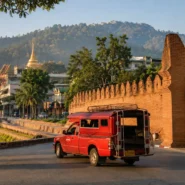
- Confirm songthaew terms before getting in for non-standard trips. Shared city rides are flexible rather than fixed-route metro journeys. For Doi Suthep, multiple stops, late-night trips or private use, agree on the destination, whether the ride is shared or private, and the price first.
- Do not plan Sunday Walking Street and an early Monday mountain departure as if both are effortless. The market is large, crowded and easy to spend several hours in. If you want to enjoy it properly, keep the following morning relatively humane.
- Tha Phae Gate is a landmark, not a half-day attraction. See it, photograph it, use it as a navigation point and move on. The surrounding streets, temples and Sunday market matter more than the gate itself.
- The Night Bazaar is convenient, but it is not automatically the “best” market. It is easy for first-timers because it operates in a tourist-friendly area with food, shopping and nearby hotels. The trade-off is repetition and a more commercial feel. For atmosphere and handicrafts, many visitors prefer the weekend walking streets; for everyday local shopping, Warorot Market is more useful.
- Do not treat the word “sanctuary” as an animal-welfare guarantee. World Animal Protection’s 2026 guidance favors observation-led elephant experiences and warns against riding and high-contact entertainment. If this matters to you, read the exact activity description and recent reviews rather than trusting the venue name. No-touch or observation-focused programs are the clearest choice.
- Burning season can completely change the trip. Chiang Mai experienced unhealthy air during the 2026 haze season, and northern Thailand’s recurring smoke problem is well documented. If traveling from February through April, check AQI daily and be prepared to swap a mountain viewpoint or strenuous hike for indoor or lower-exertion activities.
- Do not book Doi Suthep only for the skyline. The temple is culturally important even when visibility is poor. If the city view is your main reason for going, check haze, cloud and rain before committing to a sunset plan.
- Do not force Chiang Rai into a short Chiang Mai stay just because the White Temple is famous. A same-day tour can work, but it is an early-start, long-road-day experience. If you only have three nights in Chiang Mai, the opportunity cost is high.
- Pai is not a sensible day trip for most people. Current road schedules commonly put the journey at roughly three to four hours each way depending on vehicle and traffic, on a famously winding route. Stay overnight if Pai genuinely matters to you.
- Keep one “unplanned” meal per day. Chiang Mai rewards wandering into markets, noodle shops and neighborhood cafés. Booking every meal around social-media-famous venues often creates more driving and waiting than eating.
- Carry temple-friendly clothing even on casual sightseeing days. Shoulders and knees should be covered when entering active temple areas. Lightweight layers solve the problem without forcing you back to the hotel.
The Full Experience
📍 Old City: Best for First-Time Sightseeing and Short Stays
Tags: Walkable temples · Sunday Walking Street · Boutique hotels · Easy food access · First-trip convenience
If you only have three or four nights, the Old City is the safest recommendation because it reduces decision fatigue. The moat forms a clear mental boundary, major temples such as Wat Phra Singh and Wat Chedi Luang sit inside it, and you can fill a morning simply by walking rather than repeatedly opening a transport app.
The area is particularly strong for travelers who like to start early. Temples are more pleasant before the midday heat, and you can return to the hotel for a shower or rest without sacrificing half an hour to cross-town traffic. This is also the most forgiving base if you have never been to Thailand and want restaurants, massage shops, convenience stores, cafés and tour pickups within easy reach.
How to use the area well: Build one temple-focused morning around Wat Phra Singh, Wat Chedi Luang and smaller temples you discover between them. Do not try to “complete” every temple on Google Maps. By the third or fourth major wat, architectural details begin to blur unless you have a specific interest in Lanna history.
What is slightly overhyped: spending a large block of time at Tha Phae Gate itself. It is worth seeing, especially around market time, but it is more useful as a starting point than as the destination.
✅ What Other Travelers Say
Travelers consistently value the Old City for location: many centrally listed hotels receive strong feedback for being close to temples, restaurants and the main sights. The best comments usually come from guests who chose a quieter lane rather than a room directly on a busy road.
⚠️ The Catch (Things to Keep in Mind)
“Old City” is still a fairly broad booking label. A cheap room near the edge can be less convenient than a slightly more expensive room near the sights you actually want. Also check for lifts if you have heavy luggage; many smaller guesthouses and heritage-style properties are low-rise buildings without the facilities of a modern chain hotel. On Sunday evenings, road closures and crowds around the walking street can make car pickup slower, so arrive back before the market is in full swing if you have luggage.
📍 Nimman: Best for Cafés, Nightlife and Modern Convenience
Tags: Specialty coffee · Rooftop bars · Maya · One Nimman · Digital nomad scene · Modern hotels
Nimman is the neighborhood people fall in love with when they expected Chiang Mai to be only temples and night markets. It is compact, polished and full of coffee shops, restaurants, bars, design stores and serviced apartments. If your ideal morning begins with excellent coffee and your ideal evening ends without a tuk-tuk ride across town, Nimman can be a better base than the Old City.
It also works well for remote workers or travelers staying a week or longer because everyday infrastructure is easy: shopping, gyms, laundry, cafés and contemporary dining are close together. For a first-time visitor, however, staying here means accepting that many heritage sights are elsewhere.
How to use the area well: Give Nimman one slow afternoon and evening rather than treating it like a list of attractions. Explore the side streets, One Nimman and the blocks around Nimmanhaemin Road, then choose a rooftop, cocktail bar, massage or dinner based on your mood.
What is slightly overhyped: café hopping as a full-day “must-do.” Chiang Mai’s coffee culture is genuinely excellent, but spending an entire day queuing for viral cafés can make your trip feel strangely interchangeable with any trendy Asian city.
✅ What Other Travelers Say
People who stay in Nimman commonly praise the density of food, coffee and nightlife and the feeling that they can step outside without planning. It is especially popular with repeat visitors who have already done the classic Old City circuit.
⚠️ The Catch (Things to Keep in Mind)
Nimman sits close to Chiang Mai Airport’s flight paths, so aircraft noise can be noticeable in some buildings. Sound insulation matters. The area can also feel less distinctly “historic Chiang Mai” than the Old City, and crossing to temples, the Night Bazaar or the river still requires rides. If you are staying only two or three nights and your priority is traditional sightseeing, Nimman may create more transport than it saves.
📍 Chang Khlan & Night Bazaar: Best for Easy Evenings and Market Access
Tags: Night Bazaar · Anusarn Market · Evening food · Larger hotels · Easy first-night base
Chang Khlan is practical rather than romantic. The Night Bazaar area gives first-time visitors an easy evening routine: walk out, eat, browse stalls, get a massage and return to the hotel without arranging another ride. This is useful if your flight lands late afternoon and you want the first night to require almost no planning.
The area also has more large-format hotels than many parts of the Old City, which can make it easier for families, tour groups, travelers who need lifts, or anyone carrying large luggage. It sits east of the moat and not far from the Ping River, so it is reasonably positioned between the Old City and riverside dining.
How to use the area well: Treat the Night Bazaar as a convenient evening district, not the centerpiece of your Chiang Mai trip. Combine it with nearby Anusarn Market, food and a relaxed walk rather than allocating an entire day.
What is overhyped: the idea that every stall is selling rare local handicrafts at unbeatable prices. You will see repetitive tourist merchandise. Browse first, compare, and buy because you like something—not because a seller tells you it is your only chance.
✅ What Other Travelers Say
Travelers like Chang Khlan for convenience, especially when they want nightlife without clubbing. Families and older visitors often appreciate being able to find food and shops close to full-service hotels.
⚠️ The Catch (Things to Keep in Mind)
The tourist infrastructure is exactly what makes the area easy and exactly what makes it feel less local. Restaurant prices can be less compelling than in neighborhood markets, and the same souvenir categories repeat quickly. If you want quiet mornings, verify that your room does not face a busy commercial stretch.
📍 Wat Ket & Ping Riverside: Best for Couples, Boutique Stays and a Slower Pace
Tags: Ping River · Boutique hotels · Romantic dinners · Wat Ket · Charoenrat Road · Quieter evenings
The riverside is where Chiang Mai feels more spacious. Boutique hotels, older buildings, restaurant terraces and the Ping River create a calmer rhythm than the Old City or Nimman. Couples and travelers who care about the hotel experience itself often prefer this side of town, particularly for a final two nights after a busier sightseeing base.
Wat Ket and nearby Charoenrat Road also reveal a more layered side of the city, with historic communities, local architecture, cafés and river crossings. It is not a zone where every attraction is famous, which is part of the appeal.
How to use the area well: come for a late afternoon walk, cross the river, have dinner and stay for the evening atmosphere. If your budget allows, this is one of the places where paying for a hotel with character can genuinely change the trip rather than simply upgrade the room.
What is slightly overhyped: booking a riverside hotel simply because “river view” sounds luxurious. Some stretches are much more attractive than others, and a room marketed as riverside may face a road, wall or partial view. Check recent guest photos.
✅ What Other Travelers Say
Riverside guests often highlight peace, design and romantic atmosphere rather than sightseeing convenience. The neighborhood tends to appeal most to people who want a retreat from the busiest tourist streets without leaving the city.
⚠️ The Catch (Things to Keep in Mind)
You will use transport more often. It is possible to walk to some central areas from parts of the river, but the experience depends heavily on your exact hotel location, heat and road conditions. This is not the base I would choose for a first visit if your main goal is to see as much as possible in 48 hours.
📍 Santitham: Best for Budget-Conscious Food Lovers
Tags: Local food · Better-value rooms · Thanin Market · Everyday Chiang Mai · Short rides to Old City and Nimman
Santitham sits north of the Old City and east of Nimman, which makes it an appealing compromise for travelers who want lower accommodation costs and a more everyday neighborhood feel. This is where Chiang Mai starts to feel less curated for short-stay tourists: local restaurants, market food, apartment buildings, cafés and ordinary services dominate.
For food-focused travelers, the area around Thanin Market is a strong reason to visit even if you do not stay here. It is also a good base for longer stays because you can reach both the Old City and Nimman without living in the busiest parts of either.
How to use the area well: stay here if you are comfortable taking short Grab rides and you value food and room value over postcard atmosphere. Use saved locations on your map; some of the best places are on small streets that are easy to walk past.
What is overhyped: calling Santitham a “hidden gem” as if no visitors know it. It is well established with expats and longer-stay travelers. The advantage is not secrecy; it is that the neighborhood still functions for residents first.
✅ What Other Travelers Say
Budget travelers and long-stay visitors often praise Santitham for affordable food, local atmosphere and access to both Nimman and the Old City without paying the most central rates.
⚠️ The Catch (Things to Keep in Mind)
Sidewalks and pedestrian comfort are inconsistent, and the neighborhood is less visually polished than the Old City or Nimman. If this is your first ever trip to Thailand and you want everything to feel obvious the moment you arrive, the Old City may still be easier.
📍 Doi Suthep & Mountainside: Best for a Half-Day Escape, Not Your Main Base
Tags: Wat Phra That Doi Suthep · Wat Pha Lat · Mountain road · Sunrise · City views · Half-day trip
Doi Suthep is essential to understanding Chiang Mai’s geography: the mountain rises immediately west of the city and Wat Phra That Doi Suthep is one of the region’s defining landmarks. For first-time visitors, the smartest approach is usually a half-day rather than an all-day mountain marathon.
A popular combination is Wat Pha Lat plus Wat Phra That Doi Suthep. Fit travelers may be interested in the Monk’s Trail, but heat, rain, trail condition and air quality should shape that decision. If you mainly want the temple, a road transfer is far more efficient.
How to use the area well: go early for cooler temperatures and fewer crowds, or later for softer light if visibility is good. Build in extra time if using shared transport because departures may depend on passenger numbers or negotiated arrangements.
What is overhyped: assuming sunset guarantees a magical city panorama. Cloud, haze and smoke can wipe out the view. The temple itself should be the reason you go; the viewpoint is a bonus.
✅ What Other Travelers Say
Visitors repeatedly describe Doi Suthep as one of the city’s defining experiences, particularly for the temple atmosphere, golden chedi and elevated setting. Many also note that going early makes the visit noticeably calmer.
⚠️ The Catch (Things to Keep in Mind)
The mountain road can be winding, and people prone to motion sickness should prepare accordingly. Crowds build quickly, temple dress rules apply, and the staircase adds exertion in hot weather. A funicular is available as an alternative to climbing the full stairway, but operating conditions can change.
How to Build a Realistic First Chiang Mai Itinerary
- 3 days / 3 nights: Day 1 Old City temples plus evening food; Day 2 Doi Suthep and Nimman; Day 3 one major experience such as a cooking class, an observation-led elephant program, a craft/market day or Doi Inthanon. Skip Chiang Rai and Pai unless one of them is the entire reason you came north.
- 4 days / 4 nights: Add a full Doi Inthanon day or ethical wildlife experience without sacrificing the Old City. Keep one evening for the Sunday or Saturday market if your dates line up.
- 5 days / 5 nights: This is where Chiang Mai becomes relaxing. You can combine two city days, Doi Suthep, one full-day nature excursion and one flexible day for a cooking class, spa, cafés, local markets or a second neighborhood.
- 6-7 days: Consider splitting neighborhoods—three or four nights Old City plus two nights Nimman or Riverside. A Chiang Rai trip becomes more reasonable, and Pai can be added as a separate overnight side trip rather than a punishing same-day return.
The scheduling trick: put your highest-effort day trip between two lighter city days. Travelers often stack Doi Inthanon, elephant activities and Chiang Rai on consecutive mornings, then wonder why Chiang Mai feels exhausting. The city is famous for a slower pace; build an itinerary that actually allows you to experience it.
Day Trips: What Is Worth the Time?
- Doi Inthanon: Worth it for mountain scenery, waterfalls, nature trails and a very different climate from the city. Treat it as a full-day commitment. The park is large, so “Doi Inthanon” is not one viewpoint you pop into for an hour.
- Chiang Rai: Worth it if the White Temple, Blue Temple and northern art/architecture are high priorities and you accept a long day on the road. It is not a relaxed add-on to a short Chiang Mai weekend.
- Pai: Worth it as an overnight or multi-night side trip if you enjoy mountain roads, a small-town backpacker atmosphere and nature. Not recommended as a same-day out-and-back for most travelers because road time dominates the experience.
- Mae Kampong: A good choice if you want a village-and-mountain day closer to the Chiang Mai region rather than another city. It works best with organized transport or a private driver because public-transport logistics are less straightforward than simply calling a Grab inside town.
- Elephant experiences: Potentially memorable, but research the welfare model carefully. For travelers who want the clearest ethical line, choose observation-led programs with no riding, tricks, forced bathing or staged physical contact.
Where First-Time Visitors Waste Money
- Booking the cheapest hotel outside the area they actually want. Saving a small amount per night can disappear into rides and lost time.
- Paying for airport-adjacent accommodation unnecessarily. Chiang Mai Airport is unusually close to the city. Unless your flight time is extreme or the hotel solves a specific logistical problem, staying in your preferred neighborhood is often simpler.
- Buying the first market souvenir you see. The same categories repeat. Compare quality and price before committing.
- Using private transport for every short Old City movement. Walk when the route is comfortable; save cars for cross-town or mountain trips.
- Overbooking Instagram cafés and rooftop venues. Chiang Mai is not a destination where expensive reservations are required to eat well.
- Choosing a day tour only by the number of stops. Ten attractions on a listing can mean ten rushed photo stops. Fewer stops with realistic time at each place is often better value.
- Assuming the lowest tour price includes the same things. Check hotel pickup zone, entrance fees, meals, group size, guide language and cancellation rules before comparing.
Key FAQs
How many days in Chiang Mai are enough for first-time visitors?
Four nights is ideal for most people. It gives you enough time for the Old City, Doi Suthep, Nimman or the river area, one substantial day trip and at least one evening market without turning every day into an early start. Three nights is workable; five nights is noticeably more relaxed.
Is it better to stay in Chiang Mai Old City or Nimman for a first trip?
Choose the Old City if temples, walking, historic atmosphere and minimizing sightseeing transport are your priorities. Choose Nimman if you care more about cafés, nightlife, modern hotels, remote-work infrastructure and easy access to Maya/One Nimman. For a first visit of three nights or less, the Old City is the more universally practical choice.
What is the best way to get around Chiang Mai without renting a scooter?
Use a mix of walking, Grab, red songthaews and occasional tuk-tuks. The Old City is walkable for sightseeing, while Nimman, the Night Bazaar, Riverside and mountain attractions are easier by vehicle. Chiang Mai Airport also lists city bus, shuttle, taxi and Grab options, so you do not need a scooter to arrive or explore efficiently.
Final Verdict and Your Next Step
For a first Chiang Mai trip, the most important planning principle is protect your time. Stay near the part of the city you want to enjoy after dark, limit yourself to one long excursion per day, and do not sacrifice the city’s food, temples and neighborhood life just to collect distant photo stops.
For first-time couples: spend the first part of the trip in the Old City, then consider one or two nights by the Ping River if the hotel experience matters. For solo travelers: Old City gives you the easiest sightseeing and social-tour access, while Nimman is better if nightlife and cafés are central to the trip. For families: prioritize a hotel with a lift, pool and easy vehicle pickup over a tiny heritage guesthouse on a difficult lane. For budget travelers: look at Santitham or the edges of the Old City, but calculate transport before chasing the lowest room rate. For digital nomads or week-long stays: Nimman and Santitham usually make daily life easier than staying beside the most famous temples.
If you are traveling in the popular cool season, over a weekend, or around major festival dates, do not wait until arrival to book the hotel you actually want. Chiang Mai has plenty of rooms overall, but the best-located, best-reviewed properties at sensible prices are the ones that disappear first. Compare cancellation terms rather than booking a poor location just because it is slightly cheaper.
Check Chiang Mai hotel deals on Agoda
Compare Chiang Mai stays on Booking.com
Browse Chiang Mai tours and activities on Klook
Check Chiang Mai private tour options on KKday
Book the stay first, then choose one or two high-value experiences around it. That order prevents the classic Chiang Mai mistake: building a technically possible itinerary that spends more time moving between attractions than enjoying the city.
Planning Sources Checked
- Airports of Thailand: Chiang Mai Airport transportation — used to verify current airport transport options.
- Airports of Thailand: Grab pickup/drop-off at Chiang Mai Airport — confirms designated Grab service at the airport.
- Tourism Authority of Thailand: Chiang Mai — destination and attraction cross-check.
- Tourism Authority of Thailand: Doi Inthanon National Park — park and mountain context.
- World Animal Protection: Elephant Friendly Tourist Guide 2026 — animal-welfare guidance.
- IQAir: Chiang Mai 2026 burning-season air quality — seasonal haze verification.