
💡 Key Takeaways
- Allow approximately THB1,000–1,700 per person daily for budget travel, THB1,800–3,200 for mid-range travel, or THB4,000–7,000 for more comfort, including accommodation on the sharing basis below.
- For the seven named Fine Arts Department monuments, current published foreign-visitor prices are THB80 per site or THB300 combined. Four individual entries cost THB320, so a pass only starts saving money when the included route suits you.
- Keep Bangkok travel and airport transfers separate. The station is across the Pa Sak River from the historical island, and a riverside hotel can still require a road transfer.
A realistic Ayutthaya travel budget is about more than a cheap train ticket. The ruins are spread across the historical island and surrounding banks, admission adds up, and heat can turn a planned walking day into several paid rides. A comfortable overnight stay can be excellent value, but a remote room and an unplanned driver hire can change the calculation.
The daily bands below are editorial planning allowances checked against official visitor information in October 2026, not guaranteed hotel or menu quotes. USD conversions use US$1 ≈ THB33.5, rounded from the Bank of Thailand’s published 24 September 2026 buying and selling rates. This is a historical planning assumption; your actual payment rate differs. See the Bank of Thailand exchange-rate information.
The 1-Min Cheat Sheet
- Budget Traveler: THB1,000–1,700 daily, approximately US$30–51. Includes a dorm bed or half of a modest THB600–1,200 double room, local meals, inexpensive movement and ordinary temple admission. It assumes a compact itinerary and limited private rides. A private room for one person requires its full price.
- Mid-Range Traveler: THB1,800–3,200 daily, approximately US$54–96. Includes half of a THB1,200–2,400 room shared by two adults, a mixture of local and restaurant meals, some tuk-tuk or car travel and regular sightseeing. It allows you to pay for comfort during the hottest part of the day.
- Comfortable Traveler: THB4,000–7,000 daily, approximately US$119–209. Includes half of a THB3,500–6,500 hotel room, restaurant meals, more private transport and spending flexibility. Special suites, substantial spa treatments and a private guide can raise the total.
These are per-person figures including accommodation under the stated sharing assumptions. Flights, Bangkok–Ayutthaya travel, airport transfers, major shopping and substantial private excursions are separate. Count the number of hotel nights rather than multiplying a room cost by every calendar day of the trip.
Three daily plans that add up
At THB1,350, an example day could allocate THB400 to your bed, THB350 to meals and water, THB150 to movement, THB300 to included temple visits and THB150 to flexibility. A THB2,300 mid-range day might divide into THB900 accommodation, THB550 food, THB400 transport, THB300 admission and THB150 spare.
A THB5,500 comfortable plan could mean THB2,500 for your half of the room, THB1,300 dining, THB1,000 private transport, THB300 admission and THB400 uncommitted. These are examples, not a requirement to spend the same amount each day. Your sightseeing day and your slower departure morning should have different allowances.
Top Budget Survival Tips
- Choose a base around your actual route. Accommodation on the historical island can suit central ruins and evening food stops. A station-side stay can simplify the first and last train journey. A riverside retreat on another bank may be perfect for relaxing, but check the road access before treating it as a walking base. Compare the room plus two ordinary return journeys, not the nightly price alone.
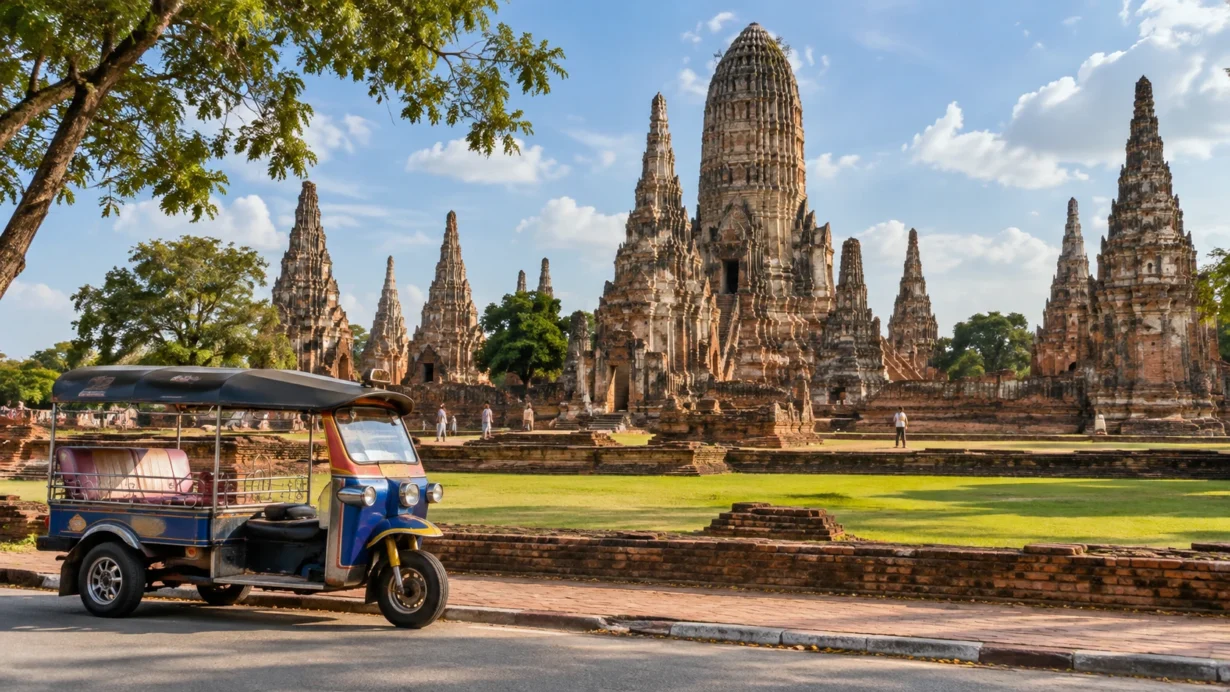
- Do the temple-pass arithmetic. The Fine Arts Department’s 2026 admission notice lists THB80 foreign single-site entry and THB300 for seven named monuments, approximately US$2.40 and US$9. Three singles total THB240; four total THB320. A pass is useful when you actually want at least four covered entries. Confirm coverage, validity and any re-entry rules at the gate.
- Do not assume the pass covers every attraction. The named group includes Wat Mahathat, Wat Ratchaburana, Wat Phra Ram, Wat Phra Si Sanphet and the Royal Palace, Wat Chaiwatthanaram, Wat Maheyong and Wat Kudi Dao. A museum, active temple or another site may have separate admission. Choose your list first and ask about the specific monuments rather than buying the broadest-sounding ticket.
- Separate a transfer from a sightseeing charter. A tuk-tuk ride from the station to your hotel and a driver waiting at several temples are different products. For planning only, allow roughly THB250–400 per vehicle-hour for a charter comparison, then obtain an actual written quote. Confirm stops, waiting time, total duration and the final drop-off. Do not multiply an hourly vehicle rate by every passenger.
- Compare cycling with the inconvenient version of cycling. Set aside roughly THB50–100 for a basic day’s bicycle rental as an editorial allowance, and inspect brakes, tires, lock and return time. A rental can save on a compact island circuit, but the saving disappears if you abandon it in the heat and need another vehicle. Ask about assistance for a puncture and any deposit before paying.
- Budget the river crossing without assuming its timetable. The station-side ferry links the eastern bank with the Chao Phrom area of the island. Ayutthaya Historical Research documents the crossing. Carry small cash and confirm the fare and last departure at the landing; a current operator tariff and timetable were not established during research. A car or tuk-tuk over a road bridge is the fallback.
- Use the train that fits your day. TAT’s official Bangkok Connex notice confirms a THB50 Krung Thep Aphiwat–Ayutthaya promotional fare through 31 October 2026. It is a dated offer, not a permanent fare for all trains. Check the selected service and Bangkok departure station with SRT, and include the Bangkok connection and final Ayutthaya transfer.
- Compare airport transfers as complete journeys. A rail connection from the Don Mueang area can be useful when its actual stopping pattern and timing suit you. From another airport, extra transfers may consume the saving. With large cases or children, compare a properly sized direct car with all public-transport legs. Keep airport travel outside your ordinary daily allowance.
- Control meals without making lunch a project. As editorial allowances, plan THB60–120 for a simple local dish and THB200–400 for a casual restaurant meal, with more for river prawns and drinks. Use convenience stores for water and straightforward breakfasts, market stalls for variety, and supermarket prepared food when convenient. Check portions: a small bowl of boat noodles is not necessarily a complete meal.
- Group sites by bank and neighborhood. Visit nearby central ruins together, then choose one deliberate outing beyond the island instead of repeatedly crossing back and forth. Short walks in cooler hours can be enjoyable; a long exposed road walk at noon is a poor way to save a modest fare. Include water, shaded breaks and a realistic return journey.
- Protect a reserve and check payment fees. Keep roughly 10–15% of planned ground spending available for a rain-driven ride, a failed ferry connection or replacement essentials. Give souvenirs their own limit. Check ATM and overseas card fees, and choose THB rather than optional home-currency conversion when paying. Cash admission and local rides make small notes useful.
Ayutthaya Budget by Travel Season
November to February: easier outdoor days, popular dates
The cooler, generally drier period makes walking and cycling more appealing, although temperatures can still feel hot in the sun. Desirable small hotels and river-view rooms can fill early around holidays or events. Compare your actual dates and room type; a broad “winter average” says little about one weekend stay.
March to May: heat changes the transport budget
The hotter season can make a low-cost bicycle plan less realistic than it looks on a map. Schedule outdoor ruins early, keep a slower midday block and allow for a vehicle when needed. Songkran in April is also a demand and access exception; check the year’s festivities before assuming hotter months mean discounted accommodation.
June to October: flexibility can be worth more than a discount
Rainier months can offer attractive room prices on some dates, but wet paths and river conditions can change a day’s movement. Keep the ability to swap sightseeing blocks and check current local conditions near your trip. A refundable booking can be worthwhile when a very cheap nonrefundable rate would lock you into an awkward itinerary.
Christmas, New Year and festival weekends
Do not assume Ayutthaya follows a quiet weekday price during a major holiday. Light events, historical celebrations or long weekends can tighten accommodation and increase evening transport demand. Verify event dates and actual night access instead of relying on last year’s program. A hotel near your evening plans can save both time and return fares.
Quieter dates and weekday comparisons
Midweek stays away from major events are worth checking, but no month or weekday is guaranteed to be cheapest. Compare a few nearby dates, cancellation conditions and whether breakfast is genuinely useful to your schedule. Saving THB100 on a room is less important than avoiding an unnecessary extra journey.
Common Budget Mistakes
- Budgeting from an old admission price. Use the current official THB80/300 figures as the starting point and confirm at purchase. Several older videos still quote different single-site and combined prices.
- Buying a combined ticket for a two-temple visit. Write down the included sites you will actually enter. At THB80 each, two cost THB160 and three cost THB240, below the THB300 pass.
- Counting the station as the historical park entrance. The station lies across the Pa Sak River. Add the crossing or road transfer and the remaining distance to the first monument before planning an ambitious day.
- Choosing a cheap room without checking the bank. A river-view listing can be on a different bank from your dinner or sightseeing area. Confirm the actual entrance and practical evening route before booking.
- Accepting an hourly rate without a total. Ask the driver to write down the hours, stops and final price. Clarify whether a lunch break, extra temple or station return changes the charge.
- Pricing every train at the same fare. Class, service and promotion matter. Check the specific train’s fare, any booking charge and the Bangkok station, and retain money for a suitable return service.
- Forgetting the luggage day. Ask your hotel or station staff about current storage options and fees. Returning across town to collect cases can be a bigger expense than storage itself.
- Assuming free walking means no extra spending. Heat can add drinks, café breaks and an unplanned ride. Include these honestly, or select a smaller circuit that fits your energy.
- Leaving no reserve for the final train. Protect the money for reaching the station and buying the return ticket. Treat shopping, a sunset cruise and dinner upgrades as optional spending from another pot.
Key FAQs
How much money do I need per day in Ayutthaya including a hotel?
Start with THB1,000–1,700 for careful budget travel, THB1,800–3,200 for mid-range travel or THB4,000–7,000 for more comfort, using the sharing assumptions above. Add Bangkok or airport travel and expensive private excursions separately.
Is the Ayutthaya combined temple ticket worth buying?
At THB300 versus THB80 per covered site for foreign visitors, it begins saving money at four included entries. It does not automatically cover every attraction. Confirm the named sites, validity and conditions before buying.
Is a day trip cheaper than staying overnight in Ayutthaya?
A day trip removes the hotel cost, but a rushed route can increase driver spending. An overnight stay buys cooler morning and evening time. Compare your actual room, return transport and sightseeing plan rather than treating either option as universally cheaper.
Final Verdict and Your Next Step
Set the budget around your chosen hotel bank, the temples you actually want and the amount of walking you will comfortably do. Use the combined ticket when the route earns the saving, keep transport quotes specific and protect the first and last transfer money.
Compare Ayutthaya accommodation on Booking.com, enter your dates and full party, and inspect the map before booking. For popular dates, reserve the room you want early, then confirm rail travel and any driver hire. A compact, well-positioned stay can save more than chasing the cheapest number in each category.