




💡 Key Takeaways
- Start with a per-person daily plan that includes your share of the room, then count the actual hotel nights. The €80, €140 and €250 examples below are planning allocations, not observed hotel offers.
- For two adults sharing a room, the worked mid-range envelopes are €580 per person for three full sightseeing days/four nights, or €855 for five full days/six nights. Both include a €50 emergency reserve; add confirmed tourist tax, airport travel, booking fees and personal extras.
- Match the ticket to the journey. An urban pass does not automatically cover Alibus or a Pompeii excursion; during 1–30 November 2026, NAP’s closure makes the actual arrival airport an essential budget check.
A useful Naples travel budget starts with the things an average daily figure hides: how many nights you need, whether a room price is shared, which airport your flight actually uses, and what your sightseeing tickets include. A pizza can be modestly priced while the full meal costs more after drinks and the listed cover charge. A cheap hotel can lose its advantage when every return to the room needs another journey.
This guide separates published prices checked on 5 November 2026 from editorial planning inputs. The latter are amounts you can allocate and replace with your own quotes; they are not claims that a particular hotel or fare is available. Museum figures are ordinary adult admission prices before any unverified booking supplement. Hotel tax, age-based reductions and exemptions need their own confirmation.
November 2026 arrival notice: the airport operator confirms NAP’s runway closure from 1–30 November 2026. Some flights operate through Salerno Airport (QSR), with temporary transport arrangements. Check your airline’s actual airport and the current transfer quote before comparing flights. Do not use the normal Naples Airport shuttle fare as a Salerno transfer estimate.
The 1-Min Cheat Sheet
All three daily envelopes include accommodation: two adults share one room and split its cost equally. They also allow for food, local travel and averaged sightseeing. The room and meal allocations are hypothetical, so replace them with the same-date quote and your eating plans. The US dollar figures are rounded using €1 = US$1.1267, the ECB reference rate dated 4 November 2026. This is a comparison rate, not a guaranteed card or cash exchange rate.
- Budget Traveler: plan around €70–100 per person per day, approximately US$79–113. A worked €80 day is €40 for half of an assumed €80 room, €25 for food, €3 for local transport and €12 averaged across sightseeing. This suits a compact route, simple meals and selective paid attractions. Finding a room that fits the allocation is a booking task, not something this estimate guarantees.
- Mid-Range Traveler: plan around €125–170 per person per day, approximately US$141–192. A worked €140 day is €75 for half of an assumed €150 room, €40 for food, €5 for local travel and €20 for sightseeing. This is the starting point for the three- and five-day examples below, which then account for extra nights, boundary-day meals and a reserve.
- Comfortable Traveler: plan around €210–300 per person per day, approximately US$237–338. A worked €250 day is €140 for half of an assumed €280 room, €65 for food, €15 for local travel flexibility and €30 for admissions or experiences. A named view category, private transfer or guided tour can still need a separate quote; a larger envelope is not an unlimited allowance.
Keep flights, long-distance rail, shopping, major guided excursions, boat days and theme-park trips outside an ordinary local daily comparison. Confirmed city tax and airport transfers are also separate here. A solo traveler paying for the whole room cannot use the shared-room figure unchanged.
Top Budget Survival Tips
- Compare the room plus the journeys you will repeat. Mark the sights, station and hotel door before comparing prices. A €20-per-night saving over four nights is €80 for the room, or €40 each for two people. Compare that saving with the actual extra travel and time, especially if you want afternoon room breaks. Do not move hotels repeatedly just to collect a slightly cheaper nightly rate without pricing the luggage day.
- Count rides before buying a pass. ANM’s currently linked tariff information lists Metro 1/6 single tickets at €1.50 and an ANM day ticket at €4.50. Two such singles cost €3; three equal €4.50; four cost €6. On that four-ride day, a valid ANM day ticket saves €1.50. It is not automatically a saving on a walking day.
- Choose the correct transport scope and validity. The same official tariff table distinguishes €1.30 urban bus/funicular singles, a €1.80 integrated 90-minute product, and €4.50 ANM versus €5.40 integrated day tickets. Operator coverage and journey rules matter. ANM describes a day ticket as valid until midnight on the validation day, not for a rolling 24 hours.
- Price the airport that appears on the flight confirmation. Outside the November closure, ANM publishes an Alibus fare of €5 per person one way: €10 return for one adult, or €20 return for two. Ordinary urban passes and Artecard do not cover Alibus. For QSR during the closure, obtain the real temporary-service fare or transfer quote; no unsupported Salerno price is inserted here.
- Compare a vehicle quote with a person fare. Ask whether a private transfer quote covers one vehicle or each passenger, and whether it includes the agreed luggage and destination. Divide a confirmed whole-vehicle quote by the number sharing it; obtain the return-leg quote separately. The cheapest apparent airport option can lose its appeal if its final stop requires an additional ride with large cases.
- Group the city by area. Pair the old-city streets with nearby visits, and put the Toledo/monumental-center stops together. Avoid a morning at one end, a lunch across town and a return to the first area. Walk when it is a comfortable connection; buy the short ride when heat, rain, hills or tired legs would spoil the next visit. The purpose is a usable day, not the lowest possible fare total.
- Keep the big excursion day separate. A Capri boat day, Amalfi excursion or guided Pompeii package has a different cost structure from a city museum day. List transport, admission, optional guide, food and any operator fees independently. An urban transport allowance is not evidence that the whole excursion is covered.
- Use simple food purchases deliberately. Alternate a planned sit-down meal with a bakery, grocery or supermarket purchase whose displayed price you can check. Ask about any discounted ready-food stock available that day rather than assuming a universal evening markdown hour. For coffee, establish the counter and seated prices before ordering. A small daily coffee, pastry and late snack allowance is easier to control than repeated unrecorded purchases.
- Reserve money for disruption before allocating shopping. The worked examples keep €50 per person as an emergency reserve for a wet-weather change, an unexpected local ride or another small disruption. It is not a quote for any service and may remain unspent. Give shopping a separate ceiling so that a souvenir purchase does not quietly consume the transport reserve.
- Check currency conversion and cash costs. Read your issuer’s foreign-transaction fee and the ATM operator’s displayed charge. Visa explains that a home-currency conversion offer can include a rate and additional markup. Paying in euros leaves conversion to your card network/issuer rather than accepting the merchant’s DCC offer; it does not remove your own card’s fees. Review the currency and charges before confirming, and do not let a familiar dollar display substitute for the euro total.
Real Price Checks: Food, Walking and Paid Sights
A compact old-city day can reduce transport spending
Life Of Italy, August 2026: Via dei Tribunali, Piazza Bellini and nearby streets. This is visual walking context, not a timed accessible route or a source of ticket prices.
The useful budget question is how many journeys your itinerary actually needs. An old-city walk can sit between paid visits without generating a new fare at every stop. It is still sensible to allow time for crowds and a rest, rather than filling the saving with another distant attraction. A hotel near the places you will revisit can be worth more than a small room-price reduction elsewhere.
A pizza price is only one part of the meal
Italia Squisita, May 2017: Ciro Salvo demonstrates pizza-making at 50 Kalò. The film illustrates the food, while the price check uses the owner’s currently linked menu, not old video prices.
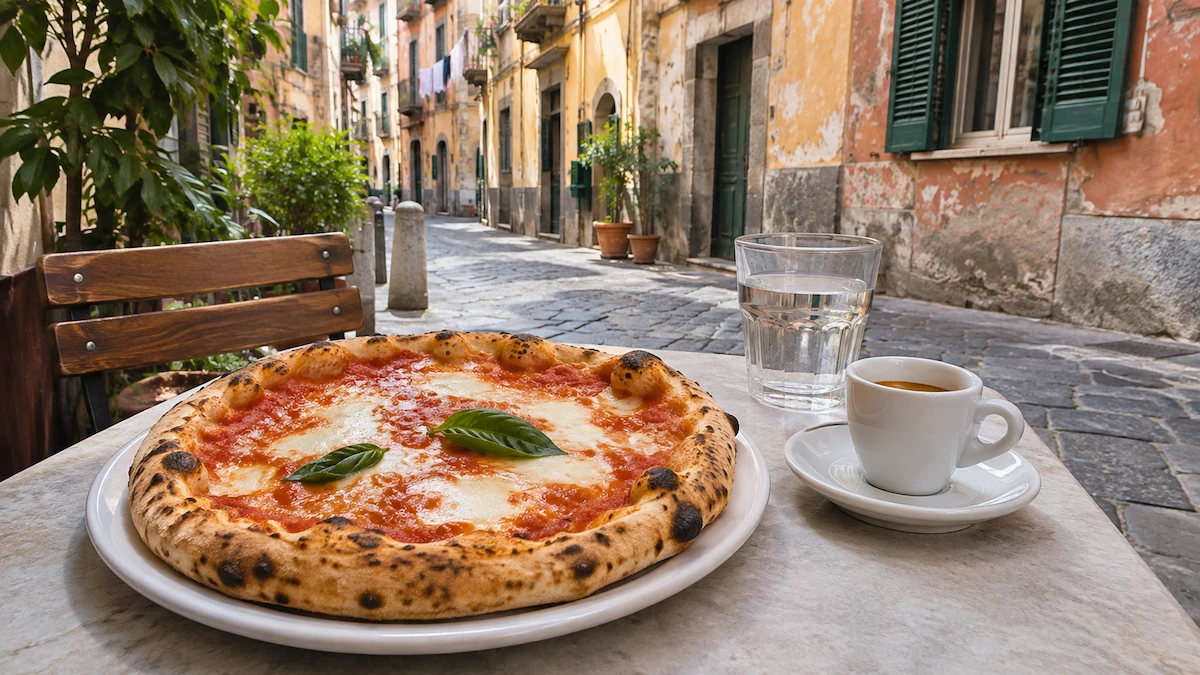
The 50 Kalò Naples page links a published menu showing Marinara at €6.50, Margherita at €7.50, and service/coperto at €2. On that menu, one Margherita plus the listed cover charge is €9.50 before drinks or extras. This is one restaurant’s published example checked on 5 November, not a citywide meal price or a future bill guarantee. Recheck the menu when ordering.
Use that distinction when setting a food allocation. The €25, €40 and €65 daily food inputs above represent different choices about breakfasts, seated meals, drinks and snacks. They are not restaurant quotes. Do not spend a taxi fare crossing the city solely to save a small amount on a pizza; compare the full outing.
Choose the Pompeii product before pricing the day
HP Walking Tours, November 2024. The film shows the archaeological site; the ticket distinctions below come from the official 2026 price information.
Pompeii’s official tariff from 12 January 2026 lists Express at €20 for the ancient city, with suburban villas excluded, and Plus at €25 for the broader listed villa/Boscoreale route and shuttle. The site says an Express holder adding the suburban-villa route on site pays €8, by card. That is €28 in total, compared with €25 for Plus bought as the intended product, before any separately confirmed sales fees. These single-entry products do not allow exit and re-entry on the same ticket.
Also price the actual return journey through the current EAV timetable and ticket channels. The worked five-day plan below uses a €15 per-person return-transport reserve; this is an editorial allowance, not a verified EAV fare. Replace it with your selected service’s actual cost. A guide, audio product or private transfer must be added if chosen.
Three Full Days or Five: Count the Nights and Boundary Meals
Shared assumptions: two adults share one room at an assumed €150 per room per night. They arrive the afternoon before sightseeing begins and leave the morning after the final full day. Full-day food is an assumed €40 per person, with an extra €20 arrival dinner and €10 departure breakfast. Local city travel is a €5-per-full-day allowance plus €6 per person reserved across arrival and departure. These are planning inputs, not observed offers.
The city admission basket is €59 per adult: Sansevero €12 + Santa Chiara’s paid complex €7 + MANN €20 + Castel Sant’Elmo €5 + Palazzo Reale’s ordinary ticket €15. These published ordinary adult prices exclude unverified booking supplements, guides and optional extras. Eligibility-based reductions and special products can change the final checkout.
- Three full sightseeing days, four hotel nights: €580 per person, approximately US$653; €1,160 for the pair, approximately US$1,307. Room: 4 × €150 = €600 for the pair, or €300 each. Food: 3 × €40 + €20 + €10 = €150 each. Local travel: 3 × €5 + €6 = €21 each. The five city entries: €59 each. Emergency reserve: €50 each. Per-person arithmetic: €300 + €150 + €21 + €59 + €50 = €580.
- Five full sightseeing days, six hotel nights: €855 per person, approximately US$963; €1,710 for the pair, approximately US$1,927. Room: 6 × €150 = €900 for the pair, or €450 each. Food: 5 × €40 + €20 + €10 = €230 each. City travel: 5 × €5 + €6 = €31 each. City entries plus Pompeii Express: €59 + €20 = €79 each. Pompeii return-transport reserve: €15 each. Emergency reserve: €50 each. Per-person arithmetic: €450 + €230 + €31 + €79 + €15 + €50 = €855.
These are working envelopes before confirmed city tax, travel to and from the actual airport, intercity travel, booking supplements, shopping and selected upgrades. The emergency reserve is included money held aside, not a compulsory expense. The five-day example includes one Pompeii visit; choosing Plus instead of Express adds €5 per person, making that envelope €860 each or €1,720 for the pair before the same exclusions.
How to add tourist tax: obtain the property’s confirmed charge per liable adult per night for your dates and its rules. If both adults are liable for all modeled nights, a rate of t means adding 4t per person or 8t for the pair to the four-night example, and 6t per person or 12t for the pair to the six-night example. Adjust for any confirmed exemption or limit, and do not add it again if already included in the quote.
How to adapt the model: a solo traveler taking that same €150 room pays its full cost. Keeping the other allocations unchanged produces €880 for the three-full-day example or €1,305 for five, before the same exclusions. For a party of three, obtain a room quote and confirmed occupancy for three; dividing a two-person room by three is not a valid saving.
Check whether the paid visits are worth their price on your actual dates. Sansevero requires advance booking. MANN’s current gallery schedule lists the Mosaic collection and Secret Cabinet closed for refurbishment during the period checked in November 2026; do not buy on an assumption that an old film’s highlights are all accessible. Ordinary weekly closures and special calendars also matter: confirm them before locking your days or a restrictive hotel rate.
Naples Budget by Travel Season
- Spring and Easter travel: compare Easter dates and Italian holiday weekends with an ordinary midweek stay. A desirable room may be harder to secure during a popular short break, but the size of any premium must come from your actual quote. An attractive flight price alone does not establish a cheap total trip.
- Late-April and early-May holiday periods: inspect weekends around Italy’s 25 April and 1 May holidays. Compare the exact room and cancellation terms on the dates you could travel. Leave an extra allowance if your alternative dates require more travel or a different hotel area.
- Summer: allow for the choices that heat can change: a ride instead of an uphill walk, a room break, drinks, or a boat day priced separately. If air conditioning is essential, check the selected room and the hotel’s current arrangements. Do not assume every August date has the same demand or that a cheaper room produces a comfortable sightseeing day.
- Autumn: compare September and October dates on their own merits, including events and weekends. November is a useful date-comparison candidate, not a guaranteed low-price month. In November 2026 specifically, the NAP closure can change the arrival cost enough to outweigh a room saving.
- Christmas and New Year: Naples’ San Gregorio Armeno craft tradition is present year-round, with particular festive interest. Give souvenirs their own ceiling, compare holiday-night room quotes, and check special restaurant or event menus before assuming an ordinary meal allocation applies.
- Quieter winter date comparisons: if flexible, begin by comparing late January and February outside holiday or event weekends with your preferred spring/autumn dates. Treat these as candidates to test, not a promise of the cheapest month. A refundable room with a workable location can beat a lower restrictive quote once weather and the complete itinerary are considered.
Season affects the budget through actual dates, room availability, opening calendars and the activities you choose. This guide has not invented percentage hotel-price premiums or claimed that one month is always cheapest.
Common Budget Mistakes
- Multiplying a daily figure by three and booking four nights. Put arrival and departure on a calendar first, then count each charged night. Add the meals outside your full sightseeing days. The worked examples show why a €140 daily planning point is not simply a complete three-day trip at €420.
- Reading a room price as a per-person price, or the reverse. Label each line “room/night,” “person,” or “vehicle.” Split the confirmed shared cost only once. Keep the original whole-room figure beside the individual calculation so the total can be checked.
- Forgetting the return airport journey. Price both directions for the actual airport and arrival/departure hours. During the NAP closure, confirm QSR transport independently. A prepaid normal-airport transfer is not automatically a solution for a changed airport.
- Expecting one pass to cover everything. Match the selected product to the operators and sites. ANM says ordinary urban passes and Artecard do not cover Alibus; Santa Chiara’s official FAQ states it has no Artecard/FAI collaboration. Do not subtract an entry fee from the budget until that exact benefit is confirmed.
- Using a pizza or coffee headline as the whole food budget. Read the actual menu for coperto, drinks and the serving option. Track the small purchases for one day, then adjust the next day’s food allowance instead of hoping they will disappear into the average.
- Buying a cheaper hotel without pricing the daily return. Compare the repeated route with bags, children or tired legs as relevant. A sensible short ride can be worth paying for; repeated cross-city detours should be a conscious choice.
- Assuming admission covers every route, guide or room. Check Pompeii Express versus Plus, the actual museum gallery openings and the booking breakdown. A guided package may be useful, but compare what it includes with ordinary admission rather than treating the two prices as equivalent.
- Leaving luggage storage, late checkout and card charges unassigned. Ask the hotel about storage supervision, collection time and fees; obtain a late-checkout quote if needed. Check the issuer and ATM charges separately. These are booking-specific costs, so no universal free service or fee percentage is assumed.
- Spending the reserve on shopping before the final day. Keep the €50 example reserve separate from the souvenir ceiling until the last essential journeys are covered. If you use it, record why and revise the remaining plan; if you do not, it stays unspent.
Key FAQs
How much should I budget per day in Naples including a hotel?
For two adults sharing one room, use €70–100, €125–170 or €210–300 per person per day as budget, mid-range and comfortable planning envelopes. These include a share of accommodation, food, local travel and averaged sightseeing; the room allocations are assumptions to replace with actual quotes. Add the actual number of nights, airport travel, confirmed city tax and chosen extras before treating the figure as a trip total.
What is a realistic Naples budget for three full days or five full days?
The worked mid-range plans are €580 each for three full days/four nights and €855 each for five full days/six nights, for two adults sharing an assumed €150 room. Both include boundary-day meals, local travel and a €50 reserve; five days also includes Pompeii Express and a clearly labeled transport allowance. They exclude confirmed tax, airport travel, booking supplements and personal extras. Replacing the room or transfer assumptions can materially change the result.
Is a Naples transport or sightseeing pass worth buying?
Only after you list the actual journeys and eligible entries. At the published ANM prices, two €1.50 Metro 1/6 singles cost less than a €4.50 ANM day ticket, while four such rides cost more. A day ticket ends at midnight, and its operator scope matters. Check sightseeing inclusion separately: Santa Chiara is not an Artecard partner according to its FAQ, and Alibus requires its own valid product.
Final Verdict and Your Next Step
Start with the daily style that fits your priorities, then rebuild the total from real nights, meals, tickets and arrival details. A compact route and a modest food plan can keep spending controlled. A more comfortable room or a well-chosen paid experience can be good value when you price it deliberately. The useful saving is the one that survives the complete itinerary.
Check accommodation early through genuine owner booking entries such as B&B HOTEL Napoli and Starhotels Terminus, comparing the exact dates, occupancy, cancellation rule and meal inclusion. For planned paid visits, use the official Sansevero ticket entry, MANN ticket information and linked sales channel, and Pompeii’s authorized Vivaticket entry. Confirm the final checkout and your actual airport transport before paying. Keep the euro total, room nights and included costs together; the rounded dollar number is only a quick comparison.