
💡 Key Takeaways
- For most travelers, take Daegu Metro Line 1. Dongdaegu Station to Jungangno takes about 8 minutes on the train, and Banwoldang about 9 minutes. There is no transfer, so it is the best mix of speed, price and predictability.
- With two or more large suitcases, a taxi can be worth the extra money. A typical ride to the Jungangno–Banwoldang downtown area is usually around the high-₩8,000 to low-₩12,000 range before unusual traffic or surcharges, but a normal sedan may not fit several big cases.
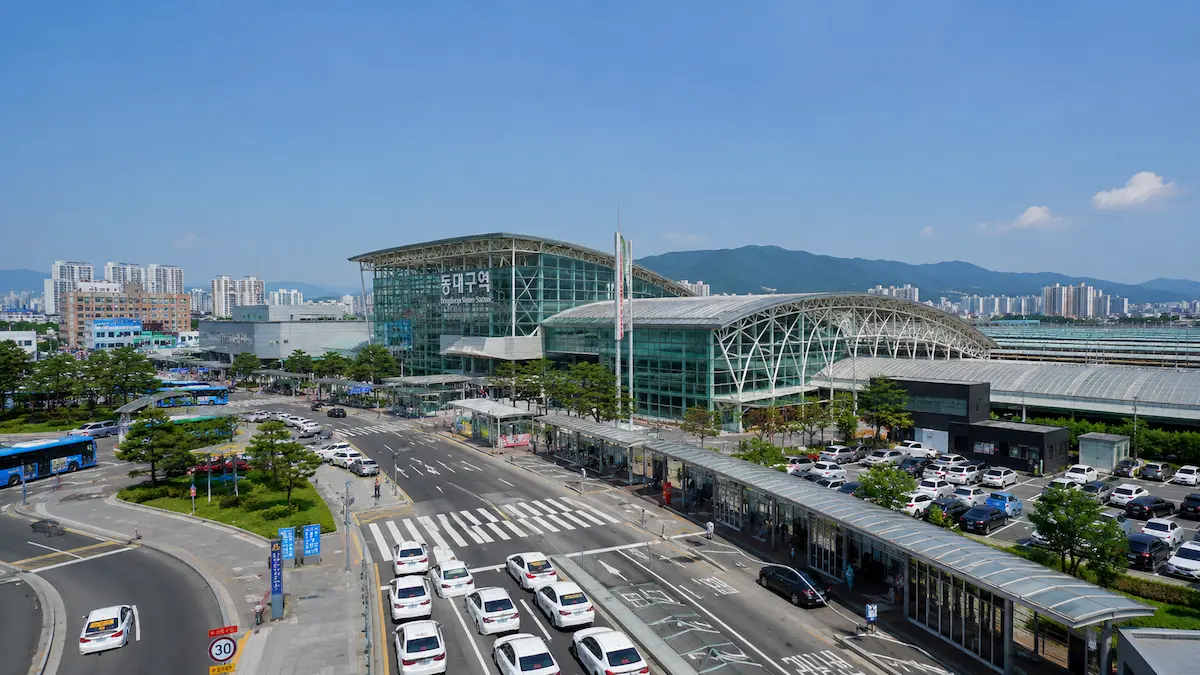
- Do not confuse Dongdaegu Station with Daegu Station. Dongdaegu is the main KTX/SRT gateway. Daegu Station is already much closer to the traditional downtown core; Jungangno is roughly a 12-minute walk from Daegu Station.
If you are searching for the easiest way from Dongdaegu Station to Daegu city center, the biggest mistake is treating every “central Daegu” hotel as if it were in the same place. Some travelers are staying beside Dongseong-ro and Jungangno, others are closer to Banwoldang, Seomun Market, or Daegu Station. That last kilometer matters when you are tired, arriving late, carrying a 23 kg suitcase, or traveling with children. It is especially noticeable if you have already spent hours getting to Daegu after a flight into Incheon, Gimhae, or Daegu Airport and the final thing you want is another awkward transfer.
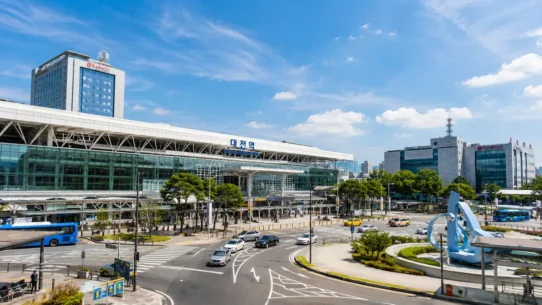
This guide uses Dongdaegu Station (동대구역) as “the main station” because it is Daegu’s principal high-speed rail hub for KTX and SRT travelers. If your ticket actually says Daegu Station (대구역), you are already close to the city center and should read the station-name warning below before paying for another ride.
Price check: Daegu’s official adult metro fare is ₩1,500 with a transportation card or ₩1,700 for a single-journey ticket. Regular city buses are ₩1,500 by transportation card or ₩1,700 cash. Daegu’s published standard medium-taxi base fare is ₩4,000 for the first 2 km, with distance/time charging after that and possible surcharges. These figures were checked against Daegu public information available in August 2026, but always treat taxi estimates as estimates rather than fixed quotes.
The 1-Min Cheat Sheet
- 🚇 Metro Line 1 — best overall: Around 8 minutes to Jungangno or 9 minutes to Banwoldang on the train, plus walking inside the station. Adult fare: ₩1,500 with a transportation card or ₩1,700 single ticket. Best for solo travelers, couples, light-to-medium luggage and anyone who hates traffic uncertainty.
- 🚕 Taxi — best with heavy luggage or a small group: Usually only a few kilometers to the main downtown zone. Expect roughly ₩8,500–₩12,000 to the Jungangno/Banwoldang area in normal conditions, but traffic, waiting time and surcharges can push it higher. Best for door-to-door convenience.
- 🚌 City bus — best only when the bus stop suits your hotel: Regular adult fare is ₩1,500 by transportation card or ₩1,700 cash. It can save walking if a direct bus stops beside your accommodation, but it is less luggage-friendly and more confusing than the metro for first-time visitors.
- 🚶 Walking — technically possible, rarely sensible with luggage: Dongdaegu to the downtown core is roughly 4–5 km depending on your exact destination, often around 45–55 minutes on foot. Choose this only if you are traveling very light and genuinely want the walk.
Top Survival Tips
- Check the Korean station name on your ticket. 동대구역 is Dongdaegu Station; 대구역 is Daegu Station. They are not interchangeable.
- Choose the downtown stop by hotel address, not by the word “center.” Jungangno is usually best for Dongseong-ro’s northern/central shopping streets. Banwoldang is better for the southern side of Dongseong-ro and hotels near the Line 1/Line 2 interchange.
- Budget extra time from the KTX platform to the metro. The metro ride itself is short, but elevators, escalators, ticketing and navigating the large station complex can easily add several minutes.
- If you have a T-money or compatible transportation card from another Korean city, try it before buying another card. Daegu’s public transport system accepts major compatible prepaid transportation cards. Keep some Korean cash because topping up prepaid transit cards is often cash-based.
- Use Naver Map or KakaoMap for the final hotel walk. In Korea, they are generally more useful for local entrances, bus stops and walking routes than relying only on global map apps.
- For buses, press the stop button early and be ready to move. Bus travel is cheap, but large suitcases make boarding, standing and getting off quickly much more awkward.
- For taxis, show the hotel name in Korean as well as the address. Screenshot it before arrival in case mobile data is slow inside the station.
- Three people plus three large suitcases may not fit comfortably in a standard sedan. If luggage volume matters more than passenger count, request a larger vehicle where available or ask your hotel to help arrange one.
- If you arrive very late, do not build your plan around catching the final metro. Last-train times vary by direction and service pattern. Check the live route on the day and switch to a taxi if the margin is tight.
- Do not take a taxi just because a hotel listing says “Daegu city center.” First check whether the hotel is beside a Line 1 station; the metro may drop you closer than a car can during busy periods.
The Full Experience
🚇 Daegu Metro Line 1: Best Overall for Jungangno, Dongseong-ro and Banwoldang
Best for: Solo travelers, couples, predictable arrival times, budget travelers, light or medium luggage · Typical cost: ₩1,500 with a transportation card / ₩1,700 single ticket · Transfers: None for Jungangno or Banwoldang
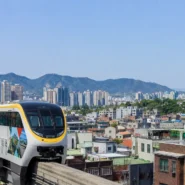
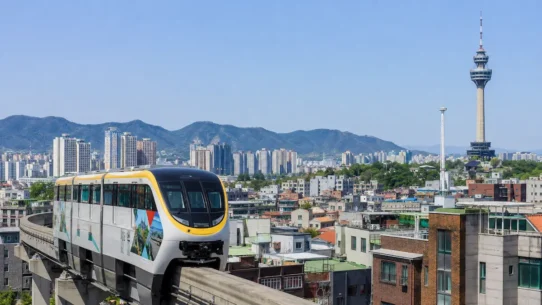
This is the option I would choose by default. From Dongdaegu Station, take Daegu Metro Line 1 westbound toward Seolhwa-Myeonggok. For the core shopping and nightlife area, get off at Jungangno. For the southern end of Dongseong-ro or hotels around the major Line 1/Line 2 interchange, stay on one more stop to Banwoldang.
Daegu city information lists Jungangno as four stops from Dongdaegu, with a train journey of about seven to eight minutes. Current journey planners put Banwoldang at about nine minutes. The important number for a tired traveler, however, is not just “8 minutes.” Once you include walking from the KTX platform, following metro signs, buying or topping up a card, waiting for a train, and reaching the correct exit downtown, a realistic station-to-street journey is longer.
Why it works so well: there is no transfer. You avoid road traffic, the fare is fixed across the metro system, and you do not need to explain your hotel address to a driver. For one or two travelers, it is also dramatically cheaper than a taxi.
Which stop should you choose? Use Jungangno if your hotel is around the central/northern Dongseong-ro shopping area, central nightlife streets, or the eastern side of the old downtown. Use Banwoldang if your hotel sits farther south, near the Line 2 interchange, or if the walking route from Banwoldang is clearly shorter on Naver Map. Do not automatically choose Banwoldang just because it is the better-known interchange; one extra station can mean walking back north with luggage.
✅ What Other Travelers Say
Traveler discussions about Daegu consistently describe the city as easy to get around without a car, with the subway and bus network covering the main urban areas well. People moving around Korea also commonly report that T-money works in Daegu, which removes the need to buy a city-specific card if you already have one. The strongest practical theme is simple: when there is a direct subway, use it unless luggage or mobility makes a taxi meaningfully easier.
⚠️ The Catch (Things to Keep in Mind)
The metro is only “effortless” if your luggage is manageable. Dongdaegu is a large transport complex, so reaching the metro involves more walking than the raw eight-minute ride suggests. At busy times, squeezing a very large suitcase into a carriage is also less pleasant. Finally, the station exit closest to your hotel matters: choosing the wrong exit can add stairs, road crossings and several hundred unnecessary meters.
My call: If you have one wheeled suitcase per person and can comfortably use escalators or elevators, take the metro. It is the least stressful choice for most visitors.
🚕 Taxi from Dongdaegu Station: Best for Heavy Luggage, Families and Late Arrivals
Best for: Two to four travelers splitting the fare, families, heavy luggage, mobility concerns, late arrivals · Typical downtown estimate: roughly ₩8,500–₩12,000 in normal conditions · Transfers: Door to door
A taxi is the comfort winner, especially after a long rail journey. Dongdaegu to Jungangno or Banwoldang is only around 4–5 km by road depending on the exact destination, so this is not the kind of cross-city taxi ride that destroys a travel budget. Current route estimates commonly land around the high-₩8,000 to low-₩12,000 range for the downtown core.
The official Daegu fare structure is more useful than any single “taxi price” quoted online: standard medium taxis start at ₩4,000 for the first 2 km, then add distance- or time-based charges. That means congestion matters. There can also be night or other applicable surcharges, so treat app estimates and blog figures as guidance rather than a guaranteed fare.
You can use the station taxi rank or a Korean taxi-hailing app. For international travelers, k.ride, Kakao T and Uber Taxi availability can be useful, but app account setup and payment behavior can vary. A simple fallback is to keep the hotel’s Korean address ready and use the official rank.
The group-math advantage: a ₩10,000 taxi split between three people is only about ₩3,300 each. If the alternative is dragging suitcases through a station, finding an elevator and then walking eight minutes from a metro exit, the extra cost can be money well spent.
✅ What Other Travelers Say
Recent Korea trip reports often say taxis feel inexpensive compared with North American or Western European prices, and travelers especially value them when changing hotels or moving with luggage. People traveling as a group also warn that vehicle size is the real issue: three passengers do not automatically mean three large suitcases will fit in a standard sedan.
⚠️ The Catch (Things to Keep in Mind)
The quoted app price is not the same as a fixed fare, and a traffic jam can erase part of the taxi’s time advantage. Large luggage may require a larger vehicle. At peak periods or very late at night, app availability can fluctuate, so do not assume the exact vehicle type you want will appear instantly.
My call: Take a taxi if you have two or more bulky cases, are traveling with small children or older relatives, arrive after normal metro hours, or your hotel is not close to a subway exit. For three people, the convenience-to-cost ratio is often excellent.
🚌 Daegu City Bus: Best Only When a Direct Bus Stops Near Your Hotel
Best for: Travelers whose hotel is directly on a useful bus route, people comfortable navigating Korean city buses · Typical cost: ₩1,500 by transportation card / ₩1,700 cash for a regular bus · Transfers: Route-dependent
The city bus is cheap, extensive and sometimes surprisingly convenient. Daegu city guidance lists several routes from the Dongdaegu Station area toward central districts. For example, route 524 has been listed from Dongdaegu Station toward the City Hall area, while routes such as 708, 101 and 401 serve stops that can be useful for the broader central area.
That does not mean you should memorize a bus number months before your trip. Bus routes, stops and temporary diversions can change, and the correct stop depends heavily on your hotel. Search the exact hotel in Naver Map or KakaoMap on the day you travel and let the app tell you which bus is actually best.
Daegu’s official regular-bus fare is ₩1,500 with a transportation card or ₩1,700 cash. Express/direct buses cost more. With a compatible transportation card, transfer rules can make bus-plus-metro journeys economical, but for this short station-to-center trip, adding a transfer usually defeats the whole point unless the bus drops you much closer to the hotel.
✅ What Other Travelers Say
Travelers generally find Korean bus networks useful once they are comfortable with Naver Map, but first-time visitors repeatedly mention two practical annoyances: stop names are not always equally obvious in English, and buses may only stop when someone signals to get off. Korea travelers carrying large luggage also commonly say buses are the least pleasant option because you need to board, secure the suitcase and get off promptly.
⚠️ The Catch (Things to Keep in Mind)
This is the mode with the highest “small hassle” count: finding the correct stop outside a huge station, checking the bus direction, managing luggage, watching your stop, and coping with traffic. A bus that looks perfect on a map can also leave you on the wrong side of a multi-lane road with a suitcase.
My call: Use the bus if Naver Map shows a direct route that saves you a meaningful walk to the hotel. Otherwise, the metro is simpler for almost the same fare.
🚶 Walking to Central Daegu: Best for Backpackers Who Actually Want the Walk
Best for: Backpack-only travelers, pleasant-weather days, people exploring slowly · Typical cost: Free · Distance: roughly 4–5 km to the main downtown zone
Yes, you can walk from Dongdaegu Station to Dongseong-ro or Jungangno. The route is roughly 4 km to Jungangno and around 4.5–5 km to the Banwoldang side of downtown, depending on the streets you choose. Most travelers should think in the range of 45–55 minutes, not “a quick walk.”
If you have only a backpack and enjoy getting your bearings on foot, walking can be a nice transition into the city. Daegu’s downtown becomes increasingly lively as you approach Jungangno and Dongseong-ro, and once you are in the core, many shops, restaurants and sights are clustered within a walkable area.
But this is also one of those routes that looks easier on a phone than it feels with a roller suitcase. Traffic lights, uneven pavement, summer heat, rain, station exits and the simple friction of pulling luggage for nearly an hour turn “free” into a hidden physical cost.
✅ What Other Travelers Say
Visitors like central Daegu precisely because the downtown area itself is walkable and packed with food, shopping and cafes. That does not mean walking from Dongdaegu Station is the best arrival strategy. The enjoyable part is usually wandering once your bags are at the hotel.
⚠️ The Catch (Things to Keep in Mind)
Daegu summers can be very hot and humid, while rain or winter cold can make a 50-minute luggage walk miserable. You also save only ₩1,500 compared with using a transportation card on the metro. If you are walking purely to save money, the saving is too small to justify the effort for most travelers.
My call: Walk only if you have no large luggage and genuinely want a city walk. Otherwise, spend the ₩1,500 and save your legs for Dongseong-ro, Seomun Market and the rest of Daegu.
Where Exactly Is “Daegu City Center”?
The phrase “Daegu city center” is too vague to choose transport well. For most leisure travelers, the practical core is around Jungangno, Dongseong-ro and Banwoldang. These areas contain a high concentration of shopping, restaurants, cafes, nightlife and convenient subway access.
Jungangno: Usually the most logical metro stop for the heart of Dongseong-ro and the northern/central old downtown. If your hotel is between Daegu Station and central Dongseong-ro, this is often the better stop.
Banwoldang: One stop beyond Jungangno from Dongdaegu. It is Daegu’s major Line 1/Line 2 interchange and a strong base if you plan to use both lines or your hotel sits south of the central shopping streets.
Daegu Station: Do not dismiss it just because Dongdaegu is the bigger high-speed hub. Daegu Station is much closer to central Daegu. Jungangno is only about 1.1 km away on foot, so if a regional train actually leaves you at Daegu Station, paying for a separate downtown transfer may be unnecessary.
Station Name Trap: Dongdaegu Station vs Daegu Station
This is the single most important naming trap in this journey. Dongdaegu Station (동대구역) means “East Daegu Station” and is the huge high-speed rail and transfer hub. Daegu Station (대구역) is a different station west of Dongdaegu and much closer to the downtown shopping core.
If your KTX/SRT ticket says Dongdaegu, follow this guide. If your train ticket says Daegu Station, check your hotel before boarding another vehicle. Jungangno is about a 12-minute walk away, and some Dongseong-ro hotels are within a reasonable luggage walk depending on weather and pavement.
Which Option Is Best for Your Travel Style?
- Solo traveler with one carry-on: Metro. It is hard to beat ₩1,500 and no transfer.
- Couple with two medium suitcases: Metro if the hotel is near Jungangno/Banwoldang; taxi if you are tired or the hotel is several blocks from an exit.
- Three adults with large suitcases: Taxi, but request enough luggage capacity. The per-person fare is reasonable once split.
- Family with children: Taxi for the smoothest door-to-door move, especially after a long KTX ride.
- Traveler arriving close to the end of metro service: Check the live route immediately. If timing is tight, use a taxi instead of gambling on the final train.
- Hotel near a direct bus stop but far from the metro: Bus can be smart if you have light luggage and the route is direct.
- Backpacker on a cool, dry day: Walking is possible, but only choose it because you want the walk, not because ₩1,500 feels worth saving.
Key FAQs
What is the cheapest way from Dongdaegu Station to Daegu city center?
The metro is the best cheap option for most visitors. The official adult fare is ₩1,500 with a transportation card or ₩1,700 for a single ticket, and Line 1 runs directly from Dongdaegu Station to Jungangno and Banwoldang without a transfer.
How long does it take from Dongdaegu Station to Dongseong-ro?
The Line 1 ride to Jungangno is about 8 minutes, with Jungangno serving the central Dongseong-ro area. In real life, allow more time for walking through Dongdaegu Station, waiting for the train and reaching the correct exit. A practical station-to-street total of roughly 20 minutes is more realistic than focusing only on the train time.
Should I take a taxi from Dongdaegu Station if I have luggage?
With one normal suitcase, the metro is still easy enough for most travelers. With two or more large cases, children, mobility concerns, or three people splitting the fare, a taxi becomes much more attractive. The main caution is vehicle size: a standard sedan may not take several large suitcases even if it has enough passenger seats.
Final Verdict and Your Next Step
For the average traveler, the answer is simple: take Daegu Metro Line 1 from Dongdaegu Station to Jungangno or Banwoldang. It is cheap, direct and immune to road congestion. Jungangno is my first choice for most Dongseong-ro stays; Banwoldang is better when your hotel is farther south or you want easy access to Line 2.
Choose a taxi when luggage, children, mobility or a late arrival makes door-to-door transport more valuable than saving a few thousand won. Choose the bus only when a direct route genuinely leaves you closer to your hotel. And save the walk for after check-in, when central Daegu is much more enjoyable without a suitcase attached to your arm.
One final planning tip: for this short transfer, you do not need to “pre-book the metro.” What is worth booking early is the part that can actually sell out or become expensive: a well-located downtown hotel and any fixed-date attraction or day tour. Staying near Jungangno or Banwoldang can save you repeated taxi fares and unnecessary walking for the rest of your trip.
Check accommodation before your dates tighten up:
Browse Daegu hotels on Agoda
Compare Daegu stays on Booking.com
Reserve Daegu activities and sightseeing in advance:
See Daegu activities on Klook
See Daegu tours and experiences on KKday