



💡 Key Takeaways
- Do not treat Suwon Station as the sightseeing center. The historic core around Hwaseong Fortress and Haenggung-dong is a separate bus or taxi ride away, while Starfield Suwon is by Hwaseo Station, not Suwon Station.
- You do not need to walk the entire fortress wall. The full route is rewarding but time-consuming; first-time visitors with one day usually get better value from a shorter wall section plus Hwaseong Haenggung, Haengnidan-gil and the markets.
- Starfield Suwon and Gwanggyo Lake Park are optional, not automatic must-sees. They are excellent for the right traveler, but adding both to a fortress day trip creates more transport than sightseeing.
A first visit to Suwon looks deceptively easy on a map. It is close to Seoul, the main sights seem to sit in one city, and social media often compresses Hwaseong Fortress, cafés, markets, Starfield Library and Gwanggyo Lake Park into a single effortless day. In reality, the biggest mistake is not choosing the wrong attraction; it is underestimating the distance between Suwon’s sightseeing zones. This Suwon travel guide is designed to help you avoid unnecessary transfers, steep uphill detours, luggage headaches and the classic mistake of trying to collect too many photogenic stops in one rushed day.
Suwon is absolutely worth visiting for the right traveler. The UNESCO-listed Hwaseong Fortress is not just one gate or one palace but a long historic landscape woven into a living city, and the nearby cafés and markets make it much easier to build a satisfying day than at many isolated heritage sites. But Suwon is not a compact old town where every attraction is five minutes apart. Plan it by area, not by Instagram checklist.
Planning note: practical details in this guide were checked against Suwon Cultural Foundation, VISITKOREA, Starfield’s official information and currently active booking pages in August 2026. Operating hours, seasonal night openings, performances and transport routes can change, so re-check the official site or a Korean navigation app on your travel date.
The 1-Min Cheat Sheet
- Best for a first visit: Hwaseong Fortress + Hwaseong Haenggung + Haenggung-dong/Haengnidan-gil + Paldalmun market area.
- Best trip length: One full day from Seoul works well; one night in Suwon is better if you want sunset, night views, Starfield or Gwanggyo without rushing.
- From Seoul: Line 1 is simple and budget-friendly but can be slow and crowded. Korail trains can be faster if the timetable suits you.
- Do not walk from Suwon Station to the fortress just to save a small fare. Use a local bus or taxi and save your legs for the walls.
- Fortress reality: the walls extend for roughly 5.7 km, while the official walking trail is around 5.1 km and is typically described as a 2-3 hour walk before palace visits, cafés, meals or photo stops.
- Best short fortress section: Hwaseomun/Janganmun toward Hwahongmun and Banghwasuryujeong for attractive walls, gates and easier access to Haenggung-dong.
- Hwaseong Haenggung: worth adding if Korean history interests you; do not assume the fortress wall and palace are the same attraction.
- Starfield Suwon: go to Hwaseo Station. It is a strong rainy-day or shopping stop, but a weak reason to sacrifice half your historic Suwon time.
- Gwanggyo Lake Park: best at sunset or evening and best for overnight visitors; skip it on a tight first-time day trip.
- Navigation: use Naver Map or KakaoMap for local bus routing and Korean addresses; save Korean place names or screenshots before you leave Wi-Fi.
- Luggage: avoid taking a large suitcase into the fortress area. Leave it at your accommodation or confirm luggage storage near Suwon Station before arrival because availability and locker size should never be assumed.
Top Survival Tips
- Do not build your day around “Suwon Station → fortress → Starfield → Gwanggyo → back to Seoul” unless you genuinely enjoy transfers. These stops sit in different parts of the city. It can be done, but it is a poor first-time itinerary because every extra zone steals time from the thing Suwon does best: walking slowly through the fortress and old neighborhoods.
- Use Suwon Station as a transport hub, not as proof that you have arrived at the sights. When you step out of the station, you are still a local bus or taxi ride from Hwaseong Haenggung and the main fortress walking areas.
- Protect your knees before your budget. Paying for a short taxi from the station to the historic core is often better value than using up your legs on a long stretch of ordinary city streets before facing stairs on Paldalsan.
- Do not start with the steepest section if you are not a strong walker. The Paldalsan side gives good views but adds stairs and elevation. Families, older travelers and anyone visiting in hot weather can enjoy Suwon without completing that climb.
- Do not confuse “free fortress” with “everything is free.” Walking the fortress is free, but Hwaseong Haenggung, the tourist trolley, archery and other experiences can have separate fees. At the time of checking, the Suwon Cultural Foundation listed daytime adult palace admission at KRW 2,000 and the tourist trolley at KRW 6,000.
- Reserve the Hwaseong Fortress Tourist Trolley if mobility or heat is a concern. VISITKOREA lists the trolley as a reservation-based service, generally operating Tuesday-Sunday, with English, Chinese and Japanese audio support. It is useful transport sightseeing, not a full substitute for walking.
- Flying Suwon is weather-dependent. The tethered balloon can give excellent views, but wind and operating conditions matter. Treat it as a bonus, not the anchor of a tightly timed day.
- Haengnidan-gil is better as a rest stop than a shopping mission. The neighborhood is enjoyable because the cafés, low-rise streets and fortress views soften the day. If you chase one viral café across several blocks and queue 40 minutes, you are missing the point.
- Chicken Street is easier for two or more people. Traditional whole fried chicken portions are naturally shareable. Solo travelers should check portion size before committing or snack through the markets instead.
- Suwon galbi can become the most expensive part of your day. It is a legitimate local specialty, but it is not mandatory. Budget travelers will get more value from market food, fried chicken, noodles or a simple Korean meal.
- Avoid midday fortress walking in summer. Shade is inconsistent and the stone paths amplify heat. Put the exposed wall section in the morning or late afternoon and use cafés, the palace, museum stops or Starfield during the hottest hours.
- In winter, daylight is your real budget. Start earlier, do the walls before the temperature drops, and keep indoor attractions or food for later.
- Do not rely on one exact bus number copied from an old blog. Routes and stops can change. Search the destination in Naver Map or KakaoMap on the day, and match the Korean stop name before boarding.
How to Get to Suwon Without Turning an Easy Day Trip Into a Transport Project
From Seoul: Line 1 vs. Korail
Line 1 is the simplest low-cost option because you can ride directly into Suwon’s metropolitan rail network without booking a seat. The downside is time and comfort: depending on where you board, the ride can feel long, and at busy times you may stand for part of it. This is fine for a light daypack; it is much less pleasant with a suitcase.
Korail intercity services can be faster when the schedule lines up with your departure point, but they require a little more planning. Suwon Station is served by intercity rail as well as the subway, and Korail’s official booking site lets you check real-time train options. Do not assume KTX is automatically the smartest choice: Suwon stop patterns are limited compared with major KTX hubs, and waiting for a particular train can erase the time you hoped to save.
The practical rule: if you want zero planning, take Line 1. If you are comfortable booking a train and the timetable gives you a meaningful saving, use Korail. For a day trip, departure convenience matters more than bragging rights about train speed.
From Suwon Station to Hwaseong Fortress
This is where first-timers often waste time. Suwon Station is not beside the fortress. Local buses run toward Paldalmun, Hwaseong Haenggung and the fortress area, and a taxi is often worth the small extra cost if you are traveling as a couple, family or group. Typical road time is short compared with walking, but traffic can change it.
For a first visit, set your navigation target to Hwaseong Haenggung, Paldalmun, Janganmun or Hwaseomun depending on the route you want. Do not simply type “Hwaseong Fortress” and follow whichever pin appears first; the fortress is large and different entrances create very different walking days.
If You Arrive With Luggage
Dragging a rolling suitcase over fortress paths and café streets is an avoidable mistake. If Suwon is an overnight stop, choose accommodation that lets you leave luggage before check-in or after check-out. Novotel Ambassador Suwon is directly connected to Suwon Station, which is why station-area hotels are so practical for travelers moving between Korean cities.
If you are only passing through, confirm a station locker or third-party storage point before you travel. Do not plan your morning around the assumption that a large locker will be empty when you arrive.
Should You Visit Suwon as a Day Trip or Stay Overnight?
Choose a day trip if your priorities are Hwaseong Fortress, the palace, a café and local food. That is Suwon’s strongest first-time combination, and it can fit comfortably into one well-planned day.
Stay one night if you want fortress lighting after dark, a slow dinner, Starfield Suwon, Gwanggyo Lake Park or a relaxed morning without commuting back to Seoul. The overnight version feels like a city break; the day-trip version feels like a heritage excursion.
Do not stay overnight only because you think the fortress needs two days. Most first-time visitors do not need that much historic-site time. Stay because you want the evening atmosphere or because Suwon fits naturally between Seoul and your next destination.
The Full Experience
📍 Hwaseong Fortress & Haenggung-dong: Best for the Essential First-Time Suwon Experience
🏰 UNESCO heritage · 🚶 Scenic walls · ☕ Café streets · 📸 Sunset views · ⭐ First-timer priority
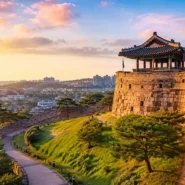
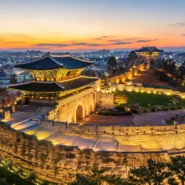
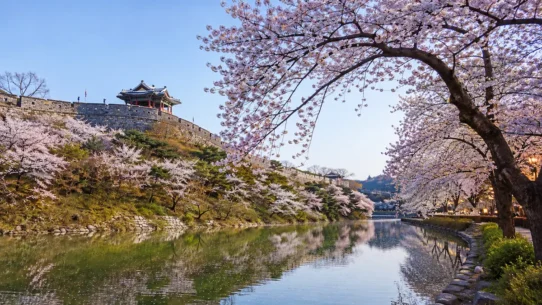
If you only have time for one Suwon area, make it this one. Hwaseong Fortress was built in the late 18th century under King Jeongjo, and the walls still wrap through the modern city rather than sitting in an isolated archaeological park. That is exactly why it works so well: one minute you are on a stone rampart, the next you are stepping into a café street or looking down over ordinary homes.
The fortress walls extend for roughly 5.7 km, but you should not interpret that as a challenge you must complete. The official Hwaseong Fortress Trail is around 5.1 km and is typically described as a 2-3 hour walk. Add palace time, photos, stairs, drinks and getting mildly lost, and a “quick full loop” can easily become most of your sightseeing day.
What is actually worth your time?
- Hwaseomun Gate and Janganmun Gate: impressive, easy-to-understand fortress architecture and good starting points for a shorter wall walk.
- Hwahongmun and Banghwasuryujeong: one of the most photogenic sections because water, pavilion architecture and walls meet in one compact area.
- Hwaseong Haenggung: the royal temporary palace inside the historic core. It adds context that the walls alone cannot provide.
- Haengnidan-gil / Haenggung-dong: the right place to slow down after the wall, with cafés, small shops and streets used as filming locations in Korean dramas.
- Paldalsan and Seojangdae: worthwhile for views if you are fit and the weather is comfortable; unnecessary if stairs are already your enemy.
What can you skip?
You can skip the full wall loop if you only have one day. You can also skip Flying Suwon if the queue is long, visibility is poor or wind conditions make the schedule uncertain. Neither omission means you “missed Suwon.” The fortress is experienced through atmosphere and route choice, not completion percentage.
✅ What Other Travelers Say
Recent traveler reviews consistently describe Hwaseong as Suwon’s standout sight and praise the ability to combine the wall with the palace. The repeated caution is walking volume: even positive reviews mention that the site is extensive, and guided-tour reviews frequently note that visitors should expect plenty of walking. Travelers also tend to prefer the fortress when they give themselves time to stop rather than treating it as a single photo point.
⚠️ The Catch (Things to Keep in Mind)
The word “fortress” makes the attraction sound compact, but it is a district-scale experience. Starting at the wrong gate can leave you far from your lunch plan. The Paldalsan side adds elevation, and summer heat can turn a pleasant wall walk into an endurance test. Build a one-way or partial route that ends near your next stop instead of walking out and then backtracking.
Best time allocation: 3-5 hours for a first visit including a wall section, Haenggung and a café. Add more only if history or photography is a major interest.
📍 Paldalmun, Nammun Markets & Chicken Street: Best for Food and Everyday Local Energy
🍗 Fried chicken · 🛍️ Traditional markets · 💸 Budget-friendly snacks · 🏮 Local atmosphere · 🚶 Easy to combine
Paldalmun is not the prettiest fortress gate to photograph because it sits in the middle of a busy road system, and that surprises visitors expecting an open historical plaza. But the surrounding market network is exactly what makes this part of Suwon worth keeping in your itinerary. You get the contrast that Suwon does well: late-Joseon architecture, ordinary commerce and old-school food streets functioning side by side.
VISITKOREA describes nine traditional markets around the South Gate area and notes a roughly 400-meter whole fried chicken street. The markets connect into one another, which means you do not need to obsess over visiting every named market. Walk, snack, look at what is busy and choose what appeals to you.
What is actually worth your time?
- Paldalmun Gate: see it as part of the neighborhood rather than making a special trip only for the gate.
- Paldalmun and connected Nammun market lanes: useful for snacks, inexpensive shopping and a less curated local atmosphere.
- Suwon Chicken Street: worthwhile if you want old-style cauldron-fried whole chicken and are hungry enough to sit down for it.
- Motgol/Yeongdong/Jidong market network: good for travelers who enjoy browsing food and daily-life markets more than souvenir stores.
What is overhyped?
Do not expect every stall to be a hidden culinary masterpiece. This is a functioning market zone, not a curated food hall. Some lanes are more practical than photogenic, and the strongest experience comes from the overall atmosphere. Chicken Street is famous, but if you already have several fried chicken meals planned in Korea, it does not need to become a pilgrimage.
✅ What Other Travelers Say
Travelers reviewing Paldalmun Market often highlight that it feels lively and friendly rather than aggressively tourist-oriented. Visitors also like the ability to move between the gate, connected markets and Chicken Street without a separate cross-city transfer. In Korea travel discussions, the walk between Paldalmun, Haenggung-dong and the fortress is often remembered as much as the individual food stops.
⚠️ The Catch (Things to Keep in Mind)
Market opening patterns vary by store, and some famous food places become busiest at conventional lunch and dinner times. If you are solo, a whole chicken can be too much food. Also, Paldalmun itself is surrounded by traffic, so this is not the place for a serene gate photo. Visit for the district, not a clean postcard shot.
Best time allocation: 60-90 minutes for browsing and snacks; 90-120 minutes if you are sitting down for fried chicken or a full meal.
📍 Hwaseo & Starfield Suwon: Best for Rainy Days, Design Lovers and Easy Shopping
📚 Starfield Library · 🛍️ Mega mall · 🌧️ Rain-proof · 🍜 Easy dining · 🚆 Direct Line 1 access
Starfield Suwon is one of the easiest places in Suwon to misunderstand logistically. It is not at Suwon Station. The mall is by Hwaseo Station, one stop north of Suwon on Line 1. That sounds minor, but it matters if your day already includes buses to the fortress and another trip toward Gwanggyo.
The mall is genuinely impressive, and the multi-level Starfield Library is a dramatic piece of interior design. Official information lists the mall’s general operating hours as 10:00-22:00, although individual stores can vary. It is free to enter the library area, and you can easily spend more time than planned because food, cafés, cinema, entertainment and shopping are stacked around the same atrium.
What is actually worth your time?
- The central library atrium: walk up several levels rather than taking one photo from the bottom.
- Upper-floor viewpoints: better for appreciating the geometry of the space and often easier for photos.
- Meal break: the mall is useful when weather is bad and you want a predictable place to eat without researching another restaurant.
- Short first-stop strategy: if coming from Seoul by Line 1, you can visit Starfield at opening, then continue one stop to Suwon and move to the fortress.
What is overhyped?
The library is not a reason by itself for every first-time Korea visitor to spend hours traveling to Suwon. If you have already seen the COEX Starfield Library and you do not care about architecture, shopping or photography, the marginal value may be small. Social media also makes the space look emptier than it usually is; tripods, repeated video takes and long photo sessions can be frustrating when tour groups arrive.
✅ What Other Travelers Say
Traveler reviews frequently compare the Suwon library favorably with the COEX version, often calling it bigger or more visually impressive. The recurring downside is crowding. Recent travel reports recommend arriving around opening time if clean photos matter, because the space can fill quickly even on weekdays.
⚠️ The Catch (Things to Keep in Mind)
This is a destination mall, so the danger is not difficulty but time leakage. You go in for a 30-minute photo stop and leave two hours later after coffee, shopping and lunch. That is perfectly fine on a rainy day, but it can destroy a carefully timed fortress itinerary.
Best time allocation: 45-90 minutes for the library and a quick browse; 2-4 hours if shopping and dining are part of the plan.
📍 Gwanggyo Lake Park: Best for a Slow Evening, Couples and Overnight Stays
🌇 Night views · 🌿 Lakeside walking · 💑 Date-night atmosphere · 🏙️ Modern Suwon · 🧘 Slow travel
Gwanggyo Lake Park shows a completely different side of Suwon: planned, spacious, modern and residential rather than historic. VISITKOREA lists the park as open 24 hours and free, and the evening skyline reflections are the main reason to come. It is a good counterpoint to the fortress, especially if you are staying overnight.
It is also the easiest place in this guide to cut. Gwanggyo is not next door to Haenggung-dong, and fitting it into a one-day historic itinerary means committing to another cross-city movement. The lake is lovely, but it will not feel unique enough to justify the detour for every first-time visitor.
What is actually worth your time?
- Sunset into evening: this is when the park earns its place in the itinerary.
- A relaxed partial loop: do not feel obliged to circle every meter of the lakes.
- Dinner nearby: pair the park with food in the Gwanggyo area so the transfer has a second purpose.
- Overnight pairing: especially good if your hotel is already in Gwanggyo or you are staying at Courtyard by Marriott Suwon near the modern commercial district.
What is overhyped?
Calling Gwanggyo an essential Suwon attraction is too strong. It is a high-quality urban park, but travelers who have only one day in Suwon will usually get more distinct cultural value from the historic core. Choose it because you want a peaceful evening, not because a checklist tells you every lake park is a must-see.
✅ What Other Travelers Say
Traveler reviews repeatedly praise the park’s cleanliness, safety, varied walking paths and night lighting. Evening walks are especially popular in warm weather, while daytime summer reviews warn about heat and intense cicada noise. The overall pattern is clear: visitors like Gwanggyo most when they treat it as a leisure space rather than a sightseeing race.
⚠️ The Catch (Things to Keep in Mind)
The park is large, so “visit Gwanggyo Lake Park” is not a precise plan. Choose a side or viewpoint, set a time limit and know how you are getting back. If you are returning to Seoul late, check your rail route before settling into a long dinner.
Best time allocation: 1.5-3 hours including sunset, a walk and dinner. Skip on a rushed day trip.
Realistic Suwon Itineraries That Do Not Require Teleportation
Best One-Day Suwon Itinerary for First-Time Visitors
- 08:00-09:30: travel from Seoul to Suwon. Earlier is better in warm months.
- 09:30-10:00: bus or taxi to Hwaseong Haenggung / Haenggung-dong.
- 10:00-11:00: visit Hwaseong Haenggung before the middle of the day gets busier.
- 11:00-13:00: walk a selected fortress section toward Hwaseomun, Janganmun, Hwahongmun or Banghwasuryujeong depending on your preferred route.
- 13:00-14:00: lunch. Choose galbi if it is a priority; otherwise save money with market food or a casual Korean meal.
- 14:00-15:30: Haengnidan-gil café break and small shops.
- 15:30-17:00: Paldalmun and the connected market area.
- 17:00 onward: early dinner on Chicken Street or return to the wall for golden hour/night lighting.
- Evening: return to Seoul from Suwon Station.
Why this works: nearly the entire sightseeing day stays inside one coherent historic zone. You spend your energy walking somewhere interesting instead of repeatedly crossing Suwon.
One-Day Suwon Itinerary With Starfield Library
- 10:00: arrive at Starfield Suwon around opening time for lower crowds.
- 10:00-11:15: library and quick mall browse.
- 11:15-11:45: travel from Hwaseo to Suwon Station and continue by bus/taxi to Haenggung-dong.
- 12:00-13:00: lunch.
- 13:00-16:30: palace + selected fortress walk.
- 16:30-18:00: café or Paldalmun market.
- 18:00 onward: dinner, then return to Seoul.
What to cut: Gwanggyo. Trying to add it here creates a day that looks impressive on paper and feels annoyingly fragmented in real life.
Low-Walking Suwon Plan for Families or Older Travelers
- Taxi directly from Suwon Station to Hwaseong Haenggung.
- Visit the palace at a comfortable pace.
- Use the tourist trolley if operating and seats are available; reserve in advance when possible.
- Choose flat sections near Janganmun, Hwahongmun and the river rather than committing to Paldalsan stairs.
- Take a café break in Haenggung-dong.
- Taxi to Paldalmun market or back to Suwon Station rather than forcing extra walking to save a small amount.
2 Days / 1 Night: The Version That Actually Feels Relaxed
Day 1: historic Suwon only. Arrive late morning, drop bags, visit Haenggung, walk the fortress, eat in Paldalmun/Chicken Street and return to the illuminated walls after dinner.
Day 2: choose one modern side of the city. Starfield for shopping/design, or Gwanggyo for a slower lake-and-café day. Do not automatically do both unless shopping is a major goal.
Where to Stay in Suwon: Pick for Logistics, Not Just the Lowest Room Rate
Stay Near Suwon Station If You Have Luggage or an Early Train
This is the most practical choice for travelers moving between cities. You have rail, subway, buses, food and shopping in one transport hub. The tradeoff is that the main fortress attractions are not outside your hotel door.
Best for: one-night stopovers, heavy luggage, early departures, travelers using Korail.
Strong practical example: Novotel Ambassador Suwon is directly connected to Suwon Station and AK Plaza, making it one of the easiest options for travelers who value friction-free transfers over old-town atmosphere.
Stay Near Haenggung-dong If the Fortress Is the Point of Your Trip
This is the atmospheric choice. You can walk to cafés, gates, palace areas and evening fortress views without repeatedly returning to Suwon Station. The downside is weaker long-distance transport convenience, especially with large luggage.
Best for: couples, photographers, café travelers, repeat Korea visitors and anyone planning sunrise/sunset wall walks.
Stay in Gwanggyo If You Prefer Modern Comfort and Evening Walks
Gwanggyo works for travelers who enjoy newer districts, spacious streets, mall dining and the lake. It is less efficient for a short heritage-focused trip because you still need to travel to the fortress.
Best for: business travelers, modern hotels, families wanting predictable facilities, travelers with a second day in Suwon.
What to Eat in Suwon — and What You Do Not Need to Force Into the Budget
Suwon Galbi
Suwon is famous for large beef ribs, and a proper galbi meal can be excellent. It is also one of the easiest ways to turn a budget day trip into an expensive food day. If you are traveling for food, book your preferred restaurant and make it a centerpiece. If not, do not feel guilty skipping it.
Whole Fried Chicken
The old-style cauldron-fried chicken around Suwon Chicken Street is more casual and easier to combine with sightseeing. Portions work best for sharing, and popular restaurants can be busy at dinner. This is a better-value local specialty for many first-time visitors than a premium beef meal.
Traditional Market Snacks
The market area is ideal when your group cannot agree on one restaurant. Browse first, then buy what looks fresh and busy. The biggest mistake is arriving already full because you scheduled a café dessert, galbi lunch and fried chicken dinner without leaving any appetite for the market.
Cafés in Haenggung-dong
Come for the break and the neighborhood, not because every café is uniquely Suwon. Pick one that fits your route. Walking 20 minutes out of the way for a viral drink is rarely worth it when a good terrace with a fortress view is already nearby.
How Much Time and Money Should You Budget?
Suwon can be a relatively affordable day trip because the fortress itself is free to walk and public transport from Seoul is inexpensive compared with a guided excursion. Your budget rises mainly through taxis, premium galbi, cafés and paid experiences.
- Lean budget: subway from Seoul, local bus, free fortress walk, market meal, one café.
- Comfort budget: faster train or mixed rail, a couple of taxis, palace admission, proper lunch, café, dinner.
- Convenience budget: guided tour from Seoul with round-trip transport, especially useful for travelers who do not want to decode local buses or who have limited mobility/time.
Do not judge the value of a taxi in isolation. A short taxi ride that saves a long walk on non-scenic city streets may be one of the smartest purchases of the day. Suwon rewards spending your limited energy on the fortress, not on proving you can avoid a small transport fare.
Common First-Time Mistakes to Avoid
- Planning by city name instead of neighborhood. “It’s all in Suwon” does not mean it is all walkable.
- Starting at Suwon Station with a suitcase. Store it first or check into your hotel.
- Walking the full wall before lunch in summer. Heat plus stairs will ruin the rest of your day.
- Assuming Paldalmun is a quiet photo spot. It is surrounded by active roads and works better as part of a market walk.
- Spending too long at Starfield because it is indoors and easy. Set a departure time if the fortress is your priority.
- Adding Gwanggyo because it appears on every “things to do” list. It is a quality optional stop, not a compulsory one-day attraction.
- Copying old bus instructions word-for-word. Check live routing on the day.
- Forgetting that seasonal night openings and performances change. Verify dates before building your whole evening around them.
Key FAQs
Is Suwon worth visiting for a day trip from Seoul for first-time visitors?
Yes, especially if you enjoy Korean history, walkable heritage and local neighborhoods. Hwaseong Fortress gives Suwon a clear identity that feels different from another Seoul neighborhood. One full day is enough for the historic core; do not try to add every modern attraction unless you are willing to trade sightseeing time for transfers.
How many hours do you need for Suwon Hwaseong Fortress and Haenggung-dong?
Allow at least 3-5 hours for a satisfying first visit including a selected wall section, Hwaseong Haenggung and a café or meal. The official fortress trail alone is around 5.1 km and typically takes 2-3 hours, so a complete wall walk plus palace and food can fill most of a day.
What is the best way to get from Seoul to Suwon without a tour?
Line 1 is the easiest no-reservation option and works well for budget travelers. Korail intercity trains can save time if the schedule fits. Once at Suwon Station, use a local bus or taxi to the historic core rather than automatically walking. Check live routing on Naver Map or KakaoMap on the travel day.
Final Verdict and Your Next Step
For a first visit, Suwon is at its best when you keep the plan simple: choose the historic core, walk only the fortress section that suits your legs and schedule, eat locally, and leave enough unscheduled time for Haenggung-dong. That will give you a much better sense of the city than racing from Hwaseong to Starfield to Gwanggyo just to say you saw everything.
If you are a history-focused first-timer: spend almost the entire day around Hwaseong Fortress, Haenggung and the markets. Skip Gwanggyo and treat Starfield as optional.
If you are traveling with parents, young children or limited mobility: use taxis strategically, reserve the fortress trolley if it suits your date, avoid the steep Paldalsan section and consider a guided tour that removes local-transfer stress.
If you are a café and photography traveler: stay overnight near Haenggung-dong so you can photograph the walls around golden hour and enjoy the neighborhood after day-trippers leave.
If you mainly want Starfield Library: go to Hwaseo Station, arrive close to opening and combine it with one carefully chosen historic half-day rather than trying to cover every Suwon attraction.
If you are traveling with large luggage: prioritize a station-connected or station-area hotel, drop your bags first, then sightsee. Saving a few dollars on a hotel is not a saving if it forces you to drag luggage through multiple buses and uneven walking routes.
Weekend rooms, guided day tours and popular time slots can become less convenient as your date approaches, particularly around major events and Korean holiday periods. Once your travel dates are fixed, compare accommodation and tour options before you lock in the rest of your route:
- Compare Suwon hotels on Agoda: Check Suwon hotel availability on Agoda
- Compare Suwon hotels on Booking.com: Check Suwon hotel availability on Booking.com
- Book a Suwon Hwaseong day tour on Klook: View Suwon Hwaseong tour options on Klook
- Check a Suwon Hwaseong night tour on KKday: View Suwon Hwaseong night tour options on KKday
Book the hotel first if you are staying overnight, because location affects every other transport decision. For a day trip, book a guided tour only if convenience, mobility or historical explanation matters more to you than flexibility. Otherwise, Suwon is very manageable independently once you stop trying to visit the entire city in one day.