
💡 Key Takeaways
- Do not treat Suwon as one compact sightseeing zone. The heritage core, the northern fortress arc, Gwanggyo, Starfield Suwon and Korean Folk Village sit in different directions. Grouping them by area is the difference between an enjoyable trip and five days of unnecessary buses.
- Do not walk the entire Hwaseong wall just because a map makes it look mandatory. The UNESCO-listed wall is 5.74 km long before you count detours, stairs, palace time, cafés or the walk back to your hotel. First-timers usually get more from one carefully chosen section.
- Korean Folk Village is in Yongin, not central Suwon. Give it a dedicated day instead of squeezing it between Hwaseong and Gwanggyo. Public transport works, but it requires planning and usually a bus transfer.
- Save your paid-ticket planning for the places where it matters. Suwon Hwaseong itself is currently free, while Hwaseong Haenggung charges a small on-site admission. Aqua Planet Gwanggyo and Korean Folk Village are the two stops where advance online tickets can genuinely reduce friction.
- Make Day 5 luggage-friendly. Starfield Suwon is a sensible final-day stop because it is close to Hwaseo Station on Line 1, then you can return to Suwon Station for bags and departure instead of dragging a suitcase across the historic district.
A good Suwon 5-day itinerary should not feel like five separate day trips stitched together from Instagram posts. That is the most common first-timer mistake here: Hwaseong Haenggung, the fortress walls, Korean Folk Village, Gwanggyo Lake Park and Starfield Suwon all appear under the broad “Suwon” travel umbrella, so visitors assume they are easy to chain in any order. They are not. Some are walkable neighbors; others are cross-city trips; Korean Folk Village is actually in neighboring Yongin. Add weekend crowds, central-city bus traffic, steep fortress sections and a suitcase you cannot comfortably carry up stairs, and a pretty-looking itinerary can become needlessly exhausting.
This route is deliberately slower than the “see everything in one day” version. That is a feature, not a weakness. It gives the heritage district its own arrival day, walks only the most rewarding fortress arc in one direction, isolates Korean Folk Village as a full excursion, pairs Gwanggyo’s indoor and outdoor attractions together, and leaves the easiest mall-and-library stop for departure day. The goal is fewer U-turns, fewer transfers and fewer moments when you ask why you crossed Suwon Station twice in the same afternoon.
Verification note: operating details and ticket links in this guide were checked against official attraction pages and live booking pages on August 11, 2026. Seasonal programs, performance timetables and attraction hours can change, so recheck the linked official pages a few days before travel.
The 1-Min Cheat Sheet
- Hwaseong Haenggung Palace — Best for first-time history lovers and anyone who wants context before walking the fortress. Allow 60–90 minutes. Current regular hours are 09:00–18:00 with last admission at 17:30; adult admission is KRW 2,000. No special fast pass is needed. Reach it by local bus or a short taxi from Suwon Station, then continue on foot around the old town.
- Paldalmun Gate & South Gate Market Area — Best for local street atmosphere, food and an easy arrival-day stroll. Allow 45–75 minutes, longer if eating. Outdoor sightseeing is free. It pairs naturally with Haenggung; do not make a separate cross-city trip just for the gate.
- Haengnidan-gil / Haenggung-dong — Best for cafés, small shops and a low-effort evening after heritage sightseeing. Allow 1–2 hours. Free to wander; budget separately for food and cafés. The area is most useful when treated as a rest zone between sights, not as another “must-complete” attraction.
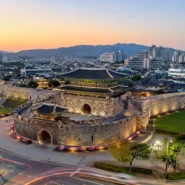
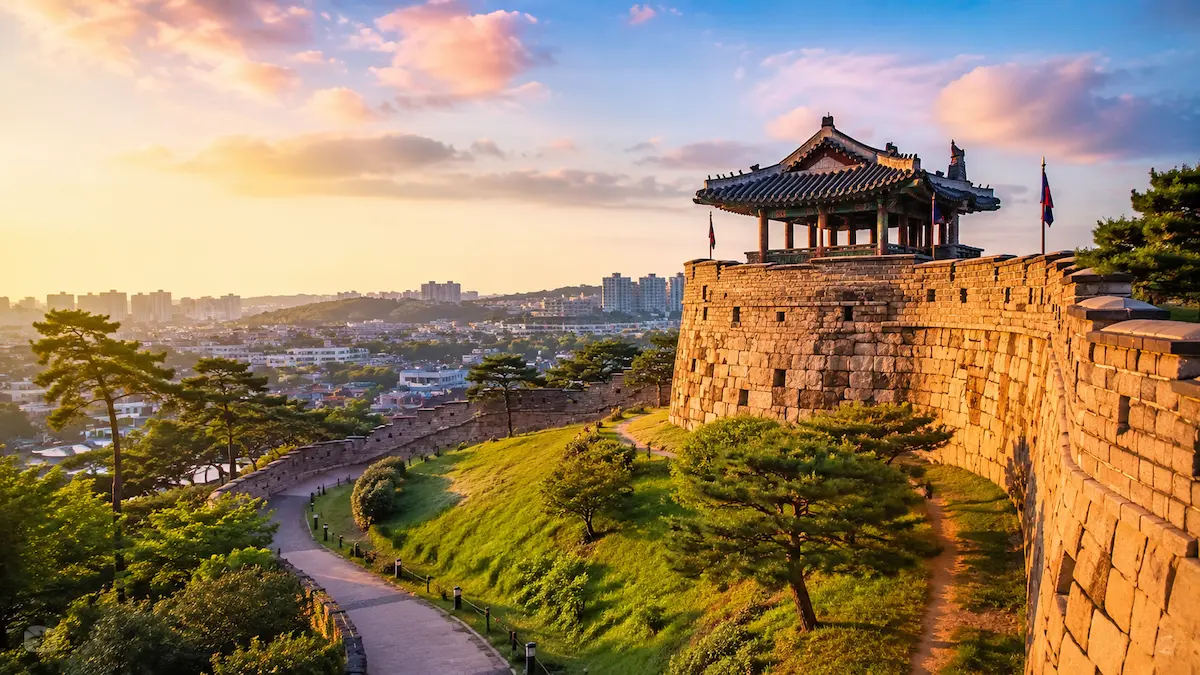
- Hwaseomun → Janganmun → Hwahongmun → Banghwasuryujeong — Best for travelers who want the fortress experience without completing the full wall circuit. Allow 2–3 hours at a relaxed pace with photos. The fortress itself is currently free. Start at one end and finish at the other; do not walk back to your starting gate.
- Yeonmudae & Traditional Korean Archery — Best for families and travelers who want an activity rather than another static monument. Allow 45–75 minutes. Archery is currently KRW 3,000 for 10 shots and is weather-dependent; it does not operate in rain or snow.
- Korean Folk Village — Best for families, historical-drama fans and travelers interested in performances and traditional architecture. Allow 5–7 hours. It is in Yongin, not central Suwon. Public transport from Suwon Station uses local bus routes such as 37 or 10-5; the nearest subway station is Sanggal on the Suin–Bundang Line, followed by a bus transfer. Check the date-specific official hours because seasonal night programs can extend the day.
- Aqua Planet Gwanggyo + Gwanggyo Lake Park — Best for families, rainy days and travelers who want a modern contrast to the old town. Allow 2 hours for the aquarium plus 1.5–2.5 hours around the lake. Aqua Planet currently opens 10:30–19:30 with last admission at 18:30; the lake park is free. An advance e-ticket is useful for the aquarium.
- Starfield Suwon & Byeolmadang Library — Best for architecture photos, shopping, bad-weather time and a low-stress final day. Allow 2–4 hours. Byeolmadang Library is free and currently operates 10:00–22:00. Go at opening on weekends if photos matter; midday is when the photogenic central space becomes least peaceful.
The Most Practical 5-Day Itinerary
Day 1: Suwon Station → Paldalmun → Hwaseong Haenggung → Haengnidan-gil
- Suggested start: 13:00–14:00 if this is your arrival day. If you arrive in the morning, drop luggage first and start around 10:30. Do not sightsee with a full-size suitcase.
- Stop 1 — Paldalmun and South Gate market lanes: 45–75 minutes. From Suwon Station, take a local bus or a short taxi to Paldalmun. This is a much better first stop than climbing directly onto the fortress because it lets you eat, buy water and orient yourself on flat ground.
- Stop 2 — Hwaseong Haenggung Palace: 60–90 minutes. Walk north from Paldalmun through the old-town corridor rather than taking another vehicle for a tiny distance. The palace gives the political and royal context that makes the fortress more meaningful on Day 2.
- Stop 3 — Haengnidan-gil / Haenggung-dong: 1–2 hours. Walk out into the café streets north and west of the palace. Use this as your coffee break instead of scheduling a separate café neighborhood later in the trip.
- Lunch or rest: If you arrive hungry, eat around Paldalmun or the traditional market zone before entering the palace. If you start later, save your main café break for Haengnidan-gil.
- What to cut if tired: Cut shopping lanes, not the palace. First-time visitors usually gain more from one focused palace visit than from trying to “complete” every market alley.
- Rain plan: Spend longer at Hwaseong Haenggung, then use a nearby museum or café rather than attempting the fortress wall. Suwon I’Park Museum of Art beside the heritage core can be a practical indoor substitute when current exhibitions and opening days suit your visit.
- Best evening area: Stay around Haenggung-dong for dinner, or move once to Suwon’s fried-chicken street / old-town dining area. Avoid returning to Suwon Station merely to eat unless your hotel is there.
- Why this beats the usual influencer itinerary: Many first-day plans add Seojangdae or a full fortress loop immediately after Haenggung. That looks efficient on a map but front-loads stairs and walking before you have recovered from travel. Day 1 should be your orientation day, not your endurance test.
Day 2: The Fortress Without the Punishment — Hwaseomun → Janganmun → Hwahongmun → Banghwasuryujeong → Yeonmudae
- Suggested start: Arrive at Hwaseomun around 08:45–09:00. The official fortress viewing hours are currently listed as 09:00–18:00, so there is little value in forcing a pre-dawn start just to claim you beat everyone.
- Stop 1 — Hwaseomun: 20–30 minutes. Reach the gate directly by taxi or local bus from your hotel. This is where the one-way logic begins.
- Stop 2 — Janganmun: 30–40 minutes. Continue east/northeast along the wall and surrounding streets. Take the wall path when your legs feel good; use street level when stairs are becoming the main memory of the day.
- Stop 3 — Hwahongmun: 25–35 minutes. The water gate is one of the most photogenic transitions in the fortress route and is naturally on the way toward Banghwasuryujeong.
- Stop 4 — Banghwasuryujeong: 30–45 minutes. Slow down here. This is a better place for a scenic pause than adding another distant attraction before lunch.
- Stop 5 — Yeonmudae: 45–75 minutes. Finish the walking arc at the eastern command post. If weather is dry, add the traditional archery experience. Current official pricing is KRW 3,000 for 10 shots.
- Most reasonable transport between stops: Walk the chain in one direction. The stops are geographically continuous. The transport mistake is taking a bus from each gate back to Haenggung or Suwon Station and then coming out again.
- Lunch or rest: Eat near the Yeonmudae / eastern old-town side after finishing the route. If restaurant choice matters more than absolute efficiency, one short taxi to your preferred dining district is reasonable after the sightseeing is complete.
- What to cut if tired: Skip archery and any extra hill climb. Do not force Seojangdae into this day unless you are specifically seeking a steep workout and views. The full fortress is 5.74 km before detours, so “I only have one more gate” is how people accidentally turn a pleasant morning into a sore-foot afternoon.
- Rain plan: Do not build the day around the tourist trolley or archery: the official experience information says archery does not run on rainy or snowy days, and trolley operations are also weather-sensitive. Swap Day 2 with Aqua Planet / Starfield, or use museums and Haenggung instead.
- Best evening area: Try Ingye-dong / Suwon City Hall for a modern dining district, especially if your first evening was in Haenggung-dong. One purposeful move after sightseeing is better than repeated short transfers all day.
- Why this beats the usual influencer itinerary: You get the gates, wall atmosphere, stream scenery and an interactive activity without walking back to the palace or completing the entire circumference simply for bragging rights.
Day 3: Korean Folk Village — Give Yongin Its Own Day
- Suggested start: Leave your hotel around 09:00–09:30, then match your arrival to the official opening time for your travel date. Korean Folk Village changes operating hours around seasonal and night programs, so check the official calendar rather than copying a fixed hour from an old blog.
- Transport option A — easiest from Suwon Station: The village’s official transport page lists buses 37 and 10-5 from the Suwon Station area. This avoids inventing a complicated subway route just because rail feels simpler on paper.
- Transport option B — rail plus bus: The nearest subway station is Sanggal on the Suin–Bundang Line; the official site notes that a bus transfer is still required. From Sanggal Station Exit 3, buses 37 and 10-5 serve the village area.
- When a taxi is worth it: If you are two to four travelers, have young children, mobility limitations, heavy rain, or simply value one less transfer, a direct taxi can be a better use of money than spending energy navigating the last-mile bus. Check the live fare in your map/taxi app before committing.
- Inside the village — first 90 minutes: Walk the traditional residential and craft areas before the busiest midday period. Do not immediately queue for amusement rides if your main reason for coming is culture.
- Midday — performance-first planning: Check the current performance board as soon as you enter, then shape your lunch around the show times. Performance schedules can change, so a rigid minute-by-minute blog schedule is less useful than the board on the day.
- Lunch: Eat inside the village / Market Village area. Leaving the attraction for lunch creates unnecessary walking and risks missing a scheduled performance.
- Afternoon: Continue with demonstrations, hands-on experiences and the areas you skipped in the morning. The site is large enough that trying to see every corner can become repetitive for travelers who are not especially interested in folk architecture.
- What to cut if tired: Skip amusement-zone rides and duplicate house sections. Keep the signature performances, a representative section of traditional homes and one hands-on activity.
- Rain plan: Light rain is manageable if you are prepared, but this is still a heavily outdoor attraction. In persistent rain, swap Day 3 with Day 4 or Day 5. Aqua Planet and Starfield are far better uses of a bad-weather day.
- Best evening area: If a seasonal night program is operating and genuinely interests you, stay and make the trip worthwhile. Otherwise return to Suwon and eat near your hotel rather than adding another cross-city attraction.
- Why this beats the usual influencer itinerary: The common “Hwaseong + Folk Village + Starfield” day tour works only because a tour bus controls the transfers and accepts a rushed pace. Independent travelers using public transport pay for the same combination with waiting, transfers and very little unstructured time.
Day 4: Gwanggyo — Aqua Planet First, Lake Park Later
- Suggested start: Aim to reach Aqua Planet Gwanggyo around its current 10:30 opening time.
- Stop 1 — Aqua Planet Gwanggyo: about 2 hours. The official site currently lists 10:30–19:30 with last admission at 18:30. Going early gives you the indoor attraction before the afternoon family crowd and keeps your outdoor lake walk for softer late-day light.
- Lunch / rest: Eat around Galleria Gwanggyo, Suwon Convention Center or the connected commercial zone. This is the day to enjoy air-conditioning and a proper seated break.
- Optional stop — Art Space Gwanggyo / Suwon Convention Center area: 45–60 minutes. Add it if you enjoy exhibitions or need more indoor time. Check the current exhibition calendar before treating it as mandatory.
- Stop 2 — Gwanggyo Lake Park: 1.5–2.5 hours. Walk only the section that suits your energy. A lake park is not improved by forcing yourself to complete every shoreline segment.
- Most reasonable transport: From central Suwon, a direct bus or taxi is often more practical than creating multiple rail transfers purely to avoid road travel. If approaching from the Shinbundang Line, Gwanggyo Jungang (Ajou University) Station is the useful rail gateway; the aquarium can then be reached by local bus or a manageable walk.
- What to cut if tired: Cut the optional exhibition space or shorten the lake loop. Keep Aqua Planet if you already bought a timed/date-sensitive ticket.
- Rain plan: This is your strongest rain day. Spend longer at Aqua Planet, the department-store / convention-center zone and an indoor exhibition. Save the lake for a dry window or skip it entirely.
- Best evening area: Stay in Gwanggyo for dinner and lake views if the weather is good. Do not return to central Suwon for dinner and then travel back east for sunset.
- Why this beats the usual influencer itinerary: Aquarium in the morning and lake later uses the same district twice for different reasons—indoor comfort first, outdoor scenery second—without crossing Suwon between them.
Day 5: Starfield Suwon & Byeolmadang Library → Collect Bags → Departure
- Suggested start: 09:30 from your hotel so you can reach Starfield close to opening. The official Byeolmadang Library page currently lists 10:00–22:00 and free access.
- Luggage first: Leave large bags with your hotel if possible, or use a suitable station storage option only after confirming the locker size and availability. Do not drag a large suitcase through Starfield for the sake of avoiding one retrieval stop later.
- Transport: Use Line 1 to Hwaseo Station when practical. Starfield Suwon sits in the north-Suwon / Hwaseo area, making rail more predictable than crossing town by bus during busy road periods.
- Stop 1 — Byeolmadang Library: 45–75 minutes. Photograph the dramatic multi-level space early, before the central viewpoints fill. If you arrive at weekend lunchtime expecting a quiet “library photo,” your experience will be much less serene.
- Stop 2 — Starfield Suwon: 1.5–3 hours. Shop, eat and use this as a weather-proof buffer before departure. The mall currently lists broad operating hours of 10:00–23:00, though individual stores can differ.
- Lunch: Eat inside Starfield. This is one of the rare days when the mall food options are not a compromise—they actively reduce transport risk before your train.
- What to cut if tired or your train is early: Skip general shopping. Visit the library, have lunch, then leave. The mall is not worth missing an intercity train for.
- Rain plan: No major change needed. This is already the most weather-resistant day.
- Best evening area: If you are staying one more night, return to Suwon Station or your hotel district for dinner. If departing, build a generous buffer for bag collection and station navigation.
- Why this beats the usual influencer itinerary: Starfield is often squeezed into a heritage day because it photographs well. Putting it last turns it into a practical buffer: indoor, easy to shorten, useful for food, and geographically close enough to Suwon Station to keep your departure under control.
Tourist Traps to Avoid & Itinerary Hacks
- Trap: “The full Hwaseong wall is the authentic way to do it.” The wall is 5.74 km, and your real walking day is longer after palace courtyards, café streets, gate detours and getting to/from the trail. Hack: choose the north/east arc and treat Seojangdae as an optional fitness add-on, not an obligation.
- Trap: combining Korean Folk Village with central Suwon because it appears in Suwon day-tour packages. The village’s official address is in Yongin. Hack: give it its own day, or join a guided coach tour only if your priority is maximizing headline stops rather than lingering.
- Trap: using buses for every cross-town move because they look cheapest. Suwon buses are useful, but traffic and stop-by-stop travel can erase the savings when you are tired or traveling as a group. Hack: use rail for clear station-to-station moves, walking for contiguous old-town clusters, and an occasional short taxi when it removes a transfer or a steep walk.
- Trap: returning to Suwon Station after every attraction. Suwon Station is a transport hub, not the center of every sightseeing cluster. Hack: once you reach Haenggung, Gwanggyo or the fortress, stay in that zone until the day is finished.
- Trap: arriving at Starfield Suwon in the middle of a weekend and expecting an empty Byeolmadang Library photo. The architecture attracts visitors precisely because it is dramatic and easy to access. Hack: arrive around opening and take photos before lunch.
- Trap: planning Yeonmudae archery as your non-negotiable rainy-day activity. Official information states that the archery experience does not operate in rainy or snowy weather. Hack: keep Day 4 and Day 5 flexible enough to swap when the forecast turns.
- Trap: reaching Aqua Planet late because “it closes at 19:30.” Current last admission is 18:30 and the official site notes that staff begin closing procedures 30 minutes before the actual closing time. Hack: go near opening, then use the lake park later.
- Trap: buying a sightseeing pass for attractions that are already free or cheap. Hwaseong Fortress itself is currently free, and Haenggung’s adult admission is only KRW 2,000. Hack: spend advance-booking effort on higher-priced attractions where a mobile voucher is genuinely useful.
- Trap: assuming every “Suwon luggage storage” suggestion online means a guaranteed large locker at the station. Locker inventory, size and availability can change. Hack: hotel baggage storage is the safest first choice. If you need station storage, check it before you leave the station and have a nearby paid storage fallback.
- Trap: splitting hotels between Haenggung and Suwon Station to save a few transit minutes. Moving accommodation creates exactly the luggage problem this itinerary is designed to avoid. Hack: choose one base for all five days unless you have a very specific reason to move.
- Trap: scheduling every meal at a famous restaurant. A 40-minute queue can destroy the geographic logic of a carefully planned day. Hack: choose the dining district in advance, not one mandatory restaurant. If a line looks unreasonable, eat 100 meters away and keep the route intact.
- Trap: treating every seasonal night opening as guaranteed. Haenggung, Korean Folk Village and city festivals can have special evening programs, but dates are not permanent. Hack: build the normal daytime route first, then add the seasonal event only after confirming your exact travel date.
Save Your Legs! The Most Efficient Route
The most efficient way to think about Suwon is not “Day 1 to Day 5” but five geographic jobs: (1) the Haenggung / Paldalmun heritage core, (2) the north-and-east fortress arc, (3) the Yongin excursion for Korean Folk Village, (4) east Suwon / Gwanggyo, and (5) north Suwon / Hwaseo for Starfield. Once you see those zones, the route stops looking like a random list of attractions.
Walk only where walking connects meaningful stops. Paldalmun → Haenggung → Haengnidan-gil is a sensible pedestrian chain. Hwaseomun → Janganmun → Hwahongmun → Banghwasuryujeong → Yeonmudae is another. By contrast, walking from Suwon Station to the heritage district with luggage is not “immersive”; it is just spending your legs before the sightseeing starts.
Use Line 1 when it gives you a clean station-to-station move. The obvious example in this itinerary is Suwon Station ↔ Hwaseo Station for Starfield. Use the Suin–Bundang Line when it aligns with your route, including the Sanggal approach to Korean Folk Village if that is more convenient from your base, but remember the village still requires a bus transfer from the nearest subway station.
Use buses when the route is direct, not because buses are automatically “more local.” The Korean Folk Village official transport page explicitly lists buses 37 and 10-5 from Suwon Station, so that is a legitimate direct public-transport choice. In the heritage core, short local bus hops can also be useful. What I would avoid is a long cross-town bus at a busy commuting period when one taxi can remove a transfer and save your energy for the actual attraction.
A short taxi is often the smart budget choice for two to four people. This is especially true for hotel → Hwaseomun on Day 2, a tired family returning from Yeonmudae, or central Suwon → Gwanggyo when the rail alternative forces awkward transfers. The correct comparison is not “taxi fare versus one bus fare”; it is taxi fare versus multiple fares, waiting time, wrong-stop risk and the cost of arriving too tired to enjoy the next stop.
Avoid road-heavy transfers at the most predictable busy times. Around commuting hours, rail gives you more predictable timing for journeys that sit close to rail corridors. In the old town, however, getting off a bus and walking the final section is often faster than sitting through slow central traffic. Do not insist on one transport mode for the whole trip.
Do not return to Suwon Station every afternoon just because your hotel is nearby. If Day 1 finishes in Haenggung-dong, eat there. If Day 4 finishes at Gwanggyo Lake Park, eat in Gwanggyo. You have already paid the time cost of reaching that district; use it. One late return to your hotel is better than two extra cross-city trips.
Where should you stay? For first-time visitors arriving and departing by rail with large luggage, Suwon Station is the most forgiving base: it simplifies arrival, departure, the Line 1 hop to Hwaseo and the direct-bus option to Korean Folk Village. The trade-off is that the historic center is not outside your hotel door. If you travel light and care much more about evening atmosphere than train convenience, Haenggung-dong is more charming. I would not change hotels mid-trip to get both.
Large-luggage rule: do not make a sightseeing plan that depends on carrying a suitcase up fortress stairs. Use hotel baggage storage before check-in or after check-out whenever the hotel permits it. If you are only in Suwon for the day, inspect station locker sizes and availability before leaving the station; if your suitcase does not fit, use a bookable nearby storage service rather than gambling that another locker will appear later. Luggage delivery can be useful for hotel-to-hotel travel elsewhere in Korea, but do not assume a service advertised for Seoul stations automatically covers Suwon—confirm the exact pickup and delivery locations first.
The principle behind every choice is simple: fewer reversals beat more attractions. A five-day trip should feel easier on Day 5 than a two-day sprint, not like a longer version of the same sprint.
Ticket Tips & Skip-the-Line Hacks
Do not apply a “buy everything online” strategy to Suwon. Some of the best stops are free; some heritage admissions are cheap and straightforward on site; some experiences are weather-dependent; and only a few attractions benefit meaningfully from an advance mobile ticket. Here is the practical split.
- Free — no advance ticket needed: Suwon Hwaseong Fortress itself is currently free. Paldalmun exterior, the fortress gates, Haengnidan-gil, Gwanggyo Lake Park and Byeolmadang Library are also not attractions where you need to buy an entry pass in advance.
- Cheap on-site ticket — advance booking is usually unnecessary: Hwaseong Haenggung currently charges KRW 2,000 for adults, with regular hours listed as 09:00–18:00 and last admission at 17:30. For most independent visitors, buying this locally is simpler than hunting for a third-party bundle.
- Weather-dependent experience — do not overcommit: Traditional Korean archery at Yeonmudae is currently KRW 3,000 for 10 shots and does not operate in rain or snow. The Hwaseong tourist trolley is useful for saving legs, but operations are also affected by weather. Treat these as day-of additions rather than the foundation of a non-refundable itinerary.
- Advance online ticket genuinely useful — Korean Folk Village: If your travel date is firm, buying the admission ticket before leaving the hotel removes one purchase decision at the gate. Performance schedules still need to be checked on arrival. Check Korean Folk Village tickets on Klook.
- Advance QR e-ticket genuinely useful — Aqua Planet Gwanggyo: KKday’s current product page states that the mobile QR code can be redeemed directly at the entrance instead of exchanging for a paper ticket. Check Aqua Planet Gwanggyo tickets on KKday or compare Aqua Planet Gwanggyo on Klook.
- Seasonal / date-specific programs: Korean Folk Village night events, Suwon festivals, Haenggung nighttime openings and special cultural programs should be checked on the official site for your actual date. Do not assume last year’s Friday-to-Sunday schedule repeats unchanged.
- Intercity trains: If you choose a Korail intercity train between Seoul and Suwon rather than Line 1, book the train you actually intend to take through Korail or an authorized seller. Do not confuse an intercity-train reservation with local metro travel, which works differently.
- Hanbok rental / workshops: Reserve only if a particular studio, time slot or photoshoot is important to you. For casual browsing in Haenggung-dong, locking yourself into a distant rental shop can create more backtracking than value.
My booking rule: prepay when it removes a real queue or secures limited inventory. Do not prepay simply because an affiliate page exists. In this itinerary, Aqua Planet is the clearest QR-code convenience, while Korean Folk Village is the most useful higher-priced attraction to have settled before departure.
Tried & Tested: My Honest Review
Editorial note: “Tried & Tested” here refers to route logic checked against current official operating information, live booking pages and recurring traveler feedback. The reviews below do not pretend that every traveler will value the same things, and current construction, weather or seasonal events can change the experience.
📍 Stop 1: Hwaseong Haenggung Palace
Tags: Royal history · Easy first-day sight · Low admission cost · Moderate walking · Good context before the fortress
Haenggung is the stop I would keep even if your five-day plan suddenly shrinks to two. The reason is not that every courtyard is spectacular; it is that the palace gives you a reason for the fortress to exist. Without that context, the walls can become a long sequence of gates and photo angles.
✅ What Other Travelers Say
Traveler reviews commonly praise the collection of buildings and displays and find the palace worthwhile as part of the larger Hwaseong visit. The manageable admission fee also makes it easy to recommend without pretending it is an all-day palace complex.
⚠️ The Catch (Things to Keep in Mind)
If you recently visited Seoul’s grand royal palaces, Haenggung can feel smaller and less visually overwhelming. Do not compare it by scale. Its value is local history and the way it anchors the Suwon story. Also, old blog posts may show seasonal night-opening dates that no longer apply.
📍 Stop 2: Paldalmun Gate & South Gate Market Area
Tags: Local food · Flat walking · Arrival-day friendly · Market atmosphere · Free outdoor sight
Paldalmun works best as a connector, not a standalone pilgrimage. The gate is visually important, but the reason to put it on Day 1 is the surrounding street life: you can eat, wander and then continue naturally toward Haenggung without spending your energy on a steep wall section.
✅ What Other Travelers Say
Visitors who enjoy markets and ordinary city texture tend to appreciate this side of Suwon because it feels less like a controlled attraction and more like a living commercial district around a historic landmark.
⚠️ The Catch (Things to Keep in Mind)
If you expect the gate itself to occupy an hour, you may be disappointed. The better experience is the gate plus the market streets plus the walk north. Traffic around the south-gate area also means the most attractive photo angle is not always the quietest pedestrian environment.
📍 Stop 3: Haengnidan-gil & Haenggung-dong
Tags: Café break · Small shops · Evening atmosphere · Couple-friendly · Best used as a rest zone
Haengnidan-gil is useful because it gives your itinerary somewhere pleasant to stop. That sounds less glamorous than calling it a “must-visit hotspot,” but it is exactly why I like its place in the route. Your feet need a café more than they need another monument after Haenggung.
✅ What Other Travelers Say
Travelers repeatedly highlight the blend of renovated neighborhood streets, cafés, shops and fortress-adjacent scenery. It is especially appealing to people who prefer wandering and people-watching over formal museum visits.
⚠️ The Catch (Things to Keep in Mind)
The most photogenic café is not necessarily the best café, and weekend queues can turn a “relaxed coffee stop” into another waiting exercise. Pick the street, not one viral shop. If a queue spills onto the pavement, keep walking.
📍 Stop 4: Hwaseomun, Janganmun, Hwahongmun & Banghwasuryujeong
Tags: Best fortress walking section · UNESCO heritage · Scenic water gate · One-way route · Free
This is the section that gives first-timers the strongest “I came to Suwon for Hwaseong” feeling without demanding the full wall. You get major gates, elevated wall segments, the water gate and the pavilion scenery in a route that actually has a beginning and an end.
✅ What Other Travelers Say
Fortress reviews consistently emphasize the views, the historic atmosphere and how attractive the site becomes toward late afternoon or sunset. The fact that you can experience large sections without an admission charge is a major strength.
⚠️ The Catch (Things to Keep in Mind)
“Free” does not mean “effortless.” There are steps, uneven sections and enough distance to surprise anyone who has already spent the morning shopping or carrying bags. The worst plan is walking a long section and then discovering that your next attraction is back where you started.
📍 Stop 5: Yeonmudae & Traditional Korean Archery
Tags: Hands-on activity · Family-friendly · Weather-sensitive · Low-cost add-on · East fortress finish
Yeonmudae earns its place because it changes the rhythm of Day 2. After looking at architecture for several hours, doing something physical and short is refreshing. The current KRW 3,000 price for 10 shots is also low enough that it does not need to become a major purchase decision.
✅ What Other Travelers Say
The archery activity is frequently remembered as a fun, accessible break from passive sightseeing, particularly by families and travelers who want a small cultural activity without booking a multi-hour workshop.
⚠️ The Catch (Things to Keep in Mind)
Weather is the real catch. The official page says it does not run on rainy or snowy days. Capacity is also limited per session, so treat it as a bonus rather than the one activity that determines whether your entire day was successful.
📍 Stop 6: Korean Folk Village
Tags: Full-day excursion · Yongin · Performances · Families · K-drama interest · Large site
Korean Folk Village is often the most polarizing stop in a Suwon-area itinerary. Families, cultural-history fans and travelers who enjoy scheduled performances can easily spend most of a day here. Travelers who dislike reconstructed historical settings or theme-park elements may feel they have seen enough after a few hours.
✅ What Other Travelers Say
Traveler feedback often praises the traditional performances and the scale of the village. Many visitors also like the opportunity to combine restored traditional architecture, crafts, food and entertainment in one place rather than moving between separate venues.
⚠️ The Catch (Things to Keep in Mind)
It is large, it can be crowded on weekends, and getting there independently is less effortless than a map thumbnail suggests. Some travelers also find that parts of the village feel repetitive if they are not deeply interested in historical houses. The biggest itinerary mistake is treating the transport time as if it were zero.
Advance ticket: Korean Folk Village admission on Klook.
📍 Stop 7: Aqua Planet Gwanggyo & Gwanggyo Lake Park
Tags: Best rain-day cluster · Aquarium · Lake sunset · Family-friendly · Modern Suwon
Gwanggyo is the day that prevents a five-day Suwon trip from becoming five days of historical architecture. Aqua Planet gives you a reliable indoor anchor, while the lake park gives you a free outdoor second half. The pairing is stronger than either stop alone.
✅ What Other Travelers Say
Families tend to value the aquarium’s manageable viewing time and indoor comfort, while the surrounding Gwanggyo district makes it easy to add food, shopping or a lakeside walk without another major transfer.
⚠️ The Catch (Things to Keep in Mind)
If you have visited major destination aquariums, Aqua Planet Gwanggyo may feel more like a polished urban aquarium than a once-in-a-lifetime attraction. Some experiences inside can cost extra or run on schedules. Do not arrive near last admission expecting a relaxed two-hour visit.
Advance QR ticket: Aqua Planet Gwanggyo on KKday · Aqua Planet Gwanggyo on Klook.
📍 Stop 8: Starfield Suwon & Byeolmadang Library
Tags: Free library · Architecture photos · Shopping · Rain-proof · Best at opening
Starfield Suwon is worth including, but not for the reason social media sometimes suggests. You do not need half a day simply to “see a library.” Its real value is that the library, food, shopping, weather protection and location near Hwaseo Station combine into an unusually convenient buffer day.
✅ What Other Travelers Say
The multi-level library is consistently described as visually impressive, and recent traveler reports also underline how busy the space can become on weekends. Visitors who enjoy malls can easily extend the stop with food and shopping.
⚠️ The Catch (Things to Keep in Mind)
This is still a shopping mall. If you dislike malls, do not let beautiful wide-angle photos convince you that the entire day is culturally essential. Visit the library early, have a meal, and leave. The “trap” is not the library; it is allocating four hours to a mall when you only wanted one photo.
Key FAQs
Is five days too long for Suwon for first-time visitors? For travelers interested only in Hwaseong Fortress and Haenggung, yes—two days can cover the essential heritage sights comfortably. Five days makes sense when you also want Korean Folk Village, Gwanggyo, Starfield Suwon, slower meals and weather flexibility. This itinerary intentionally treats five days as a relaxed regional stay rather than stretching one day of sights into five.
What is the best area to stay in Suwon without wasting time on transport? For most first-time visitors arriving by train with luggage, Suwon Station is the easiest all-round base because it simplifies arrival/departure, Line 1 access to Hwaseo and direct-bus options toward Korean Folk Village. Haenggung-dong is more atmospheric and walkable for Days 1–2, but less convenient for your rail arrival and several outer districts. Pick one base and avoid moving hotels.
Can I visit Suwon Hwaseong, Korean Folk Village and Starfield Suwon without a car? Yes. Hwaseong is reached easily by local bus or taxi from Suwon Station; Korean Folk Village officially lists public bus connections from Suwon Station and from Sanggal Station; Starfield Suwon is served from the Hwaseo Station area. The key is not whether public transport exists—it does—but whether you group each destination on the right day instead of forcing all three into one independent day trip.
Final Verdict and Your Next Step
The best first-time Suwon itinerary is not the one with the most pins on a map. It is the one that makes each transfer earn its place. Keep Day 1 flat and easy around Paldalmun, Haenggung and Haengnidan-gil. Walk the fortress once, in one direction, on Day 2. Accept that Korean Folk Village is a separate Yongin excursion. Treat Gwanggyo as one east-Suwon cluster. Save Starfield for the final day when an indoor, flexible stop is exactly what you want before collecting bags.
If your dates are fixed, I would book only the paid attractions where advance purchase creates a real convenience. Korean Folk Village is worth settling in advance if you know you are going: check the current Klook ticket here. For Aqua Planet Gwanggyo, a mobile QR ticket is particularly useful: check KKday or compare Klook. For Hwaseong Fortress, Haengnidan-gil, Gwanggyo Lake Park and Byeolmadang Library, save your money—the core experience does not require a paid skip-the-line product.
Before you leave: check the weather, then decide whether Day 2 or Day 4 should come first. Rain affects the value of the fortress, archery and Korean Folk Village far more than it affects Aqua Planet or Starfield. One smart day swap can save more frustration than any transport pass.
Official Planning Links & Verification Sources
- Suwon Cultural Foundation — Hwaseong Fortress, Haenggung, trolley and archery prices
- Suwon Cultural Foundation — Traditional Korean Archery operating information
- UNESCO World Heritage Centre — Hwaseong Fortress
- Korean Folk Village — Official transportation information
- Korean Folk Village — Official site and date-specific operating information
- Aqua Planet Gwanggyo — Official operating hours
- Starfield Suwon — Byeolmadang Library official information
- Starfield Suwon — Official mall information