


💡 Key Takeaways
- Buy for the operator and journey, not the word “metro.” ANM runs Lines 1 and 6, Trenitalia runs Line 2, and EAV runs several other railways. An ANM company ticket does not become a ticket for every operator because the lines share a map.
- Use the October 2026 tariff, and count your actual rides. ANM bus/funicular singles remain €1.30, ANM metro singles €1.50 and the company day ticket €4.50. The urban integrated timed ticket is now €1.90 and the integrated day ticket €5.70. A day ticket expires at midnight, not 24 hours after purchase.
- Plan the hill, the hotel entrance and the return journey. A funicular can save an uphill walk, a nearby street route can beat an unnecessary interchange, and a taxi can help with bags. Check live service and lift access before relying on a late return or a step-free route.
This Naples transportation guide starts with the part that most affects your day: how to connect the places you actually want to visit without buying the wrong ticket or exhausting yourself between them. Naples has useful metro lines, hill-climbing funiculars, buses and regional trains. Their names, operators and ticket conditions overlap enough to confuse a first visit.
The practical approach is to group nearby sights, use rail or a funicular for the journeys that genuinely save effort, and keep airport transfers and trips outside the city as separate purchasing decisions. Prices and notices below were checked on 5 November 2026. The recommendations are research-based; videos illustrate real transport environments and are dated, while current fares and operating claims come from the operators.
Current November checks: NAP is closed from 1–30 November 2026, with some flights using Salerno (QSR). The temporary QSR service is not normal NAP Alibus. For rail excursions, use EAV’s current timetable and service information. An earlier EAV notice announced Campania Express suspension from 1 October 2026 until further notice; its old page was unavailable at this check. Confirm that tourist product’s operation for your date before buying it from an older itinerary.
The 1-Min Cheat Sheet
- 🚇 Metro and urban rail: compare first for longer city journeys. ANM Line 1 links Garibaldi with useful central stops and the Vomero area; Line 6 connects Municipio with Chiaia and the western city. An ANM metro single costs €1.50. Trenitalia’s Line 2 is another operator with its own ticketing; an ANM-only ticket is not the default choice there. Best when the stations and exits suit the whole trip.
- 🚠 Funiculars: use them to remove an uphill leg. The ANM single is €1.30. Compare Centrale for Augusteo–Piazza Fuga and Chiaia for Parco Margherita–Cimarosa, according to where you start and finish. Best for reaching the hill without committing to a long climb; the final street approach still matters.
- 🚌 Urban buses: useful where their stops beat the rail route. A standard ANM urban bus single is €1.30. Route 151 is a useful corridor to investigate between Garibaldi, the port-side city, Chiaia and the Campi Flegrei area. Best when the current stop, direction and arrival information make it a clear improvement on walking or rail.
- 🚆 EAV regional trains: choose the exact line and out-of-city ticket. The Circumvesuviana network serves journeys toward Ercolano, Pompei and Sorrento; Cumana and Circumflegrea serve other corridors. A Naples urban pass is not a pass for every distant destination. Best for a planned excursion with a checked return and the correct station name.
- 🚶 Walking, with a taxi when it solves a real problem: walking costs €0 and is often useful within a compact sightseeing area. Compare a licensed taxi for luggage, an awkward entrance, reduced mobility or a late return. Its cost is per car and address-dependent, rather than a universal “Naples city transfer” price.
Top Survival Tips
- Learn three operator names. ANM covers its metro lines, funiculars and city surface network; Trenitalia operates Line 2; EAV operates the Circumvesuviana, Cumana and Circumflegrea, among other services. “Integrated” describes a ticket’s eligible operators and area, not permission to board every train or special airport service.
- Save the destination entrance, not just the attraction pin. A railway station and your hotel may share a district name while leaving a long walk or stairs between them. Check the useful exit, road crossings and the building’s entrance before descending to a platform.
- Make the return plan before the outward journey. The last departure at a terminal is not the departure time at your intermediate station. A railway, funicular and connecting corridor can close at different times. Check each part, especially after dinner, a performance or a day trip.
- Validate the actual product you bought. Buying a ticket and making it valid for travel are different steps. Follow its paper, app or contactless instructions, and keep it available for inspection until leaving the system. A depleted phone battery can make a digital ticket impractical at exactly the wrong moment.
- Verify both ends of an accessible trip. Check ANM’s lift/escalator status, RFI’s station accessibility information or EAV’s current accessibility notices as appropriate. A map symbol does not prove every lift, connecting passage and destination entrance is usable today.
- Use live notices to qualify the timetable. Check the operator the evening before and again before a critical connection. Allow a practical buffer before a booked train, flight or ferry instead of choosing the last theoretically possible departure. A bus or train shown in a sightseeing video is not evidence that today’s service is running.
Which Naples Ticket or Pass Is Worth Buying?
The official UnicoCampania tariff valid from 1 October 2026 is the price reference here. It retains separate ANM/EAV company-fare columns. For ANM, a bus/funicular single is €1.30, a Line 1/6 metro single €1.50, and a company day ticket €4.50. The urban integrated timed ticket is €1.90 and the integrated day ticket €5.70. Older pages showing €1.80/€5.40 for those integrated products have not caught up.
Use singles for a light transport day. Two ANM metro rides cost €3. One metro ride plus one funicular ride costs €2.80. A €4.50 company day ticket does not save money in either example. If you spend most of the day within the old center, do not invent extra rides to justify a pass you already bought.
Compare the ANM company day ticket for a busier ANM-only day. Four €1.50 metro rides would cost €6, so €4.50 saves €1.50. Two metro rides and two €1.30 funicular rides total €5.60, a €1.10 difference. Three metro rides total €4.50, which is the break-even point for that particular pattern. These are planning examples, not a recommendation to add unnecessary transfers.
Compare the integrated product when you actually need more than one operator. The €5.70 urban integrated day ticket costs €1.20 more than the ANM company day ticket. That premium can make sense for an eligible urban day involving Line 2 or EAV as well as ANM. First check the geographical limit and the exact services; it is not an automatic ticket to Pompei, Sorrento or an airport.
Understand the time limit. EAV’s current ticket conditions give the urban integrated timed ticket 90 minutes from first validation. Rail use is limited to one journey on each eligible rail infrastructure during that window; it is not an unlimited back-and-forth metro pass. A day ticket lasts until midnight on the validation day. Buying or validating one late in the evening does not give you the following morning.
Use ANM’s official purchase-channel information for its apps, ticket machines, staffed points and authorized sellers. Check the product shown at purchase against the current tariff. For longer stays, compare the current weekly or multi-day options against your actual dates and operators rather than multiplying a day-pass price or assuming a calendar-week rule.
The Full Experience
🚇 Metro and Urban Rail: Best for Useful Cross-City Connections
Feature tags: avoids road traffic · different operators · station walking · exit and lift checks
Use Line 1 when the station sequence fits your day. From Garibaldi toward Piscinola, central stops include Duomo, Università, Municipio, Toledo, Dante and Museo; the route also serves Vanvitelli in Vomero. This makes it a useful first comparison for a station arrival, the museum district or a journey between the lower city and the hill. The official 2026 network map helps relate the lines to places you intend to visit.
Line 6 is a separate route, not an extension of every Line 1 train. It links Municipio and Mostra through the Chiaia/Mergellina side of the city. Compare it when that corridor helps your address. Check its own service for the date and day of the week; do not transfer Line 1’s evening timetable to it. An extra interchange can erase the advantage for a short trip.
Line 2 is Trenitalia. Its official route guide identifies Piazza Garibaldi, Piazza Cavour, Montesanto, Piazza Amedeo, Mergellina and Campi Flegrei as useful stops. Compare it for those corridors, using the correct Trenitalia or eligible integrated ticket. If traveling beyond the city’s urban fare area, price that actual journey separately. Do not assume an ANM-only day ticket covers a service because it is called “Linea 2.”
✅ What Other Travelers Say
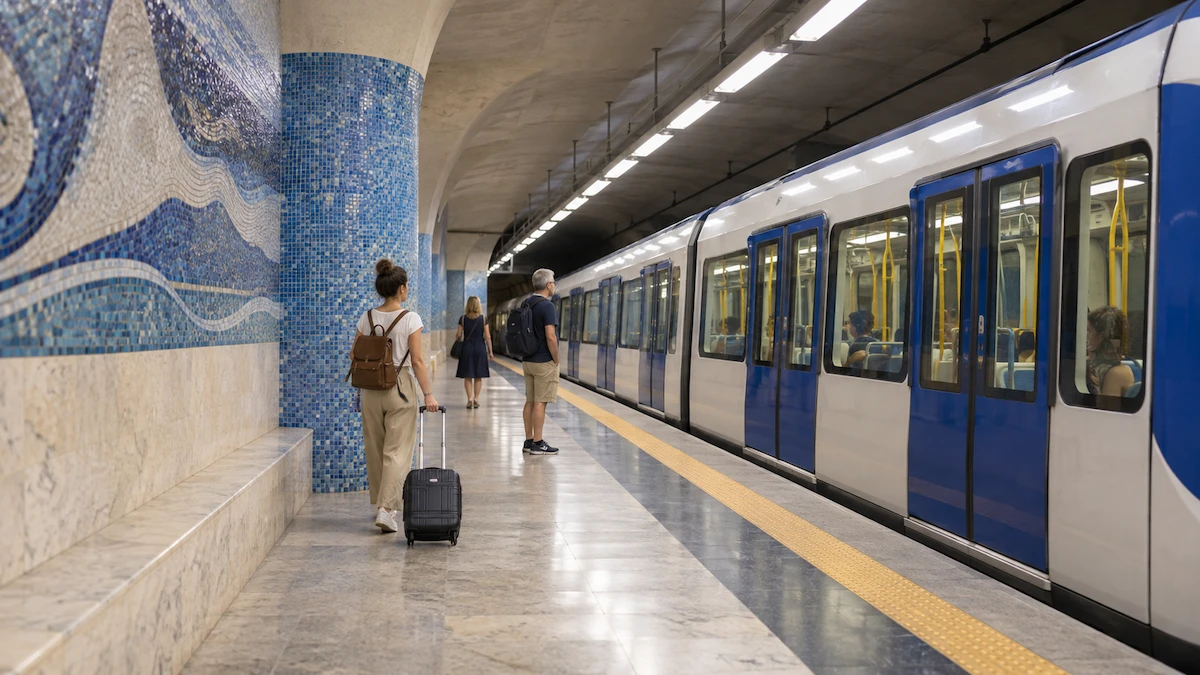
The embedded rail video shows the distinction between attractive station architecture and the practical journey: platforms, train doors and vehicle interiors still determine boarding and luggage comfort. It also shows different rolling stock. Those dated scenes help you picture the system; they do not prove today’s frequency, crowding or lift availability.
⚠️ The Catch (Things to Keep in Mind)
A metro journey includes reaching the platform and finding the right street exit. For 2–5 November 2026, ANM’s Line 1 notice lists early closure for testing: last passenger trains leave Piscinola at 20:52 and Centro Direzionale at 21:27. These are dated terminal departures, not a permanent timetable or guaranteed departure from your stop. For other dates, read the latest notice and have a surface or taxi alternative if the complete connection is unavailable.
🚠 Funiculars: Best for Saving Your Legs on the Hill
Feature tags: uphill effort saved · ANM ticketing · different lower stations · final walk remains
Think of a funicular as a useful vertical connection, then choose the line by its lower and upper stations. Centrale links Augusteo, off the Via Toledo side of the lower city, with Piazza Fuga in Vomero. Chiaia links Parco Margherita with Cimarosa. Montesanto provides another hill approach, while Mergellina serves the Posillipo side. The names describe different routes, not interchangeable entrances to one service.
The €1.30 ANM single makes a one-way hill journey an inexpensive option when it fits the day. Compare the trip from your starting address and the remaining walk at the top. Riding up and walking down may suit someone happy with steps; it is not a step-free itinerary. Anyone who cannot comfortably descend stairs should plan the return transport as carefully as the ascent.
Check the specific line’s operating information. Centrale and Chiaia publish different closing patterns across the week. Centrale also distinguishes direct trains from trains serving intermediate stops. If your accommodation is near an intermediate station, verify that the train you board stops there.
✅ What Other Travelers Say
The embedded Chiaia journey shows that the useful hill ride still comes with a station approach, ticket barrier and internal circulation. That makes it more informative than an uninterrupted scenic view from the top. It is one traveler’s dated journey, not evidence that every approach is currently accessible or that all funicular services share its conditions.
⚠️ The Catch (Things to Keep in Mind)
The funicular saves the climb on its own route. It does not remove every slope, step or crossing between the upper station, your hotel and a viewpoint. Do not promise yourself a completely effortless journey from the map alone. Check lift arrangements where necessary and make sure the return line remains open after your planned visit.
🚌 ANM Buses: Best When the Stops Solve a Gap in the Rail Map
Feature tags: low urban fare · useful surface stops · road traffic exposure · direction matters
A bus can be the sensible option when it leaves you closer to the destination than a metro station. It is less appealing when you need two uncertain surface legs for a journey a train covers directly. Compare the stop-to-door route first and the headline fare second.
ANM’s Route 151 page describes the broad Garibaldi–port-side streets–Chiaia–Campi Flegrei corridor. Use that as a route to investigate, then check today’s direction, stop and diversions. The outward and return bus can use different streets. A stop across the road may not simply be the reverse journey you expect.
A standard ANM urban bus single costs €1.30. Buy or activate the appropriate ticket and validate it as instructed. If relying on contactless, confirm the actual vehicle is enabled; expanding coverage does not mean every bus has a working reader. Carry a usable alternative ticket or payment method. Check how to request your stop and follow on-board signs rather than waiting for a vehicle to stop automatically everywhere.
✅ What Other Travelers Say
The genuine 151 passenger-view film shows the city through the front of a bus, including large roads and traffic along the waterfront-side corridor. It gives a useful sense of the route’s surface environment. Its creator’s old frequency, rating and journey duration are not used as current operating evidence here.
⚠️ The Catch (Things to Keep in Mind)
Road traffic, temporary diversions and waiting can outweigh a small fare saving before a fixed departure. Use current ANM information and the stop’s direction display. With large bags or a stroller, consider boarding space and the remaining pavement route; a lower-floor vehicle does not by itself prove the entire trip is step-free. Do not plan a critical rail or ferry connection around a bus timelapse or an undated frequency claim.
🚆 EAV Regional Rail: Best for a Planned Trip Beyond Central Naples
Feature tags: exact branch required · urban fare boundary · return checked in advance · current timetable essential
Choose the railway by the place and station you need, not simply by the word “Pompei” or “Sorrento.” EAV’s Circumvesuviana services are separate from the ANM metro. At the Centrale/Garibaldi hub, follow the appropriate EAV signs and allow for the internal transfer. Montesanto is another important EAV hub for different routes, including the western railways.
For an excursion toward the archaeological sites or Sorrento, check EAV’s current railway timetable index. At this check it links the Napoli–Sorrento timetable effective 17 October 2026; old March schedules may still rank in searches. Confirm the station, branch, stops, date pattern and return. Pompei Scavi–Villa dei Misteri and other stations named Pompei are not interchangeable arrival points for every entrance or hotel.
Buy a company or integrated ticket that covers the actual origin, destination and required operators. The urban Naples day ticket does not extend itself to Sorrento or Pompei because the same railway also serves city stations. EAV provides official ticket-purchase information, including GoEav and its ticketing channels. Compare the fare shown for your precise journey rather than applying a city-metro price to a regional excursion.
✅ What Other Travelers Say
The embedded journey shows the transfer environment, a train interior and the changing scenery toward Sorrento. It is useful context for the practical size and character of the journey. One 2022 film cannot establish current crowding, reliability, seating availability or which rolling stock your train will use.
⚠️ The Catch (Things to Keep in Mind)
Check live service and accessibility as well as the timetable. EAV warns that operating conditions can cause delays or cancellations; a schedule is not a protected onward connection. The separate tourist Campania Express needs current confirmation before booking: an EAV notice announced suspension from 1 October 2026 until further notice, but its old page was unavailable at this check. Do not treat an older “guaranteed seat” recommendation as proof that the tourist service operates on your date. The verified current timetable for the ordinary railway is a separate planning reference.
🚶 Walking and Licensed Taxis: Best for the Last Stretch
Feature tags: exact entrance matters · walking has no fare · taxi cost shared per vehicle · slopes and access limits
Walking is a useful default within a compact cluster of sights. It avoids buying a ticket for one stop and often lets you finish at the entrance you actually need. Group the old-center stops together, then use transport to change districts or climb the hill when that reduces the day’s effort.
Keep the distinction between a sightseeing stroll and a luggage arrival. Market crowds, changing pavement, crossings and narrow streets can make the same route feel very different with a case. Use the accommodation’s arrival advice and a saved map. If mobility, weather or exhaustion makes the walk unsuitable, paying for a direct vehicle can be a sensible part of the day’s budget.
A licensed taxi is priced per car under its applicable tariff, not per metro passenger. The municipal tariff includes predetermined routes that must be requested at the start. From Centrale, published qualifying examples include €11 to the historic-center ZTL and €15.50 to Molo Beverello/Piazza Municipio. Confirm your exact address, capacity, applicable exclusions and where the vehicle can legally stop; a pedestrian entrance may remain beyond the drop-off.
✅ What Other Travelers Say
The high-view walking film shows why a short distance and an easy route are different questions: there are market passages, crowds and varied street surfaces. Its starting station is Montesanto, not Centrale. Use the visible environment to assess a street-based day, without treating the creator’s pace or total film length as your transfer time.
⚠️ The Catch (Things to Keep in Mind)
Walking has a physical cost even when it has no fare. A taxi has a financial cost even when several people can share it. Compare both against the whole route, including the final legal drop-off. Use an official rank or a confirmed licensed booking, agree whether a qualifying predetermined route applies or the meter will be used, and request a receipt. For a private prearranged service, obtain a written total and luggage/child-seat details; its quote is not automatically the municipal taxi tariff.
Contactless: Keep One Card or Device Consistent
UnicoCampania’s Tap&Go instructions explain entry and exit at enabled rail gates. Use the same physical card or the same device for both taps. A card in your phone and its physical counterpart are different identifiers to the reader; switching between them can create separate journeys. Remove the chosen card from the wallet so another contactless card is not read.
Follow the marked system’s instructions and check current accepted cards and enabled services. UnicoCampania distinguishes rail tap-in/tap-out from Alibus tap-in-only operation, and says bus coverage is expanding. Do not assume all buses, every rail operator or every card works the same way. Retain enough phone battery when using a device and check later charges through the official channels if a journey was recorded incorrectly. An initial bank authorization is not necessarily the final fare.
Airport Transfers Are a Separate Decision
For 1–30 November 2026, confirm the airport on your airline booking. Busitalia’s temporary QSR–Naples coach costs €12 per person one way, requires a valid flight ticket for the day of use and identifies its Naples stop as Via Galileo Ferraris. Its published departures have gaps; it is not a continuous city shuttle. A Naples urban pass is not its ticket.
When NAP is operating and the service is confirmed for your date, normal ANM Alibus is a separate airport product with a €5 single-ride fare and a distinct €5 UNICO ALIBUS integrated option. Neither should be confused with a €1.30 urban bus single. Price the airport, exact hotel approach and luggage together before choosing.
Key FAQs
Is the Naples day pass worth it for a first visit?
Count the rides you expect to take. Two ANM metro rides cost €3, below the €4.50 company day ticket. Four metro rides cost €6, so that day ticket saves €1.50. If you need eligible urban trips on other operators, compare the €5.70 integrated day ticket and its coverage. Both day-ticket decisions depend on actual use before midnight.
Can I use an ANM ticket on Naples Metro Line 2 or the train to Sorrento?
An ANM-only company ticket is not the default ticket for Trenitalia’s Line 2 or an EAV journey. Use the appropriate operator or integrated product for the actual route. An urban Naples integrated ticket still has a geographical limit; it does not automatically cover Pompei or Sorrento.
What is the easiest way to get around Naples with heavy luggage or limited mobility?
Choose the complete route, including the station entrance, working lifts and accommodation access. A direct metro can work with verified access; a licensed taxi can remove an awkward interchange but may still have a pedestrian last stretch. Check the appropriate operator’s accessibility information and ask the accommodation for its best arrival entrance before traveling.
Final Verdict and Your Next Step
Begin with a walkable cluster of sights, add Line 1 or another useful rail route to change districts, and use a funicular when it saves an uphill leg. Choose buses when their current stops provide a better connection. Treat an EAV excursion, an airport transfer and a difficult luggage arrival as separate journeys to plan and price.
Before buying a pass, write down the actual rides and operators for one day. Then use ANM’s official purchase channels or EAV’s ticket information for the correct product, checking current prices at purchase. Arrange required assistance or a confirmed licensed vehicle in advance when the arrival calls for it, and save a fallback for the return. The worthwhile plan is the one that gets you to the right entrance with enough energy to enjoy Naples.