

💡 Key Takeaways
- For most first-time visitors, the easiest default is an IC card plus the fastest route shown by a navigation app. Do not force every journey onto one railway company just because you bought an unlimited pass.
- The Tokyo Subway Ticket can save money, but only when your itinerary is subway-heavy. It does not cover JR trains, the Yamanote Line, the Yurikamome, most private railways or airport limited-express surcharges.
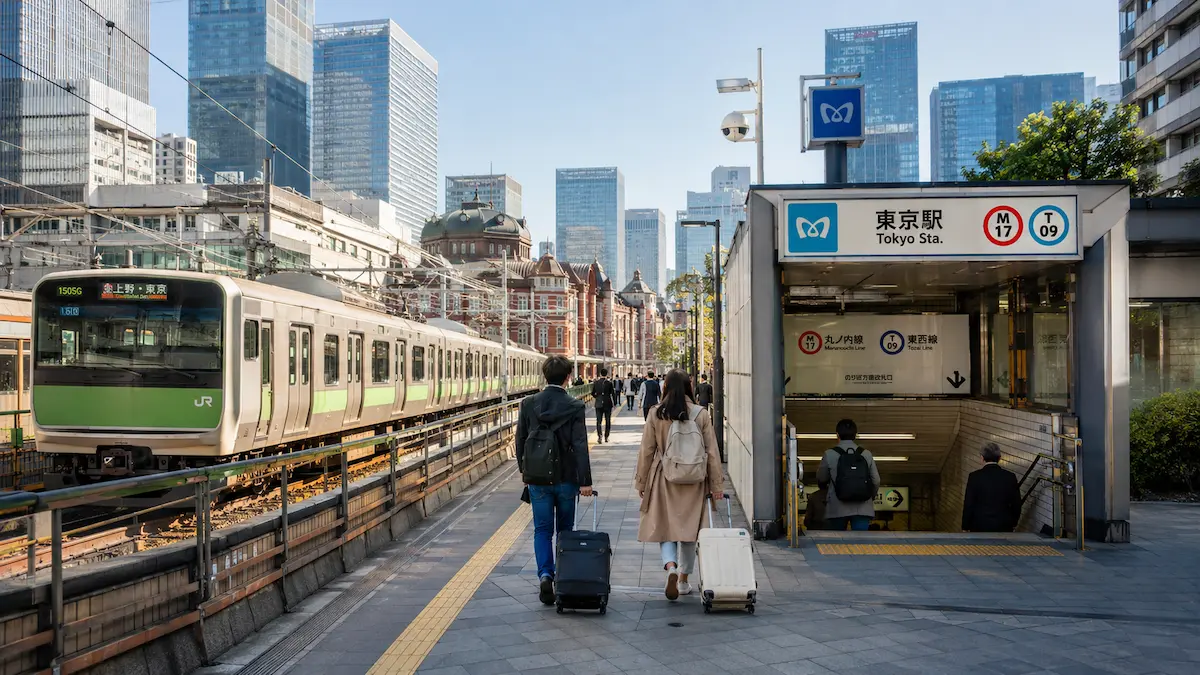
- In Tokyo, the wrong exit can waste more time than the wrong train. Save the exit number, check for an elevator before you arrive, and avoid major interchanges with large luggage during commuter peaks.
A good Tokyo transportation guide should do more than explain that Tokyo has trains, subways and buses. The real challenge for a first-time visitor is deciding which operator to use, whether a transport pass is genuinely worth buying, where to transfer, which station exit is closest to the hotel, and how to avoid dragging a suitcase through a maze of stairs.
Tokyo’s network is reliable and well signed, but it is not one single system. JR East, Tokyo Metro, Toei Subway and several private railway companies operate overlapping routes with separate ticket rules. A route that looks simple on a tourist map may involve a ten-minute underground walk, a gate exit, another operator and an extra fare. The practical goal is not to master the entire network. It is to make each journey with the fewest avoidable mistakes.
Fare and ticket information in this guide was checked on August 2, 2026. Prices and operating rules can change, so confirm time-sensitive details on the linked official websites before travel.
The 1-Minute Cheat Sheet
| Option | Best For | Typical Cost | Main Advantage | Biggest Catch | Our Verdict |
|---|---|---|---|---|---|
| IC card + fastest route Suica, PASMO or compatible card | Most first-time visitors | Pay per ride; many central journeys are roughly ¥160–¥330 | Works across JR, subways, buses and many private railways | It is a payment method, not an unlimited pass | Best default choice |
| Tokyo Subway Ticket 24 / 48 / 72 hours | Subway-heavy sightseeing days | ¥1,000 / ¥1,500 / ¥2,000 | Unlimited Tokyo Metro and Toei Subway rides | No JR, Yamanote Line or most private railways | Good only after checking your route |
| JR Tokunai Pass | A full day focused on JR stations inside Tokyo’s 23 wards | ¥870 | Unlimited local and rapid JR rides in the covered area | Subways and private railways are excluded | Niche but useful |
| Toei bus | Short local hops and places awkward by rail | Usually ¥210 in Tokyo’s 23 wards | Can reduce walking and avoid deep subway platforms | Traffic and unfamiliar bus stops can slow you down | Useful backup, not the main plan |
| Taxi / GO / Uber | Heavy luggage, tired feet, families and late nights | From ¥500 for the first 1 km, plus distance, time and possible app fees | Door-to-door travel with minimal walking | Cross-city trips become expensive quickly | Excellent in short, strategic doses |
The simplest rule: use an IC card for ordinary travel, buy a pass only after plotting your actual itinerary, and treat taxis as a tool for solving specific problems rather than as an all-day transport strategy.
Top Survival Tips
- Choose the station exit before the train arrives. Tokyo Station, Shinjuku, Shibuya, Ikebukuro and Otemachi are not just stations; they are underground districts. An exit on the wrong side can add 10–20 minutes of walking. Save the exact exit number from your hotel website or navigation app. With luggage, check the station map for an elevator rather than assuming the nearest exit is step-free.
- Do not confuse a station name with a convenient transfer. Two lines may appear to meet on a map while their platforms are far apart. Kuramae is a classic example: changing between the Toei Asakusa and Oedo lines involves leaving the station and walking at street level. At large complexes, a route with one extra train but an easier transfer may save energy and time.
- Use the line colour, station code and direction together. “Ginza Line toward Shibuya” is safer than following “Ginza” alone. Station codes such as G09 or E27 reduce confusion when different stations have similar names. On the platform, confirm the next two or three stations, not only the final destination shown by your app.
- Enter and exit with the same card or device. Do not tap in with a physical credit card and tap out with the same card stored in your phone. The system treats them as different payment tokens. The same principle applies when switching between a physical Suica and mobile Suica.
- A basic IC card does not include limited-express or reserved-seat charges. You can tap through the gate for the base fare on many routes, but trains such as the Narita Express, Keisei Skyliner and certain private-railway limited expresses require an additional ticket. Check before boarding instead of assuming every train shown on the departure board is covered.
- Avoid commuter peaks with large luggage. Roughly 7:30–9:30 in the morning and 17:30–19:30 in the evening are the least pleasant times to board central commuter trains with suitcases. When timing is unavoidable, use an airport express, luggage forwarding, an airport bus, or a short taxi to a major terminal instead of making several crowded local transfers.
- Do not buy a pass first and redesign your itinerary around it later. Saving ¥200 is not a win if the pass forces a slower route, a longer walk or an unnecessary transfer. Tokyo sightseeing is tiring enough without turning every journey into a fare-maximisation exercise.
- Keep at least ¥2,000–¥3,000 available on your IC card. A low balance is easy to fix, but discovering it while rushing for an airport train or boarding a bus is unnecessary stress. Recharge before the evening, when you are tired and more likely to make mistakes.
- Stand near the door before your stop, but do not block it. Trains can become crowded, and boarding begins quickly after passengers leave. With a suitcase, prepare one station early and move to the side of the doorway so you can exit without fighting the incoming flow.
- Check the last train, not only the journey time. Most urban rail services stop around midnight, but the final departure varies by line, direction and day. A 20-minute journey at 10 p.m. can become a costly taxi ride after the last connection is missed.
Which Tokyo Transport Pass Is Actually Worth Buying?
Unlimited travel sounds reassuring, but Tokyo passes are usually limited by operator. That is the detail many first-time visitors miss. A Tokyo Metro pass does not automatically include Toei Subway. A subway pass does not include JR. A JR pass does not include the subway. The best pass is therefore determined by the geography of your itinerary, not by how long you are staying.
| Pass | 2026 Adult Price | Coverage | Rough Break-Even Test | Who Should Buy It? |
|---|---|---|---|---|
| Tokyo Subway 24-hour Ticket | ¥1,000 | Tokyo Metro + Toei Subway | Usually 5–6 subway rides within 24 hours | A concentrated sightseeing day using mainly subway stations |
| Tokyo Subway 48-hour Ticket | ¥1,500 | Tokyo Metro + Toei Subway | Usually 8–9 subway rides in total | Two busy days with limited JR use |
| Tokyo Subway 72-hour Ticket | ¥2,000 | Tokyo Metro + Toei Subway | Usually 10–12 subway rides in total | Three subway-heavy days based near a Metro or Toei station |
| Tokyo Metro 24-hour Ticket | ¥700 | Tokyo Metro only | Usually 4 rides | Visitors certain they will not need Toei or JR that day |
| Tokyo Metro + Toei 1-Day Pass | ¥1,100 | Both subway operators for one calendar day | Usually 6 rides | A busy day that begins early and ends before midnight |
| JR Tokunai Pass | ¥870 | JR local and rapid trains in Tokyo’s 23 wards | Usually 5–6 short JR rides | A JR-focused loop through places such as Shinjuku, Shibuya, Ueno and Akihabara |
| Tokyo 1-Day Ticket | ¥1,720 | JR in the 23 wards, Tokyo Metro, Toei Subway, Toei buses and selected Toei services | Requires a very transport-heavy day | Only travellers making many mixed-operator journeys in one day |
Important price warning: many older blogs and videos still quote the pre-March 14, 2026 Tokyo Subway Ticket prices of ¥800, ¥1,200 and ¥1,500. The current official prices are ¥1,000, ¥1,500 and ¥2,000. Recalculate the value using the new prices rather than trusting an old “must-buy” recommendation.
Pass decision shortcut: mark every planned trip as JR, Tokyo Metro, Toei, private railway or bus. If at least 80% of your journeys fall inside one pass and the expected pay-per-ride total clearly exceeds the pass price, buy it. If the result is close, use an IC card and preserve route flexibility.
The Full Experience
🚆 JR Trains: Best for the Yamanote Line and Fast Cross-City Travel
Best for: Shinjuku, Shibuya, Harajuku, Ikebukuro, Ueno, Akihabara, Tokyo Station | Payment: IC card or ticket | Pass warning: Not covered by the Tokyo Subway Ticket
JR East is often the quickest way to move between Tokyo’s biggest commercial districts. The Yamanote Line is the famous loop, but it is not always the fastest option. Parallel lines such as the Saikyo, Shonan-Shinjuku, Chuo Rapid and Keihin-Tohoku lines can cut journey times when they match your route.
For a first visit, think of JR as the backbone connecting major hubs. Use it when moving from Shinjuku to Shibuya, Ueno to Akihabara, or Tokyo Station to Shinagawa. The station signs are clear, trains are frequent and IC cards work smoothly. The difficulty is not riding the train; it is choosing the right platform and leaving the station through the correct side.
✅ What Other Travelers Say
Visitors consistently praise JR for speed, frequency and easy access to the city’s best-known neighbourhoods. Many also report that an IC card is less stressful than trying to make every trip fit a subway-only pass. The repeated complaint is the physical size of major JR stations, especially Shinjuku and Tokyo Station, where a technically simple transfer can involve long corridors and multiple levels.
⚠️ The Catch (Things to Keep in Mind)
- The Tokyo Subway Ticket does not cover JR trains, including the Yamanote Line.
- Express, rapid and local trains may share a platform but stop at different stations. Confirm the service type before boarding.
- At Tokyo Station, the Keiyo Line platforms are a long walk from many other JR platforms. Allow significantly more transfer time for Tokyo Disney Resort trains.
- IC cards cover ordinary fares, but reserved-seat or limited-express trains may need a separate ticket.
🚇 Tokyo Metro and Toei Subway: Best for Dense Sightseeing Coverage
Best for: Asakusa, Ginza, Roppongi, Tsukiji, Otemachi, Nihombashi | Typical fare: Tokyo Metro ¥180–¥330 | Pass option: Tokyo Subway Ticket
Tokyo Metro operates nine lines, while Toei operates four. Together, they reach a huge share of central Tokyo’s attractions. The system is easier than the map first appears because every line has a colour, letter and station number. Once you learn to follow all three, the network becomes much less intimidating.
The subway is often better than JR for journeys that cut through the centre rather than around it. Ginza to Roppongi, Asakusa to Nihombashi and Shinjuku to the Tokyo Metropolitan Government area are typical examples. Deep stations can add vertical travel time, however, so the fastest train route is not always the least tiring route.
✅ What Other Travelers Say
Travellers who plan three packed sightseeing days near subway stations often find the 72-hour ticket good value. Others regret buying it because they end up using JR or private railways for Shibuya, Harajuku, Odaiba, Disney or day trips. The common lesson is that the pass itself is not bad; buying it without mapping the itinerary is the mistake.
⚠️ The Catch (Things to Keep in Mind)
- Tokyo Metro and Toei are separate operators, although the Tokyo Subway Ticket covers both.
- Some through-services continue onto private railway tracks. A subway pass covers only the eligible section, and you may need to pay the difference at your destination.
- Some transfers require exiting one set of gates and entering another. Follow the transfer signs and complete the change within the permitted time.
- Deep lines, especially parts of the Toei Oedo Line, can require long escalator or elevator journeys.
- The nearest station entrance may not have an elevator. Check the station map before arriving with luggage or a stroller.
💳 Suica, PASMO and Contactless Cards: Best for Flexible, Low-Stress Travel
Best for: Almost every independent traveller | Works on: JR, subways, buses and many private railways | Key fact: Convenience card, not a discount pass
An IC card is the closest thing Tokyo has to a universal transport solution. Load money, tap in, tap out and let the system calculate the fare. Suica, PASMO and compatible nationwide IC cards are broadly interchangeable for ordinary urban transport. They can also be used at many convenience stores, vending machines and station lockers.
Temporary visitors can use a physical Welcome Suica, which is valid for 28 days from purchase, or Welcome Suica Mobile on supported iPhones. Regular Suica and PASMO availability and sales locations can change, so check official information close to departure rather than relying on an old airport guide.
Contactless bank-card entry is now available across Tokyo Metro and Toei Subway and on participating private railways. It is useful, but it is not yet as universally simple as an IC card. Tokyo Metro specifically notes that contactless travel cannot continue onto JR East, and certain stations or transfer patterns have restrictions.
✅ What Other Travelers Say
The most common positive feedback is freedom: travellers can follow the fastest route without worrying which company operates it. People also appreciate using the same balance for buses, lockers and convenience-store purchases. The recurring problem is overloading a temporary card near the end of a trip, because leftover balances may be difficult or impossible to refund depending on the card type.
⚠️ The Catch (Things to Keep in Mind)
- Welcome Suica is valid for 28 days from the purchase date.
- An IC card does not automatically include reserved seats, Green Cars or limited-express supplements.
- Do not store multiple active contactless cards against the same reader; card clash can cause gate errors.
- Use the same physical card or device to enter and exit.
- Contactless credit-card travel may charge adult fares only and does not cover every possible through-service.
🚌 Toei Buses: Best for Saving Your Legs on Awkward Local Routes
Best for: Short neighbourhood hops, elderly travellers, families, rainy days | Central fare: Usually ¥210 | Payment: IC card recommended
Buses are not the first transport mode most visitors need in Tokyo, but they can be excellent when the railway route creates an unnecessary detour. A bus may connect two nearby neighbourhoods directly while the train requires walking to a station, descending several levels, transferring and walking back again.
In Tokyo’s 23 wards, standard Toei bus routes generally use a flat ¥210 adult fare. Using an IC card is the simplest approach. On most central Toei buses, board through the front door, tap or pay when boarding, and exit through the rear door. Procedures can differ outside central Tokyo, so follow the signs and watch what local passengers do.
✅ What Other Travelers Say
Travellers who use buses strategically like the reduced walking and the chance to see the city at street level. They are especially useful after a long sightseeing day when a 15-minute walk feels much longer. The less positive feedback concerns traffic delays, crowded buses and uncertainty about the correct stop.
⚠️ The Catch (Things to Keep in Mind)
- Buses are affected by road traffic, so do not rely on a tight connection.
- Bus stops with similar names may be on opposite sides of a wide road or in different parts of a station complex.
- Large suitcases are awkward on ordinary city buses.
- Only ¥1,000 notes and coins are accepted for cash payment or onboard IC-card charging on Toei buses; larger notes are not accepted.
- Press the stop button after your stop is announced rather than assuming the bus will stop automatically.
🚕 Taxis, GO and Uber: Best for Luggage, Exhaustion and Difficult Last Kilometres
Best for: Families, mobility needs, late nights, hotel-to-station transfers | 2026 base fare: ¥500 for the first 1 km | Budget rule: Short rides are reasonable; cross-city rides are not
Tokyo taxis are most valuable when they eliminate a problem: two suitcases, a child who has fallen asleep, a station with too many stairs, heavy rain, or the final kilometre between an airport train terminal and a hotel. A short taxi at the right moment can save more energy than an expensive all-day pass.
As of April 20, 2026, the standard fare in Tokyo’s 23 wards, Musashino and Mitaka is ¥500 for the first 1 km, then ¥100 for each additional 232 metres. Slow traffic also increases the meter, and fares are 20% higher from 10 p.m. to 5 a.m. App bookings can add pickup, platform or international-service fees depending on the operator and account.
GO is Japan’s major taxi-dispatch app, while Uber in Tokyo often connects users with licensed local taxis. Street hailing and taxi ranks can avoid some dispatch fees. For a short ride, compare the app estimate with the convenience of walking to a taxi stand.
✅ What Other Travelers Say
Many travellers say a short taxi becomes one of the best-value decisions of the trip when feet are sore or luggage is involved. Others are surprised by extra app charges and by how quickly the fare rises in traffic. The strongest consensus is to use taxis selectively rather than attempting to tour the entire city by car.
⚠️ The Catch (Things to Keep in Mind)
- Traffic can make a taxi slower than the train during busy periods.
- GO, Uber or hotel dispatch may add fees beyond the metered fare.
- Highway tolls are charged separately.
- Do not manually open or close an automatic taxi door unless instructed.
- For airport journeys, compare a fixed-fare taxi or private transfer with an airport train plus a short local taxi.
✈️ Haneda and Narita Airport Transfers: Best Chosen by Hotel Location, Not Airport Branding
Best for: Arrival and departure days | Decision factors: Hotel district, luggage, arrival time, number of transfers | Golden rule: Fewer transfers usually beat the lowest fare
The “best” airport train depends on where you are staying. Do not choose Narita Express simply because your flight lands at Narita, or the Monorail simply because your flight lands at Haneda. Choose the service that leaves you closest to your hotel with the fewest difficult transfers.
From Haneda Airport
- Tokyo Monorail: best for Hamamatsucho and onward JR Yamanote Line connections. The regular fare from Haneda to Hamamatsucho is ¥520. On selected dates, the Monorail and Yamanote Line Discount Ticket costs ¥590 to any Yamanote Line station.
- Keikyu Line: best for Shinagawa, Asakusa, Nihombashi and through-services toward the Toei Asakusa Line. Check the destination carefully because trains continue onto different lines.
- Airport Limousine Bus: best when it stops at your hotel or a nearby major hotel. It may be slower in traffic, but avoiding stairs and transfers can be worth the premium.
- Taxi or private transfer: most sensible for late arrivals, families, several large bags or hotels poorly connected to rail.
From Narita Airport
- Keisei Skyliner: best for Ueno, Nippori and easy JR connections. The official one-way fare to Ueno or Nippori is around ¥2,470, and the fastest services reach Nippori in about 36 minutes.
- Narita Express: best for Tokyo, Shinagawa, Shibuya, Shinjuku and Yokohama without changing trains. The N’EX Tokyo Round Trip Ticket is ¥5,200 and is valid for a return journey within 14 days.
- Keisei Access Express: cheaper than the Skyliner and useful for direct services toward Asakusa, Nihombashi and Shinagawa, but it has ordinary commuter-style seating and less dedicated luggage space.
- Airport Limousine Bus: practical for selected hotels and for travellers who prefer not to transfer with luggage. Allow for road traffic.
- Taxi: convenient but expensive for a full Narita-to-central-Tokyo trip. A train to Ueno, Nippori, Tokyo or Shinjuku followed by a short taxi is often the better compromise.
✅ What Other Travelers Say
Travellers with large luggage repeatedly recommend paying slightly more for a direct airport train or bus instead of attempting two or three commuter-train transfers. A popular compromise is to take the Skyliner to Ueno or Nippori, or the Narita Express to a major hub, then use a short taxi to the hotel.
⚠️ The Catch (Things to Keep in Mind)
- Check the terminal number before choosing the station and departure time.
- Airport limited expresses require a dedicated ticket or surcharge; an IC-card balance alone may not be enough.
- Do not schedule the last feasible train after an international arrival. Immigration, baggage collection and customs can take longer than expected.
- For departure, arrive at the airport based on airline guidance and add time for finding the correct terminal and check-in area.
- Airport train platforms at major stations may be far from local subway platforms.
Three First-Timer Route Examples
Example 1: Shinjuku → Meiji Shrine → Shibuya → Tokyo Station
Use JR for the main movements. Shinjuku to Harajuku and Harajuku to Shibuya are straightforward on the Yamanote Line. From Shibuya to Tokyo Station, compare JR and subway options in real time. An IC card is better than a subway pass for this mixed route.
Example 2: Asakusa → Tsukiji → Ginza → Roppongi
This is a subway-friendly day. A Tokyo Subway Ticket may be worthwhile if you add more rides, return to your hotel by subway and avoid JR. Check the exact station entrances at Tsukiji and Roppongi because long underground walks can affect the practical route.
Example 3: Narita Airport → Ueno Hotel with Two Suitcases
Take the Keisei Skyliner to Ueno or Nippori, then use a short taxi if the hotel is not genuinely close to the station exit. Do not assume “five minutes from Ueno Station” means five easy minutes with luggage; Ueno has several exits and the pedestrian route may include stairs or busy crossings.
Key FAQs
What is the easiest way to get around Tokyo for first-time visitors?
For most travellers, the easiest method is to use a Suica, PASMO or compatible IC card and follow the fastest sensible route in Google Maps, Apple Maps, NAVITIME or Japan Travel by NAVITIME. This keeps JR, subway, bus and private-railway options open. Buy an unlimited pass only when your mapped itinerary clearly fits its coverage.
Is the Tokyo Subway Ticket worth it for a 3-day Tokyo trip?
It can be worth it when most of your journeys use Tokyo Metro and Toei Subway and you expect roughly 10–12 subway rides over 72 hours. It is less attractive when your plans include frequent JR journeys, Odaiba, Tokyo Disney Resort, airports or day trips. The 72-hour ticket now costs ¥2,000, so ignore older recommendations based on the former ¥1,500 price.
How do I get around Tokyo with large luggage without using too many stairs?
Use a direct airport train or limousine bus, travel outside commuter peaks, check elevator exits before arrival and consider a short taxi for the final leg. For hotel changes, luggage forwarding can be more comfortable than carrying large suitcases through major interchange stations. The cheapest route is not always the best value when it adds several transfers and staircases.
Final Verdict and Your Next Step
The most reliable Tokyo transport strategy is not “buy the biggest pass.” It is use an IC card, choose the fastest low-stress route, and buy a pass only when the numbers and operator coverage make sense. Tokyo’s trains and subways are easy once you stop treating them as one giant system and start checking three details: operator, direction and exit.
Before departure, save your hotel’s nearest station, exit number and elevator route. Decide your airport transfer based on the hotel district and luggage, not only the ticket price. For a packed subway itinerary, compare the official price with advance booking offers—but remember that a discounted pass is still poor value if it does not cover the routes you actually need.
Useful booking links:
- Check Tokyo Subway Ticket options on Klook
- Check Tokyo Subway Ticket options on KKday
- Compare Tokyo hotels on Agoda
- Compare Tokyo hotels on Booking.com
Book early when it matters: reserve hotels near a convenient station, airport limited-express seats during busy travel periods, and private transfers for late arrivals or large groups. Ordinary urban trains do not need advance booking, so keep those journeys flexible.