

💡 Key Takeaways
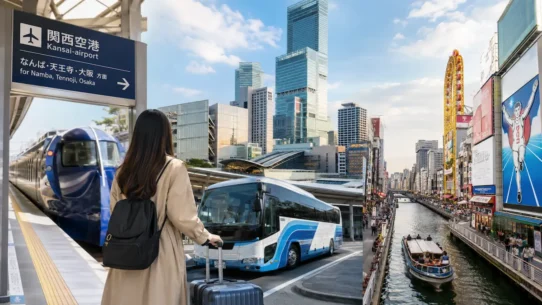
- Kyoto does not have a major commercial airport. Most international travelers mean Kansai International Airport (KIX), about 80–100 minutes from Kyoto; domestic flyers may arrive at Osaka Itami Airport (ITM), which is closer.
- The JR HARUKA is the best default from KIX to Kyoto Station: direct, weather-resistant, luggage-friendly, and currently ¥2,200 with the discounted WEST QR one-way ticket. But it may still leave you with an awkward final subway, bus, or taxi ride to Gion or Kawaramachi.
- Do not choose by headline journey time alone. Terminal 2 transfers, ticket collection, waiting for the next departure, traffic, and the “last mile” to your hotel can add 20–60 minutes and several thousand yen.
Fares and service details in this guide were checked on August 2, 2026. Airport timetables and booking conditions can change, so recheck your exact travel date before flying.
Searching for how to get from Kyoto Airport to the city center can be surprisingly confusing because there is no major passenger airport called “Kyoto Airport.” In practice, most overseas visitors land at Kansai International Airport (KIX), while some domestic connections use Osaka Itami Airport (ITM). The right transfer is not simply the fastest train on paper. It depends on whether your hotel is near Kyoto Station, Kawaramachi, Gion, Karasuma, Arashiyama, or somewhere reached only by a crowded city bus.
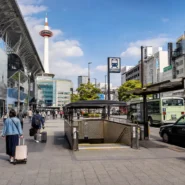
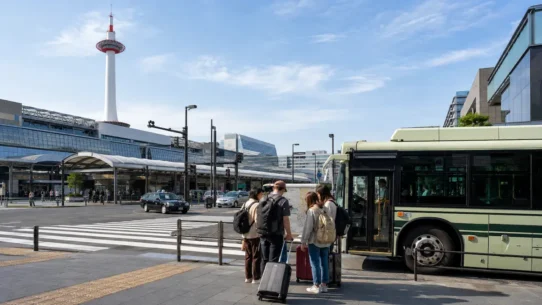
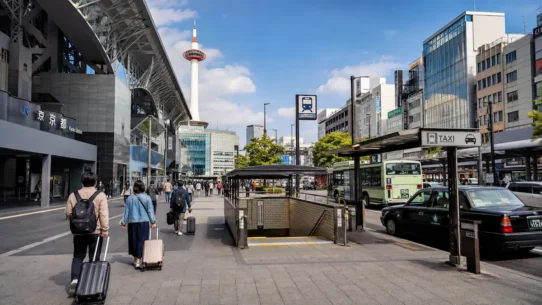
The biggest mistake is assuming that “direct to Kyoto Station” means “direct to my hotel.” Kyoto Station sits south of the main sightseeing and nightlife districts. If you are staying near Gion or Kawaramachi, arriving at Kyoto Station may still mean a subway change, a bus ride with luggage, or a taxi costing roughly another ¥1,500–¥3,000 depending on traffic and distance. This guide compares the real door-to-door experience so you can choose once and avoid an exhausting arrival-day detour.
The 1-Min Cheat Sheet
- JR HARUKA from KIX: Choose this for Kyoto Station, southern Kyoto, a JR-connected hotel, predictable timing, or a Japan Rail Pass. Around 80 minutes on a direct service; discounted one-way fare to Kyoto is currently ¥2,200.
- Airport Limousine Bus from KIX: Choose this when you have large suitcases, dislike railway stations, or want staff to place luggage in the hold. Around 85–100 minutes to Kyoto Station Hachijo Exit; ¥2,800 one way. Traffic is the main risk.
- Nankai + Osaka Metro + Hankyu or Keihan: Consider this only when your accommodation is around Kawaramachi, Karasuma, or Gion and you are comfortable with transfers. It can reduce the final backtracking from Kyoto Station, but it is not a good heavy-luggage route.
- Shared door-to-door shuttle: Best for one or two travelers who want hotel drop-off without paying for a whole private car. The trade-off is possible waiting, multiple pickups, and a less predictable arrival time.
- Private transfer or taxi: Best for families, groups of four or more, late arrivals, mobility needs, or hotels far from rail stations. Expensive for solo travelers, but often sensible once the total is divided among several people.
First, Check Which Airport You Actually Booked
KIX — Kansai International Airport: The main international gateway for Kyoto, Osaka, Nara, and Kobe. It is built offshore and is a long transfer from Kyoto. Most of this article focuses on KIX.
ITM — Osaka International Airport (Itami): Mainly domestic. It is much closer to Kyoto than KIX. The simplest option is normally the airport limousine bus to Kyoto Station, taking about 50–55 minutes under normal conditions. Travelers heading to downtown Kyoto can also use the Osaka Monorail and Hankyu Railway, but transfers are less pleasant with large luggage.
UKB — Kobe Airport: Occasionally appears in domestic or regional itineraries. It is not the usual “Kyoto airport” choice and requires additional connections through Kobe or Osaka.
Top Survival Tips
- Match the transfer to your hotel area, not the word “Kyoto.” Kyoto Station favors HARUKA and the airport bus. Kawaramachi and Karasuma can justify the Nankai–Hankyu route. Gion is often easiest with HARUKA or bus plus a short taxi, especially after a long flight.
- Add a realistic airport buffer. Immigration, baggage collection, customs, walking, ticket redemption, and waiting for the next departure can easily add 45–90 minutes after landing.
- Terminal 2 passengers must plan extra time for trains. KIX railway station is beside Terminal 1/Aeroplaza. The official free shuttle between Terminal 2 and Aeroplaza takes about 7–9 minutes, not including waiting and walking.
- Avoid Kyoto city buses with full-size luggage whenever possible. They can be crowded, boarding space is tight, and many hotels that look “one bus away” are easier reached by subway plus a short walk or by taxi from Kyoto Station.
- Do not blindly tap an IC card and board HARUKA. HARUKA is a limited express. You need the correct limited-express entitlement in addition to the basic fare unless your specific pass or ticket covers it. A discounted HARUKA ticket is usually simpler for visitors.
- Reserve seats during peak periods. Weekends, cherry blossom season, autumn foliage, Japanese holidays, and evening flight banks can fill trains and buses. A reserved seat also reduces the stress of keeping luggage beside you.
- Check your hotel’s exact entrance and reception hours. Kyoto machiya stays and small inns may have narrow lanes, stairs, or unattended late check-in. A driver may not be able to stop directly outside.
- For late flights, compare the cost of one airport hotel night. Missing the last practical public transport connection can turn a cheap flight into a very expensive taxi ride. Sleeping near KIX and traveling early may be safer and cheaper.
- Use luggage forwarding when your first day is busy. Kyoto City actively promotes hands-free travel services. Sending large bags ahead can make even a transfer-heavy route manageable.
The Full Experience
🚆 JR HARUKA: Best for Kyoto Station, JR-Linked Hotels and Predictable Timing
Best overall · Direct train · Reserved seats available · Good for large luggage · Weather-resistant
The JR Kansai-Airport Express HARUKA is the easiest recommendation for most first-time visitors. Direct trains reach Kyoto Station in roughly 80 minutes, and the official discounted WEST QR HARUKA one-way ticket is currently ¥2,200 for an adult and ¥1,100 for a child. That is cheaper than the airport bus and substantially cheaper than buying an ordinary walk-up limited-express journey without checking visitor discounts.
At KIX Terminal 1, follow signs across the connecting walkway to Kansai-airport Station. JR and Nankai share the station area, so check the operator signs before entering. With a WEST QR product, follow the activation instructions carefully and make sure your phone has power, data access, and sufficient screen brightness. Physical-ticket products may require collection at a green ticket machine, which can create a queue just when several international flights have landed.
Who should choose it: Travelers staying near Kyoto Station, Kujo, Tofukuji, Fushimi, or another JR-connected area; travelers who value predictable arrival times; Japan Rail Pass users; and anyone who would rather sit on one train than navigate Osaka with suitcases.
Real door-to-door estimate: For a Terminal 1 arrival, allow roughly 2 to 3 hours from touchdown to a Kyoto Station-area hotel. For Gion or Kawaramachi, allow another 20–40 minutes for the final transfer. Terminal 2 arrivals need extra shuttle and walking time.
✅ What Other Travelers Say
Travelers consistently value the direct ride, clean reserved seating, onboard comfort, and the relief of avoiding traffic. Advance-ticket platforms show very high booking volumes and strong ratings for HARUKA products. The most common positive theme is not raw speed; it is the ability to sit down after a long flight and know exactly where the train will finish.
⚠️ The Catch (Things to Keep in Mind)
Kyoto Station is not the same as downtown Kawaramachi or Gion. A family with several cases may save little effort if everyone must then squeeze onto the Karasuma subway or take a second train. Ticket activation and collection rules also differ between WEST QR and physical-ticket products. Read the voucher before arrival rather than standing beside the gate trying to decode it.
The advertised train time also excludes the wait for the next departure. If you miss a train by a few minutes, the practical advantage over the bus can shrink. During disruption, check JR West service information before committing.
Useful booking links: Check HARUKA tickets on Klook or check HARUKA tickets on KKday. Compare the ticket format, seat-reservation process, cancellation terms, and validity rather than buying only on price.
🚌 Airport Limousine Bus: Best for Heavy Luggage and Zero Railway Transfers
Least walking · Luggage stored underneath · Direct to Kyoto Station · Easy after a long flight
The KIX airport limousine bus is the most underrated option for travelers carrying large suitcases. The official fare between Kansai Airport and Kyoto Station is currently ¥2,800 one way, with an official estimated journey of roughly 1 hour 25 minutes to 1 hour 30 minutes between Terminal 1 and Kyoto Station Hachijo Exit. Staff handle tagged bags in the luggage compartment, so you do not need to maneuver them through ticket gates or onto escalators.
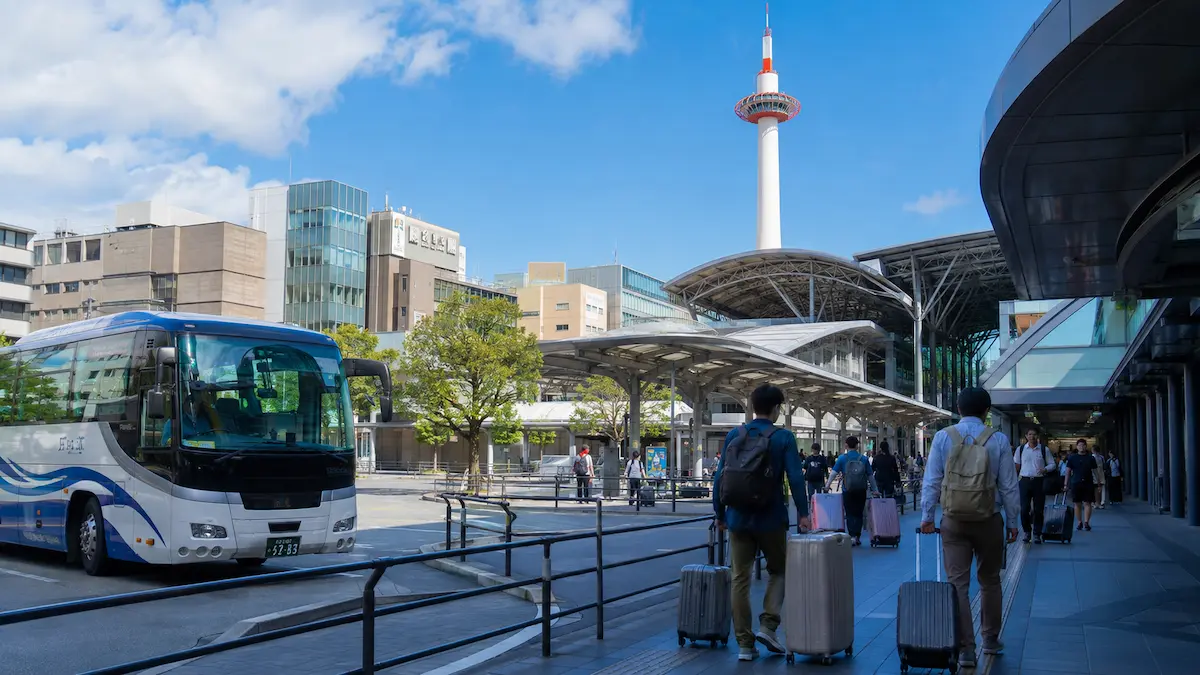
The bus is especially attractive if you arrive tired, are uncomfortable navigating Japanese rail stations, or have luggage that would make a second train unpleasant. Hachijo Exit is on the south side of Kyoto Station, convenient for many station hotels and a straightforward taxi pickup point.
Who should choose it: Couples with two or more large cases, older travelers, families with children, first-time Japan visitors, and anyone prioritizing minimum walking over maximum speed.
Real door-to-door estimate: Around 2.5 to 3.5 hours from landing to a Kyoto Station hotel, depending on immigration, the next bus, and road traffic. Add time and taxi cost for Gion, Kawaramachi, northern Kyoto, or Arashiyama.
✅ What Other Travelers Say
Bus passengers commonly praise the orderly boarding process, clean coaches, comfortable seats, and staff assistance with luggage. The Kyoto/Osaka limousine-bus product on KKday currently shows strong ratings and tens of thousands of bookings, suggesting that many travelers value simplicity more than saving the final few hundred yen.
⚠️ The Catch (Things to Keep in Mind)
Traffic is the unavoidable weakness. A crash, holiday congestion, bad weather, or peak-hour roads can erase the schedule advantage. The bus also does not magically deliver everyone to a hotel; many current services terminate at Kyoto Station, so check the exact stop rather than relying on an old blog post that lists hotel stops no longer operating.
Luggage allowances and oversized-item rules matter. Bicycles, unusually large cases, and multiple bags per person may be restricted. Keep medication, valuables, passports, batteries, and anything needed during the journey in your hand luggage, not under the bus.
Useful booking link: Check the KIX–Kyoto airport limousine bus on KKday. Also compare the live timetable on the official operator site before choosing a departure.
🚇 Nankai + Metro + Hankyu or Keihan: Best for Kawaramachi, Karasuma or Gion—Only With Light Luggage
Downtown-focused · Multiple transfers · Better final location · Not beginner-friendly with suitcases
This route looks complicated because it is complicated—but it can be strategically useful. Instead of traveling all the way to Kyoto Station and then backtracking north, take Nankai from KIX to Tengachaya. For Kyoto-Kawaramachi or Karasuma, transfer to the Osaka Metro Sakaisuji Line, continue toward the Hankyu network, and change as required for the Hankyu Kyoto Line. For Gion-Shijo, one practical variation is Nankai to Tengachaya, Osaka Metro to Kitahama, then Keihan to Gion-Shijo.
Kyoto’s official tourism guidance estimates around 110 minutes for the Rapi:t–Metro–Hankyu route to Kyoto-Kawaramachi under a well-timed connection. Actual door-to-door time can be longer because Tengachaya, Awaji, or Kitahama transfers involve walking, finding the correct platform, and waiting for the right service.
You can use the ordinary Nankai Airport Express instead of the reserved-seat Rapi:t to reduce cost, but the trade-off is a commuter-style train with less controlled luggage space. Rapi:t adds comfort and a reserved seat but may not be the cheapest combination.
Who should choose it: Confident public-transport users with cabin-size luggage staying within easy walking distance of Kawaramachi, Karasuma, or Gion-Shijo. It is also useful for repeat Japan visitors who understand platform changes and can read live route information.
Real door-to-door estimate: About 2.5 to 3.5 hours after landing for a downtown hotel, assuming smooth connections. A missed express connection or wrong-direction train can add 20–40 minutes.
✅ What Other Travelers Say
Budget-conscious travelers like finishing closer to Kyoto’s restaurant, shopping, and nightlife districts instead of paying for a taxi from Kyoto Station. Experienced visitors also appreciate that Hankyu and Keihan stations can be more useful than Kyoto Station for specific downtown hotels.
⚠️ The Catch (Things to Keep in Mind)
This is the route most likely to look clever on Google Maps and feel miserable in real life. Platform changes, stairs, commuter crowds, and a tired group pulling four cases can turn a modest saving into a false economy. “No transfer needed” on one section can also be misleading: through-services vary, and you may still need to change trains at Awaji or another station depending on the departure.
Do not choose this solely because your hotel address says “Nakagyo Ward” or “Higashiyama Ward.” Check the walking route from the final station, including bridges, underground exits, stairs, and cobbled or narrow streets.
🚐 Shared Door-to-Door Shuttle: Best Middle Ground for One or Two Travelers
Hotel drop-off · Lower cost than a private car · Advance reservation required · Variable journey time
A shared shuttle bridges the gap between public transport and a private transfer. You reserve in advance, meet the operator at the airport, and travel to a hotel or approved address in Kyoto. For solo travelers, couples with large bags, or people staying away from railway stations, this can be the most physically comfortable option without paying for an entire vehicle.
The best-case experience is excellent: no ticket machine, no transfer, no dragging a suitcase through Kyoto Station, and no debate about which station exit to use. It can also solve the “HARUKA is direct, but my hotel is another 30 minutes away” problem.
Who should choose it: Solo travelers with heavy luggage, couples staying in Gion or a less convenient district, older visitors, and travelers who are happy to trade exact arrival time for door-to-door service.
Real door-to-door estimate: Highly variable. Airport waiting, grouping passengers, and multiple drop-offs can make the journey longer than a direct private car. Allow roughly 2.5 to 4 hours after landing unless the operator provides a tighter pickup window.
✅ What Other Travelers Say
Travelers who book shared shuttles usually value the removal of the last-mile problem. The service is most satisfying when the hotel is not near Kyoto Station and the alternative would be a train plus taxi anyway. It is also easier to budget than taking an unreserved meter taxi after arrival.
⚠️ The Catch (Things to Keep in Mind)
“Door-to-door” may mean the nearest legal stopping point, not the front step of a machiya in a narrow lane. You may wait for other passengers, and your hotel may be the last drop. Operators also impose booking deadlines, service-area boundaries, luggage limits, flight-number requirements, and rules for delayed arrivals.
Read the cancellation policy and confirm whether the operator tracks flight delays. A cheap shuttle is not a bargain if your flight arrives outside the pickup window and the booking becomes a no-show.
Useful booking link: Check shared KIX–Kyoto shuttle availability on KKday.
🚖 Private Transfer or Taxi: Best for Families, Groups and Late Arrivals
True door-to-door · 24-hour options · Best for groups · Highest total price
A pre-booked private transfer is the lowest-effort option: meet the driver, load the luggage, and go directly to your accommodation. It is particularly valuable for families with young children, groups with several cases, travelers with reduced mobility, and late arrivals when public transport choices become risky.
Do not compare the vehicle price with one train ticket. Compare it with the total group cost of HARUKA or bus tickets, one or two last-mile taxis, the value of avoiding transfers, and the consequences of missing the final connection. For four to six people, a suitable vehicle can be more rational than it first appears.
Pre-booking is normally better than joining the regular taxi queue because the price, vehicle size, luggage capacity, meeting point, and waiting policy are clearer. One current KKday private-transfer product includes 90 minutes of free airport-arrival waiting, but conditions vary by supplier and package.
Who should choose it: Groups of four or more, families using child seats, travelers arriving late, people with mobility limitations, ski or bulky equipment travelers, and guests staying far from a convenient station.
Real door-to-door estimate: Often around 90–150 minutes of driving, but road conditions can change this significantly. Add immigration and meeting time. A driver cannot bypass expressway congestion.
✅ What Other Travelers Say
Private-transfer reviews repeatedly highlight punctual drivers, help with luggage, spacious vehicles, and the comfort of not making decisions after a long-haul flight. This is one of the few options where the arrival experience is genuinely close to door-to-door.
⚠️ The Catch (Things to Keep in Mind)
Vehicle labels such as “seven-seater” do not mean seven people plus seven large suitcases. Passenger capacity drops quickly when luggage is bulky. Enter the real number and size of bags, not an optimistic estimate. Child seats, late-night surcharges, waiting beyond the included allowance, parking, tolls, address changes, and remote pickups may cost extra depending on the supplier.
A normal airport taxi can be extremely expensive over the roughly 90-kilometer road journey to central Kyoto. Never assume the meter will be similar to a city-center taxi ride. Ask about a fixed fare or book an airport transfer with a clearly stated total.
Useful booking links: Compare KIX private transfers on Klook or check a KIX–Kyoto private transfer on KKday. Confirm that “Kyoto” is available in the selected package before paying; some airport-transfer pages default to Osaka.
What If You Land at Osaka Itami Airport (ITM)?
ITM is much easier than KIX for Kyoto. The simplest choice is usually the airport limousine bus to Kyoto Station, with Kyoto’s official tourism guidance quoting about 50–55 minutes under normal conditions. It avoids the monorail and railway transfer and is the safest recommendation with large bags.
For accommodation near Karasuma or Kawaramachi, the Osaka Monorail plus Hankyu Railway can take about 60 minutes under a good connection. It may place you closer to downtown than Kyoto Station, but the transfer at Minami-Ibaraki is less attractive with suitcases. A private car becomes appealing for a family or a hotel in eastern Kyoto.
Always search using the airport code ITM, not “Osaka airport,” because search results often mix Itami with KIX.
Which Option Is Best for Your Kyoto Hotel Area?
Kyoto Station, Hachijo, Shichijo, Kujo: Take HARUKA for speed and reliability, or the limousine bus for easier luggage handling. Do not overcomplicate the trip.
Kawaramachi, Shijo, Karasuma: Light packers can consider Nankai plus Hankyu. Most first-time visitors with checked luggage should take HARUKA or the bus, then use the subway or a short taxi.
Gion, Higashiyama, Kiyomizu area: HARUKA plus taxi is often the best balance. The Nankai–Metro–Keihan route can finish at Gion-Shijo, but multiple transfers are a poor welcome after a long flight. A shared or private shuttle is excellent for heavy luggage.
Arashiyama: No airport option is truly direct. HARUKA to Kyoto Station followed by JR Sagano Line is usually understandable, but the Sagano platforms are a long walk inside Kyoto Station. A private transfer saves energy for groups.
Nijo, Enmachi, western central Kyoto: HARUKA plus a JR local connection can be efficient. Check whether your discounted ticket permits onward travel within the applicable Kyoto area before exiting the gates.
Northern Kyoto, Philosopher’s Path, Kurama or Ohara: Expect a long final leg. Avoid planning a city bus with several large cases. Train or bus to Kyoto Station followed by taxi, luggage forwarding, or a private transfer is usually kinder.
Key FAQs
What is the fastest way from Kansai Airport to Kyoto city center?
For most travelers, the direct JR HARUKA is the fastest predictable public-transport option to Kyoto Station at around 80 minutes. A private car may be faster door-to-door for Gion or Kawaramachi when roads are clear, but traffic can make the result unpredictable.
Is the HARUKA or airport bus better from KIX to Kyoto with luggage?
Choose HARUKA when timing matters, your hotel is near Kyoto Station, or you prefer rail reliability. Choose the airport bus when minimizing walking and handling large cases matters more than possible traffic delays. The bus costs only ¥600 more than the current ¥2,200 discounted HARUKA ticket, so luggage effort—not price—should decide.
How do I get from Kansai Airport to Gion or Kawaramachi without dragging luggage through transfers?
The easiest practical choices are HARUKA or the airport bus to Kyoto Station followed by a taxi, a shared door-to-door shuttle, or a private transfer. The Nankai–Metro–Hankyu/Keihan route can finish closer to downtown but involves multiple transfers and is best reserved for light packers.
Final Verdict and Your Next Step
For most first-time visitors: book the JR HARUKA if you are staying near Kyoto Station or want the most reliable balance of speed, comfort, and price. Reserve a seat during busy periods and study the QR or ticket-redemption instructions before landing.
For travelers with heavy luggage: take the airport limousine bus if your hotel is near Kyoto Station, or book a shared/private transfer if your accommodation is in Gion, Kawaramachi, northern Kyoto, or a hard-to-reach lane.
For confident light packers staying downtown: the Nankai–Metro–Hankyu or Keihan route can reduce backtracking, but it is not the universal “cheapest and best” hack that route planners make it appear to be.
For families and groups: price a private vehicle before dismissing it. Once you include four or more public-transport tickets, a Kyoto Station taxi, luggage stress, and late-arrival risk, the difference may be smaller than expected.
Book the transport that fits your actual hotel location and luggage count, then reserve accommodation close to the station you intend to use. You can compare Kyoto city-center hotels on Booking.com, reserve HARUKA on Klook, check airport-bus tickets on KKday, or compare a private transfer on KKday. Advance booking is most valuable during cherry blossom season, autumn foliage, Japanese holiday periods, and for late arrivals when missing one departure can change the entire plan.