

💡 Key Takeaways
- Take the Karasuma Line subway for Shijo-Karasuma and western Nishiki Market. It is usually the fastest, most predictable choice: two stops, about four minutes on the train, and ¥220 for an adult.
- Do not choose the city bus simply because it looks direct. A one-seat ride can become slower than a subway-plus-walk journey once queues, traffic and crowded aisles are included—especially with a suitcase.
- A taxi is often good value for two to four people with luggage. The total fare is much higher than public transport, but the per-person difference can be modest once you factor in hotel-door delivery, no transfers and fewer exhausted steps.
Getting from Kyoto Station to Kyoto city center looks simple on a map, but the last few kilometres are where many arrivals lose time and patience. Travelers coming from Kansai Airport by train or airport bus often reach Kyoto Station already tired, then discover that “central Kyoto” is not one single stop. A hotel near Shijo-Karasuma needs a different strategy from one near Shijo-Kawaramachi, Pontocho or Gion.
The biggest mistake is treating the cheapest fare as the cheapest journey. A ¥230 bus is not a bargain if you queue for twenty minutes, stand with two suitcases in a packed aisle and then walk several blocks from the wrong stop. Likewise, a four-minute subway ride is not truly four minutes once you include the walk through Kyoto Station, elevator detours and the final distance to your hotel.
This guide compares the realistic door-to-door experience—not just the advertised ride time. Fares and operating guidance were checked in August 2026, but transport schedules can change, so confirm your exact departure in a live journey planner on the day.
The 1-Min Cheat Sheet
- Kyoto City Subway: Best overall for Shijo-Karasuma, Karasuma Oike and the western side of Nishiki Market. Expect roughly 10–20 minutes door to door after station walking. Adult fare: ¥220 to Shijo.
- Subway plus walking: Best budget option for eastern Nishiki Market, Teramachi and many Kawaramachi hotels when you have light luggage. Ride to Shijo, then walk east for approximately 10–20 minutes depending on the property.
- Kyoto City Bus: Best only when the stop is genuinely close to your hotel, traffic is light and you are not carrying bulky luggage. Adult flat-zone fare: ¥230. Allow a large time buffer.
- Taxi: Best for Gion, families, late arrivals, limited mobility, bad weather or two or more large bags. Budget roughly ¥1,400–¥2,000 to the Shijo-Kawaramachi area in ordinary daytime conditions, with traffic, dispatch fees and late-night surcharges potentially increasing the total.
- Walking: Best for backpackers who want to save every yen and arrive in mild weather. Roughly 25–30 minutes to Shijo-Karasuma and around 35–45 minutes to Shijo-Kawaramachi, before any wrong turns or traffic-light waits.
Top Survival Tips
- Pin the hotel entrance, not just the hotel name. Large properties may have entrances on different streets, and a “five-minute walk” can become ten minutes when you emerge from the wrong subway exit.
- Separate Shijo Station from Kyoto-Kawaramachi Station in your head. Shijo is on the north–south subway line at Karasuma Street. Kyoto-Kawaramachi is farther east on the Hankyu line. They are not the same station.
- Use an IC card for speed, not necessarily for a discount. ICOCA, Suica and PASMO are accepted on Kyoto City Subway and City Bus services. Tapping avoids ticket-machine decisions when you are tired.
- Do not rely on the Japan Rail Pass for this last leg. Kyoto City Subway, Kyoto City Bus and Hankyu Railway are not ordinary JR services.
- Avoid the bus with full-size suitcases. Kyoto’s official guidance asks visitors to avoid bringing large baggage onto city buses, and staff may refuse luggage judged excessive in size or quantity.
- Check elevator locations before following the nearest exit number. The shortest staircase route may be a poor choice with a stroller, wheelchair or 23-kilogram suitcase.
- At night, decide before the last train. Kyoto City Subway generally operates from around 05:00 to 23:00, with fewer services early and late. Check the exact timetable for your date rather than assuming Tokyo-style late-night frequency.
- Do not buy a one-day pass for one short transfer. The Subway & Bus 1-Day Pass costs ¥1,100 for adults. It makes sense only if you will take enough covered rides later that day.
The Full Experience
🚇 Kyoto City Subway: Best for Shijo-Karasuma and Nishiki Market
Fastest predictable option • ¥220 adult fare • Two stops • Better with luggage than the bus
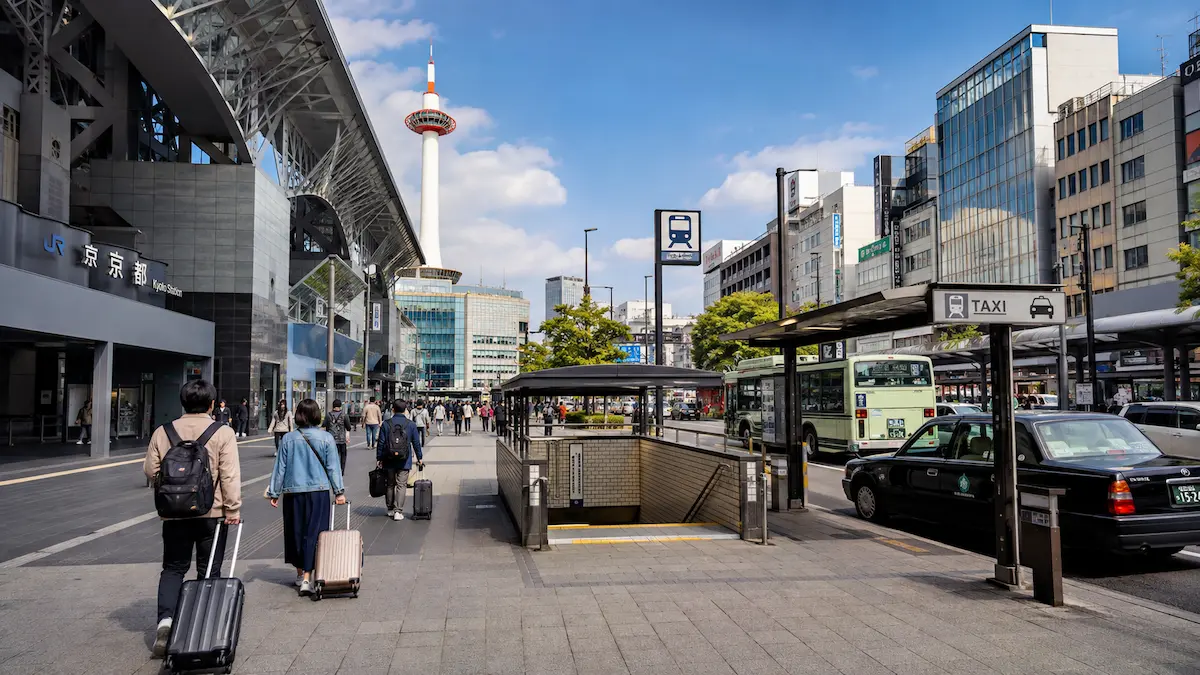
Follow signs for the Kyoto City Subway and the Karasuma Line. From Kyoto Station (K11), take a northbound train toward Kokusaikaikan and get off at Shijo (K09). The train ride itself is about four minutes. The official fare is ¥220 for an adult under the fare schedule effective from October 1, 2025.
This is the cleanest answer for hotels near Shijo-Karasuma, Karasuma Oike, Daimaru Kyoto and the western entrance of Nishiki Market. Kyoto’s official tourism guide specifically recommends the subway for central Kyoto and Nishiki Market, followed by a short walk east from Shijo Station.
The subway also works for Kawaramachi, but read the map carefully: Shijo Station does not place you at Shijo-Kawaramachi. You still need to walk east along Shijo-dori, or connect underground to Hankyu Karasuma Station and pay another fare for the one-stop ride to Kyoto-Kawaramachi. For most able-bodied travelers with light luggage, walking is often simpler than making that extra train transfer.
Real door-to-door time: About 10–20 minutes to a Shijo-Karasuma hotel, 20–35 minutes to a Kawaramachi hotel, and longer if you wait for elevators or exit on the wrong side of Shijo-dori.
✅ What Other Travelers Say
Travelers usually value the subway for one reason above all others: predictability. You are not gambling on road traffic, and station signs are easier to follow than a crowded bus terminal full of similar route numbers. Visitors also appreciate being able to use an IC card and avoid handling coins.
⚠️ The Catch (Things to Keep in Mind)
The hidden cost is walking. Shijo Station is excellent for western downtown but only a partial solution for Kawaramachi, Pontocho and Gion. Escalators and elevators are not always beside the exit closest to your hotel, so travelers with heavy bags may add several minutes by taking an accessible route. Credit and debit cards are not accepted for ordinary subway ticket purchases at the machines, although IC cards are accepted.
Choose this when: Your hotel is near Karasuma Street, you want the lowest-risk journey time, or you have one manageable suitcase per person.
🚌 Kyoto City Bus: Best for a True One-Seat Ride—But Only Off-Peak
Direct to many downtown stops • ¥230 flat-zone fare • No station transfer • Highest congestion risk
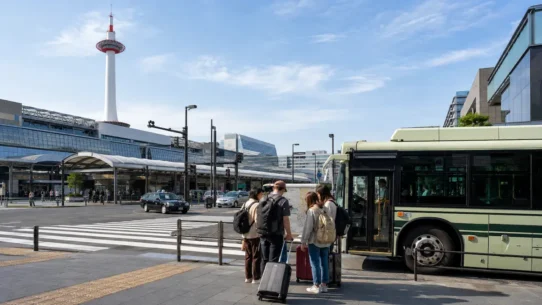
Several buses from the north side of Kyoto Station serve central stops such as Shijo-Karasuma, Shijo-Kawaramachi and parts of the Gion corridor. The exact best route can change with timetables, construction and seasonal service, so use the station departure board or a live planner instead of memorizing a route number from an old blog post.
The attraction is obvious: board once, get off near your hotel and avoid carrying bags through subway corridors. The standard adult fare in the flat-fare zone is ¥230, and IC cards are accepted. On a quiet road with a seat available, the bus can feel easier than the subway.
However, central Kyoto is exactly where this advantage often collapses. The city’s own visitor guidance does not recommend taking a city bus from Kyoto Station to the central Nishiki Market area because of congestion at the stops, inside buses and on the roads. A scheduled journey that looks competitive can stretch badly during weekends, cherry-blossom season, autumn foliage season, school-trip periods and rainy evenings.
Real door-to-door time: Around 20–35 minutes in reasonable conditions, but 40 minutes or more is possible when the boarding queue or road traffic is heavy.
✅ What Other Travelers Say
Travelers who board during a quiet period often describe Kyoto buses as easier than expected: board, watch the stop display, press the stop button and pay when leaving. People staying beside a direct stop also like avoiding the eastward walk from Shijo Station.
⚠️ The Catch (Things to Keep in Mind)
The bus is the least luggage-friendly choice. Large suitcases block aisles, reduce standing space and are specifically discouraged by Kyoto’s official hands-free travel campaign. If the driver or staff considers your luggage too large or numerous, it may not be accepted. You also need to identify the correct boarding bay at Kyoto Station; missing one bus because the queue is full can erase the fare advantage.
Choose this when: You have a small backpack, your hotel is beside a direct stop, traffic looks light and you are not under time pressure.
🚕 Taxi from Kyoto Station: Best for Luggage, Families, Gion and Late Arrivals
Door-to-door • No transfers • Best for 2–4 travelers • Traffic and surcharge risk
For travelers with two large suitcases, young children, sore knees or a Gion address, a taxi is often the sensible choice rather than a luxury. Use an official taxi stand at Kyoto Station. The north-side Karasuma exit is normally the logical side for downtown Kyoto, while the Hachijo side is south of the station.
For a normal daytime ride to Shijo-Kawaramachi, a practical budget is roughly ¥1,400–¥2,000. Treat this as a planning range, not a fixed quote. Kyoto taxi fares are metered; slow traffic adds waiting-time charges, app dispatch may add a call-out fee, and a late-night or early-morning surcharge of around 20% may apply between 22:00 and 05:00 depending on the operator.
Split among three travelers, a ¥1,800 ride is about ¥600 each. That is still more than the subway, but the real comparison is ¥600 for hotel-door delivery versus ¥220 plus station walking, stairs and dragging bags through downtown. For the right group, the extra cost buys a meaningful amount of comfort.
Real door-to-door time: Often 10–20 minutes to Shijo-Karasuma or Shijo-Kawaramachi in ordinary traffic, but longer during peak congestion. Gion may take slightly longer depending on the hotel entrance and road restrictions.
✅ What Other Travelers Say
Travelers commonly praise Japanese taxis for professionalism, clean vehicles and the relief of entering a destination in an app rather than explaining it verbally. Groups and families often find the total cost more reasonable than expected once divided among passengers.
⚠️ The Catch (Things to Keep in Mind)
A regular taxi may seat four passengers, but four people plus four large suitcases may not fit. Kyoto’s official guide notes that some cars cannot accommodate bulky luggage and that not every taxi accepts cards. During major tourist periods, taxi queues can become long. “Foreign Friendly TAXI” vehicles offer larger luggage capacity and multilingual support, but availability is limited.
Choose this when: Two or more people are sharing the fare, you have multiple bags, your hotel is in Gion or east of Kawaramachi, it is raining, or you arrive after subway service.
🚶 Walking from Kyoto Station: Best for Backpackers in Good Weather
Free • Flat urban route • No waiting • Poor choice with wheeled luggage in heat or rain
Central Kyoto is closer than it first appears, and much of the route is relatively flat. Walking can make sense for a fit traveler with a backpack, particularly if the accommodation is around Gojo or southern Shijo-Karasuma and check-in is not urgent.
As a realistic planning range, allow about 25–30 minutes from Kyoto Station to Shijo-Karasuma, 35–45 minutes to Shijo-Kawaramachi, and around 45–60 minutes to parts of Gion. Those estimates assume purposeful walking and no navigation mistakes. Traffic lights, crowds and finding the correct hotel entrance add time.
The walk can also be a useful “zero-transfer” option when buses are gridlocked. But Kyoto summers are hot and humid, sudden rain is common in the warmer months, and repeated curb cuts are tiring with small hard-wheel suitcases. Saving ¥220 is rarely worth arriving soaked or exhausted before sightseeing has even started.
✅ What Other Travelers Say
Light-packing travelers enjoy seeing ordinary streets between the station and downtown and appreciate avoiding queues. The route is straightforward enough when navigation is working, and it can be pleasant in spring or autumn.
⚠️ The Catch (Things to Keep in Mind)
Map apps tend to understate the effort of rolling luggage through crowds, crossings and uneven pavement. Walking is also a false economy if it leaves you too tired to enjoy the first afternoon. In July, August, heavy rain or winter evenings, the subway or taxi is usually the better decision.
Choose this when: You are carrying a backpack, the weather is mild, your hotel is on the Kyoto Station side of downtown and you genuinely enjoy urban walking.
Choose by Destination, Not by Transport Brand
Staying near Shijo-Karasuma or Karasuma Oike
Take the Karasuma Line subway. It is difficult for the bus or taxi to beat the combination of price, speed and predictability unless you have heavy luggage or mobility needs.
Staying near Nishiki Market
For the western and central market entrances, take the subway to Shijo and walk east. The official Kyoto route recommendation uses this approach. For a hotel on the far eastern side near Teramachi, compare the final walk with a taxi—especially with luggage.
Staying near Shijo-Kawaramachi or Pontocho
Solo travelers with light luggage should usually take the subway to Shijo and walk. A direct bus is acceptable off-peak, but it is not the most reliable. Couples or groups with large bags should price the taxi as a serious option rather than dismissing it automatically.
Staying in Gion or southern Higashiyama
A taxi is the least stressful arrival method with luggage. A bus may stop closer than the subway, but crowding and road delays make it a poor first choice after a long airport or Shinkansen journey. Budget travelers can take the subway to Shijo and continue on foot, but the final walk is substantial.
Arriving after 23:00
Plan around a taxi. Do not assume there will be a convenient outbound night bus from Kyoto Station to your hotel. Save the hotel address in Japanese, take a screenshot of the entrance and keep enough payment flexibility for a taxi that may not accept your preferred card.
Key FAQs
What is the fastest way from Kyoto Station to Shijo Kawaramachi?
The most reliable low-cost route is the Karasuma Line subway from Kyoto Station to Shijo, followed by a walk east. A taxi can be faster door to door when traffic is light, particularly with luggage. A direct bus may look fastest in an app but is more vulnerable to queues and road congestion.
Can I take a large suitcase on a Kyoto city bus?
It is not automatically forbidden in every case, but Kyoto officially asks visitors to avoid bringing large luggage onto city buses. Luggage must not obstruct other passengers, and oversized or excessive baggage may be refused. Use the subway, a taxi, a locker or luggage delivery instead.
How much is a taxi from Kyoto Station to downtown Kyoto?
For Shijo-Karasuma or Shijo-Kawaramachi, budget roughly ¥1,400–¥2,000 in ordinary daytime conditions. The actual metered fare can be higher because of traffic, waiting time, a dispatch fee or late-night surcharges. Gion hotels may cost more depending on the exact entrance and route.
Final Verdict and Your Next Step
For most travelers, the subway is the winner. Take the Karasuma Line to Shijo when your accommodation is around Shijo-Karasuma, Karasuma Oike or Nishiki Market. It is cheap, quick and far less vulnerable to traffic than a city bus.
For Kawaramachi, the answer depends on your luggage. With a backpack or cabin bag, take the subway and walk east. With two large suitcases, a stroller or tired children, take a taxi from Kyoto Station and protect your energy for Kyoto itself.
For Gion, late-night arrivals and groups, book convenience rather than hardship. The small per-person saving from forcing everyone onto a crowded bus often does not justify the extra steps, uncertainty and luggage stress.
Before booking, zoom in on your hotel’s exact entrance and measure the walk from Shijo Station, Kyoto-Kawaramachi Station and the nearest bus stop. A hotel described as “central Kyoto” can sit on either side of downtown, and that difference changes the best arrival route.
Reserve early during cherry-blossom season, autumn foliage season, Golden Week and major festival dates:
- Check central Kyoto hotels on Booking.com
- Compare hotels in Kyoto’s Kawaramachi area on Agoda
- Book Osaka/Kyoto hotel and Kansai Airport luggage delivery on Klook
- Check same-day Kyoto luggage delivery options on KKday
Affiliate disclosure: Some booking links may earn travelstayguide.com a commission at no extra cost to you. Availability, prices and service coverage can change, so check the latest conditions before payment.