

💡 Key Takeaways
- Choose for your hotel area, not for “Tokyo.” The fastest train on paper can become the slowest door-to-door option after a long transfer with luggage.
- For Shinjuku, Shibuya and Tokyo Station, the Narita Express is usually the least stressful. For Ueno and Nippori, the Skyliner is faster and normally cheaper.
- The biggest traps are hidden after the airport ride: deep platforms at Tokyo Station, unreserved commuter trains, one-suitcase limits on the low-cost bus, road delays and late-night taxi surcharges.
Working out how to get from Narita Airport to Tokyo sounds simple until you see six different options, similar-looking train names and prices that do not include the awkward final transfer to your hotel. A route that reaches “central Tokyo” in 36 minutes may still leave you dragging two suitcases through Nippori Station. A direct bus may stop at your hotel door, but it can lose an hour in traffic. And the cheapest train is not a bargain if you have to stand with luggage after an overnight flight.
This guide focuses on the journey that actually matters: from the arrivals hall to your accommodation. The recommendations below consider your hotel area, landing time, group size, mobility, luggage and total door-to-door effort—not just the operator’s headline journey time. Fares and service information were checked on August 2, 2026, but timetables and promotional prices can change, so use the linked official pages for your travel date.
The 1-Min Cheat Sheet
| Option | Typical Fare | Useful Journey Time | Best For | Main Catch |
|---|---|---|---|---|
| JR Narita Express (N’EX) | ¥3,140 to Tokyo; ¥3,330 to Shinagawa, Shibuya or Shinjuku | From 53 min to Tokyo; roughly 70–90 min farther west | Tokyo Station, Shinjuku, Shibuya, Shinagawa; travelers with luggage | Costs more, and the platform at Tokyo Station is deep underground |
| Keisei Skyliner | ¥2,470 to Nippori or Keisei-Ueno | 36 min to Nippori; 41 min to Ueno | Ueno, Nippori, Ikebukuro, northern Tokyo | Most travelers still need a JR or subway transfer |
| Keisei Access Express | About ¥1,087 to Asakusa; ¥1,129 to Nihombashi or Shimbashi by IC card | Usually about 55–80 min, depending on destination and service pattern | Asakusa, Tokyo Skytree, Nihombashi, Shimbashi, some Shinagawa hotels | No reserved seat; can be crowded and the train destination matters |
| Airport Limousine Bus | About ¥3,100 to Tokyo Station; ¥3,600 to many Shinjuku routes | Often 70–120 min | Hotels with a direct stop, families, heavy luggage, minimal walking | Traffic is unpredictable and not every hotel has frequent service |
| TYO-NRT Low-Cost Bus | ¥1,500 to Tokyo Station or Ginza; ¥3,000 on designated early/late services | About 68 min to Tokyo Station from Terminal 1 in normal traffic | Solo travelers staying near Tokyo Station or Ginza | One checked suitcase per person and no current seat reservations |
Fast decision: Stay in Ueno? Take the Skyliner. Stay in Asakusa? Take the Access Express. Stay in Shinjuku or Shibuya with a large suitcase? Take the N’EX. Have a bus stop at your hotel? The Limousine Bus may beat every train door to door. Traveling as a family or arriving very late? Compare a private transfer before accepting the taxi-meter shock.
Top Survival Tips
- Search your exact hotel, not only the nearest famous station. A “five-minute walk” can involve stairs, a confusing underground passage or the wrong station exit.
- Add 30–60 minutes after your scheduled landing. Immigration, baggage delivery, customs, toilet stops and ticket collection can easily make a timed departure unrealistic.
- Terminal 3 passengers need extra time for trains. Narita Airport Terminal 2·3 Station is about a 10-minute walk from Terminal 3. Airport buses serve Terminal 3 directly, which can matter with children or heavy bags.
- An IC card is not the whole ticket for premium trains. The N’EX and Skyliner require the appropriate limited-express or reserved-seat ticket component; do not assume tapping Suica alone guarantees your seat.
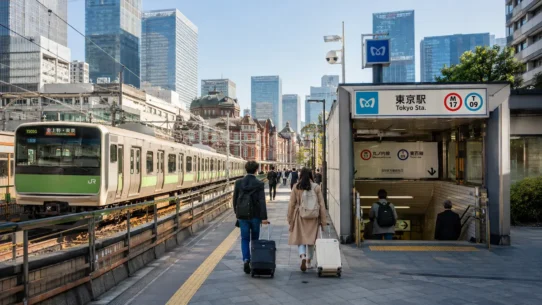
- At Tokyo Station, count the walk inside the station. The N’EX uses deep Sobu Line platforms. Reaching the Marunouchi side, Yaesu side or a Shinkansen platform can take another 10–20 minutes with luggage.
- Read the full train name and destination. “Keisei,” “Access Express,” “Limited Express” and “Skyliner” are not interchangeable. The wrong train may be slower, use another route or require an unexpected transfer.
- Do not ignore luggage rules. The TYO-NRT low-cost bus generally limits each passenger to one suitcase within approximately 158 cm total dimensions.
- After 9:00 p.m., plan defensively. A late landing can become a post-10:00 p.m. airport exit. Rail and bus choices thin out, while fixed-fare taxis add expressway tolls and apply a late-night/early-morning surcharge from 10:00 p.m. to 5:00 a.m.
- For your flight home, avoid a road-only plan with a tight margin. Trains are normally more predictable than buses or cars during congestion, accidents or holiday traffic.
The Full Experience
🚆 JR Narita Express: Best for Tokyo Station, Shibuya and Shinjuku
Direct · Reserved seating · Large luggage areas · Power outlets · Best after a long flight
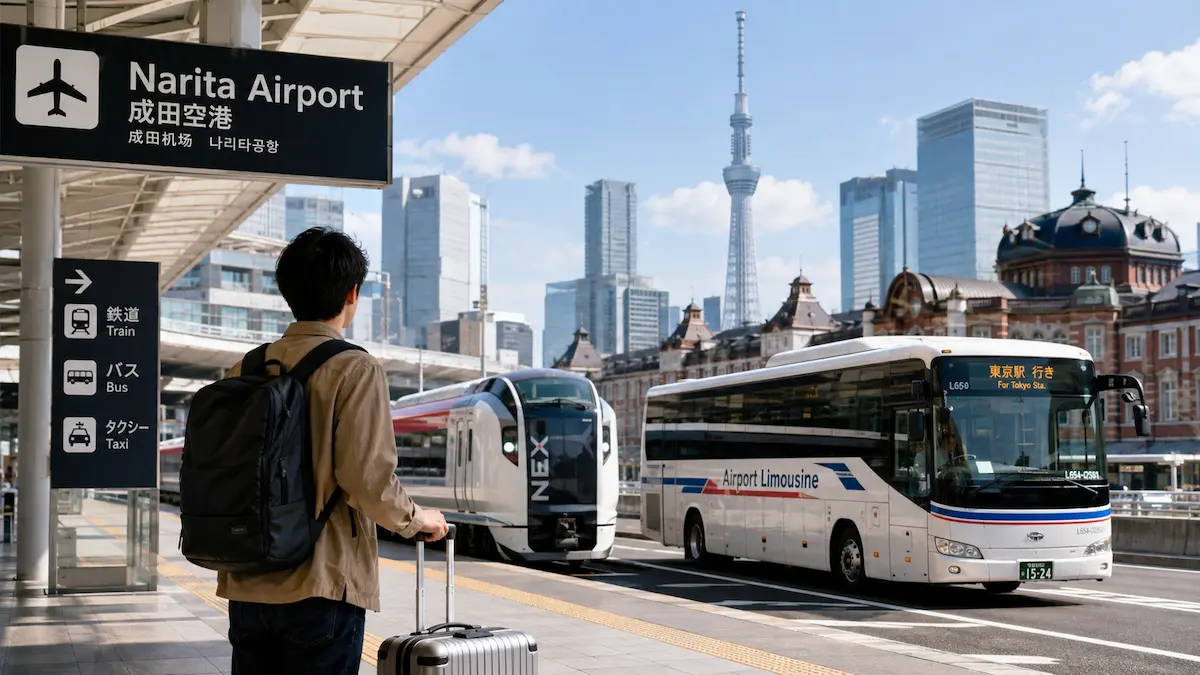
The Narita Express is the safest default for travelers staying near a major JR station on the western or central side of Tokyo. It runs directly from Narita Airport to Tokyo, Shinagawa, Shibuya and Shinjuku without forcing you to change trains while tired and carrying luggage. The fastest airport-to-Tokyo service takes 53 minutes, although Shibuya and Shinjuku take longer.
As of August 2026, the ordinary-car fare is ¥3,140 to Tokyo Station and ¥3,330 to Shinagawa, Shibuya or Shinjuku. The N’EX TOKYO Round Trip Ticket costs ¥5,200 and is valid for a round trip within 14 days, making it a strong deal when both your arrival and departure plans suit the train.
- Choose it for: Tokyo Station, Marunouchi, Shinjuku, Shibuya, Shinagawa, Yokohama, or an easy onward JR connection.
- Luggage reality: Dedicated storage areas are much better than balancing a suitcase on a commuter train.
- Ticket reality: Reserve a seat. If using a pass or special ticket, confirm whether a separate seat reservation is needed.
- Official information: JR East Narita Express guide.
✅ What Other Travelers Say
Travelers consistently value the direct ride, guaranteed seat, clean carriages and secure luggage space. It is especially popular after overnight flights because there is no need to decode a transfer at Nippori or carry bags through a regular commuter train. Families also appreciate the toilets and wider, calmer environment.
⚠️ The Catch (Things to Keep in Mind)
The headline arrival at Tokyo Station is not the end of the journey. The N’EX platforms are deep underground, and the station is enormous. A hotel advertised as “near Tokyo Station” may still be a 15-minute indoor walk away. The N’EX is also poor value for Ueno or Asakusa, where Keisei services are more direct. If your trip is longer than 14 days, the discounted round-trip ticket will not work for your return.
Editor’s verdict: Pay the premium when avoiding a transfer is worth more than saving ¥500–¥1,500. For a first visit, two suitcases, young children or a hotel near Shinjuku Station, this is usually money well spent.
🚄 Keisei Skyliner: Fastest for Ueno and Nippori
36 minutes · Reserved seating · Excellent luggage space · Best for northern Tokyo
The Skyliner is the speed champion if your destination matches its route. It reaches Nippori in as little as 36 minutes and Keisei-Ueno in 41 minutes. The standard fare is ¥2,470 to either station, with small fare differences depending on payment method and any current online promotion.
Nippori is the smarter transfer point for the JR Yamanote Line to Ikebukuro, Shinjuku, Shibuya, Tokyo and Akihabara. Keisei-Ueno is best for Ueno-area hotels, Ueno Park and nearby subway connections. Do not automatically ride to the last stop: transferring at Nippori is often easier than walking between Keisei-Ueno and another station with heavy luggage.
- Choose it for: Ueno, Nippori, Yanaka, Ikebukuro and many northern or eastern Tokyo neighborhoods.
- Luggage reality: Excellent on the Skyliner itself; less comfortable after transferring to a busy JR train.
- Ticket reality: All seats are reserved. Third-party vouchers may need to be exchanged for a physical ticket or assigned train before boarding.
- Official information: Keisei Skyliner guide.
✅ What Other Travelers Say
Reviewers regularly praise the speed, comfortable seats and easy luggage storage. The service has an unusually strong traveler rating on major booking platforms, and repeat visitors often consider it the best-value premium airport train—provided they are staying near Ueno or can make an easy connection at Nippori.
⚠️ The Catch (Things to Keep in Mind)
The Skyliner is marketed as a fast train “to Tokyo,” but it does not go to Tokyo Station, Shibuya or Shinjuku. The final transfer can erase the time advantage, especially during rush hour or with multiple bags. Also check the redemption instructions on discounted vouchers: an email confirmation may not be the ticket that opens the gate.
Editor’s verdict: This is the obvious winner for Ueno and Nippori. For Shinjuku, it is a good budget-speed compromise only when you are comfortable transferring to the Yamanote Line with luggage.
🚇 Keisei Access Express: Best Budget Train for Asakusa and Nihombashi
No express surcharge · Direct services to Asakusa · IC card friendly · No reserved seats
The Access Express is the route many first-time visitors overlook. Unlike the premium Skyliner, it is a regular train service with no limited-express surcharge. Selected trains continue through to Oshiage, Asakusa, Nihombashi, Shimbashi and Shinagawa, allowing a direct ride to areas that otherwise require a transfer.
Indicative IC-card fares are about ¥1,087 to Asakusa, ¥1,129 to Nihombashi or Shimbashi and ¥1,313 to Shinagawa. Travel time varies by service pattern and destination, but Asakusa is commonly around an hour. This is one of the best cost-to-convenience choices in the entire airport network when your hotel is near a through-service station.
- Choose it for: Tokyo Skytree/Oshiage, Asakusa, Kuramae, Nihombashi, Shimbashi and some Shinagawa-area stays.
- Luggage reality: There are no guaranteed seats or premium luggage bays. You may stand with your suitcase among commuters.
- Train reality: Not every departure goes to the same destination. Check the platform display and train destination before boarding.
- Official information: Keisei Access Express route guide.
✅ What Other Travelers Say
Budget-conscious travelers staying in Asakusa often describe the Access Express as the sweet spot: no need to buy a premium ticket, no transfer and a straightforward IC-card fare. It is particularly satisfying when the train is quiet and you get a seat from the airport.
⚠️ The Catch (Things to Keep in Mind)
This is still a commuter train. At busy times, a large suitcase can feel intrusive, seats are not guaranteed and luggage storage is limited. The naming is also confusing: a Keisei Main Line limited express and a Narita Sky Access “Access Express” can have different routes and journey times. Follow the destination display rather than boarding the first orange- or blue-labeled train you see.
Editor’s verdict: For Asakusa, this is often the best answer—not merely the cheapest. Avoid it if you have mobility limitations, several large bags or a strong need to sit.
🚌 Airport Limousine Bus: Best for Direct Hotel Drop-Offs
Minimal walking · Luggage handled · Guaranteed seat when booked · Hotel stops
The Airport Limousine Bus is not always the fastest way into Tokyo, but it can be the easiest. The key question is whether it stops at your hotel—or at a hotel close enough that the remaining walk is painless. Major routes serve Tokyo Station, Shinjuku, Ginza, Ikebukuro, Shinagawa, Tokyo Disney Resort and selected hotels across the city.
Typical fares include ¥3,100 to Tokyo Station and ¥3,600 to the Shinjuku area. Journey times vary widely with traffic and the number of stops. In light traffic, the ride can be smooth and competitive. During rush hour, rain, accidents or holiday congestion, it can take much longer than the timetable estimate.
- Choose it for: A hotel with a direct stop, families, seniors, travelers with heavy luggage or anyone who hates station transfers.
- Luggage reality: Staff place large luggage in the underfloor compartment, saving stairs and crowded-platform stress.
- Booking reality: Seat capacity is limited. Some routes allow advance reservations; same-day passengers can be refused if the bus is full.
- Official information: Airport Limousine Bus routes and reservations.
✅ What Other Travelers Say
Travelers love getting off beside their hotel instead of navigating a huge station. The bus is frequently praised by families and people carrying two large suitcases because staff handle the bags and every passenger has a seat. For the right hotel, it can save more energy than any train.
⚠️ The Catch (Things to Keep in Mind)
“Direct” does not mean fast. Your hotel may be the fourth or fifth stop, and road conditions can destroy a tight schedule. Route frequency also varies: some hotels receive only a handful of buses each day. If your flight is delayed, check the ticket’s change and cancellation rules immediately; the bus does not wait for a specific flight.
Editor’s verdict: Choose the Limousine Bus when it stops at your hotel or within one easy block. Do not choose it merely because buses seem simpler—first check the stop location, departure frequency and expected traffic at your arrival time.
💴 TYO-NRT Low-Cost Bus: Cheapest Simple Route to Tokyo Station
¥1,500 · Tokyo Station · No train transfer · Strict luggage limit
The Airport Bus TYO-NRT is the strongest budget option for travelers staying near Tokyo Station, Ginza or a convenient onward subway line. The standard one-way fare is ¥1,500, while designated early-morning and late-night services cost ¥3,000. The scheduled ride from Narita Terminal 1 to Tokyo Station is about 68 minutes, but road conditions can add significant time.
This bus is simpler than piecing together local trains, but it is not a premium hotel shuttle. It serves defined bus stops rather than dropping you at your accommodation. At the time of checking, reservations were not available and seats operated on a non-reserved basis.
- Choose it for: Tokyo Station, Yaesu, Ginza and solo travelers prioritizing price over flexibility.
- Luggage reality: One suitcase per passenger, generally within 158 cm total dimensions. Oversized or extra luggage may be refused.
- Traffic reality: Allow a generous buffer, especially when traveling from Tokyo to the airport.
- Official information: TYO-NRT official website.
✅ What Other Travelers Say
Travelers praise the low fare and the relief of reaching Tokyo Station without a rail transfer. It is often described as the best option for a light-packing solo traveler who does not mind waiting for the next available bus.
⚠️ The Catch (Things to Keep in Mind)
The one-suitcase rule is a real restriction, not a suggestion. The Tokyo Station drop-off may also be on the wrong side of the station for your hotel, creating a long final walk. Non-reserved seating means you should not build a tight connection around a specific departure, particularly during peak arrival periods.
Editor’s verdict: Excellent value for one traveler with one normal suitcase. For two people with multiple bags, the savings shrink once you add taxis at the Tokyo end or luggage-delivery fees.
🚕 Private Transfer or Fixed-Fare Taxi: Best for Groups, Children and Late Arrivals
Door to door · No transfers · Best for 3–6 people · Late-night safety net
A private transfer is expensive for one person but can become rational for a family or small group. You avoid ticket machines, platform changes and the final taxi from a station. The driver can meet you at arrivals and take you directly to a hotel, apartment or less convenient neighborhood.
Narita’s official fixed-fare taxis use Tokyo zones. Published base fares range from about ¥23,500 for closer eastern wards to ¥38,500 for farther western zones, and expressway tolls are extra. A late-night/early-morning surcharge applies between 10:00 p.m. and 5:00 a.m. Pre-booked private transfers may quote a clearer all-in price, but you must check waiting-time rules, child seats, tolls and luggage capacity.
- Choose it for: Three or more travelers, babies, seniors, limited mobility, late arrivals, ski equipment or accommodation far from a station.
- Luggage reality: Vehicle size matters more than passenger count. Four adults plus four large suitcases may need a van, not a sedan.
- Booking reality: Enter the correct flight number and phone contact. Confirm how long the driver waits after landing and what happens after a major delay.
- Official taxi information: Narita Airport fixed-fare taxi guide.
✅ What Other Travelers Say
Families frequently say the transfer feels worth the price after a long-haul flight: no stairs, no station navigation and no need to keep children and luggage together during a transfer. Groups also appreciate knowing the pickup plan before they land.
⚠️ The Catch (Things to Keep in Mind)
The cheapest quote may exclude tolls, waiting time, extra stops, oversized luggage or a larger vehicle. A flight delay can trigger additional charges after the free waiting period. Standard taxis from the rank are convenient, but the total can be startling once tolls and the night surcharge are added.
Editor’s verdict: Compare the total group price, not the per-vehicle sticker shock. For four travelers heading to a difficult address, the extra cost over four premium train tickets may be smaller than expected—and the energy saved is substantial.
Key FAQs
What is the cheapest way to get from Narita Airport to Tokyo Station?
The TYO-NRT low-cost bus is usually the simplest cheap option at ¥1,500 one way. It goes directly to Tokyo Station, but it is affected by traffic, currently uses non-reserved seating and generally accepts only one standard suitcase per passenger. Local Keisei trains can be inexpensive for Ueno or Asakusa, but they are not a direct ride to Tokyo Station.
Is the Narita Express or Skyliner better for Shinjuku and Shibuya?
The Narita Express is better for most travelers with luggage because it runs directly to Shinjuku and Shibuya. The Skyliner is faster to Nippori and cheaper, but you must transfer to the JR Yamanote Line. Choose the Skyliner when saving money matters and you are comfortable making the transfer; choose the N’EX when minimizing walking and luggage handling matters more.
How do I get from Narita Airport to Tokyo late at night?
Check the live train and bus timetable before leaving immigration because the last useful departures vary by terminal and date. If your airport exit will be late, pre-book a private transfer or consider an airport hotel rather than assuming a train will still run. Official fixed-fare taxis remain available, but expressway tolls are extra and a surcharge applies from 10:00 p.m. to 5:00 a.m.
Final Verdict and Your Next Step
There is no single “best” Narita Airport transfer. The right choice depends on where your bed is, not where the airport operator says “Tokyo” begins.
- Ueno or Nippori: Book the Keisei Skyliner.
- Asakusa, Skytree or Nihombashi: Check a direct Access Express before paying for a premium train.
- Tokyo Station, Shibuya, Shinjuku or Shinagawa with luggage: The Narita Express is the low-stress choice.
- A hotel served directly by the Airport Limousine Bus: Take the bus and save your legs, provided the schedule works.
- Tokyo Station or Ginza on a strict budget: Use the TYO-NRT low-cost bus and respect its baggage limit.
- Family, group, late flight or awkward hotel location: Price a private transfer before ruling it out.
Airport trains and popular bus departures can fill during weekends, school holidays, cherry blossom season and major events. Booking in advance also gives you time to read the redemption rules instead of solving them while jet-lagged in the arrivals hall.