
💡 Key Takeaways
- Porta Nuova is Turin’s main railway station; Porta Susa is a different major station. Check the name on your actual arrival and departure tickets before choosing a city-centre transfer or booking a station-side room.
- For the Musei Reali/Piazza Castello end, the museum’s official directions give about 1.4 km/20 minutes on foot from Porta Nuova, or 1.7 km/25 minutes from Porta Susa. Those are landmark walking baselines, not luggage-ready guarantees to every hotel entrance.
- Walk when the actual route and bags suit you; use GTT when its real stop saves work; compare a licensed taxi for an awkward complete transfer. GTT’s City ticket is €1.90 digital or €2 on chip-on-paper, valid for 100 minutes with one metro journey, and needs validation on each boarding or entry.
The practical question about Turin Porta Nuova to City Center is whether the route to your actual door is easy with the bags you have. Porta Nuova is already central, but that does not put every historic-centre apartment, river-side room or museum entrance outside its forecourt. A manageable-looking walk can become a poor arrival choice when it ends beyond the place you used as your map pin.
Start with the station on your ticket. The city’s mobility information identifies Porta Nuova as the main station and Porta Susa as another major rail interchange. Both connect with the metro and surface transport, but they are different places. An airport train arriving at Porta Susa has not brought you to Porta Nuova, and a hotel described as “near the main station” needs an exact address.
This guide compares three useful onward methods: walking, GTT public transport, and a licensed taxi or separately agreed chauffeur. Current primary information was checked on 6 November 2026. Route judgments are researched planning advice, not a claimed personal timed luggage transfer, invented guest survey or fixed taxi quote. Arrival from the airport is a separate first leg; this guide starts after the railway journey.
The 1-Min Cheat Sheet
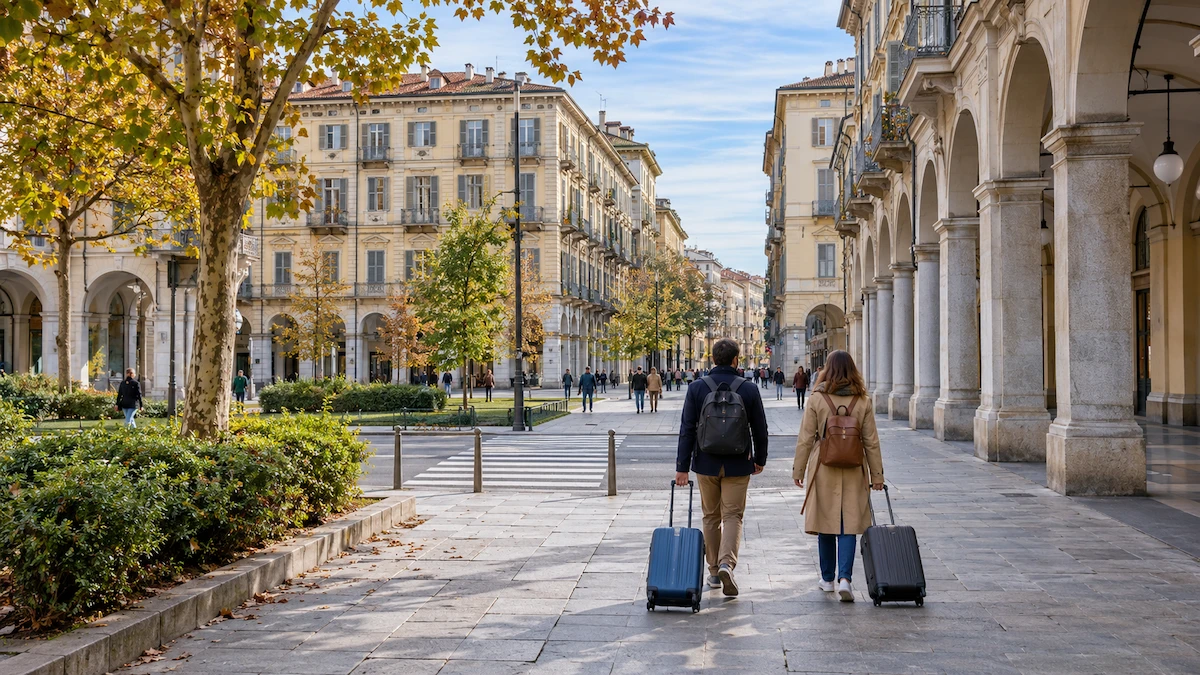
- 🚶 Walk: best for manageable bags and a suitable central entrance. From Porta Nuova, the Via Roma axis leads through the central squares toward Piazza Castello. The Musei Reali owner gives its own approach as approximately 1.4 km/20 minutes. Use the actual hotel route and a realistic carrying pace rather than treating that landmark baseline as a universal transfer time.
- 🚇 GTT metro, bus or tram: best when the real stop removes enough walking to justify boarding. The City ticket is €1.90 digital or €2 on chip-on-paper, with 100-minute validity and one metro journey. The metro links Porta Nuova and Porta Susa, but it does not deliver you to Piazza Castello. Match the route to the final entrance, not simply a familiar station name.
- 🚕 Licensed taxi or accepted chauffeur: best for the difficult final leg. Price the actual station, property, party, cases and arrival time. Taxi Torino’s online calculator is indicative, not a confirmed fixed fare for every central hotel. The airport’s central maximum must not be copied into this short station-to-hotel comparison.
For a room genuinely close to Porta Nuova, walking can be simpler than buying a ticket and negotiating a second boarding. For a room deeper into the old town, a useful surface service or a suitable taxi can remove more work. Do not take a vehicle merely to reach an attractive square and then discover that the accommodation lies back in the direction you started.
Top Survival Tips
- Save the entrance before leaving the platform. Confirm the reception building, street number and any apartment check-in appointment. A neighborhood label, booking-map marker and baggage-drop door can refer to different places. Keep the actual instructions offline and identify how you will contact the host if the train is late.
- Check departure as well as arrival. You may arrive at Porta Susa and leave from Porta Nuova, or the reverse. Plan those as two separate luggage journeys. A convenient arrival is still valuable, but it should not disguise an early departure transfer that needs another vehicle or more time.
- Count the load each person will move. Two people with small cases and a parent carrying bags while supervising children have different practical limits. Include a stroller, walking aid and anything too large for one hand. Choose a route you can finish comfortably, rather than one that only looks short in kilometres.
- Do not equate arcades with an entirely protected route. Turin’s central porticoes can make walking pleasant, but junctions, crossings, temporary works and the final building approach still exist. Use current marked crossings and signs. A dry-looking walking film is not a promise of today’s pavement or weather.
- Read validation rules before the doors close. GTT’s ordinary City product requires validation on each bus/tram boarding or metro entry within its validity. A purchased but unused ticket and a valid journey are not necessarily the same thing. Keep the ticket or payment medium accessible for inspection.
- Do not use one contactless card for the whole group. GTT’s current Tap&Go FAQ says repeated taps on the same card cannot buy simultaneous tickets for several people. That differs from some airport-coach payment arrangements. Obtain the correct tickets for the actual party, and do not assume a railway ticket covers an onward city ride.
- Resolve accessibility before the arrival. RFI’s station information warns that temporary lift outages and the difference between platform and train height can alter accessibility. Contact the relevant assistance service for the rail leg and check the street, public-transport and building route separately. A lift somewhere inside a station does not settle the complete path.
- Agree the taxi load and lawful drop-off. State occupants, cases, special equipment and any child restraint requirement. A vehicle can remove the public-transport change without removing the property’s internal stairs. Ask where it may actually stop and how far the final approach remains.
Define “City Center” Before Choosing a Route
For the Via Roma/Piazza San Carlo corridor, walking from the Porta Nuova side is a natural comparison when your bags and the actual entrance suit it. For the Piazza Castello/Musei Reali end, use the whole route and consider a suitable surface service when the walk is too much. For the eastern centre or river side, add the remaining distance beyond the central squares; the first famous landmark may not be your destination.
The Musei Reali’s own arrival instructions give approximately 1.4 km/20 minutes from Porta Nuova: cross Corso Vittorio Emanuele II and Piazza Carlo Felice, then follow Via Roma toward Piazza Castello and Piazzetta Reale. From Porta Susa, the museum describes approximately 1.7 km/25 minutes via Via Cernaia and Via Pietro Micca. These are useful owner-provided landmark routes. They do not include your train-platform exit, a hotel detour, a rest stop or a difficult load.
Porta Susa deserves its own assessment if that is your real arrival. An address near Via Cernaia or Cit Turin may not need a detour to Porta Nuova at all. For a Porta Nuova-side room, the metro may be useful; for a central-north door, another route may be more sensible. The objective is reaching the accommodation, not collecting both station names.
For a four-person full-fare party, four digital City tickets total €7.60, or €8 on the stated chip-on-paper medium. Compare those actual one-journey inputs with a suitable vehicle quote if needed, then add the walking each option leaves. Those figures do not establish child eligibility, a guaranteed group product or the price of a taxi. Use the product that actually applies to the party.
The Full Experience
The three genuine films below were discovered in actual searches and checked against their watch/oEmbed identity, publication date and embedding permission. Sample storyboard images were inspected. They show a dated Porta Nuova orientation, a dated metro boarding context and a commercial chauffeur-category preview. Relevant candidates and their displayed popularity were compared without claiming a complete platform-wide popularity ranking. None is treated as a current service notice, a hotel-route guarantee or a verified traveler-review consensus.
🚶 Walking: Best When the Actual Door and Bags Suit the Central Route
No ticket purchase · Via Roma orientation · Your own pace · Full entrance route matters
Walking is often the most straightforward answer for an unhurried arrival with a small load and a suitable central room. You leave the station once, avoid another payment interface and keep control of the pace. From the Porta Nuova side, the central Via Roma axis is useful orientation, with the owner’s Musei Reali directions providing a concrete route toward Piazza Castello.
Use the hotel’s actual street and entrance before choosing an exit. A room on the San Salvario side of the station, a Via Roma-side hotel and a property nearer the river are different walks. Do not cross the main road toward the best-known central square automatically if the room is on another side. Read the station’s current signs, use the appropriate pedestrian exit and follow marked crossings.
The municipal Via Roma project covers pedestrianization, surfaces and crossings along the central axis. A project description is not a live statement that every section is currently free of works. Check the route’s present signs and any instructions from the accommodation rather than assuming a film’s pavement remains unchanged.
I would keep the first walk purposeful: reach the room or an agreed baggage drop, then explore. A case rolling awkwardly over joints makes a very different introduction from the same street with free hands. Walking remains a good sightseeing choice even if you buy a taxi for the luggage transfer; the two decisions solve different problems.
Allow extra margin if you need to find an apartment door, wait for a host or supervise children at crossings. The museum’s approximate walking baseline is a helpful reference, not an appointment you should promise to meet immediately after your train arrives. There is no benefit in saving a small fare and starting the stay rushed or uncomfortable.
✅ What Other Travelers Say
Via Mondo’s March 2025 Porta Nuova film shows the station frontage, surrounding streets, metro access and the interior. Its inspected opening frames are useful for recognizing the interchange. It is a station-orientation film, not a continuous demonstration of the exact route to your room, and its explanatory captions are not adopted as current ticket or service rules.
⚠️ The Catch (Things to Keep in Mind)
The last few streets matter as much as the main avenue. A “central” apartment can still leave a considerable approach or an awkward entrance. If the full route looks marginal with your load, decide on the alternative while still at the station rather than after carrying the cases halfway there.
🚇 GTT Metro, Bus or Tram: Best When the Real Stop Removes Useful Walking
City ticket €1.90 digital/€2 paper medium · 100 minutes · One metro journey · Validate each boarding
Public transport earns its place when the destination stop removes enough walking to justify reaching it, buying or validating the ticket, waiting and boarding. The current GTT fare page lists City at €1.90 digital or €2 on chip-on-paper, valid for 100 minutes from first validation with one metro journey. It is an individual ticket and requires validation when boarding a bus/tram or entering the metro within that period.
The actual GTT metro stop sequence connects Porta Susa, Vinzaglio, Re Umberto and Porta Nuova on line M1. That can help with a transfer between station-side addresses. It does not make Piazza Castello a metro stop. For a museum-side door, a surface service or a suitable walk may finish closer than an unnecessary descent to the metro.
For the museum end, the owner lists surface connections from both main stations. Use those as a starting point and confirm today’s operator route, direction, stop and any diversion. A line number copied into a guide is less useful than the actual next service to a stop that suits your entrance. This article deliberately does not promise a permanent bay, a particular headway or uninterrupted late-night operation.
GTT’s current contactless FAQ says the same payment card cannot be tapped repeatedly to buy simultaneous journeys for several people. Each traveler needs the applicable ticket or payment arrangement. Keep the medium available for validation and inspection, and be clear whether you are using an existing ticket or buying a new contactless journey.
A short transfer does not automatically justify a day pass. If you will walk after dropping the bags, price the necessary City journey first. If the day genuinely includes repeated rides, compare the current appropriate pass separately. Do not activate a sightseeing or transport product simply because it is already in your pocket without checking its timing and coverage.
✅ What Other Travelers Say
Tito Rhan’s March 2021 film shows the street approach, stairs, ticket machines, gates and metro platform context in the inspected opening sheet. It helps explain why boarding is its own part of a luggage journey. Its old machine screens and stair route are not current fare instructions or proof that an accessible alternative is unavailable today.
⚠️ The Catch (Things to Keep in Mind)
Several station levels, a wait and a final walk can outweigh a short ride. Check the actual lift status and route if stairs are unsuitable, and verify the service for your arrival time through GTT’s operator information. If the stop-to-door leg remains awkward, public transport may have moved the same problem rather than solved it.
🚕 Licensed Taxi or Agreed Chauffeur: Best for the Difficult Complete Transfer
Actual station and entrance · Whole-vehicle comparison · Capacity and cases confirmed · Indicative calculator is not a quote
A taxi is useful when it removes an arrival task the party would otherwise struggle to complete: too many cases, an awkward onward route, unsuitable weather or a hotel entrance far from a helpful stop. Both main railway interchanges have taxi services according to the city’s mobility information. Follow the actual official rank arrangement or use the local operator’s genuine dispatch methods.
Taxi Torino’s owner site provides dispatch and advance-booking methods and asks travelers with special needs to contact its service. Give the actual station, pickup point, occupants, cases and any necessary equipment. If you arrange collection in advance, agree what happens when the train is late and how to identify or contact the assigned vehicle.
The owner’s fare page calls its route calculator indicative and explains that automated estimates cannot settle all queues, tolls or waiting. Do not invent a fixed station-to-every-hotel fare from that tool, and do not copy the separate airport maximum into an urban trip. Ask about the applicable fare or accepted quote for the actual journey.
For a group, compare one suitably sized vehicle with the total of the tickets you would actually need. The taxi may leave you with fewer transfers, but it still has to fit the party and luggage. If an apartment is on a pedestrian street, establish the permitted drop-off and remaining approach. A car does not guarantee reception-level access or remove the building’s internal stairs.
A separately booked chauffeur has its own agreed price and conditions. It can make sense for a planned larger vehicle or equipment requirement, but the booking must actually confirm those details. A glossy service video is not evidence that the car shown is waiting at Porta Nuova, and an airport-focused transfer offer may not be the right product for a short urban trip.
✅ What Other Travelers Say
The February 2021 Transfer Airport24 film is a commercial chauffeur-category preview, with promotional airport and car scenes. It is not a filmed Porta Nuova taxi journey, a current station-queue report or an independent traveler review. It illustrates the prearranged-vehicle category only; the actual city taxi and fare guidance comes from the local mobility and taxi sources above.
⚠️ The Catch (Things to Keep in Mind)
A useful vehicle transfer ends at a useful lawful place and includes the actual load. Confirm those details before comparing prices. If the property has not explained its final approach, ask first: paying more for a car is worthwhile when it removes known work, rather than delivering you to another uncertain luggage route.
Key FAQs
Can I walk from Turin Porta Nuova to the city center?
For a suitable route and manageable bags, yes. The Musei Reali owner gives its Piazza Castello-side approach as approximately 1.4 km/20 minutes via the Via Roma axis. Check the actual accommodation entrance and add the platform exit, carrying pace and any detour instead of treating that landmark route as every hotel’s transfer.
Should I arrive at Porta Nuova or Porta Susa for a Turin hotel?
Use the station served by the train you actually book, then compare the complete property journey. Porta Nuova and Porta Susa offer different central approaches. A useful rail schedule or suitable room can matter more than selecting one universal “best” station; check the return train independently.
Does the Turin metro go from Porta Nuova to Piazza Castello?
Piazza Castello is not on the M1 stop sequence cited here. The metro is useful for the station corridor and other destinations along its line. For a Castello-side entrance, compare a current surface service with the complete walk or a suitable taxi.
Final Verdict and Your Next Step
Walk from Porta Nuova when the actual entrance and bags suit the route. Use GTT when its real stop and operating time remove useful work. Compare a licensed taxi when one suitable vehicle resolves the difficult final stage. If the ticket says Porta Susa, begin the same comparison there rather than transferring to Porta Nuova by habit.
Choose a genuine GTT ticket through its listed purchase channels, check the actual RFI station and assistance information, or use Taxi Torino’s real booking and dispatch entry for a required vehicle. Agree special requirements early, save the property instructions, and plan the enjoyable central wandering after the cases have reached their destination.