

💡 Key Takeaways
- Seomyeon is the safest all-round choice for a short first trip when your sightseeing list is split across Busan. Metro Lines 1 and 2 meet here, so you are not committing your entire trip to either the western old-town sights or the eastern beaches.
- Do not choose a hotel from beach photos alone. Haeundae and Gwangalli are excellent places to stay, but both can add repeated cross-city travel if your must-sees are Jagalchi, Gamcheon, Songdo and Nampo. Busan is spread out enough for the wrong base to become a daily tax on your time.
- Check the exact hotel-to-station walk before paying. A listing can say “Haeundae” or “Gwangalli” while still leaving you with a noticeable walk to the metro. That matters much more when you are dragging luggage, traveling with children, or coming back after a full day on your feet.
Choosing among the best areas to stay in Busan is less about finding the “nicest” neighborhood and more about deciding which inconvenience you are willing to accept. Busan is not a compact city where every major sight sits a few subway stops away. Its beaches, markets, temples, cable cars, hillside villages and KTX station are distributed across a long urban coastline. A hotel that looks perfect on Instagram can quietly turn into two long transit sessions every day.
The real pain point is geography. Haeundae puts you close to the classic beach experience and the eastern coastal attractions. Nampo-dong places you beside markets, old downtown streets and a strong cluster of west-side sightseeing. Seomyeon sits between the two worlds and gives you the most flexible subway setup, but no sea view. Gwangalli delivers one of the best evenings in the city, yet the beachfront is not directly on top of the metro. Busan Station is unbeatable for certain arrivals and departures, but it is a transport base rather than the most atmospheric holiday base.
This guide compares those five areas with one goal: help you spend less time transferring, walking with luggage and regretting a cheap hotel that was cheap for a reason.
The 1-Min Cheat Sheet
- Seomyeon — best overall for first-time visitors with a mixed itinerary. Choose it for Metro Lines 1 and 2, food, shopping and late-night energy. Skip it if waking up by the sea is non-negotiable.
- Haeundae — best for beach-first trips, families and east-Busan sightseeing. Choose it for Haeundae Beach, Blue Line Park, resort-style hotels and an easy holiday atmosphere. Skip it if most of your plan is Gamcheon, Nampo, Jagalchi and Songdo.
- Gwangalli — best for couples, cafés, bridge views and evenings with atmosphere. Choose it if the neighborhood itself is part of the trip. Skip it if you want your hotel door to be only a minute or two from a subway platform.
- Nampo-dong — best for markets, street food and west-Busan sightseeing. Choose it for Jagalchi, BIFF Square, Gukje Market, Yongdusan Park and easier access toward Songdo and Gamcheon. Skip it if your nights revolve around beach bars or you plan multiple east-coast mornings.
- Busan Station / Choryang — best for KTX convenience, one-night stays and early departures. Choose it when arrival and departure logistics matter more than neighborhood charm. Skip it for a relaxed three- or four-night beach holiday.
Top Survival Tips
- Build your hotel choice from your itinerary, not from a “top 10 Busan hotels” list. Put your must-see places into two rough groups: west/old-town Busan (Nampo, Jagalchi, Gamcheon, Songdo, Yeongdo) and east/coastal Busan (Haeundae, Cheongsapo, Songjeong, Haedong Yonggungsa, Centum City). If your days are evenly split, Seomyeon usually creates the least friction. If 70% of your plan sits on one side, sleep on that side.
- Treat the station walk as part of your commute. Official Visit Busan directions place Haeundae Beach at roughly a 15-minute walk from Haeundae Station and Gwangalli Beach at roughly a 13-minute walk from Gwangan Station. Your exact hotel may be closer or farther, but the lesson is simple: “near the beach” and “near the subway” are not always the same thing.
- Do not underestimate Seomyeon Station itself. It is convenient because Lines 1 and 2 connect there, but a big interchange plus underground shopping passages can make a hotel on the wrong side of the junction feel farther than the map suggests. Check the recommended station exit and the above-ground walking route before booking.
- If you arrive late by KTX, do not force a cross-city transfer just to sleep beside the beach. One night near Busan Station can be sensible if your train arrives late and you are moving on early. Alternatively, Seomyeon is a straightforward Line 1 ride from the station and gives you a better base for a multi-day stay.
- If you fly into Gimhae, check the current airport-bus timetable rather than assuming the old route still applies. Busan reorganized airport limousine services in 2026, with routes serving Haeundae/Gijang and Seomyeon/Bujeon. They can be useful with luggage, but service frequency and operating hours matter.
- Avoid making a hillside attraction your luggage base. Gamcheon Culture Village is worth visiting; it is not where most travelers should drag suitcases. The same principle applies to pretty accommodations that require steep climbs, multiple outdoor stairs or a long walk from the nearest practical transit stop.
- For Gwangalli, verify the exact room category if the bridge view is why you are paying extra. “Ocean view,” “partial ocean view” and “Gwangan Bridge view” are not interchangeable. A cheaper room in the same building may face inland.
- For Haeundae, decide whether you want the beach or the metro closer. A beachfront room is convenient for sand, sunrise and evening walks; a hotel nearer Haeundae Station can reduce the repeated walk when you are sightseeing elsewhere.
- Do not split hotels on a two-night trip. Packing, checking out, storing bags and checking in again can erase the time you hoped to save. A split stay starts making more sense around four nights, especially if you want both an old-town/west-side phase and a beach/east-side phase.
- Book popular beach areas earlier for summer weekends and major event dates. Haeundae and Gwangalli have a finite supply of genuinely well-located rooms, and the best-value options tend to disappear before the merely expensive options do.
The Full Experience
🚇 Seomyeon: Best for First-Time Visitors, Food and Easy Cross-City Transport
Metro Lines 1 + 2Best All-Round BaseFood & NightlifeNo Beach
Choose Seomyeon if you want one hotel for a short trip and your sightseeing list goes in several directions.
Seomyeon wins the practical argument because it is where Busan Metro Lines 1 and 2 meet. Line 1 is useful for the Busan Station and Nampo/Jagalchi side of the city; Line 2 runs toward Gwangalli, Centum City and Haeundae. That does not make Seomyeon “close” to everything. It makes it less inconvenient than committing to one end of the city when your itinerary is spread out.
This distinction matters. Travelers sometimes book Seomyeon expecting to walk to major Busan landmarks and then feel underwhelmed. Seomyeon is not a sightseeing district in the same way Haeundae or Nampo can be. Its value is the combination of transport, restaurants, shopping, department stores, underground shopping and nightlife. You come back after a long day and still have plenty of places to eat without planning another journey.
The best micro-location is usually within a genuinely comfortable walk of Seomyeon Station, preferably on the side that matches your hotel exit. If you like trendier cafés and a slightly different evening feel, the Jeonpo side is appealing, but do not casually add a long walk just because a property describes itself as “Seomyeon.” With luggage, seven minutes and seventeen minutes are very different hotel locations.
✅ What Other Travelers Say
Across recent traveler discussions, Seomyeon is repeatedly recommended for first visits because Busan is so spread out. The common theme is not that Seomyeon is the prettiest part of the city; it is that the Line 1/Line 2 interchange makes it easier to visit both the old-town sights and the eastern beaches without changing hotels. Travelers also consistently mention the density of food, shopping and nightlife as a major convenience after sightseeing.
⚠️ The Catch (Things to Keep in Mind)
You are choosing efficiency over coastal atmosphere. There is no beach outside your door, and your first morning view will be dense downtown Busan rather than sea and sand. If the emotional highlight of your trip is supposed to be sunrise at Haeundae, evening drinks by Gwangan Bridge and spontaneous beach walks, Seomyeon can feel like the sensible choice that never becomes your favorite neighborhood.
Also remember that a major interchange is not automatically effortless. Seomyeon Station is busy, its underground network is extensive, and hotel listings can make walking distances look simpler than they feel in practice. Check the exact exit, elevators if you have heavy luggage, and the final street crossing.
Best decision: For a two- or three-night first trip covering both east and west Busan, Seomyeon is the recommendation I would make most often. It minimizes the chance that your hotel choice controls your itinerary.
🏖️ Haeundae: Best for Beach Lovers, Families and East-Busan Sightseeing
Iconic BeachResort HotelsFamily-FriendlyBest for East Busan
Choose Haeundae if being at the beach is part of the trip itself, not just one item on your sightseeing list.
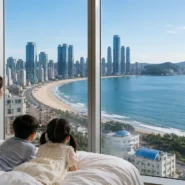
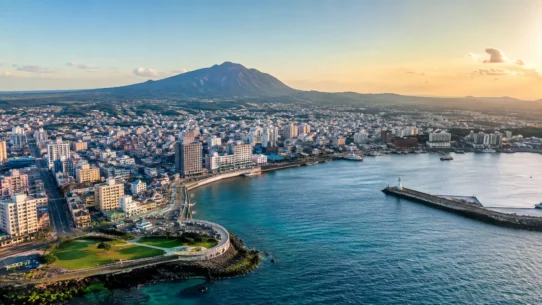
Haeundae gives you the version of Busan many first-time visitors have in mind: a broad urban beach, tall hotels and towers, restaurants, cafés, a busy evening promenade and easy access toward the Blue Line Park corridor. It is the strongest base if your itinerary leans toward Haeundae Beach, Cheongsapo, Songjeong, Centum City and the eastern coast.
It is also one of the easiest areas for families to understand. You can build low-effort days without repeatedly boarding the subway: beach in the morning, lunch nearby, aquarium or coastal activities, hotel break, then dinner and a walk. That ability to return to the room without crossing the city is worth more than it sounds when traveling with children, older relatives or anyone who dislikes hyper-efficient sightseeing.
The hotel stock is broad, from practical mid-range chains to high-end beachfront properties. The trade-off is that “Haeundae” covers enough ground that location still matters. A hotel can be in the district without giving you the walkable beach holiday you imagined. Check the distance to the sand, to Haeundae Station and to the specific attractions you care about. If you are using the subway daily, a slightly less glamorous room near the station can be more useful than a sea-view room that adds a repeated walk.
✅ What Other Travelers Say
Travelers who recommend Haeundae usually emphasize how much there is to do in one area. Recent first-time visitor discussions often describe it as the easiest place to get the classic Busan experience without needing to travel every evening. Hotel reviews also frequently praise beach proximity and the convenience of having restaurants and attractions close by.
⚠️ The Catch (Things to Keep in Mind)
Haeundae is on the eastern side of the city. If you are planning a heavy Nampo/Jagalchi/Gamcheon/Songdo itinerary, the commute becomes repetitive. One long cross-city day is fine. Doing it on most days is the point where your “dream beach hotel” starts charging you in lost time.
Summer weekends and event periods can also change the character of the area. The same lively atmosphere that feels exciting in the evening can mean higher room rates, fuller restaurants and more people on the promenade. If you want quiet rather than energy, a room a few streets back or a less central beach area may suit you better.
Best decision: Stay in Haeundae when at least half of your priority list is on the eastern/coastal side or when you deliberately want to slow down and enjoy the neighborhood between sightseeing stops.
🌉 Gwangalli: Best for Couples, Cafés, Night Views and a More Local Beach Vibe
Gwangan Bridge ViewsCouplesCafés & BarsBeachfront Atmosphere
Choose Gwangalli when you care more about how your evenings feel than about having the mathematically shortest sightseeing commute.
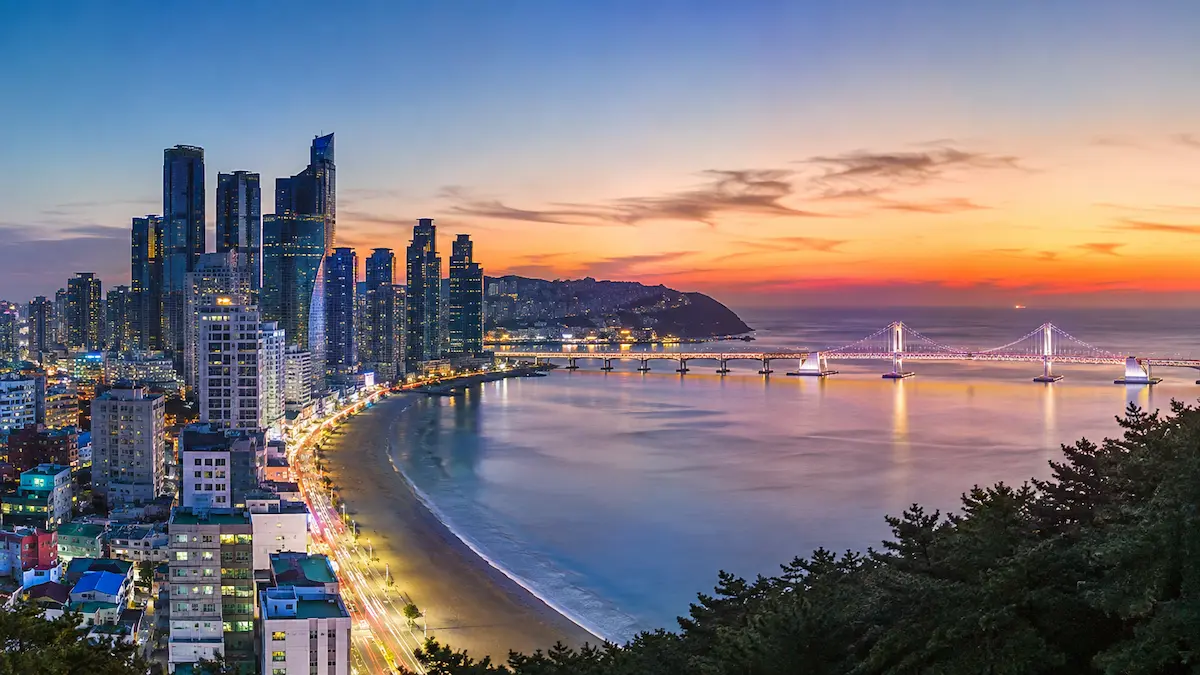
Gwangalli is the area I would put ahead of Haeundae for some couples and repeat visitors. The reason is simple: the Gwangan Bridge view gives the neighborhood a strong sense of place after dark. Cafés, restaurants and bars line the beach, and the waterfront feels like somewhere you would intentionally spend an evening rather than simply return to sleep.
This is a particularly good choice for travelers who dislike the resort feeling of Haeundae but still want the sea outside. It can feel more social and café-driven, with a long waterfront that encourages lingering. Busan Metropolitan City highlights Gwangalli for its night views, fine sand, restaurants, cafés and marine activities; that description aligns closely with why people choose to stay here rather than simply visit for an hour.
However, Gwangalli has one very specific luggage problem: the beach itself is not directly at the metro station. Visit Busan lists Gwangalli Beach at around a 13-minute walk from Gwangan Station. That is fine on a pleasant evening with a small bag. It is less charming with a large suitcase in humid summer weather. If your hotel is beachfront, check whether a bus or taxi from your arrival point makes more sense than forcing the metro plus walk.
✅ What Other Travelers Say
Recent traveler discussions frequently give Gwangalli the edge for “vibe,” cafés and bridge views. People who stay here tend to like that the neighborhood itself becomes part of the evening plan. Several travelers also note that they used buses or taxis more than expected because the beachfront and the subway are not the same location.
⚠️ The Catch (Things to Keep in Mind)
Gwangalli is not the best base for a checklist-heavy first trip that repeatedly crosses to Nampo, Jagalchi, Gamcheon and Songdo. It is also easy to overpay for the idea of a view. Before booking, confirm whether your exact room faces Gwangan Bridge, the side sea, another building or the city.
If you are sensitive to noise, read recent room reviews carefully. A beachfront full of restaurants, bars, buskers and weekend activity is atmospheric because it is active. Travelers who want early nights should not assume every oceanfront room will be quiet just because the water looks peaceful in the listing photos.
Best decision: Choose Gwangalli for a romantic or slower-paced trip where sunset, cafés and the night view are priorities. For a two-day sightseeing sprint, Seomyeon is usually more efficient.
🐟 Nampo-dong: Best for Markets, Street Food and West-Busan Sightseeing
Jagalchi & BIFFStreet FoodOld DowntownBest for West Busan
Choose Nampo-dong if your Busan list starts with Jagalchi, BIFF Square, Gukje Market, Songdo, Gamcheon and Yeongdo rather than Haeundae.
Nampo is the antidote to the idea that everyone should stay in Seomyeon. If your sightseeing plan is west-heavy, Nampo can be more logical because several major attractions are clustered around the old downtown. Visit Busan groups Gukje Market, BIFF Plaza, Jagalchi Market, Gwangbok-ro and nearby attractions into a walkable Nampo experience, and that concentration is the neighborhood’s biggest strength.
You can wake up and walk straight into a day of markets, seafood, street snacks and old commercial streets. You are also better positioned for short onward trips toward Gamcheon Culture Village, Songdo and parts of Yeongdo than someone starting from the far eastern beaches. For travelers who love eating through a neighborhood, Nampo offers more immediate street-level reward than a purely transport-focused base.
The best hotel micro-location depends on your priorities. Staying near Nampo Station works well for Gwangbok-ro, Yongdusan Park and the waterfront. Staying toward Jagalchi Station can be useful for the markets and connections toward other west-side sights. Do not book too far uphill just to save a small amount of money unless you have checked the actual walking route with luggage.
✅ What Other Travelers Say
Travelers who prefer Nampo often say the same thing: there is a lot to do on foot. Recent discussions highlight the old-town atmosphere, markets, food and easier access to the western sightseeing cluster. Some travelers who split a Busan stay between Nampo and a beach area report that the combination works well because each hotel serves a different half of the trip.
⚠️ The Catch (Things to Keep in Mind)
Nampo is not the strongest choice if your dream Busan evenings involve Haeundae or Gwangalli. The area can feel quieter later than Seomyeon, and the commercial atmosphere is older and grittier than the polished beachfront districts. That is part of its character, but it is not for everyone.
You should also resist the temptation to label every west-Busan attraction “walkable from Nampo.” Jagalchi, BIFF Square, Gukje Market and Yongdusan Park form a useful central cluster; Gamcheon, Songdo and Yeongdo still require buses, taxis or additional transit. Nampo reduces those journeys. It does not eliminate them.
Best decision: If two of your three sightseeing days are focused on markets, Gamcheon, Songdo and Yeongdo, Nampo is often more sensible than automatically following the crowd to Seomyeon.
🚄 Busan Station / Choryang: Best for KTX Arrivals, One-Night Stays and Early Departures
KTX ConvenienceLine 1Easy Luggage DaysShort Stays
Choose Busan Station when your train schedule is more important than your holiday atmosphere.
Busan Station is one of those areas that can be either a brilliant choice or a completely unnecessary compromise. If you arrive late on the KTX, leave early, have only one night, or want to store luggage and move quickly, staying within a short walk of the station removes a lot of friction. Busan Station is also on Metro Line 1, so Nampo and Seomyeon are straightforward to reach.
This base makes particular sense for travelers doing a stopover between Seoul and another destination. Instead of crossing to Haeundae with a suitcase, sleeping, then retracing your route for an early KTX, you can keep the logistics simple and spend your limited sightseeing time in the Nampo/old-town side.
For a longer leisure trip, though, convenience at 8 a.m. on departure day should not dominate the previous three evenings. The station surroundings are functional and interesting in pockets, including Choryang and nearby food streets, but most travelers will find Seomyeon, Nampo, Haeundae or Gwangalli more rewarding as a place to come home to each night.
✅ What Other Travelers Say
Hotel feedback around Busan Station commonly values exactly what you would expect: closeness to the railway, easy check-in after a train ride and the ability to leave quickly with luggage. Travelers making short KTX-based visits often find that convenience more important than a picturesque neighborhood.
⚠️ The Catch (Things to Keep in Mind)
Do not confuse “central transport hub” with “central to Busan’s tourist experience.” The city stretches far beyond the station. Haeundae and the eastern coast are still a meaningful journey away, and you will not step outside into a beach or the city’s most appealing nightlife district.
Also verify which “Busan Station” a hotel means in its marketing. The KTX railway station and the Metro Line 1 station are close together, but a property name can use “Busan Station” broadly. Check the walking route to the actual railway concourse if catching an early train is the reason you booked there.
Best decision: Excellent for one night, late arrivals, early trains and luggage-heavy transfers. For three nights of sightseeing, I would usually move one step outward to Seomyeon or Nampo unless your itinerary is deliberately KTX-centric.
Key FAQs
What is the best area to stay in Busan for first-time visitors?
For most first-time visitors with only two or three nights, Seomyeon is the best all-round area because Metro Lines 1 and 2 meet there. It gives you a balanced base for both western sights and eastern beaches. Haeundae is the better first-time choice if the coast is the main purpose of your trip and you would rather enjoy one neighborhood deeply than optimize every subway ride.
Is it better to stay in Haeundae or Seomyeon in Busan?
Stay in Haeundae for the holiday experience; stay in Seomyeon for the transport strategy. Haeundae is better for beach walks, families, resort hotels, Blue Line Park and east-Busan days. Seomyeon is better when your itinerary mixes Haeundae/Gwangalli with Nampo/Gamcheon/Songdo. If you are asking the question because you cannot decide, look at your itinerary: whichever side contains most of your fixed-time bookings should usually win.
Should I split my Busan stay between two neighborhoods?
Usually not for a two- or three-night trip. You lose time packing, checking out, storing luggage and waiting for the next room. For four nights or more, a split can be smart if your trip naturally divides into two halves—for example, Nampo or Seomyeon first for the old town and west-side sights, then Haeundae or Gwangalli for the coast. Split because the itinerary demands it, not because two hotels look exciting.
Final Verdict and Your Next Step
If you want one answer with the lowest risk of regret, book Seomyeon. It is the most forgiving base for a first Busan trip because you can change your plans without discovering that your hotel is on the wrong side of the city.
Choose Haeundae when the beach is the centerpiece of the trip. Choose Gwangalli when atmosphere, cafés and the Gwangan Bridge night view matter more than perfect transit efficiency. Choose Nampo-dong when your itinerary is dominated by Jagalchi, BIFF Square, markets, Gamcheon, Songdo and Yeongdo. Choose Busan Station when a late KTX arrival, early departure or one-night stop makes luggage convenience the top priority.
The biggest mistake is not choosing the “wrong” famous neighborhood. It is booking a hotel before you map your actual sightseeing days. Spend five minutes grouping your itinerary by east and west Busan, then check the exact walk from the hotel entrance to the station or bus stop you will use. That small check can save hours over a three-day trip.
Once your area is decided, book earlier than you think you need to—especially for summer weekends, holidays and major events. The rooms that disappear first are often not the luxury suites; they are the well-reviewed, sensibly priced hotels in the genuinely convenient micro-locations.
Ready to compare your options?