
💡 Key Takeaways
- Choose Suwon Station if logistics matter most. It is the easiest base for rail arrivals, Seoul side trips, late check-ins and travelers who would rather roll a suitcase across a concourse than drag it onto a local bus.
- Choose Haenggung-dong if Suwon itself is the trip. Staying by Hwaseong Fortress gives you the best sightseeing atmosphere and the most walkable access to the historic core, but you give up direct subway access.
- Do not book “central Suwon” without checking the nearest station and street. Ingye-dong, Gwanggyo and Yeongtong can all look convenient on a hotel map, yet they serve very different trips: nightlife, modern lake-side comfort, or business/value stays.
Finding the best areas to stay in Suwon is less obvious than it looks on a booking map. Suwon is not a single compact tourist center where every hotel is a short walk from Hwaseong Fortress, the railway station and the best nightlife. The city’s main attractions and hotel clusters sit in different pockets, and the “wrong” base can mean repeating the same bus or taxi ride every morning and evening. That matters even more if you are arriving with luggage, taking day trips to Seoul, traveling with children, or trying to fit Suwon into a short Korea itinerary.
The biggest planning mistake is assuming Suwon Station is next to Hwaseong Fortress. It is not. Korea Tourism Organization guidance places the fortress roughly a local bus or short taxi ride from the station, while Suwon’s official tourism site highlights the Hwaseong–Haenggung-dong area as its own sightseeing zone. In practical terms, you are choosing between transport convenience and doorstep sightseeing, unless you are happy to use taxis or buses. VisitKorea’s Hwaseong Fortress information and the official Suwon tourism site are useful for checking current attraction information before your trip.
This guide compares the five Suwon bases that make the most sense for most visitors: Suwon Station, Haenggung-dong, Ingye-dong/Suwon City Hall, Gwanggyo and Yeongtong/Mangpo. Rather than calling every area “convenient,” the sections below focus on the real trade-offs: how often you will need a taxi, whether the streets are lively or noisy at night, how easy it is to move with luggage, and which area actually fits your itinerary.
The 1-Min Cheat Sheet
- 🚉 Suwon Station — best overall for first-timers who prioritize transport: the strongest choice for train arrivals, Seoul connections, malls, food and simple luggage handling. The compromise is that Hwaseong Fortress is not outside your hotel door.
- 🏯 Haenggung-dong / Hwaseong Fortress — best for sightseeing, cafés and atmosphere: stay here if your ideal morning begins with a fortress walk rather than a subway transfer. Expect fewer big-chain hotels and more reliance on buses or taxis for the main rail network.
- 🌙 Ingye-dong / Suwon City Hall — best for restaurants, nightlife and mid-range hotels: a practical “city center” base with the Suin-Bundang Line nearby and a dense food scene. Avoid the loudest bar streets if you are a light sleeper.
- 🌊 Gwanggyo — best for modern comfort, lake walks, conventions and couples: polished, spacious and attractive, especially around Gwanggyo Jungang and the lake. It is a poor choice if most of your time will be spent around Hwaseong Fortress.
- 💼 Yeongtong / Mangpo — best for Samsung-area business trips, longer stays and value: local, functional and often easier on the budget than Gwanggyo. For a classic Suwon sightseeing trip, however, it puts you farther from the historic core.
Top Survival Tips for Choosing Where to Stay in Suwon
- Do not measure convenience by straight-line distance. Suwon’s hotel districts are separated by major roads, rail lines and different transit corridors. A hotel that looks only a few kilometers from an attraction can still require a bus, taxi or transfer. Always check the actual route to your top two daily destinations.
- There is no subway station directly at the main Hwaseong Fortress sightseeing core. If the fortress, Haenggung Palace, Haengnidan-gil cafés and traditional-market area are your priority, sleeping in Haenggung-dong can save repeated cross-city rides. If your priority is arriving and departing by train, Suwon Station saves more effort.
- With luggage, Suwon Station is difficult to beat. Hotels immediately around the station reduce the number of elevators, street crossings and bus transfers you need on arrival day. This matters more than a slightly prettier neighborhood if you are carrying large suitcases or leaving early in the morning.
- Check which side of the station or nightlife block your hotel is on. Around Suwon Station and Ingye-dong, two hotels with nearly identical map locations can feel very different after dark. One may open onto a mall or main road; another may sit among late-night bars, karaoke venues or motel-style properties. Read the newest location and noise comments, not only the overall rating.
- For Ingye-dong, “near Suwon City Hall Station” is a better booking filter than simply “Ingye-dong.” Staying within a short walk of the station keeps the neighborhood’s restaurant advantages while making it easier to reach other parts of the city without defaulting to taxis.
- In Gwanggyo, distinguish Gwanggyo Jungang Station from Gwanggyo Station. For most leisure travelers interested in Gwanggyo Lake Park, the convention center, department-store shopping and the main modern hotel cluster, Gwanggyo Jungang (Ajou Univ.) is usually the more useful reference point. The Suwon Convention Center states that it is about a 10-minute walk from Gwanggyo Jungang Exit 4. Check the convention center’s current access information here.
- Gwanggyo has a useful airport advantage for some travelers. The convention center currently lists airport limousine bus 8877 between Incheon Airport and the Gwanggyo Jungang/Ajou University transfer center. Airport routes and timetables can change, so verify the latest schedule rather than building a tight connection around an old blog post.
- Do not choose Yeongtong just because the room is cheaper. It is a sensible base for work, longer stays and people with business around the Samsung/Yeongtong side of Suwon, but sightseeing travelers can spend the savings on extra transport and lose time crossing the city.
- If you plan several Seoul days, compare the exact Seoul neighborhood you will visit. Suwon Station is naturally convenient for the Line 1 corridor and Korail trains, while Gwanggyo’s Sinbundang Line orientation is more attractive for Gangnam-side trips. “Easy to Seoul” is not one single thing.
- Use taxis strategically rather than treating them as a planning failure. For two or more travelers, a short taxi between Suwon Station and the fortress area can be a reasonable way to save time and avoid wrestling luggage onto a bus. The key is choosing a hotel that minimizes repeated long rides, not avoiding every taxi at all costs.
The Full Experience
🚉 Suwon Station: Best for Easy Transport, First-Time Visits and Heavy Luggage
Best for: rail travelers · Seoul side trips · short stays · late arrivals · shopping · luggage-friendly itineraries
If you want the lowest-friction base in Suwon, start with Suwon Station. The station is more than a platform: it is a major transport and commercial hub, with department-store and mall infrastructure close by, a dense restaurant zone, local buses and multiple rail options. Booking.com’s current Suwon Station listings show hotels directly beside the station as well as cheaper properties within walking distance, which is exactly why this area works so well for travelers who hate wasting the first and last hour of a stay moving luggage across town.
The strongest argument for Suwon Station is not that it is the prettiest district. It is that it makes your itinerary resilient. If you arrive later than planned, the area still gives you food, convenience stores and transport. If you are splitting your trip between Suwon and Seoul, you do not need to cross Suwon before you can even start the intercity part of your day. KORAIL’s booking system lists Suwon as an intercity rail station, while the metropolitan rail network connects the station with Line 1 and the Suin-Bundang corridor. Always check the actual train for your date, because not every long-distance service stops at Suwon.
The compromise is historic sightseeing. Hwaseong Fortress and Haenggung-dong are not attached to the station district. VisitKorea’s access guidance has long directed visitors onward by local bus or taxi from Suwon Station. That ride is easy enough once or twice; it becomes annoying if you chose Suwon specifically to spend dawn, sunset and evening around the fortress walls.
Where to book within the area: for maximum convenience, stay on the station/mall side within an easy, well-lit walk of the concourse. If you are comparing a cheaper hotel several blocks away, inspect the pedestrian route on a map rather than trusting the property’s “near Suwon Station” label. A 10-minute walk with a carry-on is not the same as a 10-minute walk with two full-size suitcases and multiple road crossings.
✅ What Other Travelers Say
Recent Booking.com feedback around Suwon Station repeatedly emphasizes the same practical benefits: walkability to the station, easy access to food and shopping, and the convenience of being close to malls and bus stops. Reviews for station-area hotels also show why the neighborhood appeals to budget-conscious travelers: there are both full-service hotels and simpler properties, so you can pay for location without necessarily paying for luxury.
⚠️ The Catch (Things to Keep in Mind)
The station district is busy and functional rather than charming. Some surrounding streets are oriented toward nightlife, motels and late-night dining, so light sleepers should read recent noise comments carefully. Most importantly, do not book here expecting to walk out of your hotel and immediately be on the Hwaseong walls. Choose Suwon Station because you value movement, not because it is the center of Suwon’s historic atmosphere.
🏯 Haenggung-dong & Hwaseong Fortress: Best for Sightseeing, Cafés and a Memorable Suwon Stay
Best for: fortress sightseeing · couples · photographers · café hopping · first-time leisure trips · slow travel
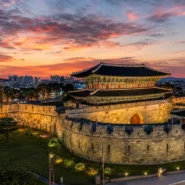
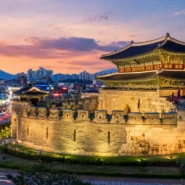
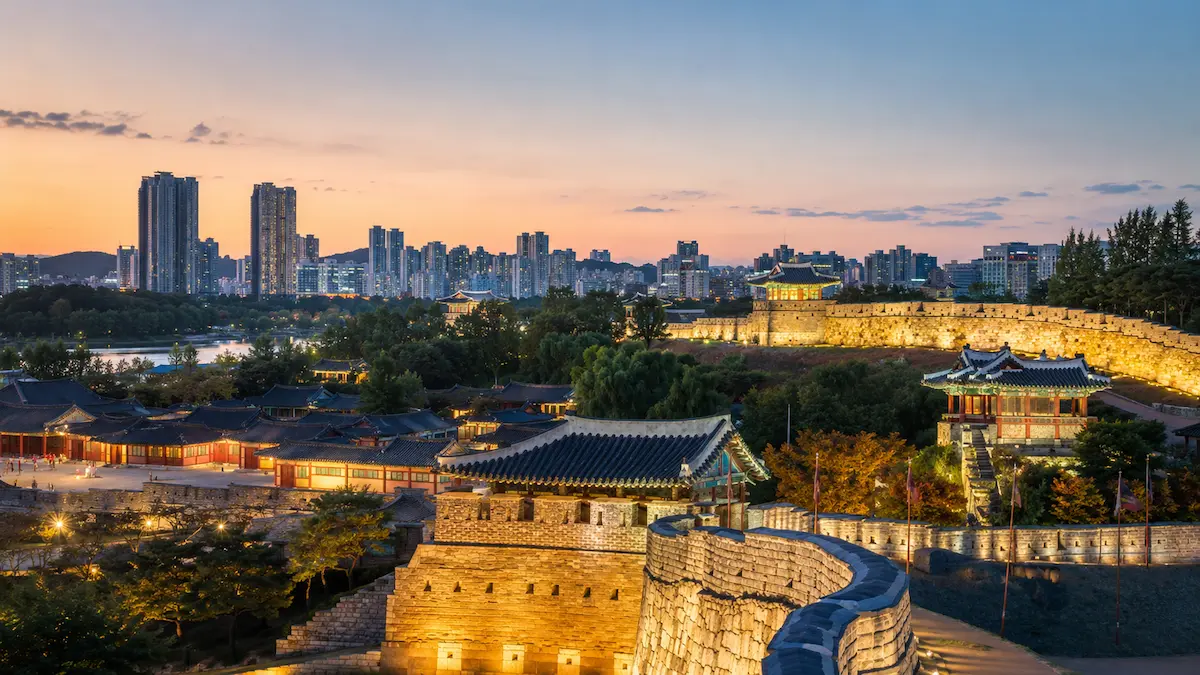
For travelers who are coming to Suwon because of Suwon Hwaseong, this is the area that makes the city feel worth staying overnight for. The UNESCO-listed fortress walls run for roughly 5.7 kilometers, and the wider tourist zone includes Hwaseong Haenggung Palace, Paldalmun, traditional markets, museums and the café-filled Haenggung-dong streets. Suwon’s own tourism site promotes the fortress and Haenggung-dong together as the core of a one-night/two-day visit, which matches the way most leisure travelers actually experience the area.
Staying here changes the rhythm of your trip. Day-trippers from Seoul tend to arrive after breakfast and leave by evening. Overnight guests can walk the neighborhood before the busiest café hours, take an unhurried sunset walk along the walls, eat near the markets, and return to the fortress after dark without budgeting another cross-city ride. That is a meaningful advantage if photography, atmosphere and walking are more important to you than rail convenience.
The best micro-locations depend on what you want to walk to. Around Haenggung Palace and Haengnidan-gil, you are close to cafés, restaurants and the most popular strolling streets. Around Janganmun, the atmosphere can feel calmer while still keeping you close to the walls. Around Paldalmun, traditional markets and food access become stronger. The area is not perfectly flat, however; parts of the fortress climb around Paldalsan, so travelers with mobility concerns should study elevation and avoid assuming every “fortress-view” accommodation is an effortless walk.
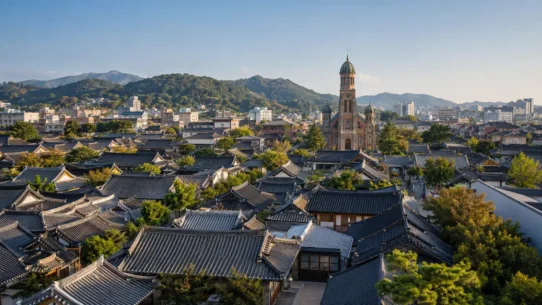
Accommodation here is also more characterful than standardized. You will find smaller hotels, guesthouses and hanok-style stays mixed into the district. That is a plus for travelers who want a memorable stay, but it means facilities such as elevators, large lobbies, 24-hour staffing or spacious parking are less consistent than in modern hotel zones.
✅ What Other Travelers Say
Recent guest feedback for Haenggung-dong stays is especially strong on location. Booking.com reviews for a hanok-style property in the neighborhood praise being able to walk to the fortress, cafés, restaurants and shopping, while Suwon Dono1796 guests similarly highlight quick access to the city’s main sights. In other words, the appeal travelers report is exactly what the map suggests: once you are checked in, much of the classic Suwon experience is on foot.
⚠️ The Catch (Things to Keep in Mind)
The historic core does not give you the same direct rail convenience as Suwon Station or the same subway convenience as Ingye-dong. If you are carrying large luggage, arriving in heavy rain or planning multiple Seoul commutes, the romantic choice can become the inconvenient one. Hotel inventory is also smaller, so the best-rated character stays can sell out earlier than generic business hotels elsewhere in Suwon. Book this area because you want to live inside the sightseeing zone, not because it is the easiest transport hub.
🌙 Ingye-dong & Suwon City Hall: Best for Restaurants, Nightlife and Mid-Range Hotel Choice
Best for: food lovers · nightlife · couples · friends · business-leisure trips · travelers who want a central-feeling base
Ingye-dong is the compromise district I would recommend to travelers who want more evening energy than Haenggung-dong and more neighborhood life than Suwon Station. The area around Suwon City Hall Station has a dense mix of restaurants, cafés, bars, convenience stores and business hotels, with the Suin-Bundang Line giving you a rail connection through Suwon’s southern and eastern districts.
It is particularly useful for people who do not want every evening to end when the tourist attractions close. Around the main entertainment streets, the neighborhood stays active late, and the concentration of food options means you can finish a long sightseeing day without researching where to eat near your hotel. Booking.com listings around Suwon City Hall include established mid-range properties such as ibis Ambassador Suwon, Four Points by Sheraton Suwon and smaller local hotels, giving this district one of the broadest “comfortable but not necessarily luxury” selections in the city.
Ingye-dong also works well for mixed-purpose trips. If one traveler is sightseeing while another has meetings in central Suwon, it offers a more balanced base than the fortress district. The station access is useful, taxis are easy to justify for the fortress, and you are not tied to a mall for your evening dining choices.
The booking trick: look for a hotel near Suwon City Hall Station but slightly outside the loudest bar-and-karaoke cluster. That gives you the transport and food advantages without placing your bedroom window directly over the late-night action. If a property is unusually cheap for its rating, inspect street-view photos and recent guest comments; parts of the district have a love-hotel/motel character that is perfectly acceptable for some travelers but not the atmosphere every family or couple expects.
✅ What Other Travelers Say
Current Booking.com reviews reinforce Ingye-dong’s practical strengths. Guests frequently mention having restaurants, shops, buses and the subway close by. Reviews for hotels in and around Suwon City Hall also praise room comfort and location, while one recent Galleria Hotel review specifically notes the convenience of being near the station and in the heart of Ingye-dong. The recurring theme is convenience after dark, not tourist-landmark scenery.
⚠️ The Catch (Things to Keep in Mind)
Nightlife is both the selling point and the biggest risk. Weekend street noise, traffic, karaoke venues and late check-ins can make some blocks less relaxing than expected. The district is also not the place to stay if your dream Suwon trip is to step outside at sunrise and walk straight onto the fortress walls. For that, Haenggung-dong wins. Ingye-dong is better when you want food, transport and evening energy in roughly equal measure.
🌊 Gwanggyo: Best for Modern Comfort, Lake Walks, Conventions and Gangnam-Side Access
Best for: couples · families · convention visitors · premium stays · lake views · Gangnam-oriented trips
Gwanggyo is the part of Suwon that can surprise travelers who only know the city for its fortress. It is a planned, modern district built around high-rise residential towers, shopping, offices, cultural facilities and Gwanggyo Lake Park. The atmosphere is cleaner-lined and more spacious than the older central districts, and the combination of the lake, malls and modern hotels makes it an easy choice for couples or families who value comfort over historic texture.
The most useful anchor for visitors is Gwanggyo Jungang (Ajou Univ.) Station, not simply anything labeled “Gwanggyo.” The Suwon Convention Center is approximately a 10-minute walk from Exit 4, and the same wider district gives access to the lake, shopping and the convention/MICE complex. Courtyard by Marriott Suwon is one of the obvious full-service hotels here, and current guest reviews often mention proximity to the park, shopping and food alongside cleanliness and comfort.
Gwanggyo is also worth considering if your Seoul time is concentrated around the Gangnam side rather than central/northern Seoul. The Sinbundang corridor is oriented toward Gangnam, which can make this base more logical than Suwon Station for certain business or shopping itineraries. The airport connection can also be convenient: the Suwon Convention Center currently lists bus 8877 between Incheon Airport and Gwanggyo Jungang/Ajou University Transfer Center. Verify the schedule before travel because airport-bus timings can change.
The lake is a real quality-of-stay advantage. Instead of finishing your day on a busy commercial street, you can take an evening walk around a large urban park. Suwon’s official tourism site specifically recommends Gwanggyo as a leisure/date area, and the city’s art-space information connects the convention complex with Gwanggyo Lake Park and nearby cultural facilities.
✅ What Other Travelers Say
Guest reviews around Gwanggyo repeatedly praise the combination of modern rooms, park access, shopping and food nearby. That pattern matters because it explains why Gwanggyo works best as a comfortable lifestyle base rather than a classic sightseeing base. Travelers who stay here are often happy with the neighborhood itself instead of merely using the hotel as a place to sleep.
⚠️ The Catch (Things to Keep in Mind)
Gwanggyo is not a clever choice if Hwaseong Fortress is the main reason for your visit and you only have one or two days. You will cross the city for the historic sights, and the modern surroundings can feel disconnected from the Suwon most tourists came to see. Prices for the best full-service hotels can also be higher than in older business districts. Choose Gwanggyo when the hotel, lake and modern neighborhood are part of the experience—not when you simply want the shortest route to the fortress.
💼 Yeongtong & Mangpo: Best for Business Trips, Longer Stays and Better-Value Local Living
Best for: Samsung-area business · repeat visitors · longer stays · value seekers · local dining · travelers with plans in southeast Suwon
Yeongtong is the least tourist-oriented recommendation in this guide, and that is exactly why it belongs here. Travelers sometimes discover good-value hotels around Yeongtong or Mangpo and wonder whether they have found a secret central base. The answer is: only if your itinerary is actually on this side of Suwon.
The district is useful for business travelers, especially people with work around the technology and Samsung-related employment belt, and for longer stays where supermarkets, restaurants, laundries and everyday convenience matter more than being beside a landmark. Yeongtong and Mangpo are served by the Suin-Bundang corridor, and the area has plenty of local commercial streets rather than being a dead suburban bedroom district.
Hotel choice here tends to lean toward practical business hotels and smaller local properties. Current Booking.com listings around Mangpo and Yeongtong show a mix of modest hotels and larger properties in nearby districts, and reviews often focus on room comfort, cleanliness and practical location rather than sightseeing. A Yeongtong stay can therefore be very efficient if your daily destination is in southeast Suwon—and very inefficient if every day begins with a trip to Hwaseong Fortress.
One point of confusion: Gwanggyo is administratively associated with Yeongtong-gu in part, but travelers should treat Gwanggyo and the older Yeongtong/Mangpo hotel belt as different bases. Gwanggyo is the modern lake/convention district on the Sinbundang side; Yeongtong/Mangpo is a more established residential and business zone on the Suin-Bundang side. Booking “Yeongtong-gu” without checking the actual station can put you in a completely different part of the city from the one you imagined.
✅ What Other Travelers Say
Guest feedback for Yeongtong-area properties tends to reward practical features: decent room size, cleanliness, parking and proximity to local amenities. Booking.com currently rates the location of K Stay Yeongtong more strongly than its overall score, which is a useful reminder to judge the hotel and the neighborhood separately. A good location for a business traveler does not automatically mean the property is the best leisure hotel in Suwon.
⚠️ The Catch (Things to Keep in Mind)
For first-time tourists, the distance from Hwaseong Fortress is the obvious drawback. You will also miss the stronger visitor atmosphere of Haenggung-dong and the transport-hub convenience of Suwon Station. Yeongtong is a smart choice when you have a specific reason to be here—work, a longer local stay, or a lower room rate that meaningfully improves your budget. It is not the default answer to “Where should a tourist stay in Suwon?”
Key FAQs
What is the best area to stay in Suwon for first-time visitors?
For most first-time visitors, Suwon Station is the safest all-round choice because it simplifies arrival, departure, Seoul connections and luggage handling. If your trip is mainly about Hwaseong Fortress and you plan to spend most of your time sightseeing on foot, Haenggung-dong is the more rewarding choice. The deciding question is simple: do you want to minimize transport friction, or maximize time inside the historic district?
Is it better to stay near Suwon Station or Hwaseong Fortress?
Stay near Suwon Station for rail convenience, malls, easier late arrivals and day trips. Stay near Hwaseong Fortress/Haenggung-dong for atmosphere, cafés, markets and walkable sightseeing. There is no universally better option. For a one-night leisure stay focused on Suwon itself, I would lean Haenggung-dong; for a multi-city Korea itinerary with luggage or repeated rail trips, I would lean Suwon Station.
How many nights should I stay in Suwon, South Korea?
One night is enough to improve significantly on a rushed Seoul day trip because you can experience the fortress area in the morning or evening. Two nights is better if you also want Gwanggyo, Starfield Suwon, cafés, markets or a slower full walk around Hwaseong. Longer stays make the most sense for business travelers, repeat visitors or people using Suwon as a base for other parts of Gyeonggi-do.
Final Verdict and Your Next Step
If you want one recommendation without overthinking it, book Suwon Station when transport is your biggest concern and book Haenggung-dong when the fortress experience is your biggest concern. Those are the two strongest choices for most leisure travelers. Ingye-dong is the best middle ground for food and nightlife, Gwanggyo is the polished modern option for lake-side comfort and conventions, and Yeongtong/Mangpo is the specialist choice for business, longer stays and southeast-Suwon plans.
Before paying, open the hotel on a map and test three routes: arrival point → hotel, hotel → your number-one attraction, and hotel → your likely evening area. That two-minute check catches more bad bookings than comparing another twenty room photos. Also read the newest noise and location reviews—especially around Ingye-dong and the streets near Suwon Station.
Suwon’s best-located rooms, hanok-style stays and major-brand hotels can become limited on weekends, festival periods and busy event dates. Once your neighborhood choice is clear, it is usually better to reserve a cancellable option early rather than wait for the “perfect” deal and end up across the city.
- Compare Suwon hotels on Booking.com: Check current Suwon hotel availability on Booking.com
- Compare Suwon hotels on Agoda: Check current Suwon hotel deals on Agoda
- Book a Suwon Hwaseong tour on Klook: View Suwon Hwaseong Fortress tour options on Klook
- Book a Suwon day tour on KKday: View Suwon Hwaseong and Korean Folk Village tour options on KKday
Planning note: transport routes, airport buses, hotel inventory and tour products can change. Recheck schedules and cancellation conditions for your exact travel date before booking.