
💡 Key Takeaways
- Take a taxi if you have a suitcase, arrive late, or are traveling as a pair or group. Downtown Gangneung is close enough to the station that the extra cost is usually modest, and you avoid waiting at a bus stop with luggage.
- Take a local bus if you are traveling light and every won matters. The current adult fare is ₩1,530 with a transport card or ₩1,700 in cash, but the real cost is your waiting time and the walk from the bus stop to your hotel.
- Walking is genuinely realistic for the Wolhwa Street–Jungang Market area, but not automatically the smartest choice. In good weather with a backpack, it is pleasant. In summer heat, rain, snow, or with rolling luggage, saving a few thousand won can quickly feel like false economy.
If you are searching for the best way to get from Gangneung Station to Gangneung city center, the first thing to know is that “city center” is not one single transport hub. For most visitors, the useful downtown zone is around Wolhwa Street, Gangneung Jungang Market, Geumseong-ro and the older commercial streets nearby. This is where you will find food, shops and a good concentration of practical accommodation. Many international travelers reach Gangneung after a long airport-to-Seoul connection and then a KTX ride, so the final 10–25 minutes can feel more annoying than the long-distance journey if you choose badly: one unnecessary bus wait, one awkward road crossing with a suitcase, or one hotel booked on the “wrong” side of town can turn an easy arrival into a tiring one.
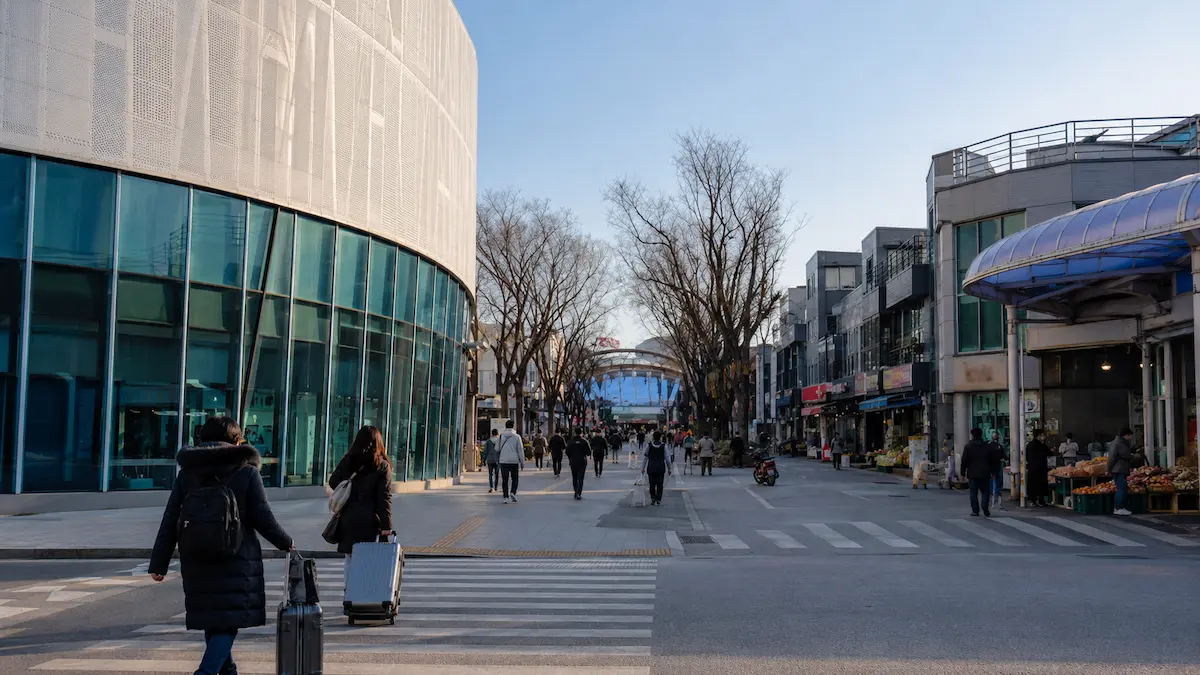
The good news is that Gangneung Station is not far from downtown. Korea Tourism Organization describes Wolhwa Street as running through downtown Gangneung and notes that it is about a ten-minute bus ride from Gangneung Station. Gangneung City also describes the Wolhwa Street corridor as a walking route beginning at the station and continuing across the city center. In other words, this is not a complicated transfer. The real decision is whether saving money is worth the extra walking and waiting for your luggage, weather, arrival time and hotel location.
The 1-Min Cheat Sheet
- Taxi — best overall for most first-time visitors: Usually the least stressful choice. Budget roughly ₩6,000–₩8,000 for the short ride toward the Jungang Market/Wolhwa Street area in normal conditions. Best with luggage, after dark, in bad weather, or for 2–4 people sharing the fare.
- Local city bus — best for solo budget travelers: Adult fare is currently ₩1,530 by transport card or ₩1,700 cash. The ride itself can be around ten minutes to the downtown zone, but your total time depends heavily on when the next useful bus arrives.
- Walk — best for backpackers in good weather: Expect roughly 15–25 minutes to reach the useful downtown/Wolhwa/Jungang area depending on your exact endpoint and pace. Free, simple and scenic, but poor value if you are dragging a heavy suitcase over pavements and crossings.
- My default recommendation: If you are unsure, take a taxi to your hotel on arrival, then walk and use buses once your luggage is out of the equation. The small saving from forcing the bus on arrival is often not worth starting your trip tired or frustrated.
Top Survival Tips
- Search your hotel by its Korean name or pin, not only its English name. Small hotels, guesthouses and motels can have inconsistent English spellings. Save the Korean address or a Naver Map/Kakao Map pin before you arrive.
- Do not assume “Gangneung city center” means Gangneung Bus Terminal. The express/intercity bus terminal is useful for regional travel, but many visitors actually want the Jungang Market–Wolhwa Street commercial core.
- For buses, check the live route on the day. Gangneung City has listed routes such as 223, 300, 302 and 314 between Gangneung Station and the central-market area, but routes, stop patterns and service intervals can change. Use the Gangneung Bus Information System, Naver Map or Kakao Map immediately before boarding.
- Use a T-money or compatible transport card if you already have one. It is cheaper than cash on Gangneung city buses and saves you from finding exact change after a long train ride.
- Do not judge the bus only by the in-vehicle time. A “10-minute bus ride” can become a 25- or 35-minute door-to-door trip after waiting, walking to the correct stop and then walking from the drop-off stop to your accommodation.
- With two or three travelers, compare the taxi fare per person. A ₩7,000 taxi split between three people is only about ₩2,333 each. The price gap versus three bus fares becomes tiny once convenience is considered.
- Late-night arrivals change the calculation. Gangneung taxi fares have nighttime surcharges, so expect more than a daytime ride. At the same time, bus frequency can be much less convenient late in the evening. Check your exact arrival train and local service before relying on a bus.
- If you plan to sightsee before hotel check-in, deal with your luggage first. Korea Tourism Organization specifically points to luggage-storage options at Gangneung Station and near Jungang Market. Storing a bag can make walking Wolhwa Street far more enjoyable.
The Full Experience
🚕 Taxi: Best for Luggage, Late Arrivals and Small Groups
Fastest door-to-door · Minimal walking · Best after a long KTX journey · Good value when shared
For most travelers arriving at Gangneung Station with a suitcase, a normal metered taxi is the option I would choose first. The city center is close enough that you are not paying for a long transfer, yet you remove almost every annoying part of the arrival: no route-number checking, no standing at a bus stop, no lifting a case on and off a bus and no final walk through unfamiliar streets.
Gangneung’s current mid-size taxi base fare is ₩4,600 for the first 2 km. For the short station-to-Jungang-Market area, route estimators commonly put a practical taxi budget around ₩6,500–₩8,000. Treat that as a planning range rather than a fixed quote: the meter, traffic, waiting time, late-night surcharge and your exact hotel can move the final amount.
The biggest advantage appears when you are not traveling alone. Two people splitting a ₩7,000 fare pay around ₩3,500 each; three people pay roughly ₩2,333 each. At that point, the difference from separate bus fares is small enough that I would prioritize convenience unless everyone has only a light daypack.
How to do it: Leave Gangneung Station, use the official taxi rank, and show the driver your hotel pin or Korean address. If you prefer app booking, Kakao T is widely used in Korea, and international travelers increasingly have workable app options. Even then, keep the destination in Korean on your phone in case the driver wants to confirm it quickly.
✅ What Other Travelers Say
The consistent pattern in traveler reports is that taxis make Gangneung much easier when luggage or multiple attractions are involved. Visitors often use taxis for the station, beaches and spread-out sights because the city is compact enough for short rides but not dense enough to make every trip equally convenient by bus. The appeal is less about luxury and more about avoiding dead time between buses.
⚠️ The Catch (Things to Keep in Mind)
A taxi is cheap only while the trip stays short. If your hotel is actually at Gyeongpo Beach, Anmok, Jumunjin or another coastal district, you are no longer making a “city center” transfer and the fare will be higher. Nighttime surcharges also apply. In addition, do not confuse a normal metered taxi with a multi-hour tourist taxi or private charter: those are different products with different prices and are better for sightseeing than a simple station transfer.
Best for: Couples, families, 2–4 friends, travelers with checked luggage, winter arrivals, rainy days, late trains and anyone staying at a small property that is not directly beside a useful bus stop.
🚌 Local City Bus: Best for Solo Travelers on a Tight Budget
Cheapest paid option · ₩1,530 with transport card · Good for light luggage · Requires live route checking
The local bus is the obvious value choice on paper. Gangneung’s official bus information currently lists the adult city-bus fare at ₩1,700 cash or ₩1,530 with a transport card. Korea Tourism Organization says Wolhwa Street is around a ten-minute bus ride from Gangneung Station, so the moving time is short.
The hidden cost is waiting. In Seoul, missing one subway train is barely an inconvenience. In Gangneung, missing the bus you wanted can matter more, especially outside the busiest periods. That is why I would never choose the bus based only on a blog post saying “take bus X.” Gangneung City has listed several useful station-to-central-market services, including 223, 300, 302 and 314, but you should check the live stop information on the day rather than treating any route number as permanent.
For downtown, you are generally aiming for the Jungang Market/Wolhwa Street commercial zone. Your exact best stop depends on the hotel. A property that looks “central” on a booking site may still be several blocks from the most convenient bus stop, so compare the walking segment before boarding. If the bus saves ₩5,000 but leaves you pulling a 20 kg suitcase for another ten minutes, it may not be the bargain it first appears to be.
How to do it: Check Gangneung Station as your origin and your accommodation as the destination in Naver Map, Kakao Map or the Gangneung Bus Information System. Confirm the bus number, direction, boarding stop and the number of stops before you step outside. Tap your transport card when boarding and follow the local card-reader instructions when alighting.
✅ What Other Travelers Say
Budget-conscious travelers generally find Gangneung buses usable for major attractions, especially when they are not in a hurry. The common frustration is not the fare but the planning: routes can be less intuitive for visitors than Seoul’s subway network, and a missed bus can add enough waiting time that a taxi suddenly looks attractive.
⚠️ The Catch (Things to Keep in Mind)
Do not assume every bus serving “downtown” stops beside your hotel. Also remember that luggage takes up space, and getting a large roller bag onto a local bus during a busy period can be awkward. If you arrive after a long international flight plus KTX journey, the mental effort of checking directions may not be worth saving a few thousand won.
Best for: Solo travelers, backpackers, repeat Korea visitors comfortable with Naver/Kakao navigation, daytime arrivals and anyone whose hotel is very close to a confirmed downtown stop.
🚶 Walking: Best for Backpackers Who Want to Start Exploring Immediately
Free · No waiting · Good introduction to downtown · Bad with heavy rolling luggage
Walking from Gangneung Station into the downtown core is not a crazy backpacker challenge. It is a legitimate option. Gangneung City describes Wolhwa Street as a 2.6 km walking trail beginning at Gangneung Station and running across the city center, and there are traveler route reports that put the station-to-central-market area at around 15–25 minutes on foot depending on the exact destination and pace.
This option is especially nice if your first stop is Wolhwa Street itself. Rather than treating the walk as dead transfer time, you can make it the start of your sightseeing. The old railway corridor, small shops, market lanes and older downtown streets give you a much better sense of Gangneung than sitting in traffic for five minutes.
But walking is where travelers most often underestimate the luggage tax. A 20-minute walk with a backpack in 18°C weather can be pleasant. The same walk with a large hard-shell suitcase in August humidity, winter wind, rain, slush or uneven curb transitions can be miserable. You may save only ₩5,000–₩7,000 compared with a taxi while arriving sweaty, cold or annoyed.
How to do it: Set Wolhwa Street, Jungang Market or your hotel as the destination in Naver Map rather than relying only on Google Maps for turn-by-turn walking in Korea. Stay on the most direct pedestrian route unless you deliberately want to follow the full Wolhwa corridor. If your hotel allows bag drop before check-in, go there first rather than sightseeing with luggage.
✅ What Other Travelers Say
Walking videos and independent trip reports show that the station-to-Wolhwa/downtown approach is straightforward and visually pleasant in good weather. Travelers who enjoy slow travel often like arriving this way because the transition from station area to older downtown feels gradual rather than abrupt.
⚠️ The Catch (Things to Keep in Mind)
The distance itself is not the problem; conditions are. Strong sun, rain, snow, a late-night arrival, tired children or wheeled luggage can turn an easy stroll into unnecessary work. Also, “downtown” accommodation may be on the far side of the market area, adding more walking than the headline distance suggests.
Best for: Backpackers, solo travelers with light bags, mild-weather arrivals, early check-ins near Wolhwa Street and visitors who actively want their transfer to double as a first city walk.
So, Which Option Should You Actually Choose?
If you have one large suitcase: Take a taxi. The amount you save with the bus or walking is too small to justify the luggage hassle for most people.
If you are a solo backpacker arriving before evening: Check the next bus. If it is coming soon, take it. If the wait is long and the weather is good, walk.
If there are two or more of you: Price the taxi per person before automatically choosing the bus. Shared short taxi rides are one of the easiest ways to save both time and energy in Gangneung.
If your hotel is near Jungang Market or Wolhwa Street: All three methods are reasonable. Choose based on luggage and weather, not distance alone.
If your hotel is at Gyeongpo, Gangmun, Anmok or Jumunjin: You are not really going to “Gangneung city center.” Recalculate the whole route for that district. A bus may still work, but a taxi ride will be longer and the walking option may no longer make sense.
If you arrive late: Unless a live bus search shows a convenient service almost immediately, take a taxi. Your first night is not the time to save a tiny amount by standing outside with bags and uncertainty.
Key FAQs
How much is a taxi from Gangneung Station to Gangneung Jungang Market?
A practical planning budget is around ₩6,000–₩8,000 for a normal short daytime trip, although the final metered fare depends on your exact destination, traffic and waiting time. Gangneung’s current mid-size taxi base fare starts at ₩4,600 for the first 2 km, and late-night surcharges can raise the total.
Can I walk from Gangneung Station to Wolhwa Street and Gangneung Jungang Market with luggage?
Yes, but whether you should depends on the bag. With a backpack or cabin-size case in mild weather, the roughly 15–25 minute walk is realistic. With a heavy roller suitcase, rain, snow or summer heat, a short taxi is usually better value. If you want to explore on foot before hotel check-in, consider station or downtown luggage storage first.
Which bus goes from Gangneung Station to Gangneung city center?
Gangneung City has listed services including 223, 300, 302 and 314 for the station-to-central-market direction, but do not rely on a static route list months after publication. Check the Gangneung Bus Information System, Naver Map or Kakao Map on the day you travel because routes, stop patterns and intervals can change. The current adult fare is ₩1,530 by transport card or ₩1,700 cash.
Final Verdict and Your Next Step
For the typical first-time visitor going from Gangneung Station to Gangneung city center, my ranking is simple: taxi first for convenience, bus first for solo-budget value, walking first only when the weather and your luggage make it genuinely enjoyable. The biggest mistake is not choosing the “wrong” transport mode; it is choosing by fare alone and ignoring the last 500 meters to your hotel.
If you have not booked accommodation yet, check the map before paying. A slightly cheaper room can become less attractive if you need repeated taxis to reach Jungang Market, Wolhwa Street or the station. For a city-center-focused stay, compare the property’s actual pin—not just the phrase “Gangneung” in the hotel name.
Useful booking links:
- Compare Gangneung hotels on Booking.com — useful for checking the real map position before booking.
- Compare Gangneung hotels on Agoda — another good place to compare station, downtown and beach-area prices.
- Book a Gangneung 3-hour taxi tour on Klook — not needed for the short station transfer, but worth considering if you want to combine several spread-out attractions without juggling local buses.
Book early if you are traveling on a weekend, holiday or peak summer period. The transport from the station is easy enough to solve on arrival, but the best-located hotels and time-saving sightseeing options are much harder to fix after they sell out. Choose your accommodation area first, save its Korean address, then decide whether your arrival is a taxi, bus or walk. That one minute of planning can save far more time than obsessing over a few thousand won.
Route-checking note: Local transport details can change. For the day of travel, verify live bus arrivals and stop information through the Gangneung Bus Information System. For destination context and walking around downtown, see VISITKOREA’s Gangneung Wolhwa Street guide.