


💡 Key Takeaways
- A regular taxi is the best default for most travelers. If you are carrying a suitcase, arriving as a couple or group, or staying inside Jeonju Hanok Village, the time and effort saved usually justify the modest extra cost.
- The direct city bus is genuinely cheap, but only “easy” if you know your exact stop. Adult fares are currently ₩1,650 with a transport card or ₩1,700 in cash, and several routes connect Jeonju Station with the Jeondong Cathedral/Hanok Village area.
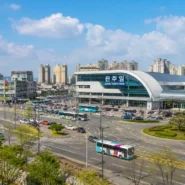
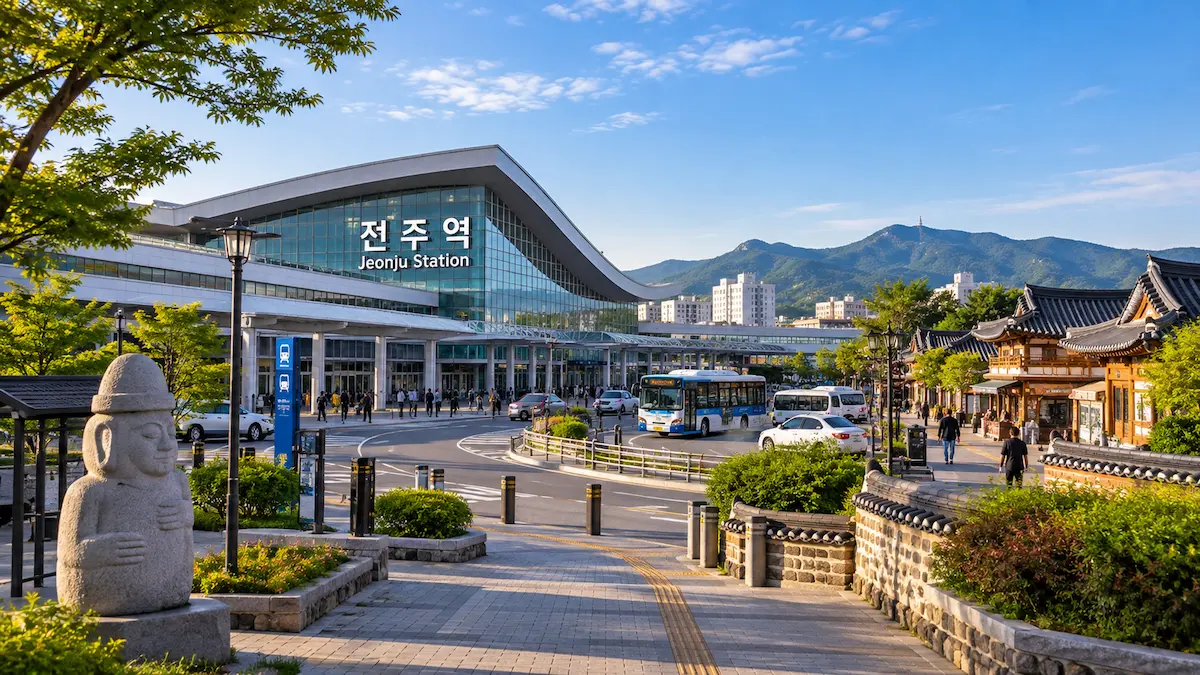
- Do not blindly follow an old blog’s station-exit instructions. Jeonju Station has been undergoing expansion and phased reopening in 2026, so bus-stop access and pedestrian routes around the station can change. Follow current station signs and check live bus information on the day you arrive.
Working out how to get from Jeonju Station to Jeonju city center looks simple on a map, but this is one of those transfers where a small planning mistake can turn into an annoying first hour in town. Jeonju Station is not in the middle of the main sightseeing district, and “city center” can mean two different areas: the historic Jeonju Hanok Village, Jeondong Cathedral and Nambu Market zone, or the more modern Gaeksa, Jungang-dong and 객리단길 (Gaekridan-gil) area. Add a suitcase, summer heat, rain, a late KTX arrival or a hotel hidden inside narrow hanok lanes, and the cheapest option is not always the smartest one.
This guide is written for travelers arriving by KTX, SRT or regular train at Jeonju Station. If you are coming from an airport, you will normally reach Jeonju by intercity transport first; this article covers the final station-to-hotel leg that many route guides gloss over. Prices and route notes below were checked against current Jeonju and Korea transport information available in August 2026, but bus routing is always worth rechecking on the day of travel.
The 1-Minute Cheat Sheet
- 🚕 Regular taxi / Kakao T — best overall: Usually the easiest choice for Hanok Village, Gaeksa and most central hotels. Budget roughly ₩9,000–₩12,000 to the Hanok Village area in normal conditions, with traffic and exact drop-off point affecting the meter. Best for luggage, couples, families and first-time visitors.
- 🚌 Direct city bus — best for solo budget travelers: Adult fare is ₩1,650 with a transport card or ₩1,700 cash. Routes including 79, 119, 501, 550 and 999 are listed for the Jeonju Station–Jeondong Cathedral/Hanok Village corridor. Allow roughly 25–35 minutes plus waiting and the final walk.
- 🌙 Late-night bus 6-1 — best only when your train timing matches: This service was introduced for late KTX arrivals and runs from the Jeonju Station area through central stops including Jeondong Cathedral/Hanok Village toward Pyeonghwa-dong. It is useful, but it is not a flexible all-night service.
- 🚖 Jeonju Tourist Taxi — best for turning arrival day into sightseeing: Not worth booking just to reach your hotel, but excellent for travelers who want station pickup plus several attractions without repeatedly loading and unloading luggage. The official tourist taxi currently lists ₩50,000 for 3 hours and ₩80,000 for 5 hours, with extra charges for additional time and some trip expenses.
Top Survival Tips
- Pin your hotel in Korean before you arrive. A hotel name written only in English may not be enough, especially for a small hanok guesthouse. Save the Korean address and a screenshot in Naver Map or Kakao Map.
- Do not tell a driver only “city center.” Show the exact hotel, or use a landmark such as 전주한옥마을 (Jeonju Hanok Village), 전동성당 (Jeondong Cathedral), 전주객사 (Jeonju Gaeksa) or 남부시장 (Nambu Market).
- Use a Tmoney or EZL card if you plan to take buses. Nationwide transport cards work on most Korean city buses and the card fare is cheaper than cash in Jeonju.
- For buses, check the direction as well as the route number. Seeing “119” on the display is not enough. Confirm that the bus is heading toward your destination and watch the stop sequence in a navigation app.
- Press the stop button early. Korean city buses do not automatically stop everywhere just because a tourist is standing near the door.
- With a 24-inch suitcase or larger, think twice before choosing the bus to save a few thousand won. The hidden cost is not the fare; it is lifting luggage, finding the correct stop, standing on a moving bus, and walking from Jeondong Cathedral into narrow accommodation lanes.
- Groups of three or four should compare cost per person. A ₩10,000 taxi split between four people can be close enough to bus pricing that the convenience wins easily.
- Late at night, keep a taxi app ready even if you plan to use the 6-1 bus. If your train is delayed or the service timing does not match, a taxi is the practical fallback.
- Do not assume the 2026 station works are finished just because a new area looks open. Jeonju Station has been reopening in phases, while adjacent transfer facilities have faced delays. Follow current wayfinding instead of relying on screenshots from older travel blogs.
- Walking all the way to Hanok Village is a false economy for most visitors. Save your feet for the village itself. Jeonju is much more enjoyable when your first activity is not hauling a suitcase across several kilometers of city streets.
The Full Experience
🚕 Regular Taxi or Kakao T: Best for Luggage, Couples and First-Time Visitors
Best for: Door-to-door ease · Heavy luggage · 2–4 travelers · Hanok stays · Rainy or hot weather · Late arrivals
If you want one recommendation that works for the largest number of travelers, take a taxi. Jeonju is exactly the kind of city where taxis can save a surprising amount of effort without blowing the budget. The city’s standard taxi base fare is currently ₩4,300 for the first 2 km, and the meter then rises by distance or slow-moving time. The official late-night surcharge is 20% from midnight to 4:00 a.m..
For Jeonju Station to Jeonju Hanok Village, a sensible planning budget is about ₩9,000–₩12,000 in normal conditions. Do not treat that as a fixed fare: traffic, the precise gate or guesthouse, and waiting time can change the total. The ride itself is often around 10–20 minutes, but allow more during busy weekends, festivals and peak traffic.
The biggest advantage is the last 500 meters. A bus can get you close to Jeondong Cathedral, but many hanok guesthouses sit inside streets where you still have to walk. A taxi can usually get much closer to your actual accommodation, which matters far more when you have a suitcase than it does when you are carrying a daypack.
You can normally take a taxi from the station area or call one through a ride-hailing app. Kakao T is widely used in Korea, and VisitKorea also lists k.ride as a foreigner-focused alternative that does not require KakaoTalk registration. If the app payment setup becomes annoying, choosing a normal taxi and paying the driver directly can be simpler.
Useful Korean to show the driver: “전주한옥마을로 가주세요” means “Please take me to Jeonju Hanok Village.” Better still, show the exact Korean hotel address so the driver does not have to guess which side of the village you need.
✅ What Other Travelers Say
Independent Jeonju travel reports repeatedly describe the taxi as the least stressful option from the station, especially for visitors who do not want to decode local bus routing immediately after getting off the train. That advice has aged better than old fare figures: several older forum posts quote much lower taxi prices, but those numbers predate Jeonju’s fare increase and should not be used for current budgeting.
⚠️ The Catch (Things to Keep in Mind)
The fare is metered, not a fixed station-transfer price. Traffic can push the total higher, and a small hanok guesthouse may be on a lane where the car cannot reach the front door. Also, do not confuse Seoul taxi pricing with Jeonju pricing; local fare structures differ. If a driver offers an unexplained flat price instead of using the meter for a normal city ride, ask for the meter or take another taxi.
🚌 Direct City Bus: Best for Solo Travelers With Light Luggage
Best for: Lowest cost · Solo travelers · Backpacks · Day trips · Travelers comfortable with Korean navigation apps
The city bus is the cheapest practical way to travel from Jeonju Station to the historic center. As of August 2026, the adult fare is ₩1,650 with a transport card or ₩1,700 in cash. The card fare matters less than the convenience: tapping a Tmoney or EZL card is much easier than worrying about change while balancing luggage.
For the Hanok Village side of downtown, Korea Tourism information lists buses including 79, 119, 501, 550 and 999 from Jeonju Station toward 전동성당·한옥마을 (Jeondong Cathedral / Hanok Village). Local Jeonju tourism information also commonly points visitors toward routes 79, 119 and 999 for a roughly 25-minute ride, although actual time varies with traffic and waiting.
The important detail is that the bus usually solves only the main-road portion of the journey. After getting off near Jeondong Cathedral/Hanok Village, you may still have a 5–15 minute walk depending on your accommodation. That final stretch can include crowds, uneven paving and narrow lanes, so a route that looks easy on paper may feel very different with a rolling suitcase.
If your hotel is in the Gaeksa/Jungang-dong side of central Jeonju rather than Hanok Village, do not assume the same bus stop is ideal. Put your exact hotel into Naver Map or Kakao Map and compare the recommended routes on the day you travel. Bus networks are living systems; route numbers and stop patterns can change more often than travel blogs do.
Before boarding, verify three things: the route number, the direction, and the destination stop. Once onboard, follow your progress on your phone and press the stop button before your stop.
✅ What Other Travelers Say
Budget travelers like the bus because it is genuinely inexpensive and several routes serve the sightseeing core. The common complaint is not the ride itself; it is the mental load of finding the correct stop, checking direction and working out where to get off. Travelers with only a backpack tend to rate the trade-off much more favorably than travelers with large luggage.
⚠️ The Catch (Things to Keep in Mind)
The station area is a moving target in 2026. Jeonju Station has been undergoing expansion and phased opening, and nearby transfer infrastructure has also faced delays. That means an old photo showing the “exact” bus-stop location may be misleading. Use station signage and live route information from the Jeonju City Traffic Information Center instead of relying on a years-old screenshot.
🌙 Late-Night Bus 6-1: Best for a Late KTX Arrival When the Timing Lines Up
Best for: Late KTX passengers · Budget travelers · Hanok Village direction · Travelers arriving around the scheduled night service
Jeonju created the 6-1 late-night bus specifically to improve connections for passengers arriving on late KTX services. The route runs from the Jeonju Station area through stops including Korea Hospital, Moraenae Market, Jungang Market and the Jeondong Cathedral/Hanok Village area before continuing toward Pyeonghwa-dong.
This is one of the most useful details for travelers who assume their only late-night option is a taxi. The route remains visible in Jeonju’s current bus system, and local reporting in late 2025 noted monthly ridership above 1,600 passengers, so it is not merely a forgotten trial service.
That said, treat the 6-1 as a timed rescue option, not an all-night network. It was designed around late train arrivals, which means a delayed train, a long station exit, or a hotel on the wrong side of downtown can erase much of the advantage. If your accommodation is deep inside the Hanok Village or you are dragging two large suitcases, paying for a taxi may still be the better end-of-day decision.
✅ What Other Travelers Say
The strongest evidence that the service fills a real need is its continued operation and reported usage. For solo travelers, it can save a meaningful amount versus a taxi while still reaching the historic-center corridor. It is particularly attractive if your stop is close to Jeondong Cathedral or Jungang Market.
⚠️ The Catch (Things to Keep in Mind)
Do not plan your entire arrival around a remembered departure time from an old article. Late-night routes can be adjusted when rail schedules or bus networks change. Check the live Jeonju bus system on the day of arrival, and keep Kakao T or k.ride ready as Plan B. Missing one bus late at night is very different from missing one at 2:00 p.m.
🚖 Jeonju Tourist Taxi: Best for Families, Older Travelers and a Sightseeing-First Arrival Day
Best for: 2–4 people · Older parents · Limited mobility · Short stays · Multiple attractions on arrival day · Avoiding repeated luggage handling
Jeonju’s official Tourist Taxi is not the cheapest way to move four or five kilometers from the station to your hotel, and it should not be sold as one. Where it becomes interesting is when your arrival day is short and you want to turn the transfer into a compact city tour.
The official Jeonju tourism program currently lists 3 hours for ₩50,000 and 5 hours for ₩80,000, with ₩20,000 per additional hour. Advance reservation is required. Official sample routes include Jeonju Station and attractions such as Deokjin Park, Jeonju Hanok Village, Nambu Market and other city sights, making it a useful option for travelers who do not want to check in, go back out, call another taxi and repeatedly move luggage.
This can be especially good value for a family or small group traveling with an older parent. The real benefit is not the raw fare; it is consolidating transport, reducing walking and keeping the day flexible. If your train arrives before hotel check-in, ask in advance whether your luggage can remain with you during the sightseeing period or whether the driver can first stop at your accommodation.
You can review the official program on the Visit Jeonju Tourist Taxi page.
✅ What Other Travelers Say
Travelers who choose private taxi-style touring tend to value the ability to customize stops and avoid the stop-start friction of buses and repeated taxi calls. It is most compelling when mobility, time or group size matters more than squeezing the transport budget to the minimum.
⚠️ The Catch (Things to Keep in Mind)
The official tourist taxi price is a time-based sightseeing service, not a cheap station transfer. Parking, admission and experience fees are not all included in the official city program, so read the conditions before reserving. If all you need is Jeonju Station to one hotel, take a normal metered taxi instead.
Which Jeonju “City Center” Do You Actually Need?
Hanok Village, Jeondong Cathedral, Gyeonggijeon and Nambu Market
This is the center most leisure travelers mean when they say “downtown Jeonju.” If you are staying in a traditional hanok, a taxi is my default recommendation with luggage. The bus is excellent if you are solo, your bag is small and your guesthouse is close to the main road.
Gaeksa, Jungang-dong, Jeonju Cinema Street and Gaekridan-gil
This is the more modern eating, drinking, shopping and nightlife side of central Jeonju. It is close to the old-town attractions but not identical. For a first arrival with luggage, a taxi is usually the cleanest solution because you avoid getting off at the Hanok Village edge and then backtracking toward your hotel.
A Hotel Near Jeonju Station or Ajung
If your accommodation is near the station, do not automatically travel into the tourist core just because a guide calls it “city center.” Check in first, leave your bags and then head out light. This can be a smart strategy for one-night stays when you have an early train the next morning.
Key FAQs
What is the easiest way to get from Jeonju Station to Jeonju Hanok Village with luggage?
Take a regular metered taxi. The fare is usually modest enough that the door-to-door convenience outweighs the savings from the bus, particularly for two or more travelers. Show the driver your hotel’s Korean address, not just “Hanok Village,” because the village has multiple access points.
How much is a taxi from Jeonju Station to Jeonju Hanok Village in 2026?
A practical budget is around ₩9,000–₩12,000 in normal conditions, but this is not a fixed fare. Jeonju’s standard taxi base fare is ₩4,300 for the first 2 km, and the meter increases with additional distance and slow-moving time. Midnight to 4:00 a.m. carries a 20% late-night surcharge.
Which bus goes from Jeonju Station to Jeonju Hanok Village, and can I use Tmoney?
Current Korea Tourism information lists routes including 79, 119, 501, 550 and 999 between Jeonju Station and the Jeondong Cathedral/Hanok Village area. Tmoney and other nationwide transport cards are accepted on Korean city buses; in Jeonju, the adult fare is currently ₩1,650 by transport card versus ₩1,700 cash. Always recheck the live route on your travel date because stop arrangements and schedules can change.
Final Verdict and Your Next Step
If you are staying in Jeonju Hanok Village, near Jeondong Cathedral or Nambu Market, take a taxi unless you are traveling light and actively want to save every won. If you are a solo backpacker arriving in daytime, the direct bus is easy enough once you have the correct route loaded on your phone. If you arrive on a late KTX, check the 6-1 night bus first, but keep a taxi app ready. And if you are traveling with older family members or want to sightsee immediately after arrival, the Tourist Taxi can turn an awkward hotel-transfer day into a much smoother half-day.
The bigger mistake is choosing a hotel without thinking about the arrival transfer. A beautiful hanok hidden deep inside a pedestrian lane can be wonderful once you are checked in, but it may be a poor choice if you have two large suitcases, mobility issues or a late arrival. Before booking, look at the exact map position and decide whether you want atmosphere in the Hanok Village, restaurants and nightlife around Gaeksa, or easy train access near Jeonju Station.
Book your stay before peak weekends and festival periods:
Check Jeonju hotels on Booking.com ·
Compare Jeonju stays on Agoda ·
Browse hotels near Jeonju Hanok Village on Klook.
If you prefer to pre-arrange a sightseeing vehicle rather than figuring out local transport after arrival, compare the local options before you go:
Jeonju private customized taxi tour on Klook ·
Jeonju private taxi tour on KKday.
One last practical check: on the morning of your trip, open the Jeonju City Traffic Information Center if you plan to use a bus. Jeonju Station is still changing physically in 2026, so a two-minute live check can save you from dragging luggage toward a stop that an old blog says should be there.
Transport information checked and updated for August 2026. Local bus routes, station access and fares can change; always verify live information before travel.