
💡 Key Takeaways
- Dunsan-dong is the safest all-round choice for most first-time visitors. It gives you Line 1 access, a deep restaurant bench, useful shops, and a central position between Daejeon Station and Yuseong without forcing you to depend on taxis.
- Stay near Daejeon Station or Jungangno if your trip is short or KTX-heavy. You will save the most luggage hauling, and Eunhaeng-dong, Jungang Market and Sungsimdang are easy to reach on foot, but hotel quality is less consistent than in Dunsan or the Expo area.
- Yuseong Oncheon is better for relaxation than sightseeing efficiency. The hot-spring area has good-value hotels, late-night food and a useful metro station, but it sits west of the main station and old downtown.
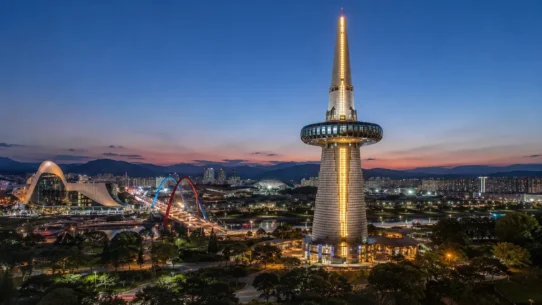
- Doryong-dong by Expo Park is the premium pick for DCC events, families and river views. The drawback is simple: there is no metro station at your hotel door, so buses and taxis matter more.
- Do not book by district name alone. In Daejeon, being a genuine five-minute walk from a Line 1 station often matters more than saving US$10 on a hotel that leaves you crossing wide roads or taking a bus with luggage.
If you are trying to work out where to stay in Daejeon for your first visit, the hard part is not finding a hotel. It is understanding how spread out the useful parts of the city are. Daejeon Station and the old downtown sit to the east, Dunsan is the modern administrative and commercial core, Yuseong is farther west, and the Expo/DCC zone sits north of the most convenient section of Metro Line 1. A hotel can look “central” on a booking map and still leave you doing an awkward bus ride, a long walk across major roads, or repeated taxi trips.
That matters even more in 2026, when Daejeon’s Line 2 tram construction is affecting roads across the city. For a first trip, I would not plan on taxis always being faster than the subway. Daejeon currently has one operating metro line, and the simplest strategy is to use it well: choose a hotel close to the station that matches the part of the city you will actually use.
The guide below focuses on the five areas that make the most practical sense for a visitor, not every neighborhood with a hotel listing. Prices are realistic planning bands rather than fixed quotes; Daejeon rates can move sharply around conferences, university events, festivals and weekends.
The 1-Min Cheat Sheet
- Dunsan-dong (City Hall / Government Complex): Best overall for first-time visitors. Choose it if you want the easiest balance of metro access, food, shopping and cross-city convenience. Typical hotel planning range: about US$50–90, with some better business hotels above that.
- Yuseong Oncheon / Bongmyeong-dong: Best for hot springs, couples and evening dining. Stay close to Yuseong Spa Station, not merely somewhere in Yuseong-gu. Typical range: US$40–90, with upper-midscale hotels often higher.
- Daejeon Station / Jungangno / Eunhaeng-dong: Best for KTX convenience and short stays. Excellent if you arrive late, leave early, or want old-downtown food and shopping on foot. Typical practical-hotel range: US$30–65.
- Doryong-dong / Expo Park / DCC: Best for conferences, families and a more polished stay. Great for Daejeon Convention Center, Shinsegae Art & Science, Expo Park and river walks. Typical range: US$90–200+, especially at the stronger full-service hotels.
- Galma-dong / Wolpyeong-dong: Best value for repeat visitors and local food. You stay on Line 1, close to Dunsan and KAIST-side neighborhoods, while often paying less than the prime business core. Typical range: US$45–100.
Top Survival Tips Before You Book
- Measure the walk to the station entrance, not the district center. “Dunsan,” “Yuseong” and “Jung-gu” cover much larger areas than a visitor expects. A property that is technically in the right neighborhood can still be 15–20 minutes from the useful metro entrance. With a suitcase, summer humidity, winter wind or rain, that difference gets old very quickly.
- Use Daejeon Station as your luggage benchmark. If you are arriving by KTX, ask how many transfers stand between the platform and your hotel. Dunsan is easy because Line 1 runs directly between Daejeon Station and City Hall in roughly a quarter of an hour. Yuseong is still straightforward but farther. Doryong/Expo usually adds a bus or taxi leg.
- Do not assume every cheap “hotel” is a conventional tourist hotel. Daejeon has plenty of motel-style and design-motel properties, particularly around nightlife and transport zones. Many are clean and good value, but room layouts, check-in style, smoking history, window size and family suitability can differ from what an international traveler expects. Read recent room-specific reviews rather than relying on the star category.
- If you are a light sleeper, zoom in on nightlife streets before paying. Dunsan, Bongmyeong and parts of Galma/Wolpyeong have late restaurants, bars, karaoke venues and busy side streets. That is convenient for dinner at 10 p.m., but a room directly over a nightlife lane is not the same experience as a hotel two blocks away on a quieter office or residential street.
- For Expo Park, price the taxi cost into the room rate. A premium Doryong hotel may look only a few kilometers from the subway, but repeated first-mile/last-mile trips add up. If your itinerary is mostly Dunsan, Eunhaeng-dong and Yuseong, paying less for a Line 1 hotel may save both money and time.
- In 2026, allow extra road time because of Line 2 tram construction. Full-scale work is taking place across multiple sections of the city, and road congestion can be worse than a normal map estimate suggests. This is another reason I prefer Line 1-adjacent hotels for first-timers whenever possible.
- Check the last 500 meters of the route, not just the total distance. Daejeon has broad roads, large intersections and long blocks in newer districts. A “700-meter walk” can feel very different if it involves multiple crossings with luggage. When two hotels are similarly priced, I would usually choose the one with the simpler station-to-lobby route.
The Full Experience
📍 Dunsan-dong: Best Overall for First-Time Visitors
Best for: first trips, car-free visitors, business + sightseeing mixes, food convenience | Useful stations: City Hall, Government Complex Daejeon | Typical hotel band: US$50–90
If a friend asked me to choose one Daejeon base without seeing their itinerary, I would put them in Dunsan-dong, preferably within a genuine five-to-eight-minute walk of City Hall Station or Government Complex Daejeon Station. It is not the most atmospheric part of the city, but it solves the most first-timer problems at once.
Dunsan is the modern administrative and commercial center. You have Line 1 running straight east to Daejeon Station and Jungangno, and west toward Galma, Wolpyeong and Yuseong Spa. Around the hotel clusters you also get convenience stores, cafés, department-store shopping, casual Korean food, late-night restaurants and enough services that you are rarely forced to make a special trip for basics.
The strongest argument for Dunsan is time saved across a multi-day itinerary. Daejeon Station to City Hall is roughly a 15-minute subway ride, so arriving with luggage is manageable. Yuseong is several stops in the other direction. Expo Park, the National Science Museum and DCC are not directly on the metro, but they are close enough for a short taxi or bus ride rather than a cross-city expedition.
Hotel reality: Dunsan has a useful mix of business hotels, residence-style properties and smaller local hotels. Recent OTA listings put many practical options around the US$50–70 range, while better rooms and peak dates climb higher. Dunsan Graytone is only a few minutes from City Hall Station, while Good Morning Residence Hue and Toyoko Inn near Government Complex are common reference points for travelers who prioritize function over resort-style facilities.
Night environment: Dunsan is lively rather than sleepy. The commercial streets stay bright and active, and there are pockets of bars, restaurants, karaoke and late-night traffic. I would not treat that as a safety warning; it is mainly a noise-and-vibe issue. If you want a quieter room, choose a hotel closer to the government-office side or ask for a high floor away from entertainment streets.
✅ What Other Travelers Say
The recurring positive theme in recent hotel reviews is convenience: guests mention walking access to the subway, a large choice of restaurants, practical room layouts and generally easy business-travel logistics. Properties around City Hall and Government Complex also tend to receive better feedback from travelers who want a predictable stay rather than a novelty hotel.
⚠️ The Catch (Things to Keep in Mind)
Dunsan is functional, but it does not give you the instant “I am in old Daejeon” feeling of Eunhaeng-dong. You will still travel for Sungsimdang, Jungang Market and Daejeon Station, and you will still need a bus or taxi for the Expo/DCC zone. Also, do not book the far edge of Dunsan just because the room is cheaper; the advantage disappears if you are 15 minutes from Line 1.
Choose Dunsan if: you want the least-complicated first stay and expect to visit several parts of the city.
Skip Dunsan if: your trip is one night, your train schedule is the main priority, and most of your plans are around Daejeon Station, Sungsimdang and Eunhaeng-dong.
📍 Yuseong Oncheon & Bongmyeong-dong: Best for Hot Springs and Evening Food
Best for: couples, hot-spring fans, relaxed evenings, good-value hotels | Useful station: Yuseong Spa | Typical hotel band: US$40–90
Yuseong Oncheon, centered around Bongmyeong-dong and Yuseong Spa Station, is the area I would choose when the hotel itself is part of the trip. The neighborhood has Daejeon’s best-known hot-spring identity, a free public foot-bath area, plenty of restaurants and a large stock of hotels ranging from inexpensive local properties to recognizable upper-midscale choices.
The key detail is that “Yuseong” is much larger than the hot-spring core. For a first-time visitor without a car, I specifically want the blocks around Yuseong Spa Station. From there, Line 1 takes you directly toward Wolpyeong, Dunsan, Jungangno and Daejeon Station. If you book deeper into Yuseong-gu because a map shows the same district name, you may lose that convenience and become bus- or taxi-dependent.
Yuseong works especially well for travelers who like a slower end to the day. You can return from sightseeing, eat locally, use a bath or spa facility, and avoid heading back out at night. The restaurant scene is useful, and the area has enough late activity that you are not stranded after normal dinner hours.
Hotel reality: this is one of Daejeon’s better areas for value, but you need to look closely at the property type. There are conventional hotels such as Ramada by Wyndham Daejeon and Hotel Interciti, plus many smaller design-motel and onsen-themed properties. Recent OTA searches show a lot of inventory around US$40–70, with stronger full-service hotels often in the US$70–120 zone depending on date.
Night environment: Bongmyeong-dong is active. Restaurants, bars and accommodation businesses keep some streets busy well into the evening. If that sounds fun, stay in the middle of the dining zone. If you want to sleep early, choose a hotel a little closer to the spa park or on a less commercial side street and request a room away from the road.
✅ What Other Travelers Say
Travelers commonly like Yuseong for its room value, large bathrooms, easy access to the hot-spring area and abundance of nearby places to eat. The better-reviewed properties tend to win praise for comfort and facilities rather than for being close to Daejeon’s old-downtown attractions.
⚠️ The Catch (Things to Keep in Mind)
You are on the western side of the city. If your priority is Daejeon Station, Jungang Market, Sungsimdang and the old center, you will spend more time riding Line 1 back east. Also, hotel quality is uneven: a low price may reflect a motel-style property rather than a standard international business hotel. Check recent photos, non-smoking information, window type and check-in policy before paying.
Choose Yuseong if: you want hot springs, a relaxed evening neighborhood and good hotel value while staying on Line 1.
Skip Yuseong if: you are in Daejeon for less than 24 hours and your KTX arrival/departure times are tight.
📍 Daejeon Station, Jungangno & Eunhaeng-dong: Best for KTX and Short Stays
Best for: one-night stays, early trains, bakery runs, old downtown, minimal luggage transfers | Useful stations: Daejeon Station, Jungangno | Typical hotel band: US$30–65
For a short Daejeon stop, this is the area that can save you the most friction. Daejeon Station is where most visitors arrive by KTX, while Jungangno and Eunhaeng-dong put you near Euneungjeongi Cultural Street, Skyroad, Jungang Market and the famous Sungsimdang bakery cluster. You can do a surprising amount on foot without first crossing the city.
The best version of this stay is not necessarily directly opposite the station. I prefer the corridor between Daejeon Station and Jungangno, where you keep train convenience but gain better access to the pedestrian shopping streets and old-downtown food. If you have only one evening in town, being able to check in, drop your bag and walk straight to dinner is worth more than a bigger room in the western suburbs.
Transport is excellent for arrival and departure. Daejeon Station is on Line 1, so Dunsan and Yuseong are still reachable without a transfer. The trade-off is that you are starting from the eastern side of the useful visitor corridor, so a trip to Yuseong or the Expo side takes longer than from Dunsan.
Hotel reality: the station/old-downtown area is one of the cheapest practical bases. Recent OTA listings show multiple properties in roughly the US$30–60 range, including newer local brands and older budget hotels. This is exactly where reading reviews matters. Two hotels on adjacent blocks can differ dramatically in renovation level, smoke smell, soundproofing, bathroom design and reception experience.
Night environment: Eunhaeng-dong’s main pedestrian streets are bright and busy around dinner and shopping hours. The mood changes quickly once you move onto quieter back streets or toward older lodging alleys. That does not automatically mean “unsafe”; it means the area feels less polished and less uniformly active than Dunsan. First-time visitors arriving late at night may simply prefer a hotel on a main road or close to the station/subway entrance.
✅ What Other Travelers Say
The strongest positive feedback is location: guests value being able to walk to the station, subway, bakery, markets and central shopping streets. Budget travelers also like the number of rooms available at modest prices. Newer properties around Daeheung and Jungangno can be surprisingly stylish for the rate.
⚠️ The Catch (Things to Keep in Mind)
This area has the widest quality spread in the guide. Do not choose solely by price or distance from the station. Read the newest reviews and inspect guest photos for bedding, windows, bathroom condition and smoking comments. If you want a polished full-service hotel, Dunsan or Doryong is a more reliable direction.
Choose Daejeon Station/Jungangno if: you are staying one or two nights, you have luggage, or you plan to make Daejeon a rail stop between other Korean cities.
Skip it if: you want the best business-hotel selection, a quieter modern district, or easy repeated access to Yuseong and the Expo side.
📍 Doryong-dong, Expo Park & DCC: Best for Conferences, Families and Premium Stays
Best for: DCC events, families, Shinsegae, science attractions, river views, higher-end hotels | Transport: bus/taxi first, metro second | Typical hotel band: US$90–200+
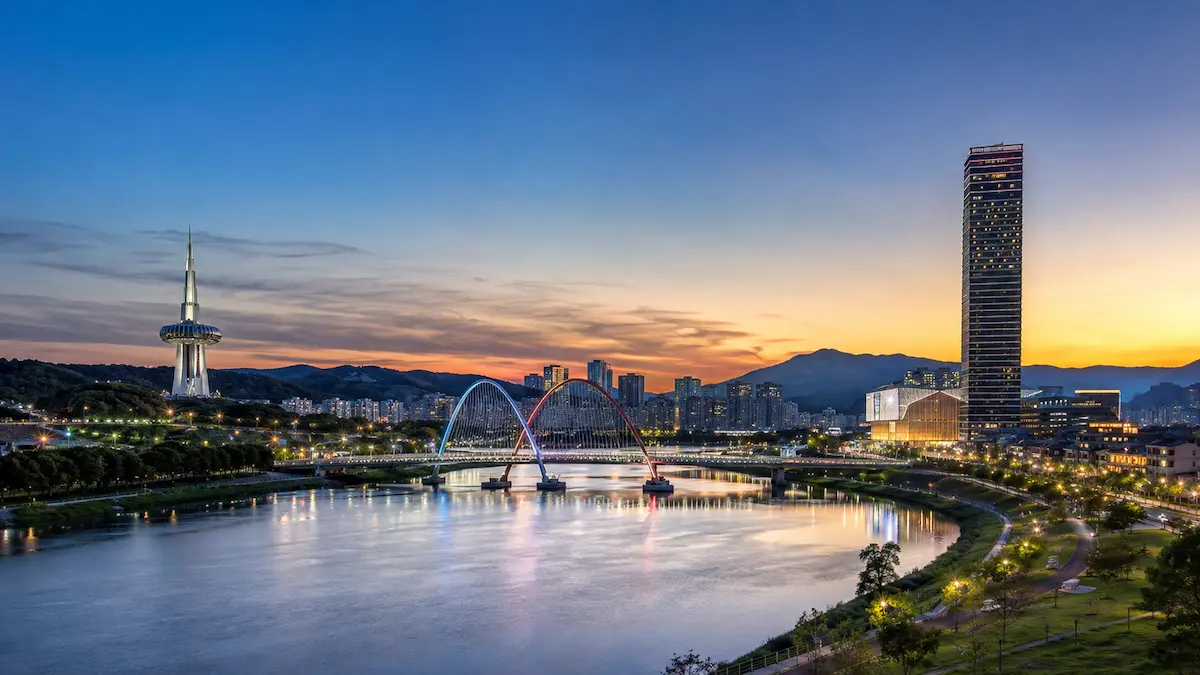
The Doryong-dong / Expo Park / Daejeon Convention Center zone is the easiest area to recommend when your itinerary is built around a conference, the science attractions, Hanbat Arboretum, Expo Park or Shinsegae Art & Science. It also has some of Daejeon’s most polished hotel inventory, including LOTTE CITY HOTEL Daejeon and Hotel Onoma.
This part of the city feels very different from the station area. It is newer, more spacious and more scenic, with river walks and major cultural/science facilities nearby. Families often prefer it because the daytime attractions are obvious and the environment feels less hectic than a nightlife district.
The problem is transport. There is no Line 1 station directly in the hotel cluster. The Government Complex Daejeon Station area is roughly a couple of kilometers away from the major Doryong hotels, so you normally use a bus or taxi for the first/last leg. If you are attending events at DCC, this is irrelevant because you can simply walk. If you are sightseeing all over Daejeon, it becomes the area’s main weakness.
Hotel reality: this is the priciest zone in the guide. Recent OTA searches put Hotel Onoma around the upper end of Daejeon’s market on many dates, while LOTTE CITY is often cheaper but still above the city’s budget-business average. Conference dates can push rates up quickly, so booking early matters more here than in the motel-heavy neighborhoods.
Night environment: the Expo riverfront can be beautiful after dark, and Shinsegae gives you a convenient indoor dining/shopping option. But this is not the neighborhood I would pick for bar-hopping or endless late-night local restaurants. Once major facilities close, the streets can feel spacious and quiet rather than lively.
✅ What Other Travelers Say
Reviews of the stronger hotels repeatedly praise comfort, staff, breakfast, cleanliness and convenience for the convention center. Guests also like the river and Expo Park access. Hotel Onoma tends to attract positive comments for facilities and service; LOTTE CITY is frequently valued for its location near DCC and the Expo attractions.
⚠️ The Catch (Things to Keep in Mind)
You are paying for hotel quality and proximity to a specific cluster, not for the city’s best public-transport position. If your plans are mostly Dunsan, Yuseong Spa, Eunhaeng-dong and markets, you may spend more on taxis while also paying a higher room rate. During tram construction, road delays can make that trade-off more noticeable.
Choose Doryong/Expo if: your event is at DCC, you are traveling with children for the science attractions, or you want the best hotel experience more than the best subway access.
Skip it if: you are budget-focused, want nightlife on your doorstep, or strongly prefer to move around by metro only.
📍 Galma-dong & Wolpyeong-dong: Best Value Near Dunsan
Best for: value seekers, local dining, repeat visitors, access to Dunsan/KAIST side | Useful stations: Galma, Wolpyeong | Typical hotel band: US$45–100
Galma and Wolpyeong are the compromise areas I would consider once Dunsan prices look silly or you want something a little more local. They sit immediately west of the Dunsan core on Line 1, so you keep straightforward subway access while often getting better-value rooms and excellent neighborhood food.
Wolpyeong is especially useful because the station is only a few stops from City Hall and also closer to Yuseong. The Empress Hotel, for example, sits just a short walk from Wolpyeong Station and has a long trail of guest feedback praising value and practical comfort. Workers Hotel Daejeon by Anook is another example of the newer boutique/business style appearing in this part of the city.
Galma has more of a local dining-and-nightlife feel. For travelers who enjoy finding restaurants away from obvious tourist streets, that can be a positive. It also makes the area less instantly legible for a first-timer who wants major landmarks outside the hotel door.
Hotel reality: inventory is smaller than in Dunsan or Yuseong and includes a mix of conventional hotels and local motel/boutique properties. Recent rates commonly fall around US$45–75, with newer or higher-spec rooms reaching US$100. This is not necessarily the cheapest area in absolute terms, but value can be strong when Dunsan is busy.
Night environment: Wolpyeong can be relatively calm around residential blocks, while Galma has livelier restaurant and bar streets. Again, the exact block matters. If you want quiet, choose Wolpyeong close to the subway. If you want late dinner and drinks, Galma gives you more choice but may bring more street noise.
✅ What Other Travelers Say
Guests at better-known Wolpyeong properties often highlight value, comfortable beds, quiet rooms, breakfast and easy station access. Reviews of newer hotels in this corridor also mention friendly staff and good location for KAIST-side trips. The area tends to work best for travelers who already understand what they want to do in Daejeon.
⚠️ The Catch (Things to Keep in Mind)
This is not the “wow, everything is outside my door” choice. You will usually ride the metro for the old downtown, Daejeon Station and major attractions, and hotel selection is less obvious to an international traveler. If the price difference from Dunsan is small, I would still pay a little more for Dunsan on a first visit.
Choose Galma/Wolpyeong if: you want to save money without giving up Line 1, or your plans lean toward Dunsan, KAIST and Yuseong.
Skip it if: you want the simplest possible first-trip orientation or a large selection of internationally familiar hotels.
Key FAQs
What is the best area to stay in Daejeon for first-time visitors without a car?
Dunsan-dong is the best default. Look within walking distance of City Hall Station or Government Complex Daejeon Station. It gives you direct Line 1 access to Daejeon Station, Jungangno and Yuseong Spa while keeping you close enough to reach Expo Park by a short bus or taxi ride. If your trip is only one night and you are arriving by KTX, staying near Daejeon Station can be even more efficient.
Is it better to stay near Daejeon Station or Yuseong Hot Springs?
Choose Daejeon Station if train convenience, Sungsimdang, Jungang Market and a short itinerary matter most. Choose Yuseong if you want hot springs, a more relaxed evening routine and better-value hotel options around Bongmyeong-dong. For a two- or three-night first trip covering both sides of the city, Dunsan is the more balanced middle ground.
Where should I stay in Daejeon to avoid long walks and luggage transfers?
Stay within five to eight minutes on foot of a Line 1 station and match that station to your arrival point. Daejeon Station is unbeatable for KTX; City Hall is the best all-round base; Yuseong Spa works for the hot-spring district. Avoid choosing a hotel based only on a district label such as “Yuseong-gu” or “Seo-gu,” because the actual walk to useful transport can be much longer than the listing makes it sound.
Final Verdict and Your Next Step
For most first-time visitors, book Dunsan-dong first. It is the least risky choice because it balances subway access, restaurants, hotel quality and travel time across the city. If your stay is very short, switch to Daejeon Station/Jungangno. If you want hot springs and relaxed nights, choose Yuseong Oncheon. If your purpose is DCC, Expo Park or a family science trip, pay more for Doryong-dong. If you already know Daejeon or see a meaningful price gap, Wolpyeong/Galma can be excellent value.
Whatever area you choose, I would book earlier than you might for a normal Korean regional city. Daejeon gets business, government, university and convention demand, and the best-located rooms can disappear before the city as a whole looks “sold out.” Before paying, compare the cancellation policy, bed configuration, smoking status, recent room photos and the walking route from the nearest station.
Check current Daejeon hotel availability:
- Compare Daejeon hotels on Booking.com
- Compare Daejeon hotels on Agoda
- Browse Daejeon Skyroad-area hotels on Klook
- Browse Yuseong accommodation on KKday
My booking rule: if two hotels are within about US$10–15 of each other, choose the one with the easier station walk. In Daejeon, that small premium can save more time and frustration than the room-rate difference is worth.