
💡 Key Takeaways
- The naming trap comes first: there is no separate airport inside Gyeongju city. “Gyeongju Airport” normally means Pohang Gyeongju Airport (KPO), which is physically in Pohang, roughly a 40-minute drive from central Gyeongju.
- Bus 1000 is the best-value direct option if its very limited schedule matches your flight. It serves Gyeongju Intercity Bus Terminal for downtown and continues into the Bomun tourist area, so many travelers can avoid a transfer entirely.
- Do not build a tight arrival plan around an old blog timetable. Current local information lists only three airport departures a day. If you miss the last direct bus, a taxi is the least stressful option; budget travelers can backtrack through Pohang Intercity Bus Terminal instead.
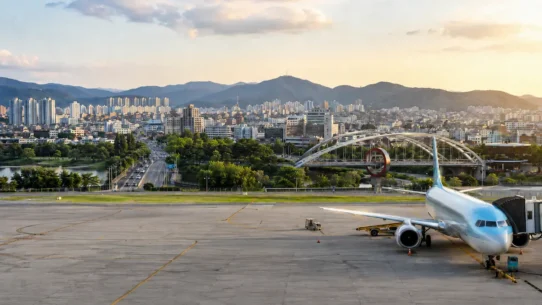
If you are searching for how to get from Gyeongju Airport to the city center, the first thing to know is that the airport name is slightly misleading. Pohang Gyeongju Airport (airport code KPO) is in Pohang, not in central Gyeongju. That matters because the cheapest route is surprisingly easy when the timing works, but surprisingly awkward when it does not. The real decision is not simply “bus or taxi.” It is whether your flight lines up with the direct Bus 1000, whether you are staying near downtown or Bomun Lake, how many suitcases your group has, and how much time you are willing to lose to a transfer.
This guide was checked against current transport information available in August 2026, including Korea Airports Corporation, Gyeongju city bus fare guidance and current local route information. Timetables can still change with flight schedules, so use the times below for planning, then re-check them shortly before travel.
The 1-Min Cheat Sheet
- Bus 1000 — best overall for solo travelers and couples: direct from KPO to Gyeongju Intercity Bus Terminal and onward to Bomun. Current Gyeongju city-bus fare guidance is ₩1,500 cash or ₩1,450 with a transport card for adults. Allow roughly 45 minutes to the downtown bus-terminal area and around 75–90 minutes to the Bomun hotel zone. The downside is the schedule: current local information lists only three airport departures daily.
- Taxi — best for late arrivals, families and luggage-heavy groups: no transfers, no timetable anxiety and direct to your hotel. Korea Airports Corporation currently estimates ₩30,000–₩35,000 to Gyeongju, with the final meter depending on traffic and exact destination. Plan roughly 40 minutes in normal conditions and keep a little fare buffer.
- Pohang city bus + intercity bus — best budget backup after missing Bus 1000: take a Pohang city bus such as Route 900 toward Pohang Intercity Bus Terminal, then an intercity bus to Gyeongju. A July 2026 timetable snapshot lists the Pohang-to-Gyeongju intercity leg at ₩4,200 and about 40 minutes, with very frequent departures. It is cheap, but you pay for that saving with a transfer and more luggage handling.
- Rental car — best if Gyeongju is the start of a road trip: worth considering for Bulguksa, Seokguram, the east-coast sights or onward travel. For a simple airport-to-downtown transfer, rental paperwork, insurance, pickup arrangements and parking usually make it more work than a taxi.
Top Survival Tips
- Check where your hotel actually is before choosing a mode. If you are staying around Hwangnidan-gil, Daereungwon or central Gyeongju, the Gyeongju Intercity Bus Terminal stop is the useful one. If you are staying around Bomun Lake, stay on Bus 1000 and let it carry you farther into the resort area instead of getting off downtown and paying for another ride.
- Screenshot the current Bus 1000 timetable. Current local guidance lists airport departures at approximately 10:35, 14:00 and 20:40, but the route is tied closely to airport demand and flight patterns. Treat those as “verify before travel” times, not permanent promises.
- Do not trust the fare shown in older Route 1000 videos. You may still see ₩1,700 quoted online. Gyeongju’s official 2026 city-bus fare notice now lists the adult fare at ₩1,500 cash or ₩1,450 by transport card for all city buses.
- If you have three or more large suitcases, think about vehicle size—not just taxi price. A standard sedan may be fine for two people with normal luggage but awkward for a family with several full-size cases. If your schedule is tight, ask your accommodation to arrange an appropriately sized vehicle or use a ride-hailing app that lets you choose a larger category where available.
- Do not detour via Gyeongju Station just because “train” sounds easier. The current rail station is outside the historic center. For an airport arrival, Bus 1000 to the intercity terminal is usually a much cleaner downtown transfer than taking extra transport to a rail station and then coming back into town.
- Know where to stand when you exit KPO. Korea Airports Corporation states that the bus stop for Gyeongju is to the right of the terminal exit. The taxi stand is between the terminal exit and the parking lot. KPO is small, so you do not need to budget a long internal walk.
- If you miss Bus 1000, decide quickly. Do not stand outside assuming another direct Gyeongju bus will appear soon. Choose between the simple taxi option and the cheaper two-stage route via Pohang Intercity Bus Terminal.
- For foreign visitors, k.ride can be easier than fighting with app registration. Korea’s 2026 visitor transport guidance lists k.ride and Uber Taxi among ride-hailing options that accept foreign-issued credit cards. Availability still varies by area and time, so the physical taxi rank remains a useful fallback at this small airport.
The Full Experience
🚌 Bus 1000: Best for Downtown Gyeongju, Hwangnidan-gil and Bomun on a Budget
Tags: Cheapest direct option • No transfer to downtown or Bomun • Good for light-to-moderate luggage • Very schedule-dependent
For most independent travelers, Bus 1000 is the smartest way from Pohang Gyeongju Airport to Gyeongju city center—provided you can actually catch it. The route connects the airport with Gyeongju Intercity Bus Terminal and then continues through the Bomun tourist complex, including stops convenient for several major hotels and the HICO/Hilton area.
The big advantage is not just the fare. It is the fact that you avoid the kind of “cheap” airport journey that becomes miserable once you add two transfers, stairs, curb crossings and a suitcase that suddenly feels twice as heavy. If your accommodation is downtown, the intercity terminal puts you in the right part of the city for the historic core. If you are in Bomun, staying on the same bus is far easier than transferring in central Gyeongju.
Current planning numbers: Gyeongju’s official 2026 fare guidance lists adult city-bus fares at ₩1,500 cash or ₩1,450 with a transport card. A current Bomun-area venue lists three Route 1000 departures from Pohang Gyeongju Airport at about 10:35, 14:00 and 20:40, with about 90 minutes to the Hilton/HICO area. Historical route information puts the airport-to-Gyeongju Intercity Bus Terminal portion at roughly 45 minutes.
Where to get off: choose Gyeongju Intercity Bus Terminal if your hotel is around central Gyeongju, Hwangnidan-gil, Daereungwon or the main historic-center zone. If your hotel is around Bomun Lake, do not automatically follow everyone off at the terminal—check your exact stop and continue on Route 1000 if it serves your hotel area.
✅ What Other Travelers Say
Travel reports consistently highlight the same strength: when the flight and bus connect well, the trip is straightforward and much cheaper than taking a taxi. Travelers also appreciate that the direct route reaches both central Gyeongju and Bomun without forcing them to navigate a second local bus with luggage.
⚠️ The Catch (Things to Keep in Mind)
The low fare can make Route 1000 look like an obvious winner, but the three-departure-a-day reality is the hidden cost. A 30- or 40-minute wait is acceptable; losing several hours is not. Also, the YouTube video above is useful for understanding the route and boarding experience, but it predates the current 2026 fare guidance, so do not use the fare shown in the video as your current price reference.
If your aircraft lands late, collect your bag first and assess the real situation. A theoretical bus connection is worthless if the bus has already gone. For a late evening arrival, a taxi may be the better value once you factor in waiting time, fatigue and the cost of an extra transfer.
🚕 Taxi or Ride-Hailing: Best for Late Arrivals, Families and Heavy Luggage
Tags: Door-to-door • Fastest practical option • Best with luggage • Cost-effective for 3–4 people
A taxi is the option I would choose when the direct bus timing is poor, when traveling with children, or when the group has enough luggage to turn every transfer into a chore. At a small airport like KPO, the process is refreshingly simple: leave the terminal and use the taxi rank outside rather than wandering around looking for a complicated airport-transport hall.
Korea Airports Corporation currently publishes an estimated fare of ₩30,000–₩35,000 from Pohang Gyeongju Airport to Gyeongju. Treat this as an estimate rather than a fixed airport price. Your hotel may be farther into Gyeongju, traffic can add meter time, and Bomun is not the same destination as the downtown bus terminal. I would keep some buffer in the budget rather than arguing with the meter because an online estimate was lower.
For two travelers, the taxi premium over Bus 1000 is noticeable. For three or four people splitting the fare, the gap becomes much easier to justify—especially if taking the bus would require a second taxi from the terminal to the hotel anyway.
Ride-hailing: Kakao T is widely used in Korea, while the foreigner-oriented k.ride app can be a useful alternative. Korea Tourism Organization’s 2026 transportation guidance also notes that foreign-issued cards can be used on ride-hailing platforms such as k.ride and Uber Taxi. In practice, app availability at KPO can vary, so keep the official taxi rank as Plan B rather than depending on one app.
✅ What Other Travelers Say
Independent travelers often describe taxis in Korea as painless for short intercity hops compared with arranging multiple buses, and recent Gyeongju trip reports mention using foreigner-friendly ride-hailing apps successfully for local journeys. The convenience becomes especially valuable after a flight, when saving one transfer can feel more important than saving a few thousand won.
⚠️ The Catch (Things to Keep in Mind)
Luggage capacity is the trap people forget. Four seats do not automatically mean four large suitcases will fit. If you are three or four adults with checked baggage, consider arranging a larger vehicle in advance through your hotel or app if that category is available. Also have your accommodation name and address saved in Korean; it removes ambiguity and is faster than trying to pronounce a small guesthouse name to a driver.
🚌 Route 900 + Intercity Bus: Best Backup When You Miss Bus 1000 but Still Want to Save Money
Tags: Budget backup • One major transfer • Frequent onward buses • More luggage handling
This is the route most short guides fail to explain, yet it is exactly what you need when Bus 1000 does not line up with your flight and you do not want to pay for a taxi all the way to Gyeongju.
The logic is simple: first travel from the airport into Pohang Intercity Bus Terminal on a Pohang city-bus route that serves the airport, such as Route 900. From Pohang terminal, take an intercity bus to Gyeongju Intercity Bus Terminal. The second leg is the reassuring part: a timetable updated in July 2026 lists 105 Pohang-to-Gyeongju intercity departures for the day shown, with a typical journey time of about 40 minutes and an adult fare of ₩4,200.
That frequency means the transfer is much less risky than the limited direct airport bus. But this is still a backup, not my first choice. You are deliberately traveling into Pohang, unloading your luggage, entering a bus terminal, buying or confirming another ticket and loading your luggage again before finally heading to Gyeongju.
Who should use it: solo travelers and couples on a tight budget, arriving at a time when Route 1000 is not useful, with manageable luggage and enough energy to make one transfer. If you have a stroller, elderly parents, several checked bags or a hotel far from Gyeongju Intercity Bus Terminal, the savings can evaporate in inconvenience.
✅ What Other Travelers Say
Travelers familiar with the Pohang–Gyeongju corridor often point out that the intercity bus itself is easy and frequent, and the high-deck coaches normally provide proper under-floor luggage space. That makes the terminal-to-terminal portion far more comfortable than trying to squeeze a large suitcase into a crowded local bus aisle.
⚠️ The Catch (Things to Keep in Mind)
The weak link is the airport-to-Pohang-terminal local-bus leg, not the intercity bus. Waiting time, the direction of travel and how comfortably you can handle your luggage all matter. Do not compare only ticket prices: compare the total door-to-door effort. If two people are already exhausted, paying for a taxi can be a sensible travel decision rather than a “waste” of money.
🚗 Rental Car: Best for Bulguksa, Seokguram and an East-Coast Road Trip
Tags: Maximum flexibility • Best for outer sights • Higher setup cost • Not necessary for central Gyeongju alone
Renting a car makes sense when the airport transfer is only the first small part of a larger driving itinerary. Gyeongju’s central historic zone is walkable enough that a car can become something you pay to park, but attractions such as Bulguksa, Seokguram and destinations farther east become much easier when you control your own schedule.
For a traveler who is simply flying into KPO, sleeping near Hwangnidan-gil for two nights and visiting the central sights, I would not rent a car just to avoid a bus or taxi. The paperwork, insurance choices, pickup arrangements and parking are hidden costs that rarely show up in a simple daily rental headline.
If you do drive, Korea Tourism Organization currently advises short-term visitors to carry the appropriate International Driving Permit, passport and required home-country licence where requested; drivers generally need to be at least 21. Rental requirements vary by company, so confirm the exact documents before paying. For navigation, use NAVER Map or Kakao Map rather than assuming Google Maps will provide full driving navigation in Korea.
Also, do not assume that “airport car rental” means you can walk up and pick from a row of counters at KPO. Korea Airports Corporation links to rental booking services, but inventory and pickup arrangements can vary at this small airport. Reserve first and confirm exactly where the vehicle is collected.
✅ What Other Travelers Say
Visitors who drive outside Seoul often find the road-trip freedom worth it, especially when linking temples, coastal areas and smaller stops that are slow to reach by local transit. The usual learning curve is not the highway itself but Korean navigation, lane positioning, parking rules and knowing which documentation the rental desk expects.
⚠️ The Catch (Things to Keep in Mind)
A cheap-looking rental rate is not your final cost. Check insurance coverage, fuel policy, tolls, parking and whether pickup or return requires extra travel. If Gyeongju is your only destination and your hotel is central, a taxi from the airport plus occasional local taxis will often be simpler than renting a car you barely use.
Which Option Should You Actually Choose?
Choose Bus 1000 if you are traveling solo or as a couple, your arrival lines up comfortably with one of the limited departures, and you are staying either near central Gyeongju or within the Bomun tourist area.
Choose a taxi if you arrive after the useful bus connection, have children or elderly companions, carry multiple large bags, or simply value reaching the hotel with zero mental overhead. For three or four people, fare-splitting makes this much more attractive.
Choose the Pohang-terminal backup if you miss Bus 1000, want to keep costs low and can comfortably handle your luggage through one transfer.
Choose a rental car only when it solves more than the airport transfer—typically when you are building an itinerary around Bulguksa, Seokguram, coastal Gyeongju, Pohang or another onward destination.
Key FAQs
Is there actually a Gyeongju Airport in Gyeongju?
No. The airport travelers usually mean is Pohang Gyeongju Airport (KPO), located in Pohang. The shared name is useful for tourism but can be confusing when you first look at a map. Always search using the airport code KPO when checking flights, maps or pickup arrangements.
How much is a taxi from Pohang Gyeongju Airport to Gyeongju city center?
Korea Airports Corporation currently estimates ₩30,000–₩35,000 for a taxi from KPO to Gyeongju, with the actual meter varying according to traffic and destination. A hotel in Bomun or an outer district may cost more than a drop near the downtown bus terminal, so leave room in your budget rather than treating the estimate as a flat fare.
Does Bus 1000 from Pohang Gyeongju Airport go to Hwangnidan-gil or Bomun Lake?
Route 1000 serves Gyeongju Intercity Bus Terminal, which is the useful stop for the downtown historic area and accommodation around Hwangnidan-gil, then continues into the Bomun tourist complex. It does not magically stop at every hotel, so check your exact accommodation against the route before boarding. The bigger issue is frequency: current local information lists only three airport departures per day.
Final Verdict and Your Next Step
For most travelers, the decision is refreshingly simple once you ignore the misleading airport name. If Bus 1000 leaves within a reasonable time after you land, take it. It is cheap, direct and unusually convenient for both downtown Gyeongju and Bomun. If the wait is long, you are arriving late, or your group has serious luggage, take a taxi without feeling that you “failed” at budget travel—the time and effort you save are real value.
If you have not booked your accommodation yet, choose your area with the airport transfer in mind. Hwangnidan-gil / central Gyeongju is best for walking to the historic core and works well with the intercity-terminal stop. Bomun Lake is better for resort hotels and a quieter setting, and Route 1000 can save you a second transfer when its timetable works. For Bulguksa-focused or road-trip itineraries, a car or planned taxi strategy becomes more useful.
Book the parts that genuinely benefit from advance planning: your hotel, any limited-capacity tours or experiences, and a larger vehicle or rental car if your luggage or itinerary requires one. The direct city bus itself is not something I would structure an entire trip around without re-checking the current timetable.
- Check Gyeongju hotels on Agoda
- Compare Gyeongju stays on Booking.com
- Book Gyeongju tours and experiences on Klook
- Browse Gyeongju experiences on KKday
One last check before you fly: confirm your accommodation address, look up the latest Route 1000 departure, save the hotel name in Korean, and decide your backup before landing. That five-minute preparation is what keeps a cheap airport transfer from turning into an hour of standing outside with luggage.
Accuracy note: Transport details were checked in August 2026 against Korea Airports Corporation, Gyeongju City Traffic Information Center, current Gyeongju/Pohang route information and current intercity-bus timetable data. Bus schedules, fares and app availability can change. Useful official references: Pohang Gyeongju Airport, Gyeongju City Bus Fare Information, and VISITKOREA Driving in Korea.