
💡 Key Takeaways
- Namba is the best all-round choice for most first-time visitors because food, nightlife, shopping and direct Kansai Airport trains are close together—but choose a hotel a few streets away from Dotonbori if sleep matters.
- Umeda is better than Namba for Kyoto, Kobe and wider Kansai day trips, although the Osaka–Umeda station complex can be frustrating with luggage and is not as atmospheric at night.
- Tennoji offers the strongest balance of price, airport access and convenience for budget-conscious travelers, families and anyone who prefers less tourist congestion.
- Shin-Osaka is a transport base, not a sightseeing neighborhood. Stay there only when frequent Shinkansen journeys or an early bullet train genuinely outweigh the daily commute into central Osaka.
- Universal City is worth the premium for a USJ-focused family trip, but it is a poor base for a normal Osaka city break. A split stay is often smarter.
Deciding where to stay in Osaka is harder than it looks on a map. The city has several major station districts, and two hotels described as being “in Namba” or “near Umeda” can produce completely different trips. One may put you beside the airport train and restaurants; the other may involve a long underground walk, multiple elevators and a suitcase-unfriendly transfer every morning.
The real question is not which Osaka neighborhood is the most famous. It is which area removes the most friction from your itinerary. A visitor planning three nights of food and nightlife needs a different base from a family visiting Universal Studios Japan, a couple taking day trips to Kyoto and Kobe, or a traveler arriving with two large suitcases after a long flight.
This guide compares seven practical bases: Namba, Umeda, Shinsaibashi, Tennoji, the Osaka Castle–Kyobashi area, Shin-Osaka and Universal City. It looks beyond attractions and covers station complexity, airport access, nighttime atmosphere, realistic hotel pricing, luggage problems and the type of traveler who may regret booking each area.
Price note: The nightly ranges below are planning benchmarks for a standard double or twin room on ordinary non-peak dates, not live quotations. Osaka hotel rates can jump sharply on Fridays and Saturdays, during cherry blossom season, Japanese holidays, major concerts and peak USJ periods. Compare the final price including taxes, breakfast and cancellation terms before paying.
The 1-Minute Cheat Sheet: Best Areas to Stay in Osaka
- Namba: Best overall for a first Osaka trip, food lovers, nightlife and easy Kansai Airport access. Typical room target: about ¥12,000–¥30,000. Avoid the canal-side party streets if you are a light sleeper.
- Umeda / Osaka Station: Best for Kyoto, Kobe, Himeji and business-class convenience. Typical room target: about ¥15,000–¥35,000. Excellent transport, but the station complex is confusing and the area feels more commercial than local.
- Shinsaibashi: Best for shopping, cafés, couples and travelers who want to walk to Namba without sleeping in its loudest core. Typical room target: about ¥12,000–¥30,000. Check the exact side of Midosuji Avenue before booking.
- Tennoji / Abeno: Best value for families, budget-conscious travelers and direct airport access. Typical room target: about ¥9,000–¥24,000. Convenient and increasingly polished, but some blocks toward Shin-Imamiya feel rougher around the edges.
- Osaka Castle / Kyobashi: Best for quieter evenings, runners, repeat visitors and travelers using Keihan trains toward eastern Kyoto. Typical room target: about ¥9,000–¥25,000. You will commute to Namba nightlife.
- Shin-Osaka: Best for frequent Shinkansen trips, a one-night transit stop or an early departure. Typical room target: about ¥8,000–¥22,000. Practical but bland, with little reason to stay for a city-focused holiday.
- Universal City: Best for families prioritizing USJ rope drop, tired children and a two-day park visit. Typical room target: about ¥18,000–¥45,000 or more. Resort pricing and weak access to the rest of Osaka are the trade-offs.
Top Survival Tips Before Choosing an Osaka Hotel
- Choose a station and exit, not only a neighborhood name. “Namba” covers several separate railway stations: Nankai Namba, Osaka-Namba, JR Namba and Osaka Metro Namba. A hotel near JR Namba may be convenient for OCAT buses but not especially close to the Nankai airport platforms. Open the route in a map app, switch to walking mode and check the exact station entrance.
- Treat an underground transfer as real travel time. Umeda and Namba have huge underground networks. A route that appears to involve one station can still mean ten to twenty minutes of walking, escalators and searching for signs. This matters after a long flight, in summer heat, with a stroller or when elevators are not near your platform.
- Match your hotel to your arrival train. Nankai services make Namba easiest from Kansai Airport. JR services favor Tennoji and Osaka/Umeda, while Shin-Osaka is useful for travelers arriving by Shinkansen. The simplest arrival is often more valuable than saving a few hundred yen on a room.
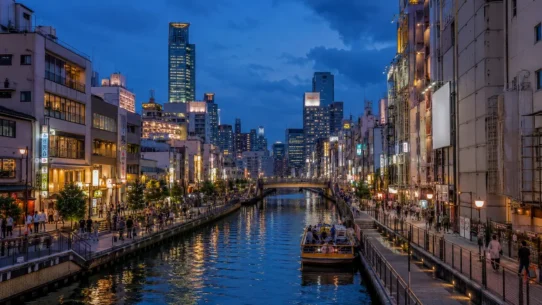
- Do not confuse “near Dotonbori” with “quiet.” The famous canal area is busy late, with restaurant queues, street noise and nightlife traffic. For the same walkable convenience with better sleep, look several blocks south near Namba Parks, west toward JR Namba, or north toward Shinsaibashi—then read recent noise reviews for the exact property.
- Check room size, not only star rating. A well-rated Japanese business hotel may offer a compact 12–15 square meter room. That can be perfectly comfortable for one traveler and miserable for two adults with open suitcases. Families should verify bed width, whether children share existing beds and whether luggage can remain open without blocking the doorway.
- Use a five-minute walking rule when carrying large luggage. In ordinary clothes, an eight-minute walk is easy. With two suitcases, crowds, stairs and rain, it can become the most annoying part of every travel day. I would pay slightly more for a genuinely close station hotel on arrival and departure nights.
- Look at the last 200 meters at night. A hotel can have an excellent station distance but sit beside host clubs, late-night bars, delivery alleys or an elevated railway. Street View, guest photos and recent reviews reveal more than the district name.
- Plan day trips before choosing between Namba and Umeda. Umeda is usually better for JR and Hankyu travel toward Kyoto, Kobe and Himeji. Namba is better for Nankai airport access, central nightlife and Kintetsu/Hanshin routes. One or two day trips do not require changing hotels, but four early departures may justify choosing the stronger rail hub.
- Consider a split stay for USJ, not for ordinary sightseeing. Moving hotels wastes time, so it rarely makes sense within central Osaka. The exception is a family with two park days: staying at Universal City for one or two nights can eliminate a tiring early commute and crowded post-closing train ride.
- Book a refundable rate early. Osaka has a large hotel supply, but the best-located family rooms, triple rooms and properties beside major stations disappear first. Reserve a sensible option, then recheck prices rather than waiting for a last-minute bargain that may never come.
The Full Experience: Honest Area-by-Area Guide
📍 Namba: Best Overall for First-Time Visitors
Best for: first trips · street food · nightlife · airport access · short stays · travelers who dislike long evening commutes
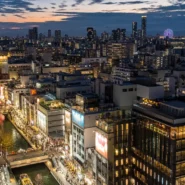
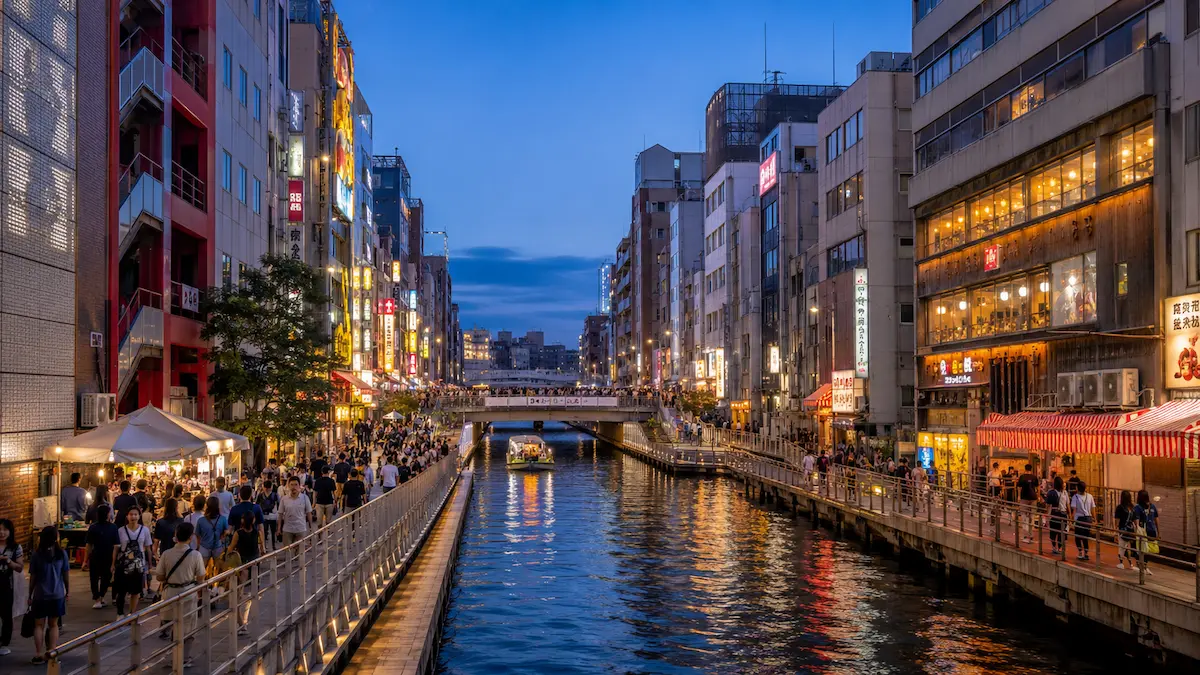
Namba is the easiest recommendation for a traveler who wants Osaka to feel immediately exciting. Dotonbori, Hozenji Yokocho, Kuromon Market, Ura Namba, Namba Parks, Den Den Town and hundreds of restaurants are within a broad walking zone. You can finish dinner, change plans spontaneously and return to your room without studying the last-train timetable.
Its strongest practical advantage is Kansai Airport access. Nankai’s Rapi:t and Airport Express run between Kansai Airport and Namba, making this one of the least stressful places to begin or end a trip. The catch is that “Namba Station” is not one simple building. Nankai, Osaka Metro, Kintetsu/Hanshin and JR facilities occupy different positions, and walking between them with luggage can be much slower than the map suggests.
Where inside Namba should you stay? The blocks immediately around Dotonbori and Sennichimae deliver maximum energy but also the most crowds and nighttime noise. South Namba near Namba Parks is often more comfortable for families and shoppers while remaining walkable. West Namba near JR Namba and OCAT tends to feel calmer, but it is less convenient for Nankai trains and the classic food streets. East toward Nipponbashi gives quick access to Kuromon and anime shopping, although some streets become very quiet after businesses close.
Transport reality: The Midosuji Line is the most useful subway line for first-time visitors, linking Namba directly with Shinsaibashi, Hommachi, Umeda and Shin-Osaka. Kintetsu trains are useful for Nara, while Hanshin services help toward Kobe. For USJ, you normally need to reach a JR line and change around Nishikujo, so Namba is convenient but not the simplest USJ base.
Hotel price reality: Well-located compact business hotels often fall around ¥12,000–¥20,000 on ordinary dates, while newer or larger mid-range rooms commonly reach ¥20,000–¥30,000. Large family rooms and upscale properties can be much higher. The cheapest listing is often cheap because it is farther from the station platform you actually need or sits in a noisy nightlife pocket.
✅ What Other Travelers Say
Verified hotel reviews repeatedly praise Namba for being able to walk to restaurants, shopping and transport, and many travelers value the direct airport connection. The most common positive theme is freedom: you do not have to plan every meal or evening in advance. Travelers can return with shopping bags, rest briefly and go out again.
⚠️ The Catch (Things to Keep in Mind)
Namba is crowded, tourist-heavy and occasionally exhausting. Dotonbori is fun to visit, but sleeping directly above the action is unnecessary for most people. Restaurant quality also varies; a long queue and giant sign do not guarantee a good meal. Light sleepers, travelers seeking elegant surroundings and anyone planning multiple northern Kansai day trips may prefer Umeda or Shinsaibashi.
Stay here if: this is your first Osaka visit, you have only two to four nights, you care about food and evenings, or you are flying through Kansai Airport.
Do not stay here if: crowds drain you, your trip is mainly Kyoto/Kobe day trips, or you need a peaceful neighborhood after 9 p.m.
📍 Umeda and Osaka Station: Best for Kansai Day Trips
Best for: Kyoto and Kobe day trips · upscale hotels · shopping malls · rainy-day convenience · JR travelers
Umeda is Osaka’s northern transport and commercial powerhouse. It is the sensible choice when your itinerary includes several days outside the city, especially Kyoto, Kobe or Himeji. JR Osaka Station, Hankyu Osaka-Umeda, Hanshin Osaka-Umeda, Umeda subway station, Higashi-Umeda, Nishi-Umeda and Kitashinchi create an enormous network of rail links.
That network is both Umeda’s advantage and its biggest problem. First-time visitors often assume all these stations share one obvious entrance. They do not. Underground malls, department stores, construction diversions and different railway companies make navigation slower than expected. Once you learn the landmarks, the area becomes efficient; during the first arrival with luggage, it can feel like an escape room.
Where inside Umeda should you stay? Hotels immediately beside JR Osaka Station offer maximum convenience and premium pricing. Chayamachi, northeast of the main station, has restaurants, shopping and a younger atmosphere. The western side toward Fukushima can provide better value and excellent dining, but the walk to some rail lines is longer. South toward Kitashinchi is convenient for business travelers and upscale dining, though parts of it have an adult nightlife atmosphere late at night.
Transport reality: JR is excellent for Kyoto Station, Kobe, Himeji and Osaka Loop Line destinations. Hankyu can be preferable for central Kyoto districts depending on your destination. The Midosuji Line goes directly to Shinsaibashi and Namba. Kansai Airport access is available by JR services and airport buses, but the correct platform or bus stop may not be close to your hotel, so verify the route rather than relying on the word “Umeda.”
Hotel price reality: Umeda often costs more than Tennoji or Shin-Osaka. Expect roughly ¥15,000–¥25,000 for many compact mid-range rooms and ¥25,000–¥35,000 or more for newer, larger or station-connected properties. Luxury hotels can rise far beyond that. A property one station away may be cheaper, but saving money is pointless if it adds a transfer to every day trip.
✅ What Other Travelers Say
Travelers with day-trip-heavy itineraries consistently appreciate the rail options, department-store food halls and ability to reach Kyoto or Kobe without first crossing Osaka. Hotel guests also like the polished shopping environment and extensive indoor routes during rain or extreme heat.
⚠️ The Catch (Things to Keep in Mind)
Umeda has less of the messy, neon-lit Osaka atmosphere many first-timers imagine. It is modern, busy and convenient, but evenings can feel like a business and shopping district rather than a food adventure. The station maze also makes “five minutes from Osaka Station” a questionable claim unless the hotel identifies the exact exit.
Stay here if: you have several Kyoto, Kobe or Himeji day trips, prefer polished malls and department stores, or want a higher-end hotel base.
Do not stay here if: your priority is Dotonbori nightlife, street-food wandering or the simplest possible station layout.
📍 Shinsaibashi: Best for Shopping and a More Balanced Night’s Sleep
Best for: couples · fashion and shopping · cafés · walkable nightlife · travelers who want Namba nearby but not outside the door
Shinsaibashi sits one subway stop north of Namba and, for many travelers, offers a smarter balance. You can walk down the covered Shinsaibashi-suji arcade toward Dotonbori, explore Amerikamura and Orange Street, then retreat to a hotel that may be quieter than the canal-side core.
The district changes noticeably from block to block. East of Midosuji Avenue, the shopping arcade is busy and commercial. West toward Amerikamura, the atmosphere becomes younger and louder, particularly on weekends. Farther west in Horie, cafés, boutiques and residential streets create a calmer base, though the nearest station may be Yotsubashi rather than Shinsaibashi. North of Nagahori-dori often feels more businesslike and quieter at night.
Transport reality: Shinsaibashi Station is on the Midosuji Line, giving direct trains to Namba, Umeda and Shin-Osaka. It also connects with the Nagahori Tsurumi-ryokuchi Line, while nearby Yotsubashi Station serves the Yotsubashi Line. Kansai Airport access is less direct than Namba: you will usually take the subway or walk to Nankai Namba, or use another airport connection. With heavy luggage, the advertised “walk to Namba” is not always appealing.
Hotel price reality: Prices overlap with Namba, around ¥12,000–¥30,000 for many useful options. Stylish boutique properties can be expensive, while business hotels north of the main shopping zone may offer better value. Weekend rates rise because the district appeals to both tourists and domestic shoppers.
✅ What Other Travelers Say
Visitors praise the ability to shop, eat and reach Dotonbori on foot while avoiding some of Namba’s most intense crowds. Couples often prefer the cafés, design stores and more polished atmosphere. The covered arcade is especially useful in rain and summer sun.
⚠️ The Catch (Things to Keep in Mind)
Shinsaibashi is not automatically quiet. Hotels near Amerikamura clubs, main roads or the busiest arcade entrances can still receive late-night noise. It is also less convenient for airport luggage than a hotel beside Nankai Namba. Travelers who dislike shopping may find the district’s main advantage less meaningful.
Stay here if: you want to walk to Namba, love shopping and cafés, or prefer a slightly more balanced base for a couple’s trip.
Do not stay here if: you need direct airport platforms, plan many northern Kansai day trips, or expect a peaceful residential neighborhood.
📍 Tennoji and Abeno: Best Value Without Sacrificing Transport
Best for: value seekers · families · airport access · larger rooms · travelers who prefer fewer tourist crowds
Tennoji is the area I would check when Namba and Umeda prices look unreasonable. It combines JR lines, the Midosuji and Tanimachi subway lines, Kintetsu services at Osaka-Abenobashi and major shopping complexes around Abeno Harukas. It is not a hidden neighborhood, but international first-timers often overlook it.
The station area is convenient for families because meals, supermarkets, department stores and transport sit close together. Tennoji Park and the Abeno side provide open space and modern facilities, while Shinsekai and Tsutenkaku are within walking distance for travelers who enjoy retro streets and casual food.
Transport reality: JR-West airport services connect Kansai Airport with Tennoji, and the Midosuji Line runs directly to Namba, Shinsaibashi, Umeda and Shin-Osaka. JR lines are useful for Nara and the Osaka Loop Line. This makes Tennoji one of the strongest “one transfer or less” bases in the city.
Choose the micro-location carefully. The Abeno side south of the station is modern and busy with malls. The park side is convenient for green space and attractions. As you move west and southwest toward Shin-Imamiya and parts of Nishinari, buildings become older and the street atmosphere more working-class. Many travelers stay there without problems, but some first-time visitors feel less comfortable with visible street drinking, older budget lodging and quieter side streets after dark. Do not label the entire district unsafe; judge the exact block and your personal comfort level.
Hotel price reality: Tennoji often offers useful rooms around ¥9,000–¥18,000, with newer or larger mid-range options around ¥18,000–¥24,000. Premium rooms around Abeno Harukas cost much more. The value advantage is strongest when comparing similar room sizes, not merely the cheapest capsule or old economy hotel.
✅ What Other Travelers Say
Guests commonly value the direct transport, malls, food options and better room-to-price ratio. Families appreciate being able to buy breakfast, medicine or children’s supplies without crossing a nightlife district. Repeat visitors often describe Tennoji as easier and less performatively touristy than Namba.
⚠️ The Catch (Things to Keep in Mind)
You will probably take the subway to Dotonbori rather than casually return to your room between stops. The station is large, and JR, Metro and Kintetsu areas are not identical. Some low-priced hotels use “Tennoji” loosely even when they are closer to Shin-Imamiya, so inspect the address and nighttime walking route.
Stay here if: you want strong value, direct airport access, family convenience or an efficient base without Namba’s constant crowds.
Do not stay here if: your ideal trip involves stepping directly into Dotonbori nightlife every evening or you want a luxury-heavy hotel district.
📍 Osaka Castle, Morinomiya and Kyobashi: Best for Quieter Evenings
Best for: quiet mornings · parks and running · repeat visitors · eastern Kyoto access · travelers who dislike tourist nightlife
“Osaka Castle area” can refer to several different bases, and they should not be treated as one identical neighborhood. Tanimachi 4-chome is an office-oriented area near the castle’s southwest side. Morinomiya sits on the southeast side with JR and Metro access. Kyobashi is a larger rail and nightlife hub east of the castle park.
This part of Osaka works well for travelers who want quieter evenings and morning access to green space. Osaka Castle Park is pleasant for running or walking before tour groups arrive. Hotels here often feel less compressed by souvenir shops and restaurant queues, and prices can be better than the most famous central districts.
Transport reality: Morinomiya connects to the JR Osaka Loop Line and Osaka Metro lines. Tanimachi 4-chome offers the Tanimachi and Chuo lines. Kyobashi provides JR, Keihan and Osaka Metro services; Keihan is particularly useful for parts of eastern and central Kyoto, including stations toward Gion-Shijo and Sanjo. However, reaching Namba usually requires a transfer or indirect route, so nightlife-focused travelers may resent the commute.
Nighttime atmosphere: Tanimachi 4-chome becomes quiet after office hours, which is either peaceful or dull depending on your expectations. Morinomiya has practical shopping but limited late-night tourism. Kyobashi is livelier, with izakaya and local nightlife around the station; some alleys feel gritty and crowded rather than polished.
Hotel price reality: Practical rooms commonly appear around ¥9,000–¥20,000, while larger or higher-grade hotels may reach ¥20,000–¥25,000 and beyond. Castle-view marketing can add a premium, but a partial distant view is not worth sacrificing station access.
✅ What Other Travelers Say
Travelers who choose this area often praise the calmer nights, castle park access and ability to experience a more everyday side of Osaka. Kyobashi fans value the Keihan connection and local food scene, while families appreciate open space compared with Dotonbori’s dense crowds.
⚠️ The Catch (Things to Keep in Mind)
The castle itself is not a reason to spend every night here. Most visitors see it once, while meals and nightlife happen elsewhere. Restaurant choice drops late around the quieter office blocks, and “near Osaka Castle” can still mean a long walk around moats and park paths. Confirm the closest gate and station, not straight-line distance.
Stay here if: you value quiet, parks, running, eastern Kyoto access or a less tourist-dominated base.
Do not stay here if: this is a short first trip centered on food, Dotonbori and spontaneous late nights.
📍 Shin-Osaka: Best Only for Shinkansen-Heavy Itineraries
Best for: early bullet trains · one-night transit stays · business travel · repeated Shinkansen day trips · simple station hotels
Shin-Osaka is often recommended because the Shinkansen stops there, but that does not make it the best sightseeing base. It is a functional transport district north of central Osaka. The station has restaurants, convenience stores and hotels, yet the surrounding streets do not deliver the food, nightlife or atmosphere most first-time visitors travel to Osaka for.
Its value depends on arithmetic. If you are taking an early Shinkansen to Tokyo, Hiroshima or another distant city, staying beside the station can remove stress. If you plan several long-distance rail trips, the saved transfer time may add up. But if you are sightseeing within Osaka for three days, commuting to Namba and back every evening is an unnecessary compromise.
Transport reality: The Midosuji Line directly connects Shin-Osaka with Umeda, Shinsaibashi, Namba and Tennoji. JR local services connect to Osaka Station. This is straightforward, but it still adds a train ride to almost every meal and attraction. The Shinkansen platforms are also separated from local and subway areas, so a hotel’s exact side of the station matters.
Hotel price reality: Business-oriented rooms often range from roughly ¥8,000–¥18,000, with newer station-adjacent options around ¥18,000–¥22,000 or more. Prices can rise on major travel dates. The value is usually better than Umeda, but you are paying with time rather than money.
✅ What Other Travelers Say
Travelers using Shin-Osaka for an early departure appreciate the simple morning and the station’s food and souvenir options. Business travelers and rail-pass users may value the predictable chain hotels. Reviews often describe the location as convenient rather than memorable—which is exactly the point.
⚠️ The Catch (Things to Keep in Mind)
The district can feel empty once station businesses wind down, and there is little reason to wander at night. A cheap room here may tempt you, but four daily subway rides can erase the satisfaction. Also, not every train from central Osaka goes where you expect, so tired travelers still need to read platform signs carefully.
Stay here if: you have an early Shinkansen, a one-night stopover or multiple long-distance rail days.
Do not stay here if: you are spending most of your trip exploring Osaka, eating late or traveling with children who tire after full sightseeing days.
📍 Universal City: Best for a USJ-Focused Family Trip
Best for: USJ rope drop · families with young children · two park days · minimizing post-park travel · themed hotel stays
Universal City is not a normal Osaka neighborhood base. It is a purpose-built visitor zone beside Universal Studios Japan, with partner hotels, restaurants and shops along Universal CityWalk. Its entire appeal is reducing friction on a park day.
For a family with small children, that benefit can be substantial. You can reach the park entrance early, return quickly when everyone is exhausted and avoid boarding a crowded train at closing time. A two-day USJ visit becomes much easier when the hotel is steps away, especially during hot weather or Halloween events.
Transport reality: Universal City Station is on the JR Yumesaki Line. From Osaka Station, some services are direct while others require a change at Nishikujo. From Namba, Umeda or Tennoji, the route is manageable but not door-to-door simple. For sightseeing elsewhere, every day begins by leaving the bay-side area.
Hotel price reality: Expect roughly ¥18,000–¥45,000 for many family-friendly rooms, with weekends, holidays and peak park dates climbing much higher. The rooms may be larger than central business hotels, but restaurants and convenience options operate in a resort environment where value is not always the priority.
✅ What Other Travelers Say
Families repeatedly praise the ability to walk back after a long park day, the child-friendly atmosphere and rooms designed for three or four guests. The convenience is most appreciated after closing, when central-Osaka visitors face queues and crowded platforms.
⚠️ The Catch (Things to Keep in Mind)
Universal City is isolated from Osaka’s main food and nightlife districts. Once the park crowd leaves, the area has limited local character. Hotel and restaurant prices can feel inflated, and staying four nights for one park day rarely makes sense. Also check current USJ entry rules, operating hours and ticket conditions on the official site before building the entire stay around an assumed schedule.
Stay here if: USJ is the centerpiece of the trip, you have young children, or you plan two consecutive park days.
Do not stay here if: you have only one USJ day and several days of central Osaka sightseeing. In that case, stay centrally or use a one-night split stay.
How I Would Choose Based on a Real First-Time Itinerary
- Three nights, first Osaka trip, food and nightlife: Namba, preferably south of Dotonbori or between Namba and Shinsaibashi.
- Four nights with Kyoto, Kobe and Himeji day trips: Umeda, close to the railway company you will use most.
- Family of four with luggage and one USJ day: Tennoji for value or Umeda for transport; consider one final night at Universal City only when the park day is intense.
- Budget trip with an early KIX flight: Tennoji or Namba, chosen according to your airport train and departure time.
- Two Shinkansen day trips plus an early departure: Shin-Osaka may finally be worth it; otherwise, Umeda is the more enjoyable compromise.
- Quiet couple’s trip with cafés and shopping: Shinsaibashi or Horie, away from Amerikamura’s loudest weekend blocks.
- Repeat visit with Kyoto access and morning runs: Kyobashi or Morinomiya near Osaka Castle Park.
Key FAQs About Where to Stay in Osaka
Is Namba or Umeda better for first-time visitors to Osaka?
Namba is better for most first-time visitors because the classic food, nightlife and shopping districts are walkable, and Kansai Airport access by Nankai is straightforward. Umeda is better when your schedule includes several day trips to Kyoto, Kobe or Himeji, or when you prefer polished malls and upscale hotels. For a short city-focused stay, choose Namba; for a region-focused itinerary, choose Umeda.
What is the best area to stay in Osaka for Kyoto, Nara and Universal Studios Japan day trips?
No single area is perfect for all three. Umeda is strongest for Kyoto and USJ connections through JR, while Namba is excellent for Nara on Kintetsu and central Osaka evenings. Tennoji is the balanced value option, with JR access toward Nara, the Osaka Loop Line and direct subway service through the city. Count the number of early departures: choose the hub that serves the majority of your most important days.
Where should a family with children and large luggage stay in Osaka?
Tennoji is often the best-value family base because it combines airport access, malls, food, elevators and larger-room options without Dotonbori-level congestion. Umeda works well for day trips but requires careful station navigation. Namba is convenient when the hotel is genuinely close to Nankai or Metro platforms. For two USJ days, Universal City can justify its higher price and limited city access.
Final Verdict and Your Next Step
For a first visit, Namba is the safest all-round recommendation—not because it is perfect, but because it minimizes evening transport and puts Osaka’s most enjoyable food and street life within walking distance. Book outside the loudest Dotonbori blocks and confirm which Namba station your hotel is actually near.
Choose Umeda when regional day trips dominate your itinerary. Choose Tennoji when price, airport access and family practicality matter more than being beside the neon. Choose Shinsaibashi for a more stylish middle ground. Treat Shin-Osaka as a rail solution and Universal City as a park solution—not default recommendations for everyone.
The best-located Osaka rooms, especially family rooms and refundable options, often disappear before the cheapest rooms do. Reserve a cancellable hotel once your dates are firm, then compare the total cost again before the free-cancellation deadline.
Compare Osaka hotels on Agoda
Check Osaka hotel availability on Booking.com
Browse Osaka attractions and transport on Klook
Compare Osaka attraction tickets on KKday
Useful official checks:
Osaka Metro station and route guide
JR-West Kansai Airport access guide
Nankai airport train timetable
Universal Studios Japan official site