



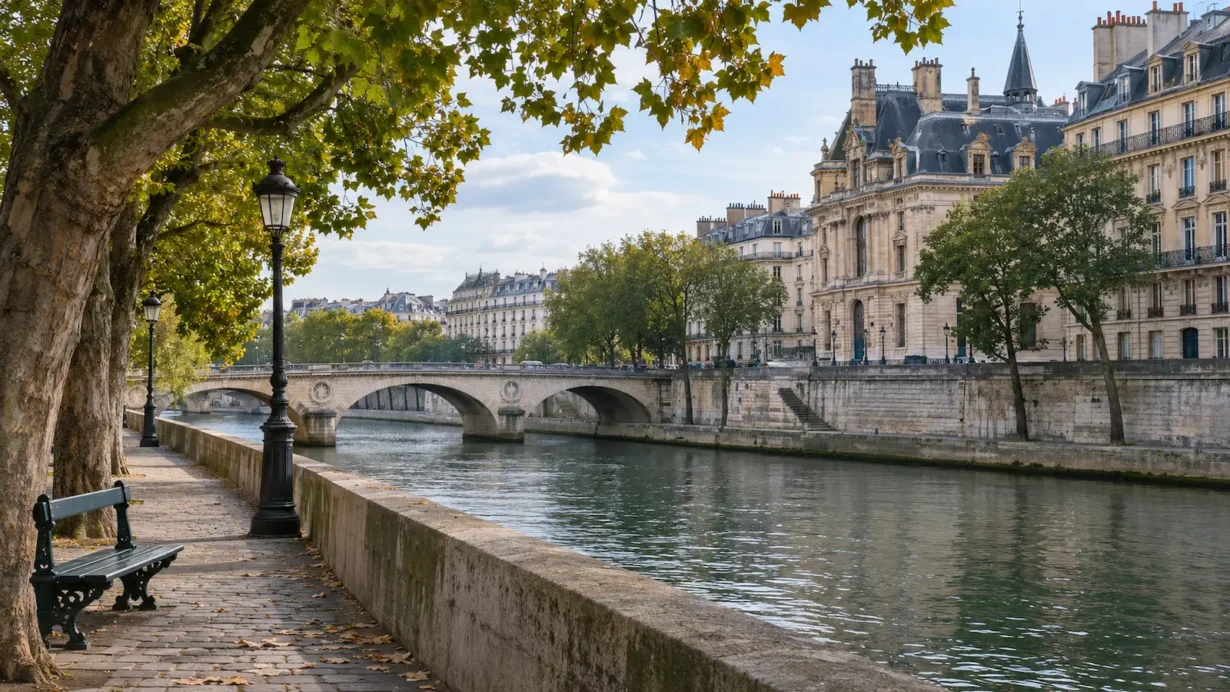
If you are deciding where to stay in Paris for a first visit, start with Saint-Germain around Odéon. It works well for walks along the Seine and evenings close to your hotel. Compare Montparnasse if you arrive there by train, or the Louvre and Palais-Royal area if central sightseeing matters most.
💡 Key Takeaways
- Start with Saint-Germain/Odéon for a short first visit if your budget can absorb the central premium. It makes an unplanned evening and a midday rest easy.
- Choose Les Halles or the Palais-Royal side for useful airport rail links, but map the exact station exit: a central interchange can still mean a long underground walk.
- Montparnasse is a practical alternative for a train arrival and more hotel choice. It is less convenient for walking home from the Marais.
- Check the door-to-platform route before paying. Most Paris Métro lines involve stairs; a lift inside the hotel does not solve the station approach.
Deciding where to stay in Paris for your first visit gets difficult when every hotel describes itself as central. Central to the Louvre, a train departure and a late dinner are three different things. The useful question is whether your particular address makes the first luggage journey manageable and the next three days pleasant.
For a first stay of roughly three to five nights, these six bases offer sensible compromises. The recommendation changes with your arrival airport, room needs and willingness to ride the Métro. Neighborhood names below describe practical search areas, not precise administrative boundaries; always inspect the actual address.
If Paris is one stop on a longer trip, our neighborhood guides can help you choose a base in your next city, too.
The 1-Min Cheat Sheet
- Saint-Germain/Odéon: best balanced first-visit base for cafés, river walks and a flexible evening. Upper-midrange to luxury; compact rooms and the location premium are the trade-off.
- Latin Quarter/Luxembourg: best for a Left Bank stay with garden breaks and a possible RER B arrival. Midrange to upper-midrange; the Panthéon side adds an uphill walk.
- Marais/Saint-Paul: best for exploring small streets, independent shops and the eastern historic center. Midrange to luxury; older buildings and busy weekend pavements need checking.
- Opéra/Grands Boulevards: best for hotel choice, shopping and several useful Métro corridors. Broad midrange to luxury range; pick the actual street carefully for traffic and evening noise.
- Louvre/Palais-Royal/Les Halles: best for a very short sightseeing stay and strong rail connections on the Les Halles side. Upper-midrange to luxury; the whole zone does not feel or function the same.
- Montparnasse: best for a Gare Montparnasse arrival or departure and a less precious hotel search. Budget through upper-midrange; more daily transit for Right Bank sights.
How to use the price labels: these are relative location indicators, not live quotes. Paris prices move sharply with dates and room category. Compare the same cancellation terms, occupancy and total including tourist tax; a cheaper outer address can lose its advantage once daily travel and a suitable room are added.
Top Survival Tips
- Build the first journey before building the dream itinerary. Save the airport or mainline-station route to the hotel door, including the station exit, final street walk and late-arrival backup. With luggage, one direct rail journey plus a longer level walk may be easier than two short Métro changes.
- Separate the airport ticket from ordinary city travel. In 2026 the Métro-Train-RER ticket costs €2.55 and the Paris Region–Airports rail ticket €14 at full fare. The ordinary rail ticket excludes airport access and does not cover buses or trams. Check the official fare list and rail ticket rules rather than relying on an old guide mentioning paper t+ tickets.
- Do not book Opéra for the old Roissybus. Roissybus ceased operating in March 2026, and Orlybus ended in March 2025. Bonjour RATP confirms the changes. For Orly, Métro 14 makes places near Pyramides, Madeleine and Châtelet worth comparing; CDG access normally starts with the RER B.
- Treat stairs as a route problem. RATP identifies line 14 as the only Métro line accessible independently from end to end. Other Métro choices, including convenient line 1, should not be assumed step-free. Consult RATP’s accessibility guidance and live lift information, then ask the hotel about entrance steps and lift dimensions.
- Read room measurements before stars. A central double can be tight once two suitcases are open. Check floor area, bed width, air-conditioning provision, bathroom layout and whether the booked category has a lift all the way to its floor. “Double” describes a bed, not space for a third person.
- Check the last 150 meters at night. Locate bars, restaurant terraces, major roads and delivery entrances beside the actual bedroom frontage. Request a courtyard room if sleep matters, while recognizing that a request is not a guarantee. No arrondissement number can promise a quiet room.
- Use a taxi comparison when luggage changes the calculation. Official 2026 direct airport flat fares into Paris are CDG €56 to the Right Bank or €65 to the Left Bank, and Orly €45 or €36 respectively. These are vehicle fares with applicable extras, including booking supplements in some circumstances. Verify the official taxi rules and use the official airport rank; private transfers have their own terms.
The Full Experience
☕ Saint-Germain/Odéon: Best Overall for a Comfortable First Visit
Left Bank cafés · Flexible walking days · Central premium
Search around Odéon, Saint-Sulpice and Saint-Germain-des-Prés if you want to leave the hotel without deciding on a transport plan first. You can make a river walk, a café stop or a visit across the Seine part of the day without turning each outing into an expedition. That flexibility is particularly valuable when jet lag makes a carefully timed itinerary fall apart.
Choose your micro-location around your arrival. Odéon has Métro 4 and 10; Saint-Germain-des-Prés has line 4. A hotel nearer Saint-Michel–Notre-Dame may shorten a CDG RER B arrival, but that station’s name on a map does not establish a step-free route to every nearby street. A hotel near Luxembourg instead changes the final walk and puts you farther south.
Who should pay the premium? First-time visitors staying a few nights who expect to walk often and return before dinner. If you will spend most days on distant excursions, a less expensive room elsewhere may offer more value. For a real starting point, Hôtel Baume’s official booking site places its address near Odéon; compare its room category and terms rather than treating it as a recommendation for every budget.
✅ What Other Travelers Say: The linked Les Frenchies neighborhood video presents one travel team’s view of the area. Use it to judge the café-and-street setting; its positive framing is not evidence that every hotel room nearby is spacious or silent.
⚠️ The Catch (Things to Keep in Mind): Expensive does not mean large. Older hotels can have small lifts and irregular layouts, while a lively café address can mean late voices below. Request the room exposure you need and get any essential access requirement confirmed in writing.
🌳 Latin Quarter/Luxembourg: Best for Garden Breaks and a Left Bank Rhythm
RER B options · Gardens and bookshops · Some uphill streets
The Latin Quarter works well when you want recognizable Paris streets with a useful place to slow down between outings. The Luxembourg side suits a gentler schedule: an early walk, one substantial visit and time outside can fit together without a cross-city transfer. The riverside Saint-Michel end is busier and usually more immediately useful for reaching the islands.
Treat “Latin Quarter” as several different final walks. Near Saint-Michel–Notre-Dame, RER B can be helpful from CDG; around Luxembourg, the same line serves a different station. Farther toward the Panthéon or Rue Mouffetard, attractive streets can add gradients and distance. A hotel with a shorter map radius may still be the harder luggage walk.
This is a sensible choice for readers who prefer a Left Bank evening and do not need a department-store district outside the door. Compare a room here against Saint-Germain on the same dates: sometimes the extra walking buys a better room, sometimes the pricing is nearly identical. Do not assume student associations make the entire area cheap.
✅ What Other Travelers Say: The linked walking video follows the Luxembourg-to-Saint-Étienne-du-Mont side of the quarter. It offers street context for deciding whether that route suits your pace; a filmed daytime walk cannot establish current hotel noise or a level approach.
⚠️ The Catch (Things to Keep in Mind): Busy restaurant streets near Saint-Michel and quieter streets farther south are different bookings. Check the exact position, likely evening frontage and garden opening times if your plan depends on cutting through the park.
🛍️ Marais/Saint-Paul: Best for an Enjoyable Evening Near the Hotel
Independent shops · Historic streets · Line 1 access
Choose the Saint-Paul side of the Marais when the evening around your hotel matters as much as the monuments. It suits a stay built around shops, smaller museums, casual meals and wandering toward the Seine. You are buying an engaging home neighborhood rather than a single transport hub.
Saint-Paul on line 1 is useful for an east–west sightseeing spine. That still leaves a transfer for most airport journeys, and line 1 is not a substitute for a verified lift route. A hotel advertised as Marais may sit toward République, Arts et Métiers or Bastille; those can be good positions, but they should be judged on their own stations and walking routes.
For a short first visit, favor an address that makes the final walk simple rather than chasing the prettiest courtyard photo. A car may not be able to stop directly at every narrow or restricted street entrance. Ask where a taxi can set down bags, particularly if your arrival is late or someone has limited walking tolerance.
✅ What Other Travelers Say: The linked traveler walk concentrates on Village Saint-Paul and the riverside approach. It gives a useful sense of street scale, not a representative review of accommodation across the Marais.
⚠️ The Catch (Things to Keep in Mind): Historic atmosphere can come with small rooms, entrance thresholds and compact lifts. The neighborhood’s popularity also brings crowded pavements at busy times. Check air conditioning and the bedroom’s orientation before paying a central-location premium.
🎭 Opéra/Grands Boulevards: Best for Hotel Choice and Shopping
Many hotel categories · Multiple Métro corridors · Busy main roads
Opéra and the Grands Boulevards make a strong search zone when you want several comparable hotels rather than one boutique room at any price. You can mix shopping, covered passages and sightseeing without committing to a riverside address. The useful compromise is often a side street close to a major station, rather than a room facing its busiest boulevard.
Pin the station to the door. Opéra, Richelieu–Drouot, Grands Boulevards, Madeleine and Saint-Lazare are not interchangeable. Madeleine and Saint-Lazare bring line 14 into the comparison for Orly; farther east along the boulevards, the hotel may be convenient for other lines but have a less direct airport route.
This zone suits travelers who like a lively urban setting and will use the Métro each day. It is less appealing if your imagined evening is a quiet lane beside the river. Check the walking route for your actual plans, particularly if returning from the Latin Quarter or eastern Marais after a long day.
✅ What Other Travelers Say: The linked boulevard walking tour shows the public-street setting around Opéra and nearby shopping landmarks. It is useful for atmosphere, while current dated room reviews remain the better place to investigate traffic noise.
⚠️ The Catch (Things to Keep in Mind): “Near Opéra” can cover a substantial search radius. The discontinued Roissybus is no longer a reason to choose the area for CDG, and a major boulevard address needs a convincing soundproofing and room-exposure check.
🏛️ Louvre/Palais-Royal/Les Halles: Best for a Short Sightseeing Stay
Major sights on foot · Airport rail on the eastern side · High demand
These adjoining central areas solve different problems. The Louvre and Palais-Royal side favors museum-focused walks and a polished central setting. Les Halles favors rail reach, shopping and a busy all-day neighborhood. Do not book one because a listing borrows the other’s name.
For a CDG arrival, Châtelet–Les Halles on RER B is the main attraction on the eastern side. For Orly, line 14 serves Châtelet and Pyramides, among other central stops. The interchange is large: choosing the right exit can matter more than shaving two minutes off the train journey. Save the exit name and a street-level route before you travel.
A short stay with a central room can reduce repeated cross-city journeys, especially if you return for a rest. Novotel Paris Les Halles’ official booking page is a genuine option to compare at the Les Halles end; the Regina Louvre Family Room page illustrates a much more expensive Louvre-side configuration for four. These are different room products, not a direct price match.
✅ What Other Travelers Say: The linked walk covers public streets around Les Halles and Palais-Royal. Use the contrast between locations to refine your search; neither a video nor a central postcode guarantees a calm bedroom.
⚠️ The Catch (Things to Keep in Mind): Heavy footfall, a busy station and high hotel demand come with the convenience. The Centre Pompidou’s Beaubourg building is closed for renovation until its planned 2030 reopening, so do not choose an address on the assumption of visiting its former museum galleries during this closure.
🚆 Montparnasse: Best for a Practical Train Arrival or Departure
Gare Montparnasse · Broad hotel choice · More transit to eastern sights
Montparnasse deserves a place on a first-visit shortlist when your trip includes an early train from Gare Montparnasse. Removing one stressful cross-city luggage journey can matter more than sleeping beside a famous café. It also gives you a wider range of conventional hotels to compare against expensive historic-center rooms.
Distinguish a hotel beside the mainline station from one farther along Boulevard du Montparnasse or toward Edgar Quinet. The station complex and Montparnasse–Bienvenüe Métro interchange can involve considerable walking. For an early departure, map the entrance for your actual train hall rather than stopping the calculation at a generic station pin.
The area suits visitors happy to ride the Métro for much of the Right Bank and enjoy a less sightseeing-heavy evening locally. It is less compelling for a two-night trip centered on the Louvre and Marais unless the room saving is substantial. Compare the saving across the whole stay, then decide whether the repeated journey is a trade you actually want.
✅ What Other Travelers Say: The linked boulevard walk shows the route toward Luxembourg, giving street context for the northern side of the search area. It is not a promise that every station-adjacent hotel has the same setting.
⚠️ The Catch (Things to Keep in Mind): Do not book for the tower observation deck: the Montparnasse observatory is closed for a multiyear renovation. The area remains useful as a base, but the old rooftop-view selling point is unavailable during the closure.
Key FAQs
What is the best area to stay in Paris for first-time visitors for three nights? Saint-Germain/Odéon is a strong default when you want a balanced walking base and can afford its room rates. Choose the Louvre/Les Halles side instead when airport rail and a museum-heavy schedule matter more. The actual room and arrival route should break the tie.
Should I stay near the Eiffel Tower on my first Paris trip? Choose it when nearby walks and that part of the city are a real daily priority. For a mixed first itinerary that includes the Marais, Louvre and Latin Quarter, a more central river-adjacent base can reduce backtracking. A tower view is a room-category feature that must be booked explicitly.
Where should I stay in Paris with heavy luggage or a stroller? Start with a hotel whose entrance and lift are confirmed suitable, then verify the complete station route. Addresses convenient to line 14 can help for Orly and city journeys, but a taxi may still be easier for a group with large bags. Do not assume a nearby Métro icon means step-free access.
Final Verdict and Your Next Step
If you are still undecided, shortlist Saint-Germain/Odéon and one arrival-friendly alternative, then compare three real rooms at the total stay price. Keep the better room if the location difference is modest; pay for the more useful location if you expect repeated hotel breaks. For a late or luggage-heavy arrival, compare live Paris airport-transfer options on Klook against official airport taxis and rail before booking.
Affiliate disclosure: the Klook link is an affiliate link; we may earn a commission at no extra cost to you. Confirm the airport, passenger and baggage capacity, child-seat availability, meeting point and cancellation policy on the selected offer. Hotel links above lead to official hotel booking sites. Transport and closure details checked in November 2026; recheck for your travel dates.